Concept
OT and Biblical Texts
Old Testament Objections, Bible Text Objections, OT Objections, Hard Bible Texts, Objections from Old Testament Texts, Troubling Bible Passages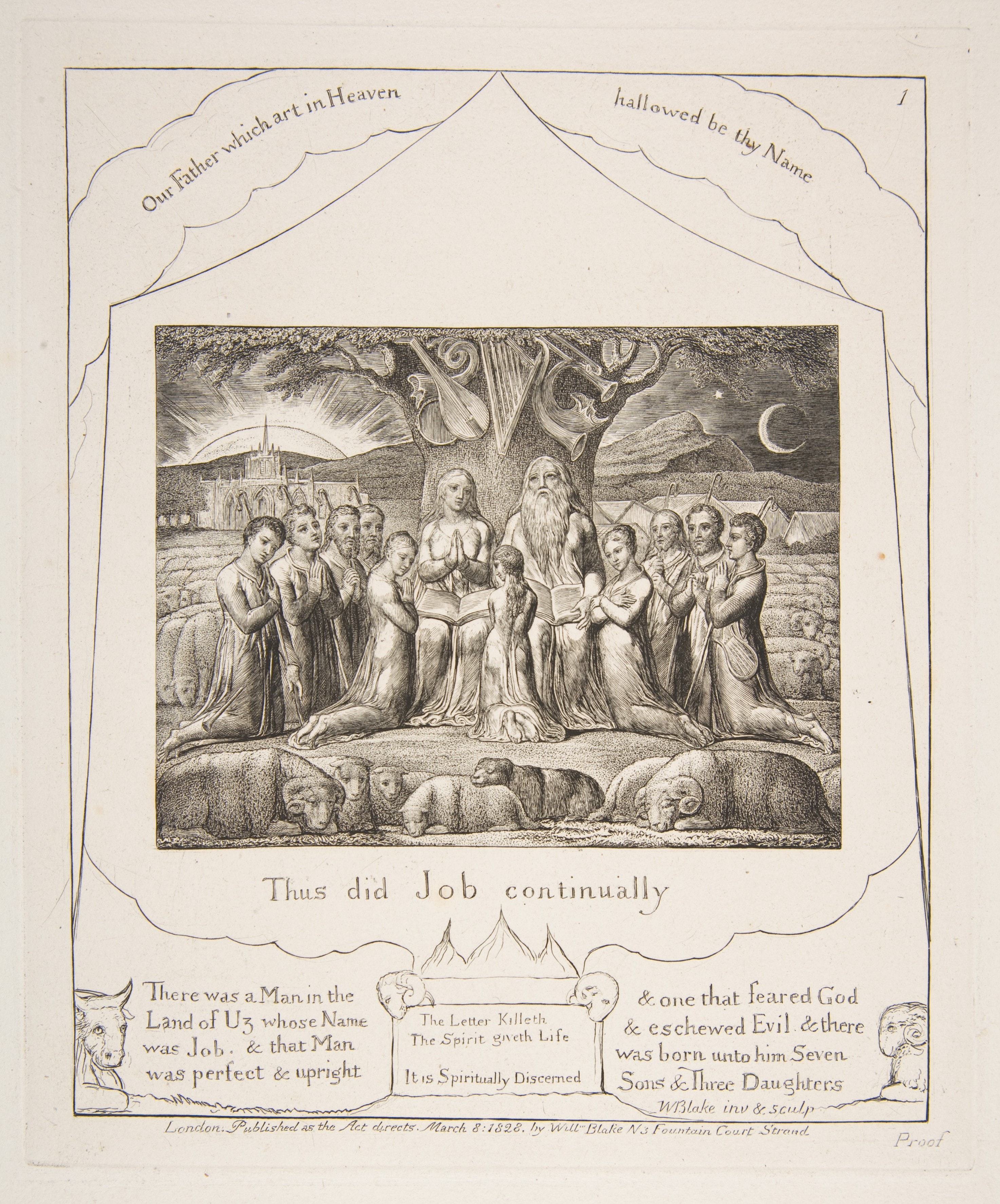
Job and His Family, plate 1 of William Blake's Illustrations of the Book of Job (engraved 1825, published 1826). Job is the Bible's own long meditation on a hard question about God, and his story is one of the texts skeptics cite most. The Metropolitan Museum of Art. Image: CC0, via Wikimedia Commons, resized.

Intro
Some of the sharpest objections to Christianity come straight out of the Bible. A skeptic opens to a hard passage, reads it aloud, and asks how a good God could be behind it. Bears and children. A worldwide flood. Slavery laws. Polygamous kings. A verse that seems to say God creates evil.
These objections deserve real answers, and the texts deserve a careful reading. This page gathers every objection in this section of the codex in one place, grouped by the kind of text involved, with the full defeater beside each one.
Most of these objections turn on a few repeated questions:
- What does the text actually say? A Hebrew word, a verb form, or the next verse often changes the picture.
- Is the Bible reporting this or approving it? Scripture records many things it does not endorse.
- What was the setting? Ancient law, war speech, poetry and prayer each work by their own rules.
- Where does the moral standard come from? Condemning a text as evil assumes a real standard of good, and that standard needs a source.
The 30-second version:
Most objections from hard Bible passages rely on a quick reading of a single verse. Read the whole passage, check the original words, ask whether the text is describing an event or commanding it, and notice the genre: law, history, poetry, or prayer. Then put the hard text beside the rest of Scripture, which presents God as good, just and merciful and every person as made in His image. And ask the skeptic where his standard of good and evil comes from, because he is using one.
See this page's graph and discover linked topics
In full
Section hub for objections that cite specific Old Testament texts, and a few related biblical ones, as evidence that the God of the Bible is immoral, incoherent, or invented. It sits under Atheist Objections, beside the philosophical objections (Philosophical) and the Bible-reliability, Christian-conduct and Zeitgeist families.
Each page here is a concept-level treatment of one objection: the objection in its strongest form, the textual and historical setting, and the response. Most have a matching debate-prep page in the argument layer, linked beside each entry below, with a cheatsheet, a grammar-and-hermeneutics section, premise blocks, and a live-cite kit.
The responses share a method that recurs across the whole section:
- Lexical and grammatical reading. Several objections rest on an English word that covers less, or more, than the Hebrew behind it: ra in Isaiah 45:7, da'at tov vara' in Genesis 3, shevet in Proverbs, the "small children" of 2 Kings 2.
- Descriptive versus prescriptive. Narrative records sin, often to condemn it by its consequences. OT Atrocities Descriptive vs Prescriptive Objection states the principle in full.
- Genre. Psalms are prayers, Proverbs are compressed wisdom sayings, and ancient war reports use stock hyperbole.
- Canonical context. A single contested text is read against the whole witness of Scripture to God's character, gathered in Verses on Gods Goodness and Human Worth.
- The moral-standard question. The objection judges God by a standard of right and wrong; the response asks what grounds that standard (see Atheist Moral Realism Objection and Moral Argument).
Many of these objections circulate together on the Evilbible.com catalog, which this codex answers entry by entry.
Genesis: Eden, the Flood, and the early chapters
- Tree of Knowledge Objection: the charge that God forbade knowledge and the serpent was the liberator; the reply turns on what the Hebrew phrase "knowing good and evil" means. Defeater: Tree of Knowledge Objection Defeater.
- God Showed No Love in Eden Objection: the claim that God's response in Genesis 3 contradicts "love is patient and kind." Defeater: God Showed No Love in Eden Objection Defeater. See also God Lied by Omission in Eden Objection Defeater, on the charge that God hid what the fruit would do.
- Cains Wife Objection: where Cain's wife came from, and whether either answer (a sister, or people Genesis never mentions) embarrasses the text. Defeater: Cains Wife Objection Defeater.
- Flood Genocide Objection: the charge that the Flood of Genesis 6 to 9 is the largest genocide in religious literature. Defeater: Flood Genocide Objection Defeater.
- Tower of Babel Objection: the reading of Genesis 11:1-9 as a jealous God sabotaging human progress; the text names the builders' motive as pride. Defeater: Tower of Babel Objection Defeater.
- Sodom and Gomorrah Objection: separates the three things this objection bundles, the destruction, Lot's wife, and the incest afterward, and answers each. Defeater: Sodom and Gomorrah Objection Defeater.
For the Adam and Eve account as a whole, see Top 20 Adam and Eve Objections and Their Defeaters and Eve From the Rib of Adam Objection Defeater.
Judgment, violence, and children
- God and the Killing of Children: the hardest cluster of texts read together, the Egyptian firstborn, the bears, and Psalm 137, faced honestly and answered in context. Related defeaters: Canaanite Conquest Objection Defeater, Amalekite Genocide Objection Defeater.
- Bears Mauling Youth Objection: 2 Kings 2:23-25, where the Hebrew and the setting change who the "small children" were and what they were doing. Defeater: Bears Mauling Youth Objection Defeater.
- Hardening Pharaohs Heart: Exodus splits the hardening into a sequence, with Pharaoh hardening his own heart first. Defeater: Hardening Pharaohs Heart Objection Defeater.
- Imprecatory Psalms Objection: Psalm 137:9 and the cursing psalms read as prayers of raw grief and protest brought before God. Defeater: Imprecatory Psalms Objection Defeater.
- OT Atrocities Descriptive vs Prescriptive Objection: Lot, the Levite's concubine, David and Uriah, Jephthah; the master principle that Scripture records many acts it condemns. Defeater: OT Atrocities Descriptive vs Prescriptive Objection Defeater.
A related New Testament charge, that Jesus told people to kill their children, is answered in Matthew 15 Kill Your Children Objection Defeater.
God's character, knowledge, and council
- OT vs NT God Objection: the claim, as old as Marcion in the second century, that the Old Testament God and the Father of Jesus cannot be the same God. Defeater: OT vs NT God Objection Defeater.
- God Is Surprised Objection: texts where God seems to learn, regret, or change plans, read against His omniscience. Defeater: God Is Surprised Objection Defeater.
- Isaiah 45.7 I Create Evil: the KJV's "create evil," where the Hebrew ra has a range that includes disaster and calamity. Defeater: God Created Evil Objection Defeater.
- The Lying Spirit and Divine Council Theology: Micaiah's vision in 1 Kings 22 and 2 Chronicles 18, and whether it shows God lying. Related defeater: Elohim Is a Divine Council Objection Defeater.
- Job Bet Objection: Job 1 and 2 read as a courtroom, with the accuser charging that no one loves God for His own sake. Defeater: Job Bet Objection Defeater.
- Inherited Guilt and Visiting Iniquity: Exodus 20:5 beside Deuteronomy 24:16 and Ezekiel 18, and how original sin fits. Defeater: Inherited Guilt and Visiting Iniquity Objection Defeater.
- OT Polytheism Objection: the academic claim that early Israel was polytheistic, from elohim, Psalm 82 and Deuteronomy 32. Defeater: OT Polytheism Objection Defeater.
Law, worship, and society
- Animal Sacrifice Objection: whether the sacrificial system shows a bloodthirsty God, and why Christians no longer practice it. Defeater: Animal Sacrifice Objection Defeater.
- Ritual Purity Laws Objection: the shellfish-and-mixed-fabric routine, which runs together different kinds of law and their purposes. Defeater: Ritual Purity Laws Objection Defeater.
- Biblical Slavery Objection: Leviticus 25 and Exodus 21, and the English word "slave" doing two different jobs. Defeater: Biblical Slavery Objection Defeater. See also Israelite Slavery Possession-vs-Ownership Defeater and Why Didnt God Ban Slavery Objection Defeater.
- Spare the Rod Objection: the Proverbs rod sayings read as wisdom literature, with attention to the Hebrew shevet. Defeater: Spare the Rod Objection Defeater.
Sex, marriage, and women
- Biblical Sexual Ethics Objection: "love is love," heard with care for the person behind it and answered on what the Christian sexual ethic actually teaches. Defeater: Biblical Sexual Ethics Objection Defeater.
- Misogyny in the Bible Objection: the household codes, the silence passages, and the Old Testament marriage laws. Defeater: Misogyny in the Bible Objection Defeater.
- OT Polygamy Objection: the Bible reports polygamy among patriarchs and kings, and the stories themselves show the damage it did in those households. Defeater: OT Polygamy Objection Defeater. See also Polygamy Is Not a Sin Objection Defeater.
- Underage and Non-Consensual Marriage Objection: Numbers 31, Deuteronomy 21:10-14, Exodus 21:7-11, and the claim about Mary's age. Defeater: Underage and Non-Consensual Marriage Objection Defeater. See also Rape Only Condemned When Unmarried Objection Defeater.
Prophecy
- Failed Messianic Prophecy Objections: eight standard charges that the New Testament misquotes the Old, answered together through typology and first-century Jewish reading. Defeater: Failed Messianic Prophecy Objection Defeater.
The anchor page
- Verses on Gods Goodness and Human Worth: the canon's positive witness to God's goodness and to human worth, the frame every hard text should be read inside.
Apologetic deployment
Step 1, read the passage aloud in full. Many of these objections lose most of their force when the surrounding verses are read.
Step 2, check the key word. Where the objection rests on one English word, the matching defeater page gives the Hebrew or Greek and its range.
Step 3, name the genre and the mode. Is this law, narrative, poetry, prayer or prophecy? Is the text reporting or commanding?
Step 4, widen the frame. Read the hard text beside the whole witness of Scripture; Verses on Gods Goodness and Human Worth is built for this.
Step 5, ask about the standard. The objection judges God guilty. Ask what makes the judgment true, and point toward the God whose character grounds it.
See also
- Atheist Objections, the parent hub for every family of objection
- Philosophical, the sister section on philosophical objections to God
- Evilbible.com, the website that gathers many of these texts into one catalog
- Quick Objection Responses, 30-second replies for live conversation
- Bible Contradictions Objection, the reliability-side companion to these moral objections
- Genesis ANE Myth Borrowing Objection, on the claim that Genesis borrows from older myths
- Moral Argument, the positive case behind the moral-standard question
Common questions this page answers
Q: How do Christians respond to violent passages in the Old Testament?
By reading each passage in full, checking the key words in Hebrew, asking whether the text records an event or commands it, and reading it in its genre and its place in the whole Bible. The individual pages above take each text one at a time, starting with God and the Killing of Children and OT Atrocities Descriptive vs Prescriptive Objection.
Q: Does the Bible approve of everything it describes?
No. Biblical narrative records the sins of its own heroes, Lot, David, Solomon and others, and usually shows their consequences. OT Atrocities Descriptive vs Prescriptive Objection lays out the principle that recording an act is different from endorsing it.
Q: Is the God of the Old Testament different from the God of the New Testament?
The early church considered that idea when Marcion taught it in the second century and rejected it. Both testaments describe one God who is just and merciful: the Old Testament is full of His compassion (Exodus 34:6-7, Hosea 11:8), and the New Testament sharpens the warnings of judgment. OT vs NT God Objection lays out the texts.
Q: Does Isaiah 45:7 say God created evil?
The Hebrew word ra there has a range that includes disaster and calamity, and in context it stands opposite "peace." See Isaiah 45.7 I Create Evil and God Created Evil Objection Defeater.
Q: Does the Bible endorse slavery?
The Old Testament regulated a form of servitude in an ancient economy, and the English word "slave" covers arrangements very different from chattel slavery. Biblical Slavery Objection works through Leviticus 25 and Exodus 21 in detail.
Q: Where can I find answers to the passages listed on evilbible.com?
Start with Evilbible.com, which maps the site's categories to the matching pages, then use the groups on this page to find the objection and its defeater.