Person
Oscar Romero
Óscar Romero, Oscar Arnulfo Romero, Óscar Arnulfo Romero y Galdámez, Archbishop Romero, Monseñor Romero, Saint Oscar Romero, St Oscar Romero, San RomeroOscar Arnulfo Romero (15 August 1917 to 24 March 1980) was Archbishop of San Salvador during the slide of El Salvador into civil war. A quiet, bookish priest who was thought a safe conservative when he was named archbishop in 1977, he became within three years the country's best-known voice for the poor and against the killing of civilians. He was shot dead while celebrating Mass on 24 March 1980, the day after he publicly ordered soldiers to stop the repression. The Catholic Church beatified him as a martyr on 23 May 2015 and canonized him on 14 October 2018.
The 30-second version:
Romero was a cautious churchman who became archbishop of San Salvador in 1977, weeks before a priest he admired, Rutilio Grande, was murdered. From then on he used his Sunday homilies, broadcast across the country, to name the dead and the disappeared, to defend the poor, and to call every side to stop killing. On 23 March 1980 he begged soldiers to obey God rather than orders to kill. The next evening a gunman shot him at the altar. He is honored as a martyr by Catholics and remembered by many Protestants, and the healing of Cecilia Flores was the miracle accepted for his canonization.
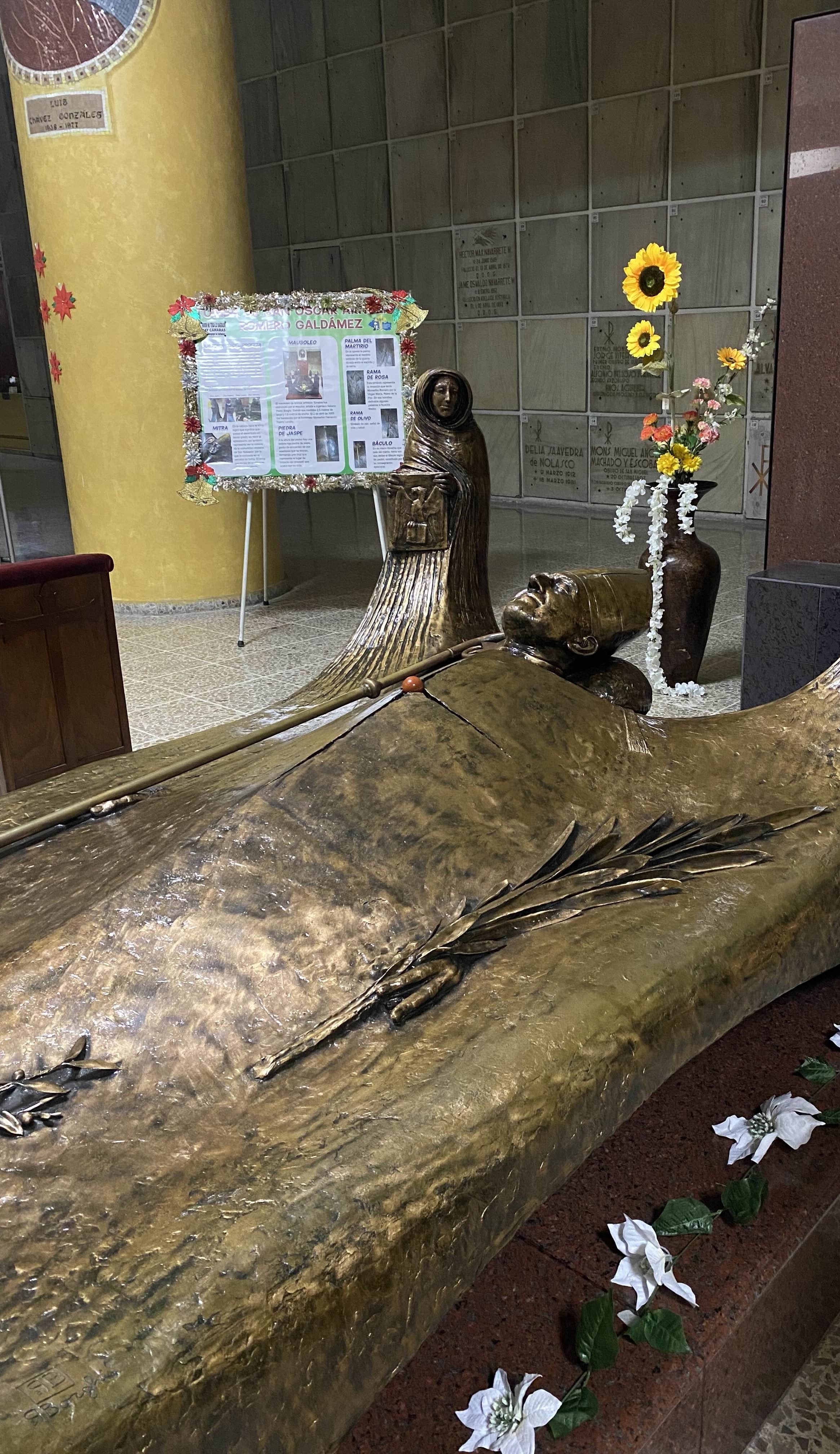
Romero's bronze tomb in the crypt of the Metropolitan Cathedral of San Salvador. The palm branch is the traditional sign of a martyr. Photo: Nelsondacoolest, CC BY 4.0, via Wikimedia Commons, cropped and resized.

Life
- Early years. Born in Ciudad Barrios, in the department of San Miguel, eastern El Salvador. He was apprenticed to a carpenter before entering the minor seminary as a boy.
- Priest. He studied in Rome at the Gregorian University and was ordained there on 4 April 1942, in the middle of the Second World War. Back in El Salvador he served for more than twenty years as a parish priest and diocesan administrator in San Miguel, known for his preaching, his radio work and his personal austerity.
- Bishop. He was named auxiliary bishop of San Salvador in 1970 and bishop of Santiago de María, a poor rural diocese, in 1974, where he saw at first hand the conditions of landless farm workers.
- Archbishop. He was appointed archbishop of San Salvador on 3 February 1977 and installed on 22 February 1977. The government welcomed the choice; many priests working among the poor were disappointed, expecting him to restrain them.
- Rutilio Grande. On 12 March 1977 the Jesuit priest Rutilio Grande, a friend of Romero, was shot dead on his way to Mass with two companions. Romero went to Aguilares, where the bodies lay, that night, and afterwards demanded an investigation. Many who knew him, and Romero himself, saw this as the turning point of his ministry.
- Three years of preaching. His Sunday homilies in the cathedral were broadcast on the archdiocesan radio station and were among the most listened-to programs in the country. He read out the names of the killed and the disappeared, defended peasants and labor organizers, and condemned the security forces and death squads; he also condemned kidnappings and killings by armed groups of the left. The radio station was bombed in early 1980.
- International notice. In 1978 a group of British parliamentarians, supported by members of the United States Congress, nominated him for the Nobel Peace Prize. In February 1980 the Catholic University of Louvain gave him an honorary doctorate.
See this page's graph and discover linked topics
The last homily and the assassination
On Sunday 23 March 1980 Romero addressed the soldiers and police directly. They were, he said, of the same people they were killing, and no soldier was obliged to obey an order against the law of God. He ended with the words for which he is best remembered: "I beg you, I ask you, I order you in the name of God: stop the repression!"
The next evening, 24 March 1980, he was celebrating Mass in the small chapel of the Hospital de la Divina Providencia, a cancer hospital where he lived. A gunman fired from the doorway of the chapel and struck him in the heart; he died at the altar. At his funeral on 30 March 1980, attended by a vast crowd, bombs and gunfire set off a stampede in which dozens died.
The United Nations Truth Commission for El Salvador concluded in its 1993 report that Major Roberto D'Aubuisson, a death-squad organizer who later founded the ARENA party, gave the order for the killing. No one has been convicted of it.
Preaching and thought
- The poor. Romero stood in the line of the Latin American bishops' conferences at Medellín (1968) and Puebla (1979), which spoke of a preferential option for the poor. He grounded it in the incarnation and in the Gospel rather than in political theory, and he kept a careful distance from Marxist readings of liberation theology. In his Louvain address of 2 February 1980 he adapted Irenaeus's saying that the glory of God is a living human being, applying it to the poor.
- Against violence. He condemned the violence of the state, the death squads and the armed left alike, and called repeatedly for conversion on all sides. His pastoral letters, four of them between 1977 and 1979, set out the church's role in the national crisis.
- The church's freedom. He held that the church must preach the whole Gospel, including its judgment on injustice, and could not be bound to any party or government.
Recognition
- Martyr. Pope Francis declared on 3 February 2015 that Romero was killed in odium fidei, out of hatred for the faith, which in Catholic practice allows beatification without a miracle.
- Beatification. 23 May 2015, in the Plaza Salvador del Mundo, San Salvador, with Cardinal Angelo Amato presiding on behalf of the pope.
- Canonization. 14 October 2018, in St Peter's Square, Rome, by Pope Francis, at the same ceremony as Pope Paul VI. The miracle accepted for canonization was the 2015 healing of Cecilia Flores, a Salvadoran mother in a coma from HELLP syndrome.
- Beyond Catholicism. In 1998 a statue of Romero was unveiled on the west front of Westminster Abbey among ten twentieth-century Christian martyrs, and the Church of England commemorates him on 24 March. In 2010 the United Nations General Assembly made 24 March the International Day for the Right to the Truth concerning Gross Human Rights Violations and for the Dignity of Victims, in his memory.
Apologetic significance
- A modern martyr in the classical sense. Romero was killed for what he preached, in the act of worship. His death belongs with the long record of Christians who chose faithfulness over safety, a record that begins with Stephen (Acts 7:59).
- The miracle record. His canonization rests on a healing reviewed by the Vatican's medical board, filed in the codex's documented tier at Cecilia Flores (Oscar Romero 2015). Protestant readers need not accept the Catholic practice of asking the saints' intercession to weigh the medical evidence on its own terms. See Miracles.
- Faith and justice held together. Romero preached both personal conversion and public justice, and refused to make the Gospel a tool of either the regime or the guerrillas. He is a useful counter-example to the charge that Christianity is always on the side of power.
See also
- Cecilia Flores (Oscar Romero 2015), the canonization miracle
- Miracles, the master hub for the codex's miracle records
- Roman Catholicism, the tradition in which he served
- John Paul II, pope from October 1978, whom Romero met in Rome in 1979 and 1980
- Mother Teresa of Calcutta, another twentieth-century Catholic figure canonized under Pope Francis