Argument
Only 144000 Will Be Saved Objection Defeater
only 144,000 will be saved, only 144000 go to heaven, 144,000 in Revelation, who are the 144,000, 144,000 and the great multitude, great crowd Revelation 7, Revelation 7:4 144,000, are only 144,000 saved, Jehovah's Witnesses 144,000, 144000 Jehovah's WitnessesIntro
Some people read Revelation 7:4 and conclude that only 144,000 people will ever be saved. It is a frightening idea, and it sounds like it comes straight from the text: "I heard the number of them that were sealed, a hundred and forty and four thousand."
Keep reading five verses. Right after John hears that number, he turns and sees "a great multitude, which no man could number, out of every nation and of all tribes and peoples and tongues, standing before the throne and before the Lamb." They are wearing robes washed "white in the blood of the Lamb." That is a saved crowd, and it is too large to count. Whatever the 144,000 are, they are not the whole number of the saved.
Christians disagree about who the 144,000 are: a picture of the whole church, the faithful of Israel, or a group of Jewish believers at the end of history. Every one of those readings agrees that salvation is far wider than 144,000. Even the Jehovah's Witnesses, the group best known for the number, teach that a great crowd beyond the 144,000 will be saved.
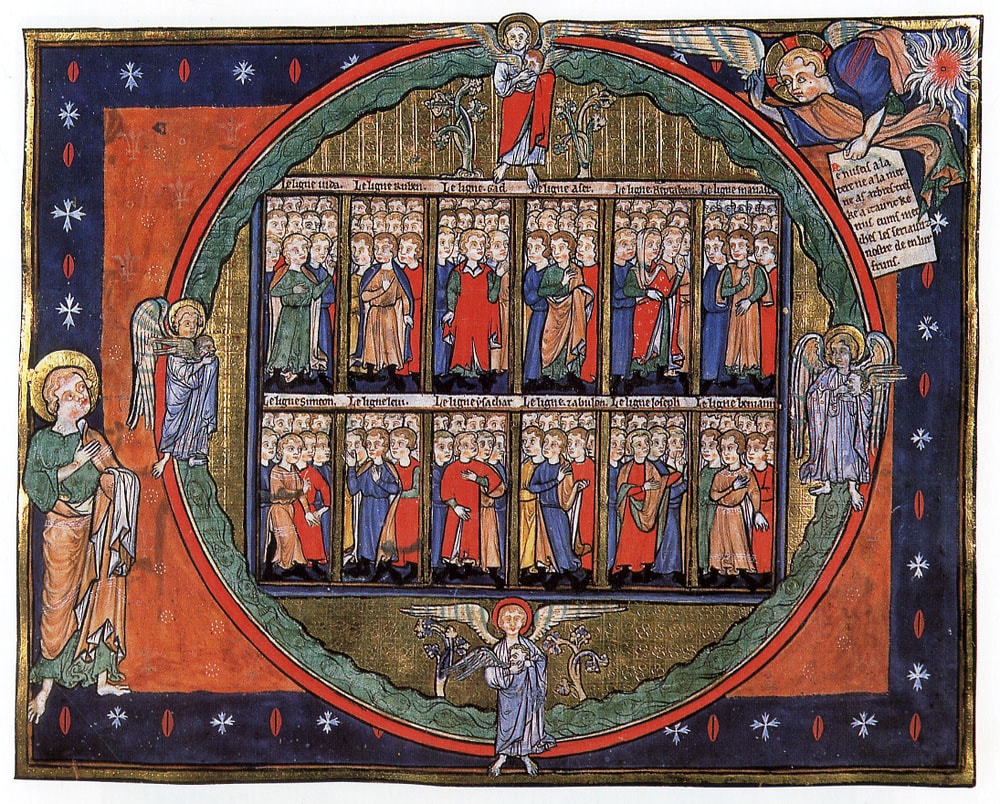 The sealing of the twelve tribes (Revelation 7:1-8), from the Trinity Apocalypse, an English illuminated manuscript of the mid-thirteenth century. Each panel is labelled with a tribe; four angels hold the winds, and John watches at the left. Public domain, via Wikimedia Commons.
See this page's graph and discover linked topics
In full
The claim "only 144,000 will be saved" takes Revelation 7:4 and 14:1-5 as a literal census of the redeemed. It fails on the immediate context before any interpretive tradition is consulted: Revelation 7:9-17 presents an uncountable multitude from every nation, cleansed by the Lamb's blood (7:14), before God's throne and serving Him "in his temple" (7:15), and Revelation's closing invitation is unlimited (22:17).
The remaining question is the relation between the two groups. Three readings have serious defenders: (1) one people seen two ways, the sealed Israel of God heard as a complete army and seen as a countless multitude (Bauckham; Beale); (2) believing Israel alongside the redeemed from the nations; (3) a literal Jewish company sealed in the last days, with the multitude as the wider body of the saved (Walvoord and dispensational interpreters). Jehovah's Witnesses hold a fourth view, a heavenly class of 144,000 and an earthly great crowd. None of the four limits salvation to 144,000. The Witness view faces specific textual difficulties at 7:15 (naos), 19:1 and 14:4, set out below, but the page does not need to win that argument to defeat the objection.
Cheatsheet
The 30-second reply:
Read five more verses. John hears the number 144,000 in Revelation 7:4, then in 7:9 he looks and sees "a great multitude, which no man could number, out of every nation," standing before God's throne in robes washed in the Lamb's blood. That crowd is saved and it can't be counted. Christians debate who the 144,000 are, but no reading makes them the only saved, and even Jehovah's Witnesses teach that a great crowd beyond them is saved.
The 5 fast facts:
- The uncountable multitude is redeemed. "They washed their robes, and made them white in the blood of the Lamb" (Revelation 7:14, ASV).
- John hears, then sees. He hears the number (7:4), then sees the multitude (7:9), the same move as chapter 5, where he is told of a Lion and sees a Lamb (Revelation 5:5-6).
- The multitude answers 6:17. "Who is able to stand?" (6:17); the multitude is "standing before the throne" (7:9). Both verbs are forms of histēmi.
- The 144,000 are "firstfruits." Firstfruits are the first of a larger harvest, and a harvest scene follows in the same chapter (Revelation 14:4, 14-16).
- The invitation has no ceiling. "He that will, let him take the water of life freely" (Revelation 22:17, ASV).
The 3 strongest counter-moves:
- "Who are the people in 7:9-14?" Ask the objector to identify them. Washed in the Lamb's blood, before the throne, sheltered by God, they are saved by any definition.
- "Literal all the way, or symbolic all the way?" If the number is literal, so are the twelve tribes, the twelve thousand from each, and "virgins ... not defiled with women" (14:4). Few who press the number accept the rest.
- "Even the Witnesses do not teach this." Watchtower doctrine saves a great crowd beyond the 144,000. The objection is stricter than the group best known for the number.
Concessions to make freely (each collects a larger one):
- Yes, the text gives an exact number. In exchange the objector concedes that the same chapter gives a second group explicitly "which no man could number," so an exact number for one group cannot be the total.
- Yes, some Christian interpreters read the 144,000 as literal ethnic Israelites. In exchange the objector concedes that those same interpreters read the great multitude as saved Gentiles and Jews beyond the 144,000, so literalism about the number does nothing for his conclusion.
- Yes, naos can occasionally refer to a whole temple complex. In exchange the Witness concedes that the multitude is still "before the throne of God" (7:15), and that Revelation places "a great multitude in heaven" at 19:1.
What NOT to defend:
- Do not insist that the 144,000 and the multitude must be identical. It is a strong reading; the Israel-and-the-nations reading is also plausible, and the objection fails on both.
- Do not rest the case on naos alone. It is suggestive; the decisive point is the identity of the multitude in 7:9-14.
- Do not mock the number. Twelve times twelve times a thousand is a deliberate picture of the complete people of God, and it deserves to be explained.
The closing line:
John heard a number and then turned and saw a crowd no one could count, from every nation, washed in the Lamb's blood. The number tells you the people of God are complete. The crowd tells you how big complete is.
Grammar and hermeneutics
- Heard, then saw. At 7:4 John "heard" (ēkousa, from akouō) the number; at 7:9 he "saw" (eidon). The pattern appears at Revelation 5:5-6: the elder announces "the Lion that is of the tribe of Judah," and John sees "a Lamb standing, as though it had been slain." The Lion and the Lamb are one figure, heard in Israel's messianic terms and seen in the terms of the cross. Many interpreters, including Richard Bauckham and G. K. Beale, read Revelation 7 the same way: a sealed Israel heard in the form of a complete tribal muster, seen as a multitude from every nation.
- Number and countlessness. The 144,000 are given a "number" (arithmos, 7:4); the multitude is one "which no man could number" (arithmēsai, the cognate verb, 7:9). The wording deliberately sets one against the other, and the counted group is the smaller one.
- "Tribes" in both lists. The 144,000 are sealed "out of every tribe (phylē) of the children of Israel" (7:4); the multitude comes "out of every nation and of all tribes (phylē) and peoples and tongues" (7:9). The second description takes up the first word and widens it to the whole world, the scope promised to Abraham (Genesis 22:18).
- "Who is able to stand?" The sixth seal ends with "the great day of their wrath is come; and who is able to stand?" (Revelation 6:17, ASV). The answer comes in the multitude "standing before the throne" (7:9). Both words are forms of histēmi, and the same verb describes the Lamb "standing" in 5:6. The chapter's structure answers the question of who survives God's wrath, and the answer is a countless multitude.
- The tribal list is stylized. Judah heads the list instead of the firstborn Reuben; Dan is absent; Levi, which received no land allotment, is counted; Joseph and his son Manasseh are both named while Ephraim is not (Revelation 7:5-8). No other tribal list in Scripture matches it, which marks it as a list shaped for its message.
- "Firstfruits." The 144,000 are "purchased from among men, to be the firstfruits (aparchē) unto God and unto the Lamb" (14:4). Firstfruits are the first portion of a harvest offered to God, and James uses the same word of believers generally: "that we should be a kind of firstfruits of his creatures" (James 1:18, ASV). A harvest of the earth follows in 14:14-16.
- "Virgins." The same group "were not defiled with women; for they are virgins (parthenoi)" (14:4). Read literally, the 144,000 are celibate men. The image fits Israel's holy-war purity rules and the biblical picture of God's people as a pure bride (2 Corinthians 11:2). A reader who treats this clause symbolically has no textual ground for treating the number beside it literally. See G3933 - parthenos.
- "In his temple." The multitude serves God "day and night in his temple" (naos, 7:15). In Revelation naos is the sanctuary in heaven (11:19; 14:15, 17; 15:5-8; 16:1, 17), and 11:1-2 distinguishes the naos from "the court which is without the temple." See G3485 - naos.
Argument structure
| Move | Notes | |
|---|---|---|
| P1 | Revelation 7 presents a redeemed multitude beyond counting immediately after the 144,000. | 7:9, 7:14, 7:15 |
| P2 | The literary and lexical signals present the number as a symbol of completeness. | hear and see; arithmos and arithmēsai; stylized tribe list; parthenoi |
| P3 | Every major reading of the 144,000, including the Jehovah's Witness reading, places saved people beyond them. | symbolic, Israel-and-nations, dispensational, Watchtower |
| P4 | The wider New Testament limits salvation by faith in Christ, never by number. | John 10:16; Revelation 21:24-27; 22:17 |
| C | Revelation does not teach that only 144,000 will be saved. |
Premise 1, A redeemed multitude beyond counting follows the 144,000
Affirmative case
- Identity markers of salvation. White robes washed in the Lamb's blood (7:14), palms (7:9), the cry "Salvation unto our God ... and unto the Lamb" (7:10).
- Location and relationship. "Before the throne of God" and serving "in his temple"; God "shall spread his tabernacle over them"; the Lamb "shall be their shepherd" (7:15-17, ASV).
- Scale. "Which no man could number, out of every nation" (7:9).
Anticipated objections
- "The multitude are saved but not in heaven; they are a separate, earthly class." (the Jehovah's Witness reading)
- "The multitude come 'out of the great tribulation' (7:14), so they are a special end-time group, and the 144,000 remain the core of the saved."
Rebuttals
- This objection concedes the point at issue: the multitude are saved, so salvation is not limited to 144,000. On location, 7:15 places them "before the throne of God," and Revelation places "a great multitude in heaven" at 19:1. See Premise 3.
- Whatever "the great tribulation" denotes, the passage still presents a countless redeemed multitude, which is the whole of what the defeater needs.
Premise 2, The signals point to the number as a symbol of completeness
Affirmative case
- Revelation's numbers are structured. Twelve tribes times twelve thousand gives 144,000; the new Jerusalem has twelve gates named for the tribes and twelve foundations named for the apostles, and its wall measures 144 cubits (Revelation 21:12-17).
- The hear-then-see pattern of 5:5-6 recurs at 7:4-9.
- The tribe list is stylized, and the parthenoi clause cannot be literal without excluding women and married men.
Anticipated objections
- "Symbolism is a way of dodging what the text says."
- "Dispensational interpreters read the number literally, and they are orthodox Christians."
Rebuttals
- Reading apocalyptic as apocalyptic is what the book asks for: it announces itself as signs "signified" by an angel (Revelation 1:1), and it interprets some of its own symbols (1:20; 5:6; 17:9, 18). The objector also reads 14:4 symbolically if he admits married people or women to the 144,000.
- Agreed, and the literal reading still defeats the objection: on it the 144,000 are Jewish believers sealed for a particular period, and the multitude is the wider body of the redeemed. Literalism about the number does not narrow salvation to it.
Premise 3, Every major reading places saved people beyond the 144,000
Affirmative case
- One people, two views (Bauckham, Beale): the 144,000 and the multitude are the same redeemed people, so the saved are innumerable.
- Israel and the nations: the 144,000 are believing Israel; the multitude includes the redeemed of every nation.
- Dispensational-literal (Walvoord): the 144,000 are a sealed company of Jewish believers in the last days; the multitude are the saved from all nations.
- Jehovah's Witnesses: the 144,000 are an anointed class who rule with Christ in heaven; the great crowd are saved and live forever on a paradise earth. Joseph F. Rutherford identified the great multitude as this earthly class in 1935.
Anticipated objections
- "The Witness view at least shows the 144,000 have a different, higher destiny."
Rebuttals
- Three textual points press against the two-destiny reading, without needing to settle it to defeat the objection:
- 7:15 places the multitude "before the throne of God" serving "in his temple" (naos), the word Revelation uses for the heavenly sanctuary and distinguishes from the outer court (11:1-2). Witness writers have replied that naos can denote a whole temple complex (compare Matthew 27:5 and John 2:20); granted, but the multitude is still "before the throne," where the 144,000 also sing (14:3).
- 19:1 speaks of "a great multitude in heaven." Whether it is the same multitude as 7:9 is debated; it shows Revelation has no difficulty placing a great multitude in heaven.
- John 10:16: the "other sheep" "shall become one flock, one shepherd." The New Testament's picture is one people with one hope (Revelation 21:3), treated further at Jehovah's Witnesses vs the Christian God.
Premise 4, The New Testament limits salvation by faith, never by number
Affirmative case
- The invitation is open. "He that will, let him take the water of life freely" (Revelation 22:17, ASV).
- The city is open to the nations. "The nations shall walk amidst the light thereof," and those who enter are "they that are written in the Lamb's book of life" (Revelation 21:24-27, ASV). The criterion is a name written in the book.
- Abraham's promise is countless. "Look now toward heaven, and number the stars, if thou be able ... So shall thy seed be" (Genesis 15:5, ASV); the multitude "which no man could number" is that promise kept.
Anticipated objections
- "'Few there be that find it' (Matthew 7:14) supports a small number."
Rebuttals
- Matthew 7:14 compares the narrow way with the broad way at any one time; it gives no number and says nothing about 144,000. Revelation 7:9, looking at the end, calls the saved uncountable. The two texts describe different vantage points.
Live-cite kit
Scripture:
- Revelation 7:9, "a great multitude, which no man could number, out of every nation"
- Revelation 7:14, "made them white in the blood of the Lamb"
- Revelation 6:17, "who is able to stand?"
- Revelation 5:5-6, heard a Lion, saw a Lamb
- Revelation 14:4, "firstfruits," "virgins"
- John 10:16, "one flock, one shepherd"
- Revelation 22:17, "he that will, let him take the water of life freely"
Scholarly:
- Richard Bauckham, The Climax of Prophecy: Studies on the Book of Revelation (T&T Clark, 1993)
- G. K. Beale, The Book of Revelation (New International Greek Testament Commentary, 1999)
- John F. Walvoord, The Revelation of Jesus Christ (Moody, 1966), for the literal reading
Aphorism:
- He heard a number and saw a crowd.
- The number tells you the people of God are complete; the crowd tells you how big complete is.
Tactical notes
- Start with 7:9-14, not with symbolism. The identity of the multitude settles the objection without any appeal to interpretive method.
- With a Jehovah's Witness, agree first. He also believes a great crowd will be saved. Then move to the two-destiny question with 7:15, 19:1 and John 10:16, and to the larger questions at Jehovah's Witnesses vs the Christian God.
- With an anxious Christian, the pastoral point is 22:17: the invitation is to "he that will," and Revelation describes the saved as more than anyone can count.
Scholarship
Published academic works this page draws on, each matched to a publisher, index or library catalog record.
- G. K. Beale, The book of Revelation (1998). Open Library
- John Walvoord, The Revelation of Jesus Christ (Moody Press, 1966). Open Library
See also
- Jehovah's Witnesses vs the Christian God, the full comparison, including the hope of one flock (Premise 6)
- Jehovahs Witnesses, history and teaching, including the 144,000 and the great crowd
- Revelation 7.4 and Revelation 7.9, the passage pages
- Richard Bauckham, whose reading of Revelation 7 informs the hear-and-see argument
- Heaven and New Heavens and New Earth, the Christian hope
- G3485 - naos and G3933 - parthenos, the lexicon entries
- World Religions Compared by Their Ultimate Ending, how the Witness hope compares with others
Common questions this page answers
Q: Does Revelation say only 144,000 people will be saved?
No. Right after the 144,000 in Revelation 7:4, John sees "a great multitude, which no man could number, out of every nation" standing before God's throne, their robes washed in the blood of the Lamb (Revelation 7:9-14). That multitude is saved and uncountable.
Q: Who are the 144,000 in Revelation?
Christians hold three main views: the whole people of God pictured as a complete twelve-tribe army, believing Israel alongside the redeemed of the nations, or a literal company of Jewish believers sealed in the last days. All three agree that the saved are far more than 144,000.
Q: What is the difference between the 144,000 and the great multitude?
John hears the number of the 144,000 and then sees the great multitude, the same hear-then-see pattern as Revelation 5, where he hears of a Lion and sees a Lamb. Many scholars read them as one people described two ways; others read them as Israel and the nations. Either way the multitude is redeemed.
Q: Do Jehovah's Witnesses believe only 144,000 will be saved?
No. Witnesses teach that 144,000 anointed Christians will rule with Christ in heaven, while a great crowd of other faithful people will be saved and live forever on a paradise earth. Christians reply that the great multitude stands "before the throne of God" (Revelation 7:15) and that Jesus promised "one flock, one shepherd" (John 10:16).
Q: Is the number 144,000 literal or symbolic?
Most interpreters read it as symbolic: twelve tribes times twelve times a thousand, a picture of the complete people of God, in a book whose numbers are carefully structured. Interpreters who take it literally still read the great multitude as saved people beyond the 144,000.
Q: Why is the tribe of Dan missing from Revelation 7?
The text gives no reason. Judah is listed first, Levi is included, and both Joseph and Manasseh are named while Ephraim is not. Because no other tribal list matches it, most scholars take the list as shaped for its message; early writers such as Irenaeus connected Dan's absence with the coming of the Antichrist.