Concept
Olivet Discourse and AD 70
Olivet Discourse, the Olivet Discourse, Mount Olivet Discourse, Matthew 24 and AD 70, this generation shall not pass away, this generation Matthew 24:34, destruction of the temple AD 70, fall of Jerusalem AD 70, siege of Jerusalem AD 70, preterist reading of Matthew 24, flight to PellaIntro
A few days before His death, Jesus sat on the Mount of Olives looking across at the temple and told His disciples that not one of its stones would be left on another. They asked Him when that would happen, and what the sign of His coming and of the end of the age would be. His answer is called the Olivet Discourse, and it appears in three Gospels: Matthew 24-25, Mark 13, and Luke 21:5-36.
About forty years later, in AD 70, a Roman army under Titus besieged Jerusalem, burned the temple and pulled the city down. The Jewish historian Josephus, who was in the Roman camp, described it in detail. So the first part of Jesus' prediction came true within the lifetime of the people who heard it.
The hard part is one sentence: "This generation shall not pass away, till all these things be accomplished" (Matthew 24:34, ASV). The same discourse also speaks of the Son of Man "coming on the clouds of heaven with power and great glory" (24:30). Did all of that happen in AD 70? Is some of it still future? Or did Jesus get the timing wrong, as some skeptics say?
Christians who believe the Bible give several different answers. This page lays out each one, the texts it leans on, and the scholars who hold it, and shows how each answers the charge of failed prophecy. It does not pick a winner.
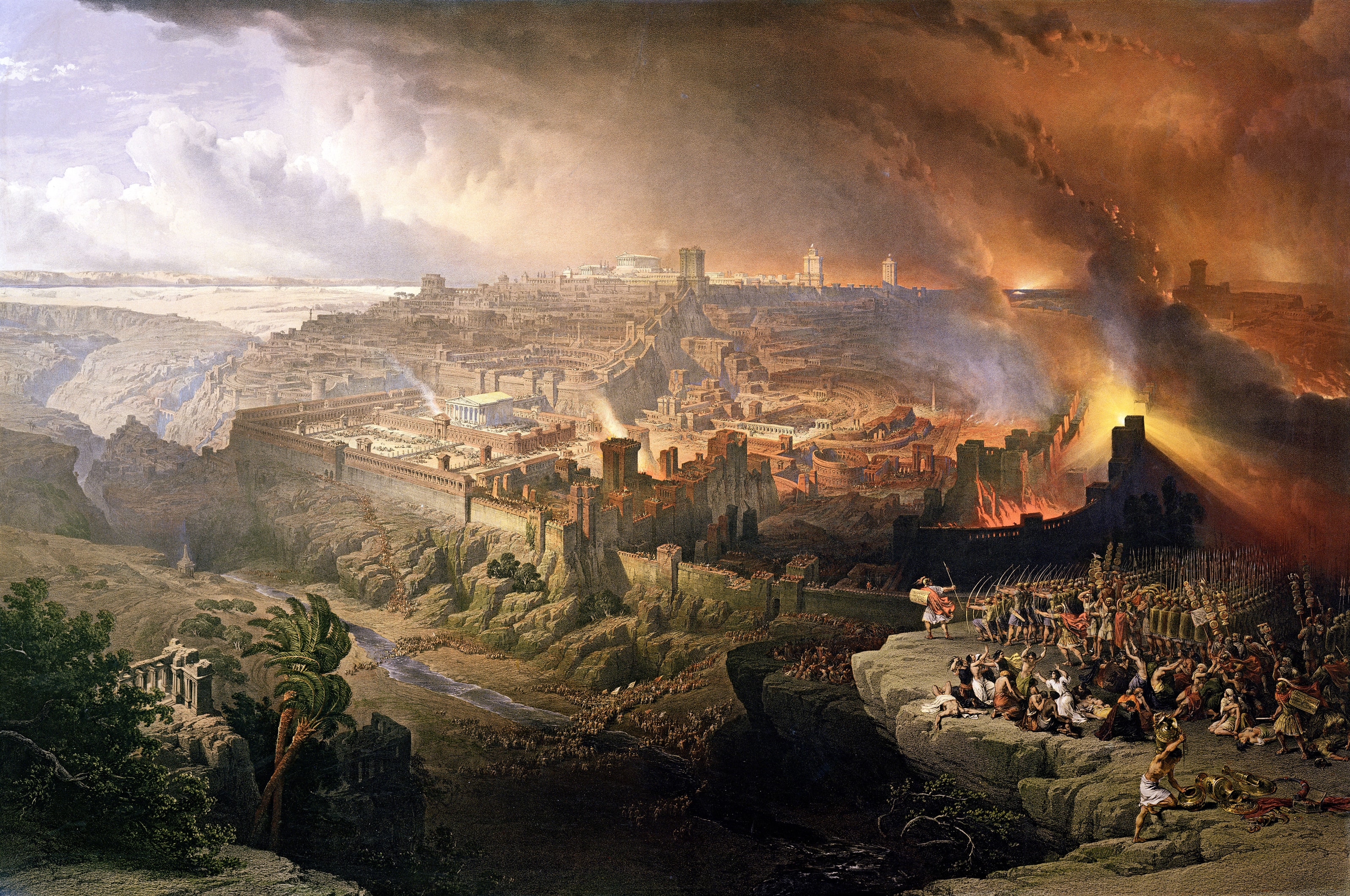
David Roberts, The Siege and Destruction of Jerusalem by the Romans Under the Command of Titus, A.D. 70 (1850), seen from the Mount of Olives, where the discourse was spoken. Image: public domain, via Wikimedia Commons, resized.

See this page's graph and discover linked topics
In full
The Olivet Discourse (Matthew 24:1-25:46; Mark 13:1-37; Luke 21:5-36) is Jesus' longest predictive teaching. It opens with a prediction of the temple's total destruction (Matthew 24:2; Mark 13:2; Luke 21:6), followed by a question that Matthew records in two parts, "when shall these things be? and what shall be the sign of thy coming, and of the end of the world?" (Matthew 24:3, ASV), while Mark and Luke record only the question about "these things" (Mark 13:4; Luke 21:7). The discourse then describes false messiahs, wars, persecution, the "abomination of desolation" (Matthew 24:15, from Daniel 9:27, 11:31 and 12:11), flight from Judea, a great tribulation, cosmic signs, the Son of Man coming on the clouds (drawing on Daniel 7:13), the gathering of the elect, the time statement of 24:34, and the statement that "of that day and hour knoweth no one" (24:36). Matthew then adds parables of watchfulness and judgment (24:37-25:46).
The interpretive question is how the near event (the fall of the temple in AD 70) relates to the far event (the coming of the Son of Man), and where, if anywhere, the discourse moves from one to the other. Five positions are held: full preterism (everything, including the Second Coming and the resurrection, was fulfilled in AD 70), partial preterism (the discourse through 24:34 was fulfilled in AD 70, including the cloud-coming read as judgment and vindication, while 24:36-25:46 concerns the future return), the two-horizon or near-and-far reading (the discourse interweaves AD 70 and the final coming, with "these things" in 24:34 limited to the signs leading to Jerusalem's fall), futurism (most of the discourse concerns a future tribulation and return, with "this generation" meaning the generation alive when the signs appear, or the Jewish people as a race), and the critical reading that Jesus or the evangelists expected the end within a generation and were mistaken. The first four are held by Christians; the fifth is the charge the others answer. Full preterism stands outside the historic creeds, which confess a future return and resurrection, and is treated here for completeness.
The prediction and the event
What Jesus said
- The temple's total destruction. "There shall not be left here one stone upon another, that shall not be thrown down" (Matthew 24:2, ASV; Mark 13:2; Luke 21:6).
- Encirclement and desolation. "But when ye see Jerusalem compassed with armies, then know that her desolation is at hand. Then let them that are in Judæa flee unto the mountains" (Luke 21:20-21, ASV). Matthew and Mark give the signal as the "abomination of desolation" standing where it ought not (Matthew 24:15; Mark 13:14).
- Captivity and Gentile rule. "They shall fall by the edge of the sword, and shall be led captive into all the nations: and Jerusalem shall be trodden down of the Gentiles, until the times of the Gentiles be fulfilled" (Luke 21:24, ASV).
- The timing. "This generation shall not pass away, till all these things be accomplished" (Matthew 24:34, ASV; Mark 13:30; Luke 21:32). One chapter earlier, at the end of His woes on the scribes and Pharisees, Jesus had said: "All these things shall come upon this generation" (Matthew 23:36, ASV).
- The unknown day. "But of that day and hour knoweth no one, not even the angels of heaven, neither the Son, but the Father only" (Matthew 24:36, ASV; Mark 13:32).
What happened, AD 66-70
| Date | Event | Source |
|---|---|---|
| AD 66 | The Jewish revolt breaks out. The Syrian legate Cestius Gallus marches on Jerusalem, then withdraws, in Josephus' words, "without any reason in the world." | Josephus, Jewish War 2.19.7 |
| AD 66 | After the Roman retreat, "many of the most eminent of the Jews" leave Jerusalem "as from a ship when it was going to sink." | Jewish War 2.20.1 |
| Before the siege | The Jerusalem church, "commanded by a revelation, vouchsafed to approved men there before the war," leaves the city "to dwell in a certain town of Perea called Pella." | Eusebius, Church History 3.5.3 |
| AD 67-69 | Vespasian subdues Galilee and Judea; Rome's civil war (the year of the four emperors) pauses the campaign. | Jewish War books 3-4 |
| Spring-summer AD 70 | Titus besieges Jerusalem and surrounds it with a wall; famine follows. | Jewish War 5.12.1-2 |
| August AD 70 | The temple burns, "the tenth day of the month Lous," the same day of the year on which Josephus says the Babylonians had burned the first temple. | Jewish War 6.4.5 |
| AD 70 | The Romans bring their ensigns into the temple court, set them opposite the eastern gate, and offer sacrifices to them. | Jewish War 6.6.1 |
| AD 70 | Titus orders the whole city and temple demolished, leaving only three towers and part of the western wall. | Jewish War 7.1.1 |
| AD 71 | In the triumph at Rome the temple spoils are paraded, including "the golden table, of the weight of many talents," the lampstand, and, last of all, "the law of the Jews." | Jewish War 7.5.5 |
| c. AD 81 | The Arch of Titus is dedicated in Rome after Titus' death, its relief showing the lampstand and the table carried in procession. | The arch stands on the Via Sacra |
Josephus also records the portents and prophets of the war years, among them Jesus son of Ananus, who cried "Woe, woe to Jerusalem" for seven years and five months before the siege (Jewish War 6.5.3), and he counts 97,000 captives and 1,100,000 dead (Jewish War 6.9.3). His figures for the dead are widely judged inflated; the scale of the catastrophe is not in dispute.
The dating question
Whether the Gospels' account of the discourse was written before or after AD 70 matters to how the fulfillment is weighed.
- Most critical scholars date Mark to c. AD 66-75 and Matthew and Luke to c. 80-90, and read the more specific details, especially Luke 21:20-24, as shaped by the events.
- Defenders of pre-70 composition point to the absence of any narrative of the city's fall anywhere in the New Testament. John A. T. Robinson (Redating the New Testament, 1976) argued on that ground that every New Testament book predates 70. Others note that a temple saying was already part of the charge at Jesus' trial (Mark 14:58), and that Jesus son of Ananus shows such predictions were being made in public before the war.
- A middle point both sides can grant: the core prediction, that the temple would fall within the generation, is attested in all three Synoptic Gospels and in the trial charge, and it was fulfilled. The dispute concerns how much detail was added afterwards, and the codex's prophecy catalog grades the individual predictions accordingly (see Biblical Prophecy, entries 102-107).
The five readings of "this generation"
| Reading | What "all these things" (24:34) covers | Where the discourse turns to the future | Coming on the clouds (24:30) | Representative proponents |
|---|---|---|---|---|
| Full preterism | Everything in the discourse | Nowhere; all fulfilled in AD 70 | Christ's coming in judgment in AD 70, understood as the Second Coming | Max R. King (The Spirit of Prophecy, 1971); Don K. Preston |
| Partial preterism | Matthew 24:4-34, including the cloud-coming | At 24:36, "that day and hour" | Christ's vindication and enthronement, made visible in the judgment on the temple | R. T. France (The Gospel of Matthew, NICNT, 2007); N. T. Wright (Jesus and the Victory of God, 1996); R. C. Sproul (The Last Days According to Jesus, 1998); Kenneth L. Gentry Jr.; Gary DeMar (Last Days Madness) |
| Two-horizon (near and far) | The signs leading to Jerusalem's fall | The discourse interweaves both horizons; 24:36 marks the unknown final day | The future bodily return | D. A. Carson (Matthew, Expositor's Bible Commentary, 1984); Craig Blomberg (Matthew, NAC, 1992) |
| Futurism | The end-time signs, tribulation and return | Most of the discourse is future; many futurists grant that Luke 21:20-24 describes AD 70 | The future bodily return | John F. Walvoord (Matthew: Thy Kingdom Come, 1974); the Scofield Reference Bible (1909), reading "generation" as "race" |
| Critical (failed expectation) | Everything, including the end of the age | Nowhere; the whole was expected within a generation | The end of the world, which did not come | Albert Schweitzer (The Quest of the Historical Jesus, 1906); Bart Ehrman (Jesus: Apocalyptic Prophet of the New Millennium, 1999) |
1. Full preterism
The claim. "This generation" means Jesus' contemporaries, "all these things" means everything in the discourse, and therefore the coming of the Son of Man, the gathering of the elect and the end of the age all took place in AD 70. The resurrection and the new creation are read as spiritual or covenantal realities that arrived with the end of the old covenant order.
Its strength. It takes the time statements at face value with no exceptions: 24:34, Matthew 16:28 ("some of them that stand here... shall in no wise taste of death, till they see the Son of man coming in his kingdom," ASV), and Matthew 10:23.
The objections it faces. Every other Christian reading rejects it. The historic creeds confess that Christ "will come again" and that believers await "the resurrection of the dead," both as future. Paul ties the Lord's coming to a bodily resurrection of the dead (1 Corinthians 15:23, 51-52; 1 Thessalonians 4:16-17), and Paul names those who said "the resurrection is past already" as having erred from the truth (2 Timothy 2:18). The angels at the ascension say Jesus "shall so come in like manner as ye beheld him going into heaven" (Acts 1:11, ASV), which describes a personal, visible return.
2. Partial preterism
The claim. The disciples' question concerns the temple, and the discourse answers it through 24:34: everything up to that verse, including the cloud-coming of 24:30, was fulfilled in AD 70. At 24:36 Jesus turns to a different subject, "that day and hour," which no one knows, and the following parables concern the final return. The Second Coming, resurrection and judgment remain future.
How it reads the cloud-coming. In Daniel 7:13 the one like a son of man "came with the clouds of heaven... and he came even to the ancient of days" (ASV): the movement is toward God, to receive a kingdom. On this reading, Jesus' use of the image is about His enthronement and vindication, which His generation would "see" in the judgment that fell on the temple that condemned Him. The partial preterist points to Jesus' words to the high priest: "Henceforth ye shall see the Son of man sitting at the right hand of Power, and coming on the clouds of heaven" (Matthew 26:64, ASV), addressed to the council itself. The cosmic signs of 24:29 are read as prophetic language for the fall of a political order, as when Isaiah describes Babylon's fall with darkened sun and moon (Isaiah 13:10) and pictures the LORD riding "upon a swift cloud" to judge Egypt (Isaiah 19:1).
Its strength. It keeps "this generation" in its normal sense (as in Matthew 11:16, 12:41-45 and 23:36), and it explains why 24:36 says no one knows the day when 24:32-33 has just said that the signs make "it" knowable. France argues that the change from "these things" to "that day" marks the turn.
The objections it faces. Futurists reply that "they shall see the Son of man coming on the clouds of heaven with power and great glory" and the gathering of the elect "from the four winds" (24:30-31) read most naturally as the visible return, the same event Paul describes in 1 Thessalonians 4:16-17, and that Matthew's question links "thy coming" with "the end of the world" (24:3).
3. The two-horizon reading
The claim. The disciples asked about two things, and Jesus answered both, weaving them together in the way Old Testament prophets often merged a near judgment with the final day. The signs of 24:4-28 (deceivers, wars, persecution, the abomination, the flight, the tribulation) belong to the period leading to AD 70 and, in the view of many who hold this reading, foreshadow the end. The coming of 24:29-31 is the final return. "All these things" in 24:34 refers to the signs Jesus has just listed, "when ye see all these things" (24:33), which that generation did see. The return itself has no announced date (24:36).
Its strength. It accounts for both the clear AD 70 material (especially Luke 21:20-24) and the clear final-return material in the same discourse. It also has an early pedigree: Eusebius read the siege and the flight to Pella as fulfillment of Jesus' words (Church History 3.5-7) while still expecting a future return, and Augustine, writing to the bishop Hesychius in 418-419 (Letter 197), refused to calculate the time of the end on the ground that Christ said no one can know it.
The objections it faces. Preterists reply that the seam has to be found somewhere and that 24:29 begins "immediately after the tribulation of those days," which ties the coming closely to the AD 70 tribulation. Two-horizon interpreters answer that prophetic "immediately" and "in those days" can join events that are separate in time, as Old Testament oracles do.
4. Futurism
The claim. The discourse looks mainly to a future tribulation, a future abomination in a rebuilt temple, and the visible return. "This generation" has two common futurist readings:
- The generation that sees the signs. The people alive when the end-time signs begin will see the whole sequence completed. Walvoord takes this line.
- "This race." The Greek genea can mean a family or stock, and so the promise is that the Jewish people will be preserved until all is fulfilled. The 1909 Scofield Reference Bible note on Matthew 24:34 argued this, on the ground that the worldwide preaching, the great tribulation and the visible return did not occur in AD 70. The reading has lost ground since: many futurist scholars now prefer the first option, because in Matthew "this generation" consistently means Jesus' own contemporaries.
Its strength. It reads the cosmic and cloud language at its most literal and connects the discourse directly to the return described in Acts 1:11, 1 Thessalonians 4 and Revelation 19.
The objections it faces. Critics of the view note that the demonstrative "this" naturally points to the generation Jesus was addressing, as in 23:36, and that the disciples' question began with the temple standing in front of them. See Rapture Timing Comparison for the in-house futurist debate on the sequence of events.
5. The critical reading
The claim. Jesus, or the early church speaking in His name, expected the end of the world within a generation, and it did not come. Schweitzer made this the centre of his account of Jesus; Ehrman presents Jesus as an apocalyptic prophet whose expectation failed.
How the four Christian readings answer it.
- The full preterist says everything was fulfilled in AD 70, so nothing failed.
- The partial preterist says everything Jesus dated to "this generation" happened in that generation, and the one thing He refused to date (24:36) is still ahead.
- The two-horizon interpreter says "all these things" refers to the signs, which came, while the final day was never given a date.
- The futurist says "this generation" (or "this race") refers to a period that has not yet run out.
Each answer works within its own reading of the text, and none of them requires the time statement to have failed. What the critical reading has to establish is that 24:34 includes the final coming and that "this generation" can only mean Jesus' contemporaries. Christians disagree about the first of those claims, and futurists dispute the second. The fullest treatment, including Mark 9:1, the Transfiguration and 2 Peter 3, is at Failed Second Coming Prophecy Objection Defeater.
What all the Christian readings share
- The temple fell as Jesus said, within the generation that heard Him. Every Christian reading, and most critical scholars, grant that the prediction of the temple's destruction was fulfilled in AD 70, whatever they conclude about when it was written down.
- Jesus refused to date His return. "Of that day and hour knoweth no one" (24:36) stands in every reading.
- The Son of Man is Daniel's figure. Every reading links the cloud-coming to Daniel 7:13-14, where the one like a son of man receives an everlasting kingdom. See Son of Man Title and Daniel 2 and 7 Prophecy Argument.
- The point of the discourse is readiness. The parables that follow (the faithful servant, the ten virgins, the talents, the sheep and the goats) all press watchfulness and faithfulness rather than calculation.
Grammar and hermeneutics
- "These things" and "that day." Jesus uses the plural demonstrative tauta, "these things," for what the disciples asked about and for what this generation will see (24:2-3, 24:33-34), and the singular remote demonstrative, "that day" (tēs hēmeras ekeinēs), in 24:36. Partial preterists and many two-horizon interpreters read the change of demonstrative as a change of subject; futurists and full preterists read 24:36 as continuing the same subject.
- "This generation" elsewhere in Matthew. Hē genea hautē occurs in Matthew 11:16, 12:41, 12:42, 12:45, 23:36 and 24:34, and in each of the earlier uses it describes Jesus' contemporaries. The "race" reading has to argue that 24:34 is the exception.
- "Coming" in Daniel 7:13. The Aramaic says the figure "came" to the Ancient of Days and was presented before Him. Daniel's direction of travel is toward the throne. Readers who hold to the future return reply that the New Testament also speaks of Jesus coming from heaven to earth (Acts 1:11; 1 Thessalonians 4:16), so the cloud imagery can carry both senses.
- Prophetic idiom. Cosmic collapse language is used in the Old Testament for the fall of particular nations (Isaiah 13:10 for Babylon; Isaiah 34:4 for Edom; Ezekiel 32:7 for Egypt). That is the strongest textual support for reading Matthew 24:29 of a historical judgment, and futurists answer that the same idiom is also used of the final day (Joel 2:31 with Acts 2:20; Revelation 6:12-14).
Scholarship
Published academic works this page draws on, each matched to a publisher, index or library catalog record.
- D.A. Carson, Mark: Walter W. Wessel and Luke: Walter L. Liefeld, The Expositor's Bible commentary (1984). Open Library
- Bart D Ehrman, Jesus: Apocalyptic prophet of the new millennium (Oxford University Press, 1999). doi:10.1093/oso/9780195124736.001.0001
- R. T. France, The Gospel of Matthew (Wm. B. Eerdmans Publishing Co, 2007). doi:10.5040/bci-000r
- John A. T. Robinson, Redating the New Testament (1976). Open Library
- R. C. Sproul, The last days according to Jesus (1998). Open Library
See also
- Failed Second Coming Prophecy Objection Defeater, the full defeater for the "failed prophecy" charge, including Mark 9:1 and 2 Peter 3.
- Eschatology, the hub for the return of Christ, the millennium and the final state.
- Rapture Timing Comparison, the futurist in-house debate that depends on how Matthew 24 is read.
- Daniel 2 and 7 Prophecy Argument, the kingdom and the Son of Man that the cloud-coming draws on.
- Daniel 9 Seventy Weeks Objection Defeater, the prophecy of the city and sanctuary destroyed after the anointed one is cut off.
- Biblical Prophecy, the catalog entries on the temple, the siege, the captivity and the flight to Pella.
- Josephus, the eyewitness historian of the war.
- Eusebius of Caesarea, who preserved the Pella tradition.
- Talmud Attests the Temple Signs Ceased Argument, rabbinic memory of the decades before the temple fell.
- Son of Man Title, the title Jesus took from Daniel 7.
- Kingdom of God, the already-and-not-yet kingdom.
Common questions this page answers
Q: What is the Olivet Discourse?
It is Jesus' teaching on the Mount of Olives about the destruction of the temple and His coming, recorded in Matthew 24-25, Mark 13 and Luke 21:5-36. It begins with His prediction that not one stone of the temple would be left on another and ends, in Matthew, with parables about readiness and judgment.
Q: Did Jesus predict the destruction of the temple in AD 70?
Yes. All three Synoptic Gospels record Him saying the temple would be thrown down, and Luke adds that Jerusalem would be surrounded by armies. In August AD 70 the Roman army under Titus burned the temple and demolished the city, as Josephus records in Jewish War books 6 and 7. Critical scholars debate how much of the Gospels' detail was written after the event, but the core prediction is attested in all three Gospels and in the charge at Jesus' trial.
Q: What does "this generation shall not pass away" mean in Matthew 24:34?
Christians read it in four main ways. Partial preterists and full preterists say it means Jesus' contemporaries, who saw the temple fall in AD 70. Two-horizon interpreters say it refers to the signs leading up to that event, while the final return has no date. Futurists read it as the generation alive when the end-time signs appear, or as the Jewish people preserved until the end.
Q: Was Jesus wrong about the timing of His return?
Each Christian reading holds that He was not. Everything Jesus tied to "this generation" is read either as fulfilled in AD 70 or as describing a generation that has not yet run out, and He explicitly refused to give the day and hour of His coming (Matthew 24:36). The skeptical case has to show both that Matthew 24:34 includes the final return and that "this generation" can only mean His contemporaries.
Q: Did the Christians in Jerusalem escape before the siege?
Eusebius (Church History 3.5.3) records that the Jerusalem church, warned by a revelation, left the city before the war and settled at Pella in Perea, which matches Jesus' instruction to flee when Jerusalem was surrounded (Luke 21:20-21). The tradition is first attested in the fourth century, and scholars disagree about how reliable it is.
Q: What is the difference between preterism and futurism?
Preterism holds that much or all of the prophecy in the Olivet Discourse and Revelation was fulfilled in the first century, especially in AD 70. Futurism holds that most of it concerns events still to come before Christ's return. Partial preterists keep the Second Coming, the resurrection and the final judgment in the future; full preterists, who place them in AD 70, stand outside the historic creeds.