Argument
Nothing Is Fixed Only Metastable Objection Defeater
nothing is fixed, nothing is fixed it's metastable, everything is metastable, metastability, metastable, everything is in flux, everything changes, only change is real, there is no permanence, process metaphysics objection, Heraclitean flux objection, panta rhei, differential efficacy, real if and only if differentially efficacious, something is real if it makes a difference, can we know anything static, causal vs explanatory, causal versus explanatory explanation, causal explanation vs metaphysical explanation, how does anything exist at all, why does anything exist on Deleuze's viewIntro
Some people argue that nothing is fixed. Everything is a process. What looks solid (a rock, a person, a law of nature) is only metastable: a pattern that holds together for a while and could shift into something else. If nothing is permanent, the argument goes, there is no unchanging foundation of reality, and no need for an unchanging God.
There is something true here. Rivers, bodies, cultures and stars all change. Christians agree that creation is always changing.
But the claim runs into four problems:
- Metastable things still have rules. Supercooled water stays liquid below freezing until something disturbs it, and then it freezes. That only works because water has a definite freezing point and definite molecules. The shifting depends on fixed conditions.
- The claim is presented as fixed. "Nothing is fixed" is offered as a truth that always holds. If it can change, it gives no reason to believe it.
- You cannot see change without something stable to compare. You know a river has changed because you recognize it as the same river.
- Describing how things change does not explain why anything exists. That is the question a process view leaves open, and Christianity answers it: God, who does not change, holds a changing world in being.
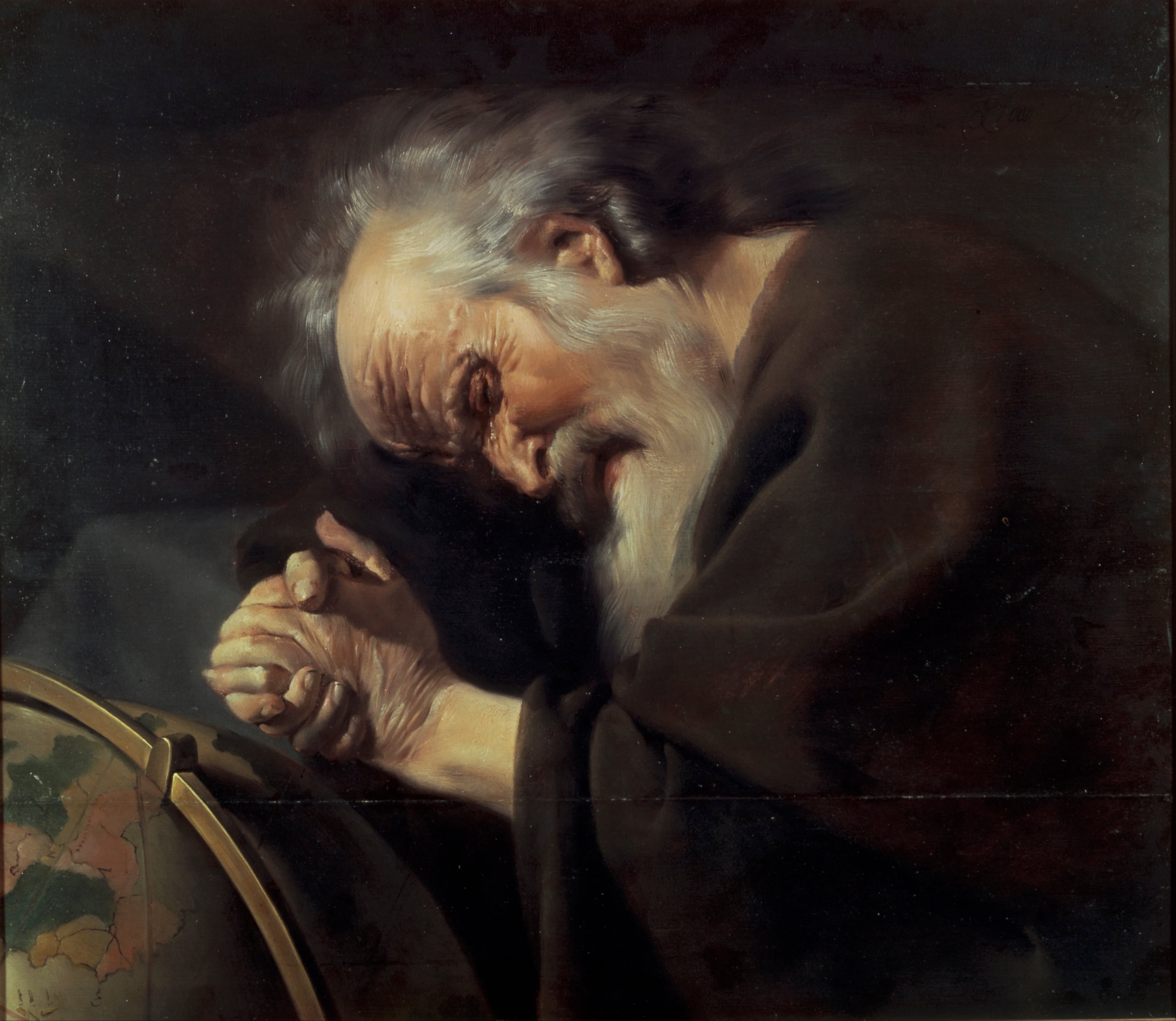
Heraclitus, the ancient philosopher of flux, painted as the "weeping philosopher" by Johannes Moreelse (c. 1630), Centraal Museum, Utrecht. Public domain, via Wikimedia Commons.
See this page's graph and discover linked topics
In full
The objection asserts a process ontology: there are no substances with fixed natures, only processes, and every apparent identity is a metastable phase of an individuating system (Simondon), a product of differential relations and intensive processes (Deleuze), or an occasion within a flux (Heraclitus, Whitehead). The atheist application is that a reality without fixed points has no room for, and no need of, an immutable ground.
The defeater grants the phenomenology of change and much of the science of metastability, then argues:
- Presupposition. Metastability is defined by determinate configurations, energy thresholds and transition conditions. It presupposes determinacy rather than abolishing it.
- Self-reference. "Nothing is fixed" is either a necessary truth (and so at least one thing is fixed) or a contingent generalization (and so gives no warrant for a universal ontology).
- Epistemic conditions. Knowledge of change requires differentiation between states, and differentiation requires stable criteria of comparison. That shows knowledge needs stable terms; it does not show that being needs change.
- Explanatory sufficiency. An account of how structures become within reality is a causal or generative account. It does not answer why reality exists. The objector must hold that reality is necessary, a brute fact, or exempt from the question, and each option carries a burden.
- Positive grounding. Classical theism explains why a changing world is both real and intelligible: it depends at every moment on a God who is pure act, the unchanging source of all change. See Divine Immutability and Actus Purus.
Cheatsheet
30-second reply: "I agree that things change and that many systems are metastable. But metastability needs rules: a threshold, a configuration, a condition for switching. So something in your picture is determinate. And when you tell me 'nothing is fixed,' are you offering that as a fixed truth? Then it refutes itself. If it's just a pattern you've noticed, why apply it to all of reality? Then my real question: you've told me how things change. Why does anything exist to change at all?"
Fast facts:
- Metastable means a system persists in one configuration while able to shift to a more stable one when disturbed. Textbook examples: supercooled water, a supersaturated solution that crystallizes when seeded, a diamond (metastable carbon at room conditions).
- Gilbert Simondon (1924-1989) made metastability central to his theory of individuation. Gilles Deleuze took it into his philosophy of difference. See Gilles Deleuze.
- Heraclitus taught that everything flows. Plato reports him as saying you could not step twice into the same river (Cratylus 402a).
- Aristotle reports that Heraclitus's follower Cratylus ended by refusing to speak at all and only moved his finger, since words would be out of date before he finished them (Metaphysics IV.5 1010a). Radical flux, pushed all the way, leaves nothing to say.
- Causal questions ask what produces an effect. Explanatory questions ask why something is so. Every causal explanation explains something, but not every explanation is causal.
Counter-moves:
- "Science shows everything is process." Science describes processes with fixed constants and invariant laws. The speed of light and the charge of the electron do not drift between Tuesday and Wednesday.
- "Your 'fixed truths' are just metastable too." Then so is that sentence, and you have no grounds to expect me to still find it true by the end of this conversation.
- "Asking why anything exists assumes your theism." It assumes only that things which depend on conditions can be asked about. You asked me for reasons first.
Concessions (with their reciprocals):
- Grant: creatures are not frozen substances; they grow, decay and transform. Collect: then creaturely change is the datum to explain, and change needs a ground.
- Grant: metastability is a real and useful scientific concept. Collect: it is defined by fixed thresholds and laws, so it presupposes determinacy.
- Grant: knowing requires interaction and difference. Collect: that is a condition on knowing, and it does not show that what is known must itself change.
Closing line: "You have given me a good description of how things change. I am asking what holds the changing world in being. My answer is the God who does not change."
Steel-man: the case for "nothing is fixed"
Take the objection at its strongest.
- Experience. Every object we meet changes: cells are replaced, mountains erode, stars burn out. Permanence is never observed.
- Heraclitus. Reality is like a river or a fire: its unity is a pattern of continual exchange. Stability is a balance of opposing tensions.
- Simondon. An individual is never complete. It emerges from a "preindividual" field charged with potentials, and remains in tension with its environment. Crystals form when a supersaturated solution, holding more than it can stably carry, is seeded. Living things are permanently metastable.
- Deleuze. Identities are effects of deeper differences. What we call fixed is a temporarily settled outcome of intensive processes that remain at work. See Gilles Deleuze.
- Physics. Particles are excitations of fields; matter is energy in particular configurations; even protons may decay over vast spans. Substance looks like a convenient fiction.
- The atheist inference. Classical theism needs a fixed point: an unchanging God and stable natures. If reality is processual all the way down, that framework is outdated.
The steel-man is strongest at points 1, 3 and 5. It is weakest at point 6, which jumps from "creatures change" to "nothing grounds change."
Argument structure
| Premise | Notes | |
|---|---|---|
| P1 | Metastability presupposes determinate configurations, thresholds and transition conditions | The objector's own concept requires fixed rules |
| P2 | "Nothing is fixed" is either necessarily true, so something is fixed, or contingently true, so it cannot ground a universal ontology | Self-refutation |
| P3 | Knowing change requires stable criteria of comparison | Epistemic condition; does not show being needs change |
| P4 | An account of how things become within reality does not explain why reality exists | Causal versus explanatory distinction |
| P5 | A changing, dependent world is best explained by an unchanging, independent ground | First Way - Motion, Contingency Argument |
| C | The flux objection fails, and the reality of change points toward the God who does not change | Divine Immutability |
Form
Defensive, combining a presupposition argument (P1), a self-reference dilemma (P2), an epistemic distinction (P3), an explanatory-sufficiency challenge (P4), and a positive abductive case (P5).
Premise 1, Metastability needs fixed rules
Affirmative case
- Physicists distinguish three states. A stable system returns to equilibrium after a disturbance. An unstable one is driven away from its present state by small disturbances. A metastable one persists in its configuration while holding potentials that a large enough disturbance can release.
- Each definition refers to a configuration, a threshold and a transition condition. Supercooled water is metastable because pure water at standard pressure has a definite freezing point and a definite crystal structure that ice adopts once nucleation begins.
- So the formal argument:
- Metastability requires distinguishable configurations and conditions that govern transitions between them.
- Distinguishable configurations and transition conditions are determinate relations.
- Therefore, metastability presupposes determinate relations.
- The objector has moved from "this thing is not permanent" to "nothing is determinate." Only the first follows from the science.
Anticipated objections
- "The rules themselves are metastable; laws of nature could change."
- "You are confusing our models with reality."
Rebuttals
- If the laws are metastable, they too have thresholds and transition conditions, which are rules of a higher order. The regress ends either in something determinate or in nothing that can be stated. And the claim that physical constants drift is a scientific hypothesis that has been tested and so far tightly constrained. Process metaphysics cannot settle it by definition.
- Deleuze himself is a realist about differential relations; he holds that they are real and mind-independent. Simondon's metastable systems are physical systems in the world. The objector cannot use realism about process and anti-realism about structure at the same time.
Premise 2, Is "nothing is fixed" fixed?
Affirmative case
- Ask: "Does your claim that nothing is fixed apply to itself?"
- If it is a necessary truth about all reality, then at least one truth is fixed, and the claim is false as stated. The objector then owes an account of how necessary truths fit a world without fixed points.
- If it is a contingent generalization from the systems we have met, it gives no right to a universal ontology. Many observed changeable things do not show that everything is changeable, any more than many observed white swans show that all swans are white.
- If it is itself provisional and revisable, the objector must say how his philosophy distinguishes an accurate account of becoming from an inaccurate one. A standard of accuracy that is itself in flux cannot do that work.
- Plato pressed this against the radical Heracliteans: if everything changes in every respect, no word can be applied correctly, not even "thus" or "not thus" (Theaetetus 182c-183b). Cratylus drew the conclusion and stopped talking (Aristotle, Metaphysics IV.5 1010a).
Anticipated objections
- "You are treating my description as a metaphysical law. I am just describing reality as I find it."
Rebuttals
- Then it is a contingent claim, and it gives no basis for concluding that there is no unchanging ground. "Every object I have examined changes" is compatible with God's existence; Christianity affirms it.
Premise 3, Knowing change needs stable terms
Affirmative case
- To recognize change you must identify a difference between two distinguishable states.
- To identify that difference you need a stable criterion of comparison.
- Therefore, recognizing change requires some stability in the conditions of recognition.
- Example: you see a river flowing and know it as one river through constantly changing water. If nothing were identifiable across successive experiences, you could not tell a changing object from a series of unrelated objects.
- Knowledge builds in stages: an encounter provokes thought, learning organizes it, pattern recognition finds regularities, and knowledge is a stable, justified grasp of those patterns. Each stage beyond the first depends on something holding still long enough to be compared.
The "differential efficacy" criterion
Process views often add a test for reality: something is real if and only if it is differentially efficacious, that is, if it makes a causal difference between possible states of affairs. Three questions expose its limits:
- Does it fit everything we count as real? The number 2, the law of non-contradiction and the truth that 2 + 2 = 4 do not push anything around, yet they are real in some sense, and the objector relies on them in every argument. Nominalists dispute that abstract objects exist, so this premise needs defense, but the criterion cannot just assume them away. See Laws of Logic and Concepts Do Not Exist Objection Defeater.
- Does it apply to itself? Is the property of being differentially efficacious itself differentially efficacious? The defender can reply that properties are real through their causal manifestations, which is coherent but no longer a simple test.
- Is it a definition or a discovery? If it defines "real," it settles nothing about what exists. If it claims to be a necessary metaphysical truth, the objector must show how he knows that without presupposing it.
Knowing versus being
There are three different claims here:
- Nothing can be known without differentiation.
- Nothing can exist without differentiation.
- Nothing can exist without causing change.
The first is plausible for empirical knowledge. It does not entail the second or third. A rock sitting still on a table is known through light reflecting off it; the rock does not need to change to be known. Likewise, classical theism holds that God does not change and yet is known through his effects: "the invisible things of him since the creation of the world are clearly seen, being perceived through the things that are made" (Romans 1:20, ASV). The knowing involves change in the knower and in creation, and the one known need not change.
Anticipated objections
- "Deleuze rejects recognition as the model of thought. Real thinking begins with an encounter that breaks our categories."
Rebuttals
- Agreed that thinking often begins that way. An encounter explains how thought is generated. It does not explain what makes the resulting belief knowledge rather than a persistent habit. Stability, accuracy and justification are three separate requirements, and the encounter supplies none of the last two.
Premise 4, How things become is not why anything is
Causal versus explanatory
This distinction carries the argument.
| Causal | Explanatory |
|---|---|
| What produces this effect? | Why is this the case? |
| Identifies mechanisms | Identifies reasons, grounds or mechanisms |
| Causal dependence | Explanatory dependence, of which causal dependence is one kind |
| Fire heats water | Why does heat flow from hot to cold at all? |
| Usually physical processes | Physical, mathematical, logical or metaphysical relations |
Every successful causal explanation explains, but not every explanation is causal. A mathematical proof explains why a theorem is true without naming any event that made it true.
Three questions about one floating ball. A ball floats in a pool, by Archimedes' principle, F = ρgV.
- Causal: what physically pushes the ball up? Water pressure increases with depth, so the pressure on the bottom of the ball exceeds the pressure on the top, giving a net upward force.
- Scientific-explanatory: why does that force equal the weight of the displaced water? It follows from hydrostatic pressure and the gravity acting on the fluid.
- Metaphysical-explanatory: why is there a world with fluids, gravity and lawful relations at all?
All three questions are legitimate. Answering the first two does not answer the third.
Explanatory priority without temporal causation. "2 + 2 = 4" has an explanation in the structure of arithmetic, but no event caused it. In the same way, classical theism holds that God explains creation as its ground at every moment, as well as at its beginning. See Divine Conservationism.
Affirmative case
- Explaining how a system operates does not, by itself, explain why the system exists.
- A process ontology explains how structures become: actualization, individuation, phase transitions.
- Therefore, a process ontology does not, by itself, explain why there is a world of processes at all.
This conclusion identifies a gap. It does not yet prove that something fills it. The Christian must add an argument that the gap needs filling, which is the work of the Principle of Sufficient Reason and the Contingency Argument.
The three exits
Asked "why does anything exist on your view?", the process metaphysician has three options:
- Necessary existence. The processual field could not have failed to exist. Then the objector has a necessary, non-contingent ground after all, and owes an account of why that ground is the shifting whole and not something whose nature is existence itself.
- Brute fact. It just exists, with no explanation. Then the view stops explaining at the one point where explanation matters most, and gives up any complaint against the theist who says God exists necessarily.
- Reject the question. Asking for an explanation of existence as a whole is illegitimate. Deleuze would likely say this, since the demand looks to him like a smuggled-in transcendence. The reply: the question comes from the dependence of every actual thing on conditions, which the process view itself emphasizes. A view built entirely on dependence cannot easily exempt the whole from it.
Anticipated objections
- "The fallacy of composition: each thing depends, so the whole depends."
Rebuttals
- Sometimes inference from parts to whole fails, and sometimes it holds (a wall made entirely of red bricks is red). The question is whether dependence is the kind of property that transfers. A whole made of nothing but dependent processes has no further ingredient that could make it independent. See Composition and Division.
Premise 5, The God who does not change grounds the world that does
Affirmative case
- Change needs a ground. Aquinas's First Way argues that whatever passes from potential to actual is brought there by something already actual, and an essentially ordered series of such causes cannot go on without a first that is pure act (Summa Theologiae I q.2 a.3). See First Way - Motion and Actus Purus.
- Immutability is fullness. God's changelessness means that God lacks no perfection that change could add. He is infinite life and act, which is why he can be the source of every creaturely change. See Divine Immutability.
- Intelligibility. A changing world that is still lawful, measurable and knowable is what one would expect if it was made through a Word and is upheld by it (Hebrews 1:3, Colossians 1:17). See Argument from Intelligibility and Logos Christology.
- Scripture states the contrast directly. The heavens "shall wax old like a garment; As a vesture shalt thou change them, and they shall be changed: But thou art the same, And thy years shall have no end" (Psalm 102:26-27, ASV). Christianity has always held both halves: a creation in flux and a Creator who does not change.
Anticipated objections
- "An unchanging God cannot act in a changing world."
- "Metastability is enough: the universe holds itself together without a ground."
Rebuttals
- God's act is eternal; the change lies in the effects, which begin and end in time. See God Changed When He Created Objection Defeater.
- Metastability explains how something keeps its identity while able to transform. It presupposes a reality with determinate relations and potentials. The question is what grounds those, which brings us back to Premise 4.
Master objections
- "This is substance metaphysics dressed up." The argument uses no doctrine of substance. It needs only that metastability has conditions, that claims have truth values, and that existence can be asked about.
- "Whitehead and process theists keep God within a process view." True, and they illustrate the point: even a process ontology seemed to Whitehead to need an ordering ground, his primordial nature of God. Classical theists reject Whitehead's changing God for other reasons. See Process Theism.
- "Eastern philosophy has taught impermanence for millennia." The Buddhist doctrine of impermanence faces the same questions: what is it that knows impermanence, and why is there any flux at all? See Buddhism.
- "God of the gaps." The argument starts from the existence of change and the conditions of knowledge, which no future science will remove. See God of the Gaps Objection Defeater.
Tactical opening and closing
Opening: "When you say nothing is fixed, do you mean that no creature is permanent, which I agree with, or that nothing at all is determinate, including the truth of what you just said?"
Closing: "Metastability explains how something can keep an identity while staying able to change. I grant that. But it presupposes a reality with determinate relations, potentials and conditions for change. You have described the dynamics of being. I am asking what grounds being itself."
Live-cite kit
Scripture:
- "For I, Jehovah, change not" (Malachi 3:6, ASV).
- "the Father of lights, with whom can be no variation, neither shadow that is cast by turning" (James 1:17, ASV).
- "Jesus Christ is the same yesterday and to-day, yea and for ever" (Hebrews 13:8, ASV).
- "and he is before all things, and in him all things consist" (Colossians 1:17, ASV).
Scholarly:
- Plato, Theaetetus 182c-183b: radical flux leaves language nothing to say.
- Aristotle, Metaphysics IV.5 1010a: Cratylus who only moved his finger.
- Aquinas, Summa Theologiae I q.2 a.3 (First Way) and I q.9 (God's immutability).
- Simondon, L'individu et sa genèse physico-biologique (1964): metastability and individuation.
Aphorism: "You need something that stays put to notice that everything moves."
Connection to Scripture
Scripture affirms creaturely change more vividly than any process philosopher: grass withers, the heavens wear out like clothing, human life is a vapor. It places all that change inside the hand of a God who does not change (Psalm 102:25-27). The unchanging God is also the faithful God: "For I, Jehovah, change not; therefore ye, O sons of Jacob, are not consumed" (Malachi 3:6, ASV). His constancy is the reason a changing people can trust him.
Patristic and scholarly note
The early Christian writers met Heraclitean flux and Stoic cycles directly. Augustine's Confessions XI and XII set the mutability of creatures against the immutability of God, holding that creatures exist in a borrowed, changing way while God simply is (see Exodus 3:14). Aquinas built his first proof of God on the reality of change. In the twentieth century, process thought (Whitehead, Hartshorne) and the philosophy of difference (Simondon, Deleuze) revived the Heraclitean picture. Christian philosophers such as Edward Feser and David Bentley Hart have answered that the classical framework of act and potency was designed for exactly this question: it makes change intelligible without denying it.
Scholarship
Published academic works this page draws on, each matched to a publisher, index or library catalog record.
- Gilbert Simondon, L' individu et sa genèse physico-biologique (Presses universitaires de France, 1964). Open Library
- Alfred North Whitehead, Process and reality: an essay in cosmology (Macmillan, 1929). Open Library
See also
- Gilles Deleuze, the philosopher of difference and immanence behind much of this objection
- Divine Immutability and Actus Purus, the doctrine of the unchanging God
- First Way - Motion, Aquinas's argument from change
- Principle of Sufficient Reason and Contingency Argument, why anything exists at all
- Self-refutation, the logic behind Premise 2
- Concepts Do Not Exist Objection Defeater, a related challenge about abstract reality
- Reductionism, another way of explaining wholes by what lies beneath them
- God Changed When He Created Objection Defeater, how an unchanging God acts in time
Common questions this page answers
Q: What does metastable mean in philosophy?
A metastable system holds one configuration for a while but can shift into another when disturbed enough, like supercooled water that stays liquid below freezing until it is jarred. Gilbert Simondon and Gilles Deleuze used the idea to argue that every individual thing is a temporary, metastable result of ongoing processes.
Q: If nothing is fixed, does that disprove God?
No. Metastability depends on fixed thresholds and laws, so it presupposes something determinate. The claim "nothing is fixed" is itself offered as a fixed truth. And explaining how things change does not explain why anything exists. Christianity agrees that creation changes and holds that it depends on a God who does not.
Q: What is the difference between a causal and an explanatory account?
A causal account says what produces an effect: water pressure pushes a ball upward. An explanatory account says why something is the case, and may involve mathematical, logical or metaphysical reasons. Every causal explanation explains, but some explanations, such as a mathematical proof, name no cause at all.
Q: Can we know something that never changes?
Yes. Empirical knowing requires some difference or interaction in the process of knowing, but the object known need not change. A still rock is known by the light reflecting off it. Christians hold that the unchanging God is known through his effects in a changing creation (Romans 1:20).
Q: How does a process philosophy explain why anything exists at all?
It usually explains how things become within reality and leaves open why reality exists. Its defenders must say that reality exists necessarily, that it is a brute fact, or that the question should not be asked. Each answer needs a defense, and the second gives up on explanation exactly where it is most needed.
Q: Is something real only if it makes a difference?
That test, sometimes called differential efficacy, fits physical objects but struggles with numbers, logical laws and truths like 2 + 2 = 4, which are real in some sense yet cause nothing. It also has to explain whether the test itself makes a difference, and whether it is a definition or a discovery.