Argument
No Empirical Evidence for God Objection Defeater
No Evidence for God Objection Defeater, There Is No Evidence for God, There is no evidence for God, No physical evidence for God, No empirical evidence for God, God does not exist because there is no evidence, Show me physical evidence of God, If you cannot measure it it does not exist, No scientific evidence for God, Absence of evidence for GodIntro
The objection is short: "There is no physical, empirical evidence for God, so God does not exist." It sounds scientific and final. It is neither.
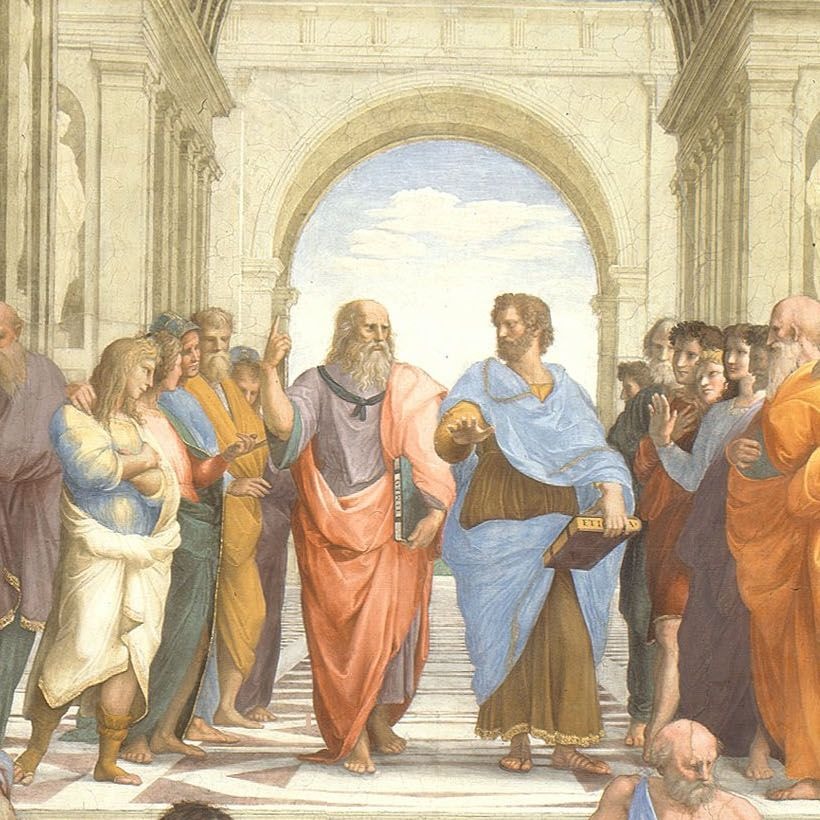 Plato points up toward what is unseen and Aristotle gestures toward the observable world, the oldest form of the question this objection raises. Detail of The School of Athens by Raphael, 1509-1511, Vatican. Image: public domain, via Wikimedia Commons, cropped and resized.

First, the logic does not work. "We found no physical evidence of X" only shows X does not exist if X would leave physical evidence of that kind. No fingerprints at a scene does not prove a suspect was absent unless he would have left prints. So the objection needs a hidden rule: everything that exists leaves physical, empirical evidence.
Second, that rule fails its own test. There is no lab measurement that shows "only physical things exist" or "only empirical evidence counts." It is a philosophical claim. By its own standard, it should be thrown out.
Third, the objector believes in many things that are not physical objects. Numbers. The laws of logic. The truth that 2 + 2 = 4. The past. Other people's minds. The wrongness of torturing a child for fun. Nobody puts these under a microscope, yet the objector uses logic and mathematics to read the very scientific evidence he appeals to.
Fourth, God was never claimed to be a physical object inside the universe. Christians say God is spirit, the Maker of matter, space and time. Asking to see Him in a test tube is asking for evidence of something Christians do not believe in.
Fifth, there is evidence. The universe had a beginning. Its physical constants fall within narrow life-permitting ranges. Moral truths bind us. Minds reason. And a man in first-century Judea was reported risen from the dead by people who had seen him. Each of these is an argument from things we can observe to the best explanation of them. Rejecting the arguments is allowed. Pretending they do not exist is not.
Quick reply: "Is the rule 'only physically detectable things exist' itself physically detectable? If not, by your rule you have to drop it. If you keep it anyway, you already believe something real without physical evidence."
See this page's graph and discover linked topics
In full
Defeater for the objection in two forms. (A) The ontological form: there is no physical, empirical evidence of God in external reality, therefore God does not exist. (B) The epistemic form: the only legitimate evidence is empirical evidence of the kind science collects; none exists for God; therefore belief in God is unjustified. Form A is common in live debate and on social media. Form B is the serious version, and it is the descendant of the verification principle of the logical positivists.
The defeat runs in five steps. (1) Hidden premise. As stated, form A is invalid; it needs the premise that whatever exists leaves physically detectable evidence, and absence of evidence counts as evidence of absence only where presence was to be expected (Sober 2009). (2) Self-refutation. That premise, and the criterion in form B, is not itself empirically established; the history of the verification principle, from Ayer through Carnap and Hempel to Quine and Plantinga, is the history of discovering that no version of it can be stated that both excludes theology and keeps science. (3) Counterexamples. Mathematical truths, logical laws, propositions, moral facts, conscious states, other minds and the past are accepted by nearly every objector without being physical objects. Whether the objector is a Platonist or a nominalist about numbers, the criterion still fails, because he reasons with logic and mathematics that he cannot verify empirically. (4) Category correction. Classical theism does not posit God as an object inside the physical order, so failure to detect such an object is not a test of theism; the appropriate evidence for a transcendent cause is inference from effects, which is how physics itself handles unobservables. (5) Positive evidence. Theism offers premises that are largely empirical: the beginning of the universe, fine-tuning, the existence of consciousness and rational inference, moral experience, and the historical claims surrounding the resurrection.
Division of labor. The counterexamples here defeat the criterion; the positive case for God is carried by the argument pages linked in P5. A naturalist can accept abstract objects while rejecting the supernatural (Naturalism, liberal naturalism), and the page does not need him to contradict himself: once he grants a single non-physical reality, the absence of physical evidence of the kind demanded is no reason to think God does not exist, and the demand cannot be justified on its own terms.
Cheatsheet
The 30-second reply (read aloud). No fingerprints only proves someone wasn't there if he would have left fingerprints. So your argument needs a rule: everything real leaves physical evidence. Where's the physical evidence for that rule? There isn't any; it's philosophy. And you already believe in things that aren't physical: numbers, the laws of logic, other people's minds, the past. You use logic and math to read your scientific evidence. Christians never said God is a physical object inside the universe; we say He made it. So the right question is not "can I weigh God?" but "what best explains a universe that began, is fine-tuned, contains minds and moral truths, and a Jesus whose tomb was found empty?" That's evidence. You can reject it, but you can't say it isn't there.
The 5 fast facts:
- The father of the criterion gave it up. A. J. Ayer's Language, Truth and Logic (1936) declared talk of God literally meaningless. Interviewed by Bryan Magee for the BBC in 1978, Ayer said the main defect of logical positivism was that "nearly all of it was false."
- No version survived. Carnap weakened "verifiable" to "confirmable" (1936-37). Hempel's 1950 survey showed each formulation either excluded scientific laws (which no finite set of observations verifies) or let in nonsense. Quine's "Two Dogmas of Empiricism" (1951) undercut the analytic/synthetic distinction the program needed.
- Popper did not save it. Karl Popper offered falsifiability as a rule for telling science from non-science, and explicitly not as a test of meaning or of existence.
- Absence of evidence has conditions. Absence of evidence is evidence of absence only to the degree the evidence would be expected if the thing existed (Elliott Sober, Philosophical Studies, 2009). An elephant in the room should be seen; a transcendent cause should not be seen as one more object in the room.
- Physics infers what it cannot see. Quarks have never been observed in isolation; dark matter is inferred from its gravitational effects; the Higgs boson was identified from its decay products. Inference from effects to unobserved causes is ordinary science.
The 3 strongest counter-moves:
- "What is the physical evidence for your rule?" The rule is a philosophical premise. Ask for its empirical support. None will come.
- "Do numbers exist? Is the law of non-contradiction true?" If yes, something real is not a physical object. If no, ask how he reasons at all without them, and why his criterion is true when it rests on logic he cannot verify.
- "Which evidence would count?" Ask him to name what kind of evidence would be appropriate for a transcendent, personal cause of the universe. If the answer is "a physical object," he is testing for something no Christian believes in.
Reciprocal concessions (grant the small point, then collect a bigger one):
- Grant: there is no physical sample of God, no instrument reading of God's mass or charge. Now collect: then there is also no physical sample of the number seven, the law of non-contradiction, or your own conscious experience, so "no physical sample" cannot be your test for existence.
- Grant: abstract objects are not God, and a naturalist can believe in numbers without believing in God. Now collect: then physical detectability is not your criterion for what exists. You now owe a different reason for excluding God, and it has to be an argument, not a measurement.
- Grant: a particular conception of God might predict observations that do not occur, and that would count against that conception. Now collect: then the debate is about specific predictions and specific evidence, which means the cosmological, design, moral and historical arguments have to be answered on their merits, not waved off as "no evidence."
The closing line. You cannot see the law of logic you are using to deny God, and you trust it anyway. The question was never whether God fits in a test tube. It is whether the universe, the mind and the empty tomb point beyond themselves.
Argument structure
| # | Premise |
|---|---|
| P1 | "There is no physical, empirical evidence of God, therefore God does not exist" is invalid unless one adds the premise that whatever exists leaves physically detectable evidence of the kind looked for. |
| P2 | That premise, and the broader criterion that only empirical evidence justifies belief, is not itself empirically established; every attempt to state it precisely has failed, and on its own terms it excludes itself. |
| P3 | The objector accepts many realities that are not physical objects (mathematical and logical truths, propositions, moral facts, minds, the past), so physical detectability is not his actual standard for existence. |
| P4 | Christian theism does not posit God as a physical object within the universe; the fitting evidence for a transcendent cause is inference from effects, the same pattern science uses for unobservables. |
| P5 | Theism offers such evidence, from premises that are largely empirical: the beginning of the universe, fine-tuning, consciousness and reason, moral experience, and the history of the resurrection. |
| C | Therefore "there is no empirical evidence for God, so God does not exist" fails: the inference is invalid, its criterion is self-refuting and not the objector's real standard, it tests for the wrong thing, and the evidence it denies exists. |
Form
Defensive (a defeater). P1 is a hidden-premise exposure on an enthymeme. P2 is a self-referential incoherence argument against the hidden premise, backed by the history of the verification principle. P3 is a counterexample argument (a single non-physical reality the objector accepts defeats a universal criterion). P4 is a category correction. P5 is a hand-off to the positive arguments, which are abductive. Soundness is contemporary: the collapse of verificationism is the settled view of twentieth-century philosophy of science, and the counterexamples are drawn from what objectors themselves affirm.
Groundwork, five words that get swapped
Live exchanges on this objection usually stall because four or five words shift meaning mid-sentence. Fix them before arguing.
| Word | Careful meaning | How it gets swapped |
|---|---|---|
| Physical | Matter, energy, spacetime and what physics describes | Used as if it meant "real" |
| Empirical | Known through observation and experiment | Used as if it meant "known at all" |
| Metaphysical | Concerning what exists and its basic nature; physicalism is itself a metaphysical view | Used as if it meant "supernatural" or "made up" |
| Natural | Part of the natural order, however the naturalist defines it | Defined as "physical" when excluding God, then widened to admit numbers and logic |
| Supernatural | Beyond the natural order, not caused or constituted by it | Redefined as "fantastical" or "extraordinary," which are attitudes, not categories |
Two consequences follow. Non-physical is not the same as supernatural. A naturalist can hold that numbers exist without being physical and still deny God; do not accuse him of contradiction for that alone. But then "physical" is not his test for existence. If he first says "everything that exists is physical" and then grants that mathematical truths exist and are not physical, one of the three claims has to go. The fair question is: "Is your naturalism the claim that everything is physical, or the claim that nothing is supernatural?" If the first, mathematics is a problem for him. If the second, ask what principled criterion admits non-physical numbers and excludes a non-physical God. See Naturalism and Equivocation.
P1, The inference needs a hidden premise
Affirmative case (second-order arguments)
- As stated, the argument is invalid. "No physical evidence of X" does not entail "X does not exist." A conclusion about existence needs a bridge premise: if X existed, there would be physical evidence of kind K, and we would have found it.
- Absence of evidence has conditions. Elliott Sober's analysis ("Absence of Evidence and Evidence of Absence", Philosophical Studies 143, 2009) shows that failing to observe something counts against it in proportion to how strongly its existence predicts the observation. The courtroom version: no fingerprints matters only if the suspect would have left them.
- So the whole weight falls on the bridge premise. For God, the bridge would have to be either "everything that exists is physically detectable" (a universal criterion, examined under P2 and P3) or "the Christian God specifically predicts physical observation K, and K is absent" (a particular prediction, examined under P4).
Anticipated objections
- "I'm not proving God doesn't exist. I just lack belief because there's no evidence."
- "The burden of proof is on the one making the claim."
Rebuttals
- Then the objection has changed. "God does not exist" is a claim about reality; "I am not convinced" is a report about the speaker. The first carries a burden; the second does not, but it also does not show anything about God. Ask which one is being defended. See Agnostic Retreat Defeater and Mere Lack of Belief Defense Defeater. Failure mode: sliding between a claim about God and a report about oneself.
- The burden is shared. Whoever asserts carries the burden for what he asserts. "There is no evidence for God" is itself an assertion about the state of the evidence, and it is false if even one serious argument exists. See Burden of Proof and Cant Prove a Negative Objection Defeater. Failure mode: treating one's own assertion as the neutral default.
Live-cite kit
- Scholarly: Elliott Sober ("Absence of Evidence and Evidence of Absence", Philosophical Studies 143, 2009); Douglas Walton (Arguments from Ignorance, 1996).
- Aphorism: "No fingerprints proves nothing unless he would have left prints."
Tactical notes
- Ask the clarifying question first: "Are you saying God does not exist, or that you have not been convinced?" Everything after depends on the answer.
- Name the condition. Absence of evidence matters exactly where presence was expected. Ask the objector to say why a transcendent Creator would be expected to show up as a physical object.
P2, The criterion fails its own test
Affirmative case (second-order arguments)
- The criterion is not empirical. "Only what is physically detectable exists" and "only empirical evidence justifies belief" are not results of any experiment. They are philosophical theses about evidence. Applied to themselves, they disqualify themselves. See Self-refutation.
- The logical positivists tried hardest, and failed. A. J. Ayer's Language, Truth and Logic (1936) made the verification principle famous: a factual statement is meaningful only if experience could verify it, so theology is literally meaningless. Strong verification excluded universal scientific laws, since no finite set of observations verifies "all copper conducts electricity." Rudolf Carnap weakened the test to confirmability ("Testability and Meaning", 1936-37). Ayer revised his formulation in the 1946 second edition after critics showed it let in nonsense. Carl Hempel's 1950 survey ("Problems and Changes in the Empiricist Criterion of Meaning") concluded that each version was either too strong (excluding science) or too weak (admitting anything).
- The program's own leaders conceded. W. V. O. Quine's "Two Dogmas of Empiricism" (1951) attacked the analytic/synthetic distinction the program depended on. Alvin Plantinga's God and Other Minds (1967) examined the criterion as an objection to theology and found no statement of it that does the job. In a 1978 BBC interview with Bryan Magee, Ayer said the main defect of logical positivism was that "nearly all of it was false."
- Popper is not a rescue. Karl Popper proposed falsifiability to separate empirical science from other inquiry, and he denied that it was a criterion of meaning. On his view, non-scientific statements can be meaningful and even true. The objector who cites Popper has cited a philosopher who rejected his conclusion.
- Science itself rests on non-empirical commitments. The reliability of reason, the uniformity of nature, the laws of logic and the applicability of mathematics are presupposed by every experiment and established by none. See Scientism.
Anticipated objections
- "It's not a rule I need to prove. It's just how science works."
- "Science works. Philosophy and religion don't produce results."
- "Fine, but empirical evidence is still the best kind of evidence."
Rebuttals
- Then it is methodological, not metaphysical. "Science looks for natural causes" is a sound working rule. It does not tell you that nothing else exists, any more than a metal detector's silence shows there is no wood in the ground. See Methodological Naturalism. Failure mode: turning a method into a map of reality.
- Success in one domain does not license a monopoly. Science's success is real and is welcome to Christians. But the claim that only science yields knowledge is not a scientific result, and history, mathematics, logic and ethics deliver knowledge by other methods. Failure mode: inferring "only" from "very good".
- "Best" is weak scientism, and it still owes an argument. Even granting that empirical evidence is the best evidence for empirical questions, whether a transcendent cause exists is not settled by deciding in advance to accept only evidence that could never detect one. Failure mode: choosing an instrument that cannot register the answer and then reporting a null result.
Live-cite kit
- Scholarly: A. J. Ayer (Language, Truth and Logic, 1936; 2nd ed. 1946); Rudolf Carnap ("Testability and Meaning", Philosophy of Science 3-4, 1936-37); Carl Hempel ("Problems and Changes in the Empiricist Criterion of Meaning", Revue Internationale de Philosophie 11, 1950); W. V. O. Quine ("Two Dogmas of Empiricism", Philosophical Review 60, 1951); Alvin Plantinga (God and Other Minds, 1967); Karl Popper (The Logic of Scientific Discovery, 1959).
- Aphorism: "The rule that only the measurable is real has never been measured."
Tactical notes
- Use Ayer's own verdict. It is more persuasive than any Christian critic, because it comes from the most famous defender of the view.
- Keep it short in live debate. One sentence of self-refutation, one sentence of history, then move to the counterexamples, which land harder.
P3, The objector already believes in non-physical realities
Affirmative case (second-order arguments)
- Mathematics. You can weigh two apples; you cannot weigh the number two. "There is no largest prime" is true, was proved by Euclid without an experiment, and would be true if no physical thing existed. Whether numbers are independent abstract objects (Platonism) or not, mathematical truth is not a physical object. See Argument from Mathematical Truth.
- Logic. Aristotle stated the law of non-contradiction: the same attribute cannot at once belong and not belong to the same thing in the same respect (Metaphysics IV.3). No microscope sees it, and every scientific inference depends on it. See Laws of Logic and Law of Non-Contradiction.
- Propositions and truth. "The earth orbits the sun" was true before anyone believed it. Truths are not pieces of matter. Augustine argued in On Free Choice of the Will (Book II) that unchanging truths of number and wisdom, which the changing mind discovers rather than makes, point to a reality above the mind. See Anyone Who Affirms Universals Must Affirm God.
- Minds. We observe behavior, brain activity and the expressions of love; we infer the conscious states behind them. No one has seen another person's pain, yet everyone knows others feel it. The objector's own conscious experience is the most certain thing he knows and it is not observed by any instrument. See Consciousness and Love Is Just Chemicals Objection Defeater.
- Moral facts. "Torturing a child for fun is wrong" is known with more confidence than most scientific theories, and it is not a measurement. Whether moral realism needs God is argued at Moral Argument; that moral truths are not physical objects is common ground.
- The past. No experiment can be run on yesterday. History is known by inference from present traces and testimony.
Anticipated objections
- "Numbers and logic are just concepts in human heads." (Nominalism or conceptualism.)
- "Love is a brain state. Ethics is about behavior. Nothing here is supernatural."
- "Abstract objects don't do anything. God supposedly acts. Different categories."
Rebuttals
- Then the criterion still fails. If the objector is a nominalist, he still reasons with logic and mathematics he cannot verify empirically, still trusts truths that held before human heads existed (the universe was expanding before anyone thought about it), and still owes an empirical justification for his criterion, which he cannot supply. The counterexamples from minds and the past remain. And if mathematics exists only in human minds, its uncanny fit to the physical world becomes harder, not easier, to explain. See Argument from Intelligibility. Failure mode: escaping one counterexample while leaving the criterion broken.
- Agreed, non-physical does not mean supernatural. That concession is the point. The objector has now admitted that "not physically detectable" is not a test for "does not exist." Ask what different principle excludes God. Failure mode: winning the label while losing the criterion.
- Fair distinction, and it moves the debate where it belongs. If God is a conscious agent who acts, the right question is what evidence an agent's action leaves: effects, order, information, events in history. That is exactly the kind of evidence P5 presents. Failure mode: raising a distinction that concedes the original objection.
Live-cite kit
- Scholarly: Aristotle (Metaphysics IV.3); Augustine (On Free Choice of the Will II); Euclid (Elements IX.20); Mario De Caro and David Macarthur (eds., Naturalism in Question, 2004), on naturalists who admit irreducible normativity and mathematics.
- Aphorism: "You can't put the law of non-contradiction under a microscope, but you can't use a microscope without it."
Tactical notes
- Ask the four questions in order. (1) Are mathematical truths objectively true whether or not humans exist? (2) Are they physical objects? (3) Do they depend on the physical universe, or would they hold regardless? (4) If they are real and not physical, what makes them "natural," and what principle then excludes God?
- Bank the concession, then pivot. Once the criterion is gone, move straight to P5 and put one positive argument on the table.
P4, Testing for the wrong thing
Affirmative case (second-order arguments)
- Christian theism describes God as spirit, not as an object in the universe. "God is a Spirit" (John 4:24, KJV). "Now unto the King eternal, immortal, invisible, the only wise God" (1 Timothy 1:17, KJV). The Creator of matter, space and time is not one more item within them. Looking for Him the way one looks for a planet is looking for a different hypothesis.
- The fitting evidence for a cause is its effects. Physics routinely infers what it cannot isolate. Quarks are never seen alone; dark matter is inferred from gravitational effects on galaxies; the Higgs boson was identified from its decay products. Scripture makes the same move about God: "the invisible things of him from the creation of the world are clearly seen, being understood by the things that are made" (Romans 1:20, KJV). See Abductive Reasoning.
- Christianity also makes historical, empirical claims. The faith stakes itself on events in public history: "That which was from the beginning, which we have heard, which we have seen with our eyes, which we have looked upon, and our hands have handled" (1 John 1:1, KJV). The resurrection is a claim about a tomb, a body and witnesses, the kind of claim historians assess.
Anticipated objections
- "A God who wanted to be known would make Himself obvious."
- "Prayer studies tested God and found nothing." (For example, the STEP trial of intercessory prayer for heart-surgery patients, Benson et al., American Heart Journal, 2006.)
- "An undetectable God is an unfalsifiable God."
Rebuttals
- That is a different argument, and a real one. It is the hiddenness argument, which grants that God's existence is a live question and asks why the evidence is not stronger. It is answered on its own page: Divine Hiddenness Objection Defeater. Failure mode: switching objections when the first one fails.
- The test assumed what Christianity denies. A protocol in which strangers pray by script for anonymous patients tests whether God answers on command under experimental control. No Christian tradition teaches that He does. A null result counts against that hypothesis, not against Christian theism. See Sign on Demand Objection Defeater. Failure mode: testing a caricature and reporting the result as a verdict on the original.
- Theism is not unfalsifiable. Paul named the condition under which his faith would be false: "if Christ be not raised, your faith is vain" (1 Corinthians 15:17, KJV). A universe without a beginning, without fine-tuning, or a body in the tomb would count against the Christian case. The claim is open to evidence; it is simply not open to a microscope. Failure mode: confusing "not physically detectable" with "not testable by any evidence".
Live-cite kit
- Scripture: John 4:24; 1 Timothy 1:17; Romans 1:20; 1 John 1:1; 1 Corinthians 15:17.
- Scholarly: Herbert Benson et al. (American Heart Journal 151, 2006), the STEP trial, for what was actually tested.
- Aphorism: "You don't find the author of a book by looking for him on page 40."
Tactical notes
- Name the category, then move to effects. Spend one sentence on "God is not an object in the universe," then go directly to what the universe shows.
P5, The evidence exists
Affirmative case (second-order arguments)
- The universe began. The expansion of the universe and the thermodynamic and cosmological evidence point to a beginning of the physical universe a finite time ago; whatever begins has a cause. See Kalam Cosmological Argument and Contingency Argument.
- The constants are fine-tuned. Measured physical constants and initial conditions fall within narrow life-permitting ranges. See Fine-Tuning Argument.
- Minds and reason exist. Conscious experience and rational inference are hard to account for if matter is all there is. See Argument from Consciousness and Argument from Reason.
- Moral facts bind us. Objective moral obligations fit a personal, good ground. See Moral Argument.
- History records a resurrection claim with strong supporting facts. Jesus' death by crucifixion, the reports of post-mortem appearances, and the early proclamation in Jerusalem are accepted by most historians who study the period; what explains them is the question. See Argument from the Resurrection and Minimal Facts Argument.
- Mathematical and logical order. The objector's own counterexamples become evidence: necessary truths and the fit of mathematics to nature are at home on theism. See Transcendental Argument for God and Argument from Mathematical Truth.
Anticipated objections
- "Those are arguments, not evidence."
- "Each of those has a naturalistic answer."
Rebuttals
- Arguments from observed facts are how evidence works. Redshift data, the cosmic microwave background, the values of physical constants and first-century documents are evidence; an argument is how evidence is connected to a conclusion. Every scientific conclusion is reached the same way. Failure mode: demanding evidence while refusing any inference from it.
- Then the honest position is "I find the evidence unpersuasive." That is a defensible position to argue case by case. It is not the position that there is no evidence. Failure mode: saying "no evidence" when the meaning is "evidence I reject".
Live-cite kit
- Scripture: Psalm 19:1, "The heavens declare the glory of God; and the firmament sheweth his handywork" (KJV); Romans 1:20; Acts 17:24-28.
- Aphorism: "You don't have to accept the evidence. You do have to stop saying it isn't there."
Tactical notes
- Pick one line, not six. In a live panel, offer the strongest one for the audience and invite the objector to say what is wrong with it.
Conclusion
"There is no empirical evidence for God, so God does not exist" fails at every joint. The inference is invalid without a bridge premise. The bridge premise, that only physically detectable things exist or only empirical evidence counts, is not empirically established, was abandoned by the philosophers who tried hardest to defend it, and refutes itself. The objector accepts mathematical truths, logical laws, minds, moral facts and the past without physical detection. Christian theism never posited God as an object inside the universe, so the demand tests for the wrong thing. And the fitting kind of evidence, inference from effects, is supplied by the beginning of the universe, fine-tuning, consciousness, moral experience and the history of the resurrection. The objector may reject that evidence. He cannot honestly say there is none.
Master objections to the defeater as a whole
- "This is just philosophy. Philosophy can prove anything." Reply: the objection itself is a philosophical claim about evidence. Rejecting philosophy rejects the objection along with the reply.
- "You've admitted abstract objects don't prove God." Reply: correct, and the page says so. They defeat the criterion. The positive case is carried by separate arguments.
- "Extraordinary claims require extraordinary evidence." Reply: that slogan concerns how much evidence a claim needs, not whether non-physical evidence counts. Its use here assumes a low prior for theism that has to be argued. See Theism Has Low Priors Objection Defeater and Epistemology Defeats Christianity Objection Defeater.
- "God of the gaps." Reply: the arguments in P5 begin from what is known (a beginning, measured constants, the reality of reason), not from what is unknown. See God of the Gaps Objection Defeater.
Cross-examination sequence
- "Are you claiming God does not exist, or that you have not been convinced?"
- "What is your justification for believing that physical evidence is the only legitimate way to establish what exists?"
- "Is that justification itself physical evidence?"
- "Do mathematical truths exist? Are they physical objects?"
- "When you say 'natural,' do you mean 'physical' or 'not supernatural'?"
- "What kind of evidence would be appropriate for a non-physical, conscious cause of the universe?"
- "Here is one piece of that kind of evidence. What is wrong with it?"
Dodge table.
| Dodge | Response |
|---|---|
| "I don't have to prove a negative." | "You asserted there is no evidence. That is a claim. Defend it, or change it to 'I'm not convinced.'" |
| "Numbers are just useful fictions." | "Then your criterion still has no empirical support, and you still trust logic you can't verify." |
| "Supernatural just means fantastical." | "That's an attitude, not a category. Do you mean 'beyond the natural order'? Then define natural." |
| "What's your scientific expertise?" | "The question isn't about my credentials. It's whether your premise is true. Which premise do you reject?" |
| "Science will explain it eventually." | "That is a promissory note, not evidence. And it concedes the evidence today points elsewhere." |
Tactical opening / closing
Opening line: "Before we talk about God, let's talk about your rule. You say nothing exists without physical evidence. I'd like to see the physical evidence for that rule."
Closing landing strip: "Every time you used logic tonight, you trusted something no instrument has ever detected. The question isn't whether God can be weighed. It's whether a universe that began, laws tuned for life, minds that reason and a tomb that was found empty point beyond themselves. That's evidence. You're free to reject it. You're not free to say it isn't there."
Connection to Scripture
- Romans 1:20, the invisible known through what is made, inference from effects to cause
- Psalm 19:1, creation as a public witness
- John 4:24 and 1 Timothy 1:17, God as spirit and invisible, the category point
- John 1:18, "No man hath seen God at any time; the only begotten Son, which is in the bosom of the Father, he hath declared him" (KJV): the unseen God made known in history
- 1 John 1:1, the apostolic appeal to what was seen, heard and handled
- Acts 17:24-28, Paul to the philosophers at Athens: the God who made the world is not far from any of us
- Hebrews 11:3, "things which are seen were not made of things which do appear" (KJV)
Patristic / scholarly note
Classical:
- Aristotle (Metaphysics IV.3), the law of non-contradiction as the first principle every demonstration presupposes.
- Augustine (On Free Choice of the Will II), unchanging truths above the changing mind as a path to God.
The criterion and its collapse:
- A. J. Ayer (Language, Truth and Logic, 1936; 2nd ed. 1946), and his 1978 retrospective with Bryan Magee.
- Rudolf Carnap ("Testability and Meaning", 1936-37); Carl Hempel ("Problems and Changes in the Empiricist Criterion of Meaning", 1950); W. V. O. Quine ("Two Dogmas of Empiricism", 1951).
- Karl Popper (The Logic of Scientific Discovery, 1959), falsifiability as demarcation, not meaning.
- Alvin Plantinga (God and Other Minds, 1967), verificationism examined as an objection to theology.
On evidence and absence:
- Elliott Sober ("Absence of Evidence and Evidence of Absence", 2009).
Scholarship
Published academic works this page draws on, each matched to a publisher, index or library catalog record.
- A. J. Ayer, Language, truth and logic (1936). Open Library
- Rudolf Carnap, "Testability and Meaning," Philosophy of Science 3 (1936). doi:10.1086/286432
- Mario De Caro, Naturalism in question (2004). Open Library
- Alvin Plantinga, God and other minds (1967). Open Library
- Elliott Sober, "Absence of evidence and evidence of absence: evidential transitivity in connection with fossils, fishing, fine-tuning, and firing squads," Philosophical Studies 143 (2009). doi:10.1007/s11098-008-9315-0
- Douglas N. Walton, Arguments from ignorance (1996). Open Library
See also
- Scientism, the broader claim that only science yields knowledge
- Empiricism, the theory of knowledge this objection radicalizes
- Naturalism, including the definitional dilemma over "natural"
- Self-refutation, the structural defect of the criterion
- Faith is Belief Without Evidence Objection Defeater, the companion objection about faith
- Epistemology Defeats Christianity Objection Defeater, the wider family of epistemic objections
- Cant Prove a Negative Objection Defeater, the burden-of-proof sibling
- Agnostic Retreat Defeater, when "no evidence" retreats to "not convinced"
- Unverified Is Not False, why lack of verification is not disproof
- Argument from Mathematical Truth, mathematics as a theistic argument
- Love Is Just Chemicals Objection Defeater, real but not a physical object
- Divine Hiddenness Objection Defeater, the serious argument this objection often becomes
- Sign on Demand Objection Defeater, why a failed demand-test proves nothing
- Kalam Cosmological Argument, Fine-Tuning Argument, Moral Argument, Argument from the Resurrection, the evidence itself
- Arguments, master index
Common questions this page answers
Q: Is there any evidence for God?
Yes. The beginning of the universe, the fine-tuning of physical constants, the existence of conscious and rational minds, objective moral obligations, and the historical facts surrounding Jesus' resurrection are each offered as evidence, through arguments from observed facts to their best explanation. A person can find these arguments unpersuasive, but that is different from there being no evidence.
Q: Does no physical evidence of God mean God does not exist?
No. Absence of evidence counts against something only if that thing would be expected to leave that kind of evidence. Christians do not claim God is a physical object inside the universe, so failing to detect Him with physical instruments is not a test of whether He exists.
Q: Is the claim "only what is physical exists" self-refuting?
In its usual form, yes. The claim is not itself established by any physical measurement or experiment; it is a philosophical thesis. Judged by its own standard, it would have to be rejected. The logical positivists who defended the closest version, the verification principle, abandoned it, and A. J. Ayer later said that nearly all of logical positivism was false.
Q: Do atheists believe in things that are not physical?
Most do. Mathematical truths, the laws of logic, the truth of propositions, other people's minds, moral facts and the past are accepted by nearly everyone, and none of them is a physical object that can be weighed or seen. That does not prove God, but it shows that physical detectability is not anyone's real test for what exists.
Q: Is metaphysical the same as supernatural?
No. Metaphysics is the study of what exists and its basic nature, and physicalism is itself a metaphysical view. A naturalist can accept non-physical things like numbers without accepting the supernatural. The fair question is what principle lets a naturalist admit non-physical numbers but exclude a non-physical God.
Q: Can science test for God?
Science can test predictions, and some claims connected to God make predictions, such as a beginning of the universe or the historical claims about the resurrection. What science cannot do is detect God as one more physical object, because Christianity never claimed He is one. Physics itself infers unobservable causes, like quarks and dark matter, from their effects.
Q: Didn't prayer studies prove God doesn't answer prayer?
Studies like the 2006 STEP trial tested whether scripted prayers by strangers for anonymous patients change outcomes under experimental control. No Christian tradition teaches that God answers on command in that way, so a null result counts against that hypothesis, not against Christian belief.