Person
Nero
Nero Caesar, Emperor Nero, Nero Claudius Caesar Augustus Germanicus, Lucius Domitius Ahenobarbus, Caesar (Acts 25), Nero Claudius CaesarIntro
Nero was the Roman emperor from AD 54 to 68. He is the "Cæsar" to whom the apostle Paul appealed when he said, "I appeal unto Cæsar," and he was emperor when Paul wrote to the Christians in Rome. The Bible never names him, but Acts refers to him as Caesar.
Nero became the first emperor to persecute Christians. After the great fire of Rome in AD 64, he blamed the Christians and had many of them killed in cruel ways. Early Christian writers say that both Peter and Paul were put to death in Rome during his reign.
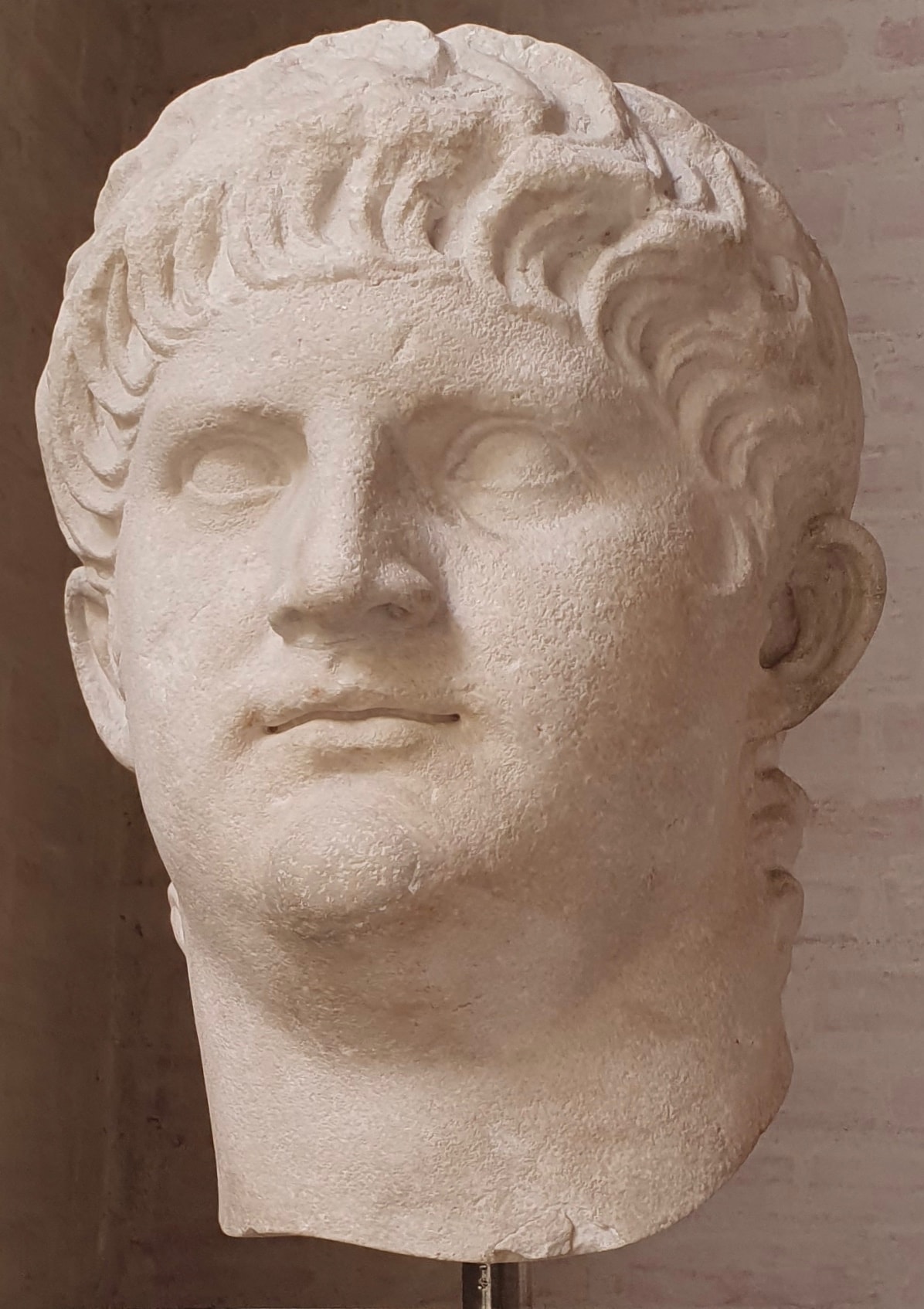
Portrait bust of Nero, Glyptothek, Munich (GL 321). Photo: Yair Haklai, CC BY-SA 4.0, via Wikimedia Commons, resized.

See this page's graph and discover linked topics
In full
Nero was born Lucius Domitius Ahenobarbus on 15 December AD 37, the son of Gnaeus Domitius Ahenobarbus and Agrippina the Younger, a great-granddaughter of Augustus. When his mother married the emperor Claudius, Claudius adopted him, and he took the name Nero Claudius Caesar. He succeeded Claudius in October 54 at the age of sixteen.
- The early reign. His first years, guided by the philosopher Seneca (brother of Gallio, the proconsul of Acts 18:12-17) and the prefect Burrus, were remembered as good government.
- The later reign. He had his mother Agrippina killed in 59 and his wife Octavia in 62. After Burrus died and Seneca withdrew in 62, his rule grew more erratic and violent.
- The fire of AD 64. A fire that began in July 64 destroyed much of Rome. Rumor blamed Nero, who used the burned land for his lavish Golden House.
- The persecution. Tacitus reports that to end the rumor Nero fastened the guilt on the people called Christians, hated for their "abominations," and put them to death with mockery and torture: some dressed in animal skins and torn by dogs, some crucified, some burned as torches at night in his gardens. Tacitus adds that the cruelty stirred pity, since they seemed to die for one man's savagery and not for the public good (Annals 15.44). Suetonius lists among Nero's acts the punishment of the Christians, "a class of men given to a new and mischievous superstition" (Nero 16.2).
- The Jewish war. In 66 the revolt in Judea began under his rule, and he sent Vespasian to put it down. See Olivet Discourse and AD 70.
- Death. Declared a public enemy by the Senate, he took his own life on 9 June 68. Rumors that he was alive and would return spread for decades; see Nero Redivivus Legend.
In the Bible
Nero is never named in the Bible. He is the reigning "Cæsar" in the last chapters of Acts, and Paul's letters to Rome and from Rome were written in his reign.
- Paul's appeal. Before Festus, Paul says, "Neither against the law of the Jews, nor against the temple, nor against Cæsar, have I sinned at all," and then, "I appeal unto Cæsar." Festus answers, "unto Cæsar shalt thou go" (Acts 25:8-12, ASV).
- Agrippa's verdict. "This man might have been set at liberty, if he had not appealed unto Cæsar" (Acts 26:32, ASV).
- The promise at sea. An angel tells Paul in the storm, "Fear not, Paul; thou must stand before Cæsar" (Acts 27:24, ASV).
- In Rome. Paul tells the Jewish leaders, "I was constrained to appeal unto Cæsar" (Acts 28:19, ASV). Acts ends with Paul under house arrest, preaching for two years (Acts 28:30-31).
- Letters in his reign. Romans 13, with its teaching that "the powers that be are ordained of God," was written about AD 57, early in Nero's reign. If Philippians was written from Rome, the greeting from "they that are of Cæsar's household" (Philippians 4:22, ASV) refers to Nero's household staff.
- Later tradition. The subscription printed at the end of 2 Timothy in the KJV, which is not part of the inspired text, says the letter was written "when Paul was brought before Nero the second time."
- Revelation. Many interpreters hold that the number of the beast, 666 (Revelation 13:18), is the value of "Nero Caesar" written in Hebrew letters (nrwn qsr). This reading is held by preterists and many historical-critical scholars and is debated by futurist and idealist interpreters. See Revelation.
Family and lineage
- Parents: Gnaeus Domitius Ahenobarbus and Agrippina the Younger.
- Adoptive father: the emperor Claudius (Acts 11:28; Acts 18:2).
- Descent: great-great-grandson of Augustus through his mother, and the last emperor of the Julio-Claudian line.
- Wives: Claudia Octavia (daughter of Claudius), Poppaea Sabina, and Statilia Messalina. Josephus says Poppaea favored the Jews and intervened in a dispute under Festus (Antiquities 20.195).
- Children: a daughter, Claudia, by Poppaea, who died in infancy.
Historical and archaeological evidence
| Source | What it says | Date | Where it is now | Grade |
|---|---|---|---|---|
| Coins | Gold, silver and bronze coinage in his name and image across the empire; provincial coins of Judea struck in his name under Felix and Festus | AD 54-68 | museums worldwide; finds at Masada and elsewhere | direct |
| Inscriptions and portraits | Numerous dedications and official inscriptions; marble portraits, many recut or defaced after his memory was condemned | AD 54-68 | Rome, Munich, Paris and elsewhere | direct |
| Tacitus, Annals 13-16 | Full narrative of his reign, including the fire and the Christians (15.44) | early 2nd century | manuscript tradition | strong |
| Suetonius, Nero | Biography; the punishment of Christians (16.2) | early 2nd century | manuscript tradition | strong |
| Cassius Dio 61-63; Josephus, Antiquities 20 and Jewish War 2 | His reign; his appointments in Judea; the beginning of the war | 1st to 3rd centuries | manuscript tradition | strong |
Lawrence Mykytiuk counts Nero among the four emperors of the New Testament confirmed by writings, inscriptions and coins ("New Testament Political Figures Confirmed," Biblical Archaeology Review 43:5, 2017).
Scholarly consensus
- His existence and reign are beyond dispute. No figure in this part of the New Testament is better attested.
- The Christians of AD 64. Tacitus's account is accepted as authentic by nearly all classicists and is one of the earliest non-Christian references to Christ. A few scholars, notably Brent Shaw ("The Myth of the Neronian Persecution," Journal of Roman Studies 105, 2015), have questioned whether Nero really blamed the fire on Christians; most specialists, including Christopher P. Jones in a published reply (New Testament Studies 63, 2017), defend the account. See Historicity of Jesus.
- Peter and Paul. That both apostles died in Rome under Nero is the unanimous early tradition. 1 Clement 5 (c. AD 96) speaks of their martyrdom without naming the emperor; later writers name Nero. Historians generally accept the tradition while noting that the details (Paul beheaded, Peter crucified) come from the second and third centuries.
- 666. The Nero reading of Revelation 13:18 is supported by the textual variant 616, which matches the Latin spelling of the name; Irenaeus knew the variant (Against Heresies 5.30.1). Others reject the identification and read the number symbolically or of a future figure.
Theological significance
- Paul's respect for authority under Nero. Paul taught submission to governing authorities (Romans 13:1-7) and used his rights as a citizen before Nero's court. The same apostle later died under that emperor. Christian ethics has drawn on both facts in thinking about obedience and its limits.
- Witness before kings. The angel's word, "thou must stand before Cæsar" (Acts 27:24), completes the promise that Paul would carry Christ's name "before the Gentiles and kings" (Acts 9:15).
- The first persecution. Nero's persecution is the first state violence against Christians recorded by a Roman historian, and it confirms that by AD 64 Rome held a group large enough to be singled out and known by the name of Christ.
Church Fathers
- Tertullian, Apology 5, as quoted by Eusebius: "Examine your records. There you will find that Nero was the first that persecuted this doctrine."
- Eusebius, Church History 2.25.5: "It is, therefore, recorded that Paul was beheaded in Rome itself, and that Peter likewise was crucified under Nero." He cites Dionysius of Corinth, who wrote that the two apostles "taught together in like manner in Italy, and suffered martyrdom at the same time" (2.25.8).
- Clement of Rome, 1 Clement 5, honors Peter and Paul as martyrs of his own generation, without naming the emperor. See Clement of Rome.
Scholarship
Published academic works this page draws on, each matched to a publisher, index or library catalog record.
- Brent D. Shaw, "The Myth of the Neronian Persecution," Journal of Roman Studies 105 (2015). doi:10.1017/s0075435815000982
See also
- Paul the Apostle, who appealed to Caesar
- Peter the Apostle, martyred in Rome in his reign by early tradition
- Porcius Festus and Antonius Felix, his governors in Judea
- Herod Agrippa II, whose territory he enlarged
- Nero Redivivus Legend, the rumor that he would return
- Revelation, the book whose 666 many link to his name
- Tacitus, the historian of the persecution
- Historical Evidence for the Martyrs, the evidence for the deaths of the apostles
- Church at Rome, the community Nero persecuted
- Romans 13, Paul's teaching on authority, written in Nero's reign
- Biblical Figures Confirmed by Archaeology, Mykytiuk's list of confirmed persons
- People of the Bible, the hub of attested biblical people by book
Common questions this page answers
Q: Is Nero mentioned in the Bible?
Not by name. He is the "Cæsar" to whom Paul appealed in Acts 25:11 and before whom the angel said Paul must stand (Acts 27:24). Many interpreters also connect the number 666 in Revelation 13:18 with his name.
Q: Did Nero persecute Christians?
Yes. The Roman historian Tacitus says that after the fire of AD 64 Nero blamed the Christians and had many killed, some burned as living torches. Suetonius also records that he punished the Christians.
Q: Did Peter and Paul die under Nero?
Early Christian tradition is unanimous that both apostles were martyred in Rome in Nero's reign. Eusebius records that Paul was beheaded and Peter crucified, and Clement of Rome, writing about AD 96, already honors both as martyrs.
Q: Is 666 in Revelation about Nero?
Many scholars think so, because "Nero Caesar" written in Hebrew letters adds up to 666, and a variant reading of 616 matches the Latin spelling. Other interpreters read the number symbolically or as pointing to a future figure. The codex presents these readings without deciding between them.