Person
Necho II
Pharaoh Necho, Pharaoh-necoh, Pharaoh-neco, Neco, Necho, Nekau II, Nekos, Pharaoh Neco IIIntro
Necho II was pharaoh of Egypt from 610 to 595 BC. In 609 BC he marched north through the land of Israel to help the dying Assyrian Empire against Babylon. King Josiah of Judah went out to stop him at Megiddo, and Necho's archers killed him. Necho then took control of Judah: he removed Josiah's son Jehoahaz after three months, put another son, Eliakim, on the throne under the name Jehoiakim, and imposed a heavy tribute.
Four years later, in 605 BC, Nebuchadnezzar of Babylon crushed Necho's army at Carchemish on the Euphrates, an event dated in Jeremiah 46:2 and recorded in the Babylonian Chronicle.
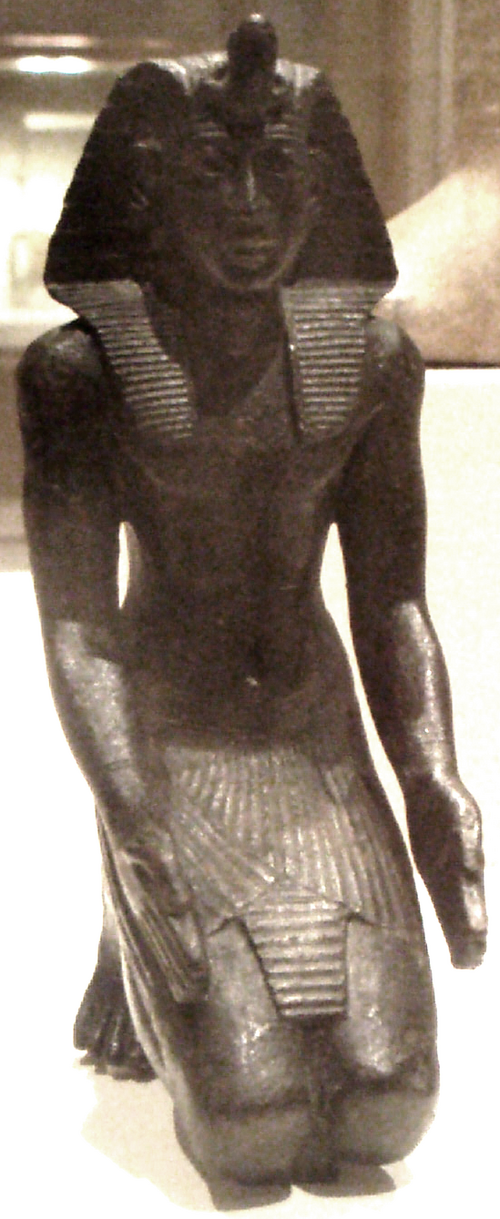 Kneeling bronze statuette of Necho II, Twenty-sixth Dynasty, 610-595 BC, Brooklyn Museum. Photo: Keith Schengili-Roberts, CC BY 2.5, via Wikimedia Commons, resized.

The 30-second version:
Necho II ruled Egypt from 610 to 595 BC. The Bible says he killed King Josiah at Megiddo in 609 BC while marching to the Euphrates, deposed Jehoahaz, made Jehoiakim king, and was defeated by Nebuchadnezzar at Carchemish in 605. The Babylonian Chronicles record Egypt's campaign to aid Assyria at Harran in 609 and the defeat at Carchemish; Herodotus remembers Necho's canal, his fleet, and a victory in Syria; and his name appears on monuments and objects across Egypt.
See this page's graph and discover linked topics
In full
Necho II (Egyptian Nekau) was the son of Psamtik I, founder of the Twenty-sixth Dynasty, which ruled from Sais in the western Delta. Psamtik had been Assyria's ally, and when Nabopolassar of Babylon and the Medes destroyed Nineveh (612 BC) and Harran (610 BC), Necho led a large army north in 609 BC to support the last Assyrian king, Ashur-uballit II, in an attempt to retake Harran. On the way he met and killed Josiah at Megiddo. The Harran campaign failed, but Necho held Syria and Palestine for four years from his base at Riblah and Carchemish. In 605 BC the Babylonian crown prince Nebuchadnezzar destroyed the Egyptian army at Carchemish and pursued it to Hamath, and Egypt lost its Asiatic holdings. Necho repelled a Babylonian invasion of Egypt in 601 BC. At home he began a canal from the Nile to the Red Sea and built a fleet; Herodotus says Phoenician sailors in his service sailed around Africa. He was succeeded by his son Psamtik II.
In the Bible
- 2 Kings 23:29-30. "In his days Pharaoh-necoh king of Egypt went up against the king of Assyria to the river Euphrates: and king Josiah went against him; and Pharaoh-necoh slew him at Megiddo, when he had seen him" (2 Kings 23:29, ASV). The phrase "against the king of Assyria" is usually understood as "to the king of Assyria," that is, to his aid, as the Babylonian Chronicle shows.
- 2 Kings 23:31-35. "Pharaoh-necoh put him in bonds at Riblah in the land of Hamath, that he might not reign in Jerusalem; and put the land to a tribute of a hundred talents of silver, and a talent of gold" (23:33, ASV). He makes Eliakim king, renaming him Jehoiakim, and takes Jehoahaz to Egypt, where he dies.
- 2 Kings 24:7. After Carchemish, "the king of Egypt came not again any more out of his land; for the king of Babylon had taken, from the brook of Egypt unto the river Euphrates, all that pertained to the king of Egypt" (ASV).
- 2 Chronicles 35:20-24. "Neco king of Egypt went up to fight against Carchemish by the Euphrates: and Josiah went out against him" (35:20, ASV). Necho warns Josiah, "God hath commanded me to make haste: forbear thee from meddling with God, who is with me, that he destroy thee not" (35:21, ASV). Josiah disguises himself, "hearkened not unto the words of Neco from the mouth of God" (35:22, ASV), and is mortally wounded by archers.
- 2 Chronicles 36:3-4. The deposition of Jehoahaz and the enthronement of Jehoiakim.
- Jeremiah 46:2. "Concerning the army of Pharaoh-neco king of Egypt, which was by the river Euphrates in Carchemish, which Nebuchadrezzar king of Babylon smote in the fourth year of Jehoiakim" (ASV). Jeremiah 46:3-12 is a poem on the battle.
Family and lineage
- Father: Psamtik I (reigned 664-610 BC), founder of the Twenty-sixth Dynasty.
- Grandfather: Necho I, ruler of Sais, named in the inscriptions of Ashurbanipal as an Assyrian vassal.
- Son and successor: Psamtik II (reigned 595-589 BC).
- Grandson: Apries, the biblical Pharaoh Hophra (Jeremiah 44:30).
Historical and archaeological evidence
| Source | What it says | Date | Where it is now | Grade |
|---|---|---|---|---|
| Babylonian Chronicle for 610-609 BC (BM 21901) | A great Egyptian army crosses the Euphrates in 609 to support Ashur-uballit's attempt to retake Harran | compiled from records; events 609 BC | British Museum | Direct for the campaign; the pharaoh is not named |
| Babylonian Chronicle for 605 BC (BM 21946) | Nebuchadnezzar defeats the Egyptian army at Carchemish and pursues it to Hamath, so that "not a single man escaped to his own country" (paraphrase) | events 605 BC | British Museum | Direct for the battle; matches Jeremiah 46:2 |
| Herodotus, Histories 2.158-159 and 4.42 | Nekos began the Nile-Red Sea canal, built triremes, defeated the "Syrians" at Magdolus, took Kadytis, and sent Phoenicians around Libya (Africa) | 5th century BC | Literary source | Independent, generally reliable for these events |
| Egyptian monuments and objects | His cartouches on stelae (including Apis bull burials in the Serapeum at Saqqara), statues, scarabs and objects; a bronze kneeling statuette of the king offering | 610-595 BC | Louvre, Brooklyn Museum, Metropolitan Museum and other collections | Direct |
| Carchemish excavations | Burned houses of the late 7th century BC containing Egyptian objects inscribed with Saite royal names | excavated 1911-1914 by the British Museum (C. L. Woolley and T. E. Lawrence) | British Museum and site | Direct for the battle setting |
Grade: direct. Lawrence Mykytiuk lists Necho II among his 53 confirmed Hebrew Bible figures. See Biblical Figures Confirmed by Archaeology.
Scholarly consensus
- Why Necho marched north. The Babylonian Chronicle settled an old puzzle. Older translations of 2 Kings 23:29 ("against the king of Assyria") suggested Necho was fighting Assyria; the Chronicle shows Egypt was Assyria's ally in 609, and the Hebrew preposition 'al is now read "to" or "on behalf of." 2 Chronicles 35:20 names his goal as Carchemish.
- Herodotus' Magdolus. Herodotus says Necho defeated the Syrians at Magdolus and took Kadytis. Many historians think Magdolus is a confusion with Megiddo, the site of Josiah's death, and Kadytis is usually identified with Gaza or Kadesh. The passage shows that Greek tradition remembered a Necho victory in the Levant.
- The death of Josiah. Kings gives one sentence ("slew him at Megiddo, when he had seen him"), which some read as an execution at a meeting rather than a battle; Chronicles describes a battle with archers. Many historians accept a battle, as Chronicles describes; others prefer the shorter text's possibility of a summons and execution. Both agree Necho was responsible.
- Chronology. The Babylonian Chronicles fix Harran in 609 and Carchemish in 605, which matches the three-month reign of Jehoahaz and Jeremiah's date of Carchemish in Jehoiakim's fourth year.
Theological significance
- God speaking through a pagan king. 2 Chronicles 35:21-22 says Necho's warning came "from the mouth of God" and that Josiah did not listen. The Chronicler presents even the best of Judah's kings as accountable to recognize God's word, wherever it came from.
- The end of Judah's last reform. Josiah's death ended the reforming reign of a king of whom Kings says "like unto him was there no king before him" (2 Kings 23:25, ASV). Jeremiah lamented him (2 Chronicles 35:25).
- Egypt's failure, Babylon's rise. Carchemish moved the balance of power from Egypt to Babylon. Jeremiah's oracles in chapter 46 interpret the battle as "a day of the Lord, Jehovah of hosts, a day of vengeance" (Jeremiah 46:10, ASV), and the stage is set for the exile under Nebuchadrezzar.
Church Fathers
No verified patristic comment on Necho as a historical figure is cited here.
See also
- People of the Bible, every person in this series grouped by the book of first mention
- Biblical Figures Confirmed by Archaeology, Mykytiuk's list of confirmed persons
- Nebuchadrezzar, who defeated him at Carchemish
- Babylonian Chronicle and the Capture of Jerusalem, the chronicle series that records his campaigns
- Josiah Wrote the Bible Objection Defeater, on the king Necho killed
- Hophra, his grandson Apries, the last pharaoh to intervene for Judah
- Ashurbanipal, whose inscriptions name Necho I, his grandfather
- Taharqa, the Kushite pharaoh driven out by the Assyrians before the Saite dynasty rose
Common questions this page answers
Q: Who killed King Josiah?
Pharaoh Necho II of Egypt, at Megiddo in 609 BC, while marching north to the Euphrates (2 Kings 23:29; 2 Chronicles 35:20-24).
Q: Why was Pharaoh Necho going to the Euphrates?
To help the last Assyrian king, Ashur-uballit II, against Babylon and the Medes. The Babylonian Chronicle records an Egyptian army crossing the Euphrates in 609 BC to attempt the recapture of Harran.
Q: Is Necho II mentioned outside the Bible?
Yes. His name is on Egyptian monuments and objects, Herodotus describes his canal, fleet and Syrian campaign, and the Babylonian Chronicles record the Egyptian campaigns of 609 BC and the defeat at Carchemish in 605 BC.
Q: What happened at the Battle of Carchemish?
In 605 BC the Babylonian crown prince Nebuchadnezzar destroyed Necho's army at Carchemish on the Euphrates and pursued it to Hamath. Egypt lost control of Syria and Palestine, as 2 Kings 24:7 and Jeremiah 46:2 record.
Q: Did God speak through Pharaoh Necho?
2 Chronicles 35:21-22 says Necho warned Josiah that God had commanded him to hurry, and that Josiah ignored "the words of Neco from the mouth of God." The Chronicler presents the warning as a genuine word from God that Josiah should have heeded.