Person
Nebuzaradan
Nebuzaradan the captain of the guard, Nabu-zer-iddin, Nabu-zeru-iddinam, Nabuzeriddinam, Nabu-zer-iddinaIntro
Nebuzaradan was the Babylonian commander who burned the temple of Solomon. A month after Jerusalem's wall was breached in 587/586 BC, he arrived from Nebuchadnezzar's headquarters, set fire to the house of the LORD, the royal palace and every great house in the city, had the walls torn down, and led the survivors into exile. He also carried out Nebuchadnezzar's order to treat the prophet Jeremiah well and set him free.
The Bible calls him "captain of the guard." His Babylonian name was Nabu-zer-iddin, "Nabu has given offspring," and a prism listing Nebuchadnezzar's court officials names him with a title meaning chief of the royal kitchens, one of the highest offices at court.
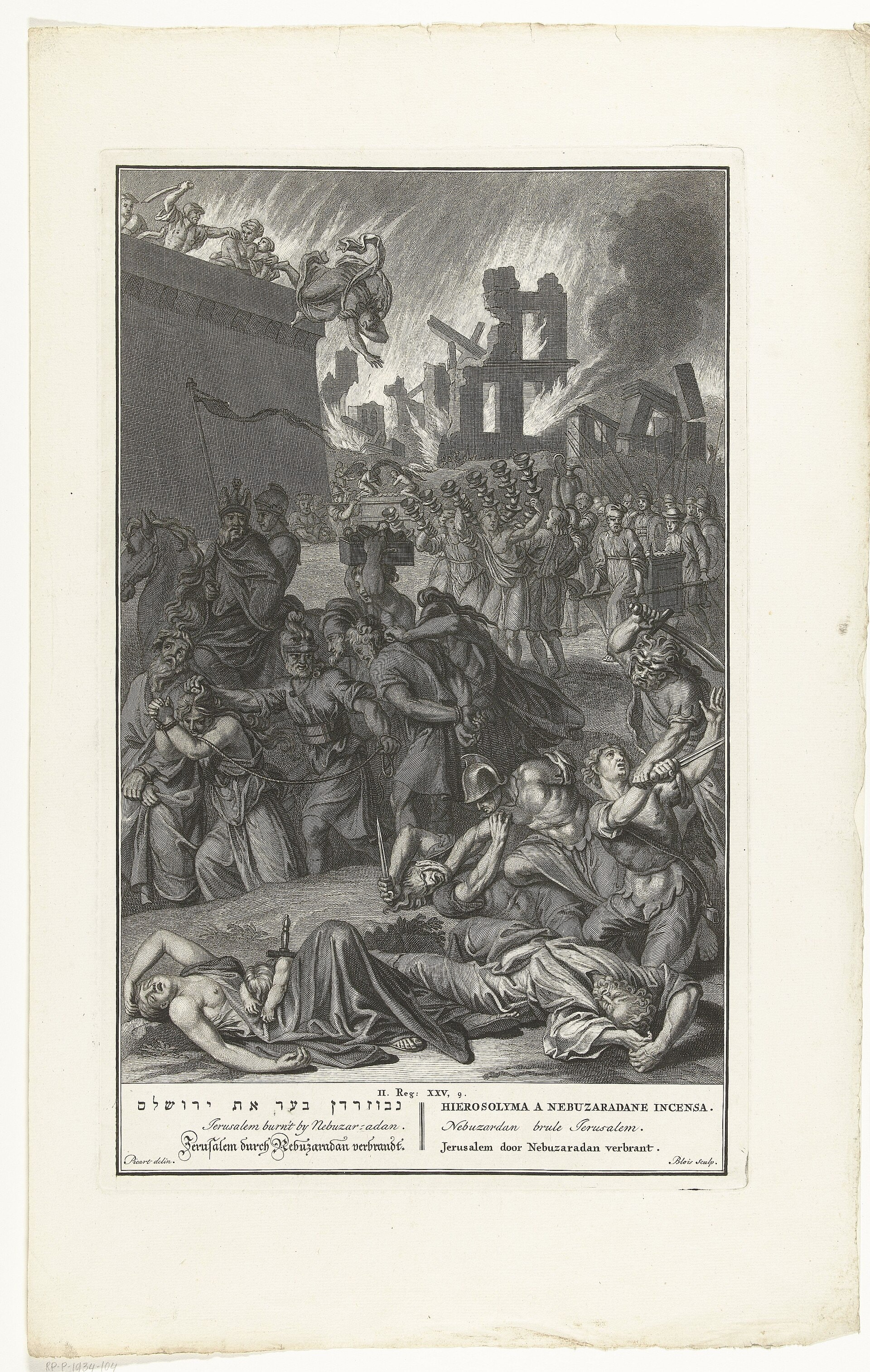
Nebuzaradan takes the gold and silver and sets fire to the temple in Jerusalem; engraving by Abraham de Blois after Bernard Picart, published by Pieter de Hondt, 18th century. Rijksmuseum, Amsterdam. Image: CC0, via Wikimedia Commons, resized.

The 30-second version:
Nebuzaradan, Nebuchadnezzar's "captain of the guard," burned Solomon's temple and Jerusalem in 587/586 BC, broke down the walls, deported the survivors, and freed Jeremiah on the king's orders. He returned five years later to deport 745 more Judeans. Nebuchadnezzar's court prism in Istanbul names Nabu-zer-iddinam, chief of the royal cooks, among the king's highest officials. Lawrence Mykytiuk added him to his list of confirmed Bible people in 2017.
See this page's graph and discover linked topics
In full
Nebuzaradan (Hebrew Nəbûzarʾădān) transcribes Babylonian Nabû-zēr-iddin(am). 2 Kings 25:8-21 and Jeremiah 52:12-30 describe him as rab-ṭabbāḥîm, rendered "captain of the guard" (literally "chief of the cooks" or "chief of the slaughterers," a court title whose exact force in Hebrew is uncertain), who came to Jerusalem in the fifth month of Nebuchadnezzar's nineteenth year, burned the temple, palace and city, demolished the walls, sent the temple bronze to Babylon, deported the population, executed the leading priests and officials at Riblah, and left the poorest as vinedressers. Jeremiah 39-40 reports that he released Jeremiah with Nebuchadnezzar's explicit instruction and committed him and the remnant to Gedaliah son of Ahikam. Jeremiah 52:30 records a further deportation by him of 745 Judeans in Nebuchadnezzar's twenty-third year (582/581 BC). Nebuchadnezzar II's prism EŞ 7834 in the Istanbul Archaeology Museums lists among the court officials Nabû-zēr-iddinam, rab nuḫatimmi, "chief of the cooks/bakers," a title the Encyclopaedia Judaica identifies as the Babylonian equivalent of the Hebrew. Rocío Da Riva's edition (2013) places him in column 3 of the court list. Lawrence Mykytiuk ("Archaeology Confirms 3 More Bible People," BAR 43:3, 2017) counts him as confirmed.
In the Bible
- 2 Kings 25:8-12. "Now in the fifth month, on the seventh day of the month, which was the nineteenth year of king Nebuchadnezzar, king of Babylon, came Nebuzaradan the captain of the guard, a servant of the king of Babylon, unto Jerusalem. And he burnt the house of Jehovah, and the king's house; and all the houses of Jerusalem, even every great house, burnt he with fire" (25:8-9, ASV). Jeremiah 52:12 dates his arrival to the tenth day; the difference is commonly explained as arrival and the start of the burning, or a copying variation.
- 2 Kings 25:18-21; Jeremiah 52:24-27. He takes Seraiah the chief priest, Zephaniah the second priest, the three doorkeepers and other officials to Nebuchadnezzar at Riblah, where they are executed.
- Jeremiah 39:9-14. He deports the people, leaves the poor with vineyards and fields, and under Nebuchadnezzar's order ("Take him, and look well to him, and do him no harm", 39:12, ASV) releases Jeremiah to Gedaliah.
- Jeremiah 40:1-6. He frees Jeremiah from chains at Ramah and, in a remarkable speech, says: "Jehovah thy God pronounced this evil upon this place; and Jehovah hath brought it, and done according as he spake: because ye have sinned against Jehovah" (40:2-3, ASV). He gives the prophet the choice to go to Babylon or stay, with provisions and a gift.
- Jeremiah 41:10 and 43:6. The remnant at Mizpah are those Nebuzaradan had committed to Gedaliah.
- Jeremiah 52:12-30. The parallel account of the destruction, ending with his deportation of 745 people in Nebuchadnezzar's twenty-third year.
Family and lineage
Nothing is recorded of his family. His name means "Nabu has given offspring."
Historical and archaeological evidence
- Nebuchadnezzar II's prism (EŞ 7834). A clay prism from Babylon, in the Istanbul Archaeology Museums, with a list of court and provincial officials after a building account. It names Nabû-zēr-iddinam, the rab nuḫatimmi (chief of the cooks), among the king's court officials, in column 3, line 36 according to Mykytiuk. Rocío Da Riva (2013) dates the text to 598 BC at the latest, eleven or twelve years before the burning of the temple. Older English translation by A. Leo Oppenheim in ANET, p. 307. Grade: very strong; Mykytiuk's confirmed list since 2017.
- The destruction layer. Excavations in the City of David, including the burnt houses of Area G (the House of Ahiel, the Burnt Room and the House of the Bullae) and the Givati Parking Lot, have exposed an extensive burn layer of 586 BC with collapsed buildings and arrowheads, the material record of the burning 2 Kings 25:9 attributes to him. It does not name him. See Azariah son of Hilkiah for the bullae preserved by that fire.
Scholarly consensus
- Identification: very strong. The name, the court rank and the date match, and the Hebrew and Babylonian titles are both culinary in form, a correspondence noted in the Encyclopaedia Judaica's entry on him. Mykytiuk judged the identification secure enough to add to his list.
- The title. Hebrew rab-ṭabbāḥîm is used of Potiphar in Genesis 37:36 and is translated "captain of the guard" in both places. Whether it denotes cooks, butchers or executioners, it had long since become a title for a senior commander.
- The narrative. Historians across the spectrum accept the outline of 2 Kings 25: a Babylonian destruction of Jerusalem and its temple in 587 or 586 BC, followed by deportations. The precise year (587 or 586) depends on how Judah's regnal years are reckoned.
Theological significance
- The day the temple burned. The seventh to tenth of the fifth month (Av) became Israel's great day of mourning. Jewish tradition fasts on the ninth of Av for the destruction of both the First and Second Temples. Zechariah 7:3-5 already refers to fasting in the fifth month during the exile.
- A pagan confesses the prophet's message. Nebuzaradan's words to Jeremiah in 40:2-3 restate Jeremiah's own preaching: the disaster was the LORD's doing because Judah had sinned. The narrator lets the conqueror explain the theology of the exile.
- Judgment and mercy together. The same commander who burned the temple freed Jeremiah, gave him a gift, and left the poor with fields and vineyards. Jeremiah had promised that those who surrendered would live (Jeremiah 38:2); the account shows both the severity and the limits of the judgment.
See also
- Nebuchadrezzar, the king he served
- Nergal-sharezer and Nebo-Sarsekim, his fellow officers in Jeremiah 39
- Babylonian Chronicle and the Capture of Jerusalem, Babylon's record of the campaigns
- Jeremiah's Seventy Years, the exile he carried out
- Shaphan, whose grandson Gedaliah received Jeremiah and the remnant from him
- Biblical Figures Confirmed by Archaeology, Mykytiuk's list
- People of the Bible, every person on the hub, grouped by book of first mention
Common questions this page answers
Q: Who burned Solomon's temple?
Nebuzaradan, the captain of the guard of Nebuchadnezzar king of Babylon, in the fifth month of Nebuchadnezzar's nineteenth year, 587 or 586 BC (2 Kings 25:8-9; Jeremiah 52:12-13).
Q: Is there archaeological evidence for Nebuzaradan?
Yes. A prism of Nebuchadnezzar II in the Istanbul Archaeology Museums lists his court officials and names Nabu-zer-iddinam, chief of the cooks, a Babylonian court title matching the Hebrew one. Lawrence Mykytiuk added him to his list of confirmed Bible people in 2017.
Q: What does "captain of the guard" mean?
The Hebrew title rab-tabbahim literally means chief of the cooks or slaughterers, the same title given to Potiphar in Genesis. By this period it was the title of a senior court officer and commander, and the Babylonian title on the prism is likewise a kitchen title.
Q: How did Nebuzaradan treat Jeremiah?
On Nebuchadnezzar's orders he released Jeremiah, took off his chains, let him choose between going to Babylon and staying in Judah, and gave him food and a gift (Jeremiah 39:11-14; 40:1-6).