Person
Nebo-Sarsekim
Nebo-sarsekim, Nebusarsekim, Nebo-Sarsechim, Sarsechim, Nabu-sharrussu-ukin, Nabu-sharrussu-ukin the rab sha-reshi, Nebo-Sarsekim the Rab-sarisIntro
Nebo-Sarsekim was one of the senior Babylonian officers who took their seats in Jerusalem's Middle Gate when the city fell in 587/586 BC. Jeremiah names him with his title, Rab-saris, "chief of the courtiers," the head of the king's household officials.
He is a minor name in a list, the kind of detail a later writer would be unlikely to get right. In 2007 the Assyriologist Michael Jursa found a small British Museum receipt, written about eight years before Jerusalem fell, recording gold sent to Marduk's temple in Babylon by Nabu-sharrussu-ukin, "chief of the courtiers." Jursa argued that this is the same man.
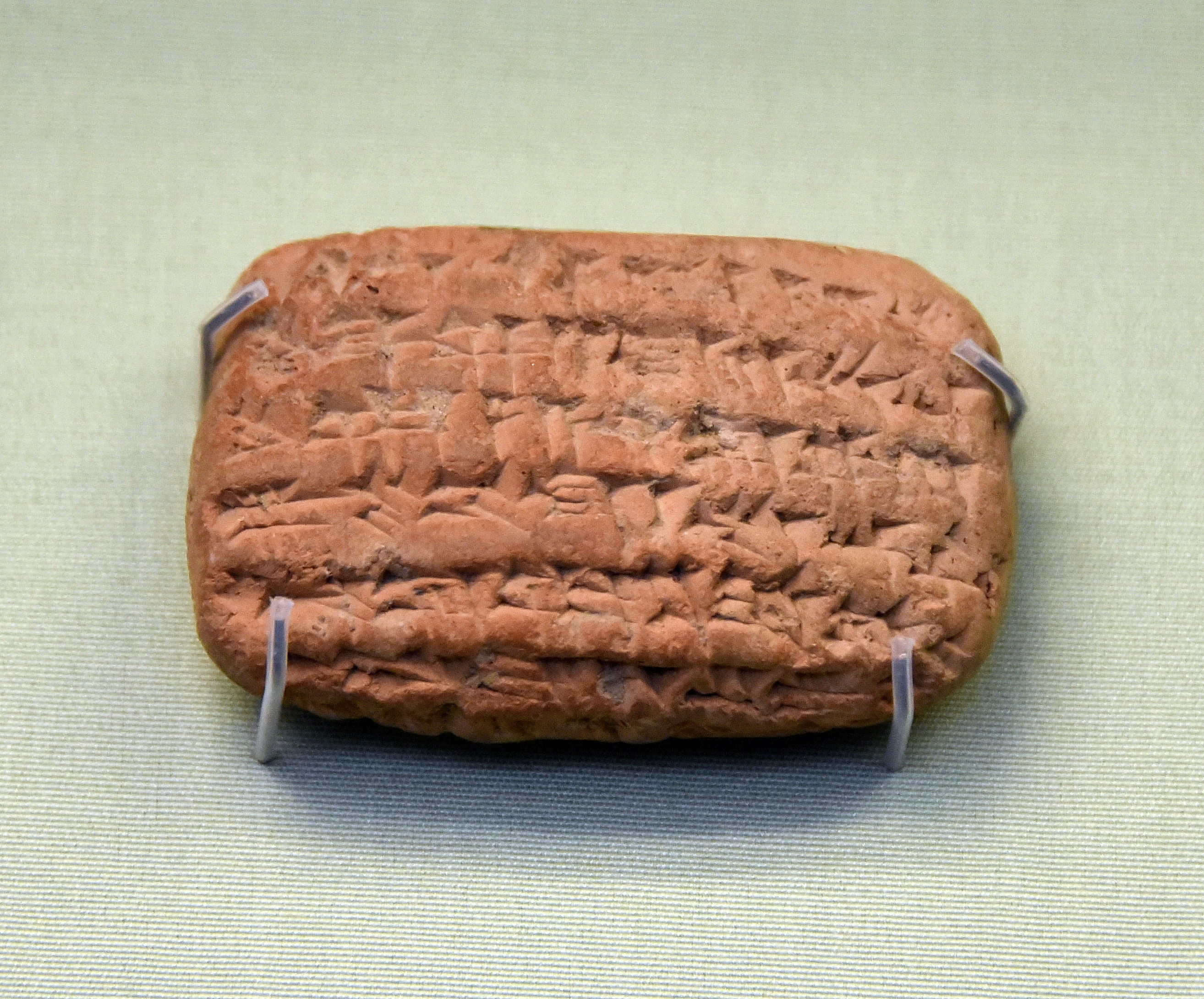
The Nebo-Sarsekim tablet, a Babylonian temple receipt for gold sent by the chief official Nabu-sharrussu-ukin, dated 594 BC, British Museum. Photo: Osama Shukir Muhammed Amin FRCP(Glasg), CC BY-SA 4.0, via Wikimedia Commons, resized.

The 30-second version:
Nebo-Sarsekim, the Rab-saris, was one of Nebuchadnezzar's top officials, seated in Jerusalem's Middle Gate when the city fell (Jeremiah 39:3). A British Museum tablet dated 595/594 BC names Nabu-sharrussu-ukin, the rab sha-reshi or chief of the courtiers, sending gold to Babylon's chief temple. The name and title match, and only one man held that office at a time. The match depends on one reading of the Hebrew, so it is a strong identification rather than a certainty.
See this page's graph and discover linked topics
In full
Jeremiah 39:3 lists the Babylonian commanders who entered Jerusalem after the wall was breached. The traditional division of the Hebrew, followed by the ASV, reads "Nergal-sharezer, Samgar-nebo, Sarsechim, Rab-saris, Nergal-sharezer, Rab-mag." Most modern scholars re-divide the words so that Samgar is the Babylonian title simmagir attached to the first Nergal-sharezer, and Nebo-sarsekim is one name followed by the title Rab-saris, Babylonian rab ša-rēši, "chief of the courtiers." Michael Jursa's 2007 reading of British Museum tablet BM 114789, a temple receipt from the Ebabbar archive of Sippar dated 18 Shabatu, year 10 of Nebuchadnezzar (February 594 BC), records 1.5 minas of gold belonging to Nabû-šarrussu-ukīn, rab ša-rēši, delivered to Esangila in Babylon. Jursa identified the two on three grounds: the office was held by one man at a time, the name is rare, and the dates are close; he explained the Hebrew spelling nbwsrskym as a scribal change from nbw-srs-kyn. Bob Becking (2009), with an appendix by Henry Stadhouders, re-examined the tablet and urged that the identity remain open to scholarly debate. Lawrence Mykytiuk counts him among the 53 Hebrew Bible persons confirmed by archaeology.
In the Bible
- Jeremiah 39:3. "that all the princes of the king of Babylon came in, and sat in the middle gate, to wit, Nergal-sharezer, Samgar-nebo, Sarsechim, Rab-saris, Nergal-sharezer, Rab-mag, with all the rest of the princes of the king of Babylon" (ASV). Read with the modern word division, the officers are Nergal-sharezer the Simmagir, Nebo-sarsekim the Rab-saris, and Nergal-sharezer the Rab-mag.
- Jeremiah 39:13. Ten verses later a Rab-saris named Nebushazban is sent with Nebuzaradan to release Jeremiah. Whether this is a second holder of the office, a different reading of the same name, or a separate commission is unresolved.
- The title elsewhere. A Rab-saris also appears among Sennacherib's envoys to Hezekiah (2 Kings 18:17), the Assyrian counterpart of the same office.
Family and lineage
Nothing is recorded of his family. His Babylonian name, Nabû-šarrussu-ukīn, means "Nabu, establish his kingship."
Historical and archaeological evidence
- The Nebo-Sarsekim Tablet (BM 114789). A small clay receipt registered in the British Museum in 1920 and read by Michael Jursa in 2007, published in NABU 2008 no. 5. It records 1.5 minas of gold belonging to Nabû-šarrussu-ukīn, rab ša-rēši, delivered to the Esangila temple by the courtier Arad-Banitu before two witnesses. Dated 594 BC (Mykytiuk gives 595). Now in the British Museum, London. Grade: strong. Full treatment at Nebo-Sarsekim Tablet.
- A namesake. A courtier of the same name with the lower title ša rēš šarri appears in a document from the reign of Amel-Marduk (561 BC). Jursa held that he is a different man; Stadhouders thought he might be the same man later in his career. Either way the name was not unique.
Scholarly consensus
- Strong, widely accepted, not unanimous. Jursa regarded the identification as certain, and the British Museum's catalogue presents the two as the same person. Becking and Stadhouders (2009) treated it as plausible but still debatable, noting that it depends on re-dividing and emending the Hebrew text.
- The re-division of Jeremiah 39:3. The reading of Samgar as the title simmagir is supported independently by Nebuchadnezzar's court prism, which names Nergal-šarru-uṣur the simmagir (see Nergal-sharezer). That makes the modern division of the verse, on which the Nebo-Sarsekim identification rests, the majority view.
- What the tablet does not show. It does not mention Jerusalem, and it does not prove he still held office eight years later at the fall of the city.
Theological significance
- Accurate memory of the conquerors. Jeremiah's list names three Babylonian officers with correct names and correct Babylonian titles. Two of them now have cuneiform matches. The narrative of Jerusalem's fall reads as the testimony of people who were there.
- Judgment carried out by real men. At his call Jeremiah was told that the kingdoms of the north would come and set their thrones at the entrance of Jerusalem's gates (Jeremiah 1:15). The officers of 39:3 are the fulfillment, named one by one.
See also
- Nebo-Sarsekim Tablet, the full artifact treatment
- Nergal-sharezer and Nebuzaradan, his fellow officers in Jeremiah 39
- Nebuchadrezzar, the king he served
- Babylonian Chronicle and the Capture of Jerusalem, Babylon's record of the campaigns
- Biblical Figures Confirmed by Archaeology, Mykytiuk's list
- People of the Bible, every person on the hub, grouped by book of first mention
Common questions this page answers
Q: Who was Nebo-Sarsekim in the Bible?
He was a senior Babylonian official, the Rab-saris or chief of the courtiers, who sat in Jerusalem's Middle Gate with the other commanders when the city fell in 587/586 BC (Jeremiah 39:3).
Q: What is the Nebo-Sarsekim tablet?
It is a small Babylonian receipt in the British Museum, dated 594 BC, recording gold sent to Marduk's temple in Babylon by Nabu-sharrussu-ukin, chief of the courtiers. Michael Jursa identified him in 2007 with the Nebo-Sarsekim of Jeremiah 39:3.
Q: Is the identification of Nebo-Sarsekim certain?
It is strong but not certain. The name, the title and the date fit, and only one man held the office at a time. But the match requires re-dividing the Hebrew words of Jeremiah 39:3 and a small correction to the spelling, and some scholars ask that the question stay open.
Q: Why does the KJV or ASV say Sarsechim instead of Nebo-Sarsekim?
Older translations follow the traditional word division, which reads Samgar-nebo and Sarsechim as two names. Most modern translations read Samgar as a Babylonian title and join Nebo to the following name, giving Nebo-Sarsekim.