Concept
Nazareth Inscription
Nazareth Decree, Diatagma Kaisaros, Edict of Caesar Nazareth, Nazareth tomb robbery inscription, Nazareth Inscription empty tombIntro
In 1878 a marble slab was sent from Nazareth to a collector in Paris. Its Greek text is headed "Edict of Caesar." It orders that graves and tombs must stay undisturbed forever, and it threatens anyone who digs up the dead, moves the bodies elsewhere, or shifts the sealing stones with death.
Because it came from Nazareth and talks about stolen bodies, some writers have suggested it was Rome's reaction to the story that Jesus's disciples stole his body (Matthew 28:11-15). That link has never been shown. The stone does not mention Jesus, nobody knows where it was actually found, and a 2020 scientific study traced its marble to the Greek island of Kos, far from Galilee. It is a real Roman-era law about tomb robbery, and it is useful background. It is not evidence for the empty tomb.
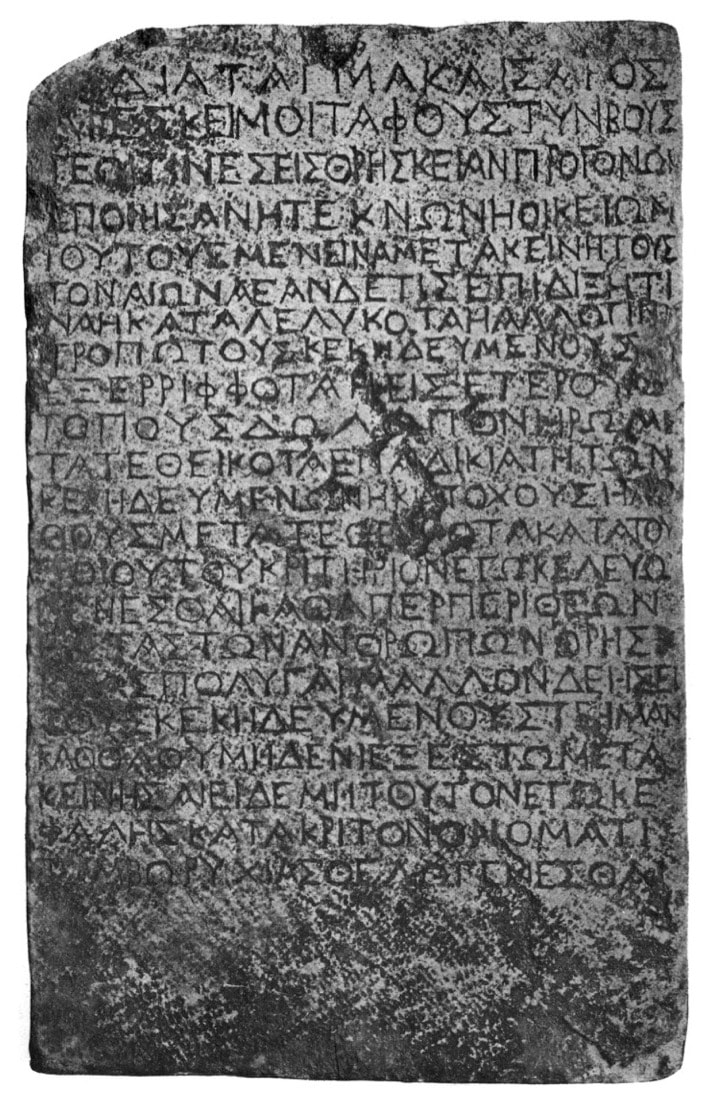
The Nazareth Inscription, marble, probably late 1st century BC or early 1st century AD, Cabinet des Médailles, Bibliothèque nationale de France, Paris. Photograph published by Franz Cumont in 1930. Public domain, via Wikimedia Commons.

See this page's graph and discover linked topics
In full
The Nazareth Inscription is a marble tablet (about 61 by 38 cm) bearing a fourteen-line Greek text headed ΔΙΑΤΑΓΜΑ ΚΑΙΣΑΡΟΣ, "Edict of Caesar." The manuscript inventory of the collector Wilhelm Froehner records it as a "marble slab sent from Nazareth in 1878." It entered the Bibliothèque nationale de France with Froehner's bequest in 1925 and is held in the Cabinet des Médailles. Franz Cumont published it in 1930 (Revue historique 163) after Michael Rostovtzeff drew it to his attention. The text, probably a Greek translation of a Latin original, declares that tombs are to remain undisturbed in perpetuity and prescribes a trial and capital punishment, "under the title of tomb-breaker," for anyone who destroys tombs, removes the buried, transfers them elsewhere with malicious intent, or displaces the sealing stones.
Its letter forms suggest a date in the late first century BC or the first half of the first century AD, and the emperor is unnamed. Proposals have ranged from Augustus to Claudius. In 2020 Kyle Harper, Michael McCormick and colleagues published stable isotope analysis of marble from the back of the slab (Journal of Archaeological Science: Reports 30, article 102228). The carbon and oxygen signature matched the upper quarry on Kos more closely than any other sampled Mediterranean source, and the authors proposed that the edict answered the desecration of the tomb of Nikias, ruler of Kos, around 20 BC. They regard that context as the best explanation, not a proven one. Because the stone's findspot is unknown, Nazareth was only its shipping point, and the text never refers to Jesus, any link to the empty tomb remains unproven and is now generally regarded as unlikely.
Discovery and history
- 1878. The slab was sent from Nazareth to Paris for Wilhelm Froehner, a German-born collector and former Louvre curator. His note says it was sent from Nazareth, not found there. Nazareth was a regional antiquities market.
- 1925. Froehner's collection passed to the Bibliothèque nationale.
- 1930. Franz Cumont published the text and photograph in Revue historique, and the inscription quickly became a talking point because of the resurrection question.
- 2020. The isotope study by Harper, McCormick and colleagues pointed to Kos as the source of the marble.
The text
The edict, in summary:
- Graves and tombs made for ancestors, children or household members are to remain undisturbed forever.
- Anyone shown to have destroyed them, removed the buried, moved them elsewhere with wicked intent, or displaced the sealing stones is to be tried.
- Honoring the dead is to be more binding than before, and no one is to disturb them at all.
- Violators are to be sentenced to death on the charge of tomb violation.
Roman law already treated violatio sepulchri as a serious offense, often punished by fines. The capital penalty is what makes the edict unusual.
Why some linked it to Jesus
- The provenance. "Sent from Nazareth" invited a Galilean connection.
- The subject. Removing bodies and moving sealing stones sounds like the rumor in Matthew 28:13: "Say ye, His disciples came by night, and stole him away while we slept" (ASV).
- The penalty. A death sentence for tomb robbery seemed to some to suggest an extraordinary provocation. Michael Green, among others, proposed that garbled news of the empty tomb reached Rome and prompted a decree, perhaps under Claudius.
Why the link is unproven
- No mention of Jesus, of Christians, of Jews, or of any event.
- Unknown findspot. The stone may never have stood in Nazareth.
- Galilee was not under direct Roman rule until after AD 44 (after the death of Agrippa I), so an imperial edict posted there earlier is unlikely. If it dates before that, it was likely set up elsewhere.
- The marble points to Kos. If the 2020 analysis holds, the slab was quarried in the Aegean, which fits a Greek-island context like the Nikias affair rather than Galilee. Critics note that isotopes identify the stone, not where it was inscribed or displayed.
- Dating does not fit well. Letter forms favor a date around the turn of the era, before the resurrection was being proclaimed. A date under Claudius is possible but is not what the lettering most suggests.
What it does show
- Tomb violation was a recognized crime in the Roman world, sometimes severely punished. That background fits the Gospels' report of an official story about a stolen body (Matthew 28:11-15): the accusation was a serious one.
- Sealed tombs with closing stones are presupposed by the decree, as in the burial accounts of Jesus.
How to use it in debate
- Do not lead with it. Presenting it as Rome's reaction to the resurrection hands a prepared skeptic an easy win.
- Use it as background, if at all, for how seriously grave robbery was taken.
- For the empty tomb, rest on the stronger case: the early burial tradition, the women witnesses, and the Jewish counter-claim of theft, which itself concedes the tomb was empty. See Stolen Body Hypothesis Defeater.
Biblical references
- Matthew 28:11-15, the guards bribed to say the disciples stole the body. "So they took the money, and did as they were taught: and this saying was spread abroad among the Jews, and continueth until this day" (Matthew 28:15, ASV).
- Matthew 27:62-66, the sealing of the tomb.
Evidential status
Genuine inscription, contested relevance. The tablet is authentic and the text is clear. Its connection to Jesus is speculative, and since 2020 the weight of evidence runs against it. The New Testament Archaeology Evidence Catalog grades it C, contextual only.
Scholarship
Published academic works this page draws on, each matched to a publisher, index or library catalog record.
- F. De Zulueta, "Violation of Sepulture in Palestine at the Beginning of the Christian Era," Journal of Roman Studies 22 (1932). doi:10.2307/296822
See also
- Stolen Body Hypothesis Defeater, the stronger response to the theft theory
- Jesus Was Not Buried in a Tomb Objection Defeater, on Jesus's burial
- Golgotha and the Tomb of Jesus, the site question
- Resurrection of Jesus, the doctrine and the historical case
- Caiaphas Ossuary, first-century Jewish burial practice in Jerusalem
- New Testament Archaeology Evidence Catalog, the graded catalog
Common questions this page answers
Q: What is the Nazareth Inscription?
It is a Greek marble tablet headed "Edict of Caesar" that forbids disturbing tombs and orders the death penalty for anyone who removes bodies or moves sealing stones. It was sent from Nazareth to Paris in 1878 and is now in the Cabinet des Médailles of the Bibliothèque nationale de France.
Q: Is the Nazareth Inscription evidence for the empty tomb of Jesus?
No, not on current evidence. The inscription never mentions Jesus, its original findspot is unknown, and a 2020 isotope study traced its marble to the Greek island of Kos. It shows that tomb robbery was a serious crime, which is useful background, but any direct connection to the resurrection is unproven.
Q: What did the 2020 study of the Nazareth Inscription find?
Kyle Harper, Michael McCormick and colleagues analyzed the carbon and oxygen isotopes of the marble and found the best match with a quarry on Kos. They proposed that the edict responded to the desecration of the tomb of Nikias, a ruler of Kos, around 20 BC. The authors call this the best explanation, not a certainty.
Q: When was the Nazareth Inscription written?
The letter forms suggest the late first century BC or the first half of the first century AD. The emperor is not named, and proposals have ranged from Augustus to Claudius.
Q: Was the Nazareth Inscription found in Nazareth?
Not necessarily. The collector's note says the slab was sent from Nazareth in 1878. Nazareth was a trading point for antiquities, so the stone may have come from elsewhere.