Argument
Naturalistic Atheism Cannot Ground Critical Thinking
Atheism Cannot Ground Critical Thinking, Atheism and Critical Thinking, Can Atheists Think Critically, Critical Thinking Argument, Naturalism Cannot Ground Reason, Atheism Undermines Critical ThinkingIntro
Atheists think critically every day. Many are careful, sharp and fair-minded. This argument does not say otherwise. It asks a different question: if the universe is only matter in motion, with no mind behind it, why does thinking work at all?
To think critically you have to trust a few things. Your mind has to be aimed at the truth. You have to be moved by reasons, not just pushed by brain chemistry. You have to be free to weigh both sides. You have to be bound by rules such as "follow the evidence." The laws of logic have to hold everywhere. And the future has to be like the past, or no lesson learned from experience would carry over.
A Christian can explain all six: a rational God made a rational world and made people in His image to understand it. A naturalist, someone who holds that nature is all there is, has to explain all six from blind physical processes. This page argues that the naturalist cannot, and that the atheist who reasons well is living on borrowed ground.
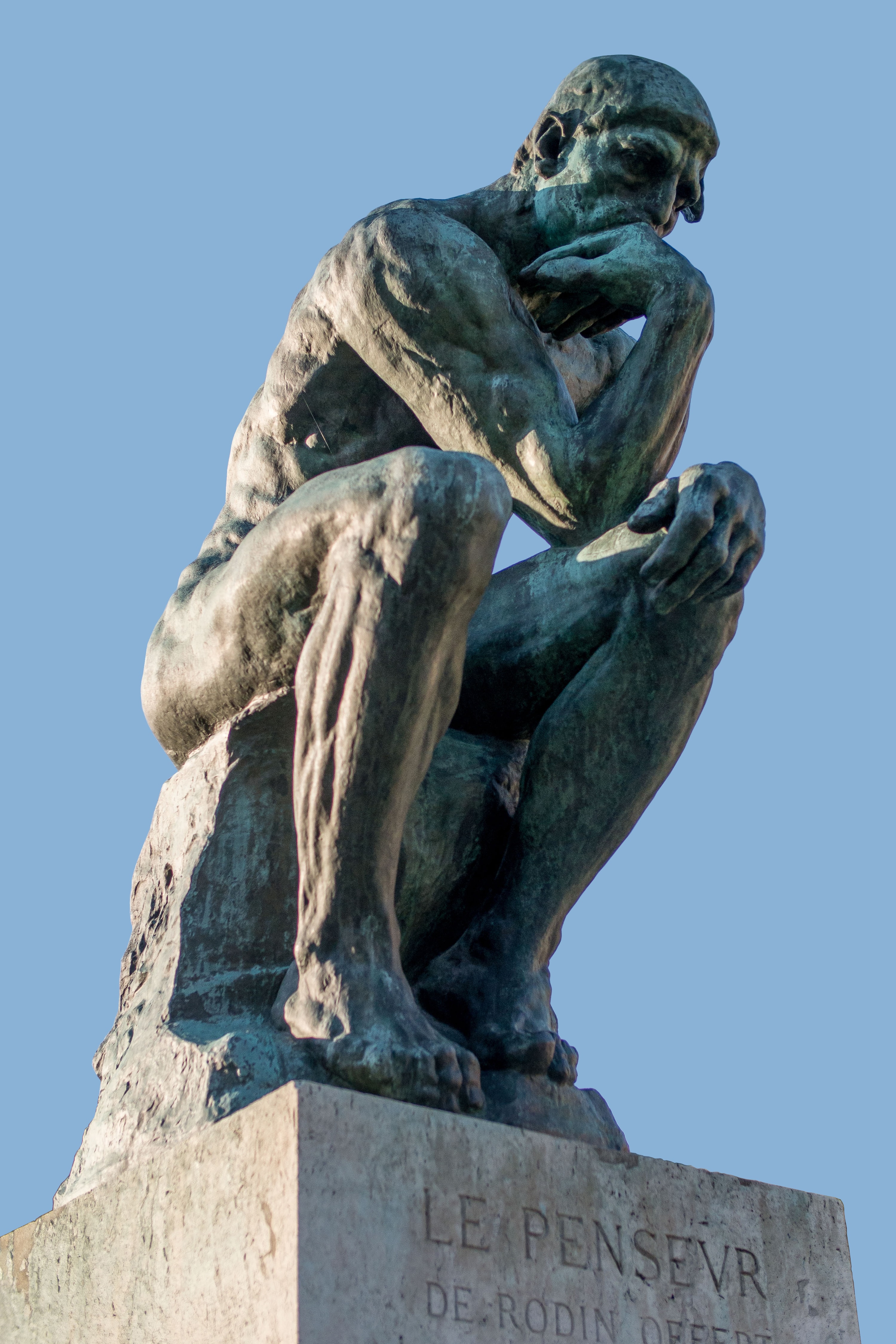
Auguste Rodin, The Thinker, in the garden of the Musée Rodin, Paris. Photo: Thibsweb, 2014, public domain, via Wikimedia Commons.
See this page's graph and discover linked topics
In full
The argument is a cumulative transcendental reductio aimed at metaphysical naturalism, the view that the physical world is all that exists and that every event, including every thought, is fixed by physical causes and laws. It identifies six preconditions of critical thinking:
- Reliability: cognitive faculties that are aimed at truth.
- Rational causation: beliefs formed because of the grounds that support them.
- Deliberation: a thinker able to weigh reasons and be answerable for the verdict.
- Normativity: binding epistemic obligations, such as the duty to proportion belief to evidence.
- Logic: laws that are universal, necessary and abstract.
- Induction: the uniformity of nature that lets past experience inform future judgment.
For each it argues that naturalism either cannot supply the precondition or supplies it only by abandoning naturalism's own commitments. Christian theism supplies all six from one source: a rational, truthful God who is the Logos (John 1:1), who orders creation and makes human beings in His image (Genesis 1:27).
The conclusion is not that atheists cannot reason. It is that naturalistic atheism cannot account for reasoning, so every atheist argument draws on capital that the atheist's worldview does not supply. The argument gathers six arguments that the codex treats in full on their own pages, and it is narrower than its title suggests in one respect: it targets naturalistic atheism. Atheists who reject naturalism (Platonists about logic and number, or Thomas Nagel with his natural teleology) escape some premises but at the cost of granting non-physical realities that sit more easily in a theistic world than a godless one.
The 30-second version:
I'm not saying you can't think. You obviously can. I'm asking what makes thinking trustworthy if you're right about the world. If your brain is only matter shaped by survival, why trust it about truth? If every thought is fixed by chemistry, when are you ever moved by a reason? Where do the laws of logic live, and why must you follow the evidence? I can answer all of that: a rational God made a rational world and rational minds. On your view, every argument you make leans on something your view can't explain.
Cheatsheet
Five fast facts:
- Darwin raised the worry first. In a letter to William Graham (3 July 1881) he described a "horrid doubt" whether convictions of a mind evolved from lower animals can be trusted.
- A leading naturalist put it bluntly. Patricia Churchland (Journal of Philosophy, 1987) wrote that a nervous system exists to help an organism survive and reproduce, and "truth, whatever that is, definitely takes the hindmost."
- Plantinga formalized it. His evolutionary argument against naturalism (1993, 2011) holds that the probability our faculties are reliable, given naturalism and evolution, is low or cannot be known.
- Lewis made the inference point. Miracles (1947, ch. 3): a thought caused wholly by non-rational causes has no claim to be a rational insight.
- An atheist philosopher concedes much of it. Thomas Nagel (Mind and Cosmos, 2012) argues that the materialist neo-Darwinian picture of nature is almost certainly false, partly because it cannot explain reason.
Counter-moves:
- "Atheists think fine" → the question is grounding, not ability.
- "Evolution favors true beliefs" → it favors useful behavior; see P1.
- "Atheism isn't naturalism" → granted; the non-naturalist atheist has already given up the core of the debate.
- "Theism is circular too" → every account of reason uses reason; only one explains why the circle is trustworthy.
Concessions, each with its return:
- Grant that atheists reason well. Collect: then their reasoning is evidence that reason is real and reliable, which is the thing to be explained.
- Grant that evolution shapes the brain. Collect: the question was never whether brains evolved but whether truth-tracking is what blind selection would produce.
- Grant that some atheists are not naturalists. Collect: they believe in necessary, abstract, non-physical truths, which is most of the way to a mind behind the world.
Closing line: "Every time you argue with me, you show that reason works. I have an explanation for that. Do you?"
Argument structure
| # | Premise |
|---|---|
| P1 | Critical thinking requires cognitive faculties aimed at truth, and naturalism gives no good reason to think ours are. |
| P2 | Critical thinking requires beliefs formed because of their grounds, and naturalism makes every belief the product of non-rational physical causes. |
| P3 | Critical thinking requires a thinker who weighs reasons and is answerable for the verdict, and naturalism reduces the thinker to a chain of events. |
| P4 | Critical thinking requires binding epistemic norms, and naturalism can describe how people reason but not why anyone ought to reason well. |
| P5 | Critical thinking requires laws of logic that are universal, necessary and abstract, and naturalism has no place to put them. |
| P6 | Critical thinking requires the uniformity of nature, and naturalism can only assume it. |
| P7 | Christian theism supplies all six from one source, a rational God who made a rational world and rational minds. |
| C | Naturalistic atheism cannot ground critical thinking; the atheist who reasons well is relying on preconditions that theism explains and naturalism does not. |
Form
A cumulative transcendental reductio. Transcendental, because it asks what must be true for critical thinking to be possible at all. Reductio, because it shows that naturalism, taken seriously, undercuts the reasoning used to defend it. Cumulative, because the six premises are independent: the argument does not fail if one is answered, and each has its own full page in the codex. P7 adds an abductive step: among the candidate worldviews, theism best explains why all six hold together.
P1, Critical thinking requires faculties aimed at truth
Affirmative case (second-order arguments)
- Selection rewards behavior, not belief. Natural selection acts on what an organism does. A false belief that produces the right behavior survives as well as a true one. What gets selected is adaptive action, and truth comes along only where it happens to pay.
- Naturalists have said so. Churchland's "four F's" passage (1987) states that the nervous system's job is to get the body where it needs to go for feeding, fleeing, fighting and reproducing, and truth "takes the hindmost."
- Darwin felt the force of it. His 1881 letter to William Graham asked whether anyone would trust the convictions of a monkey's mind.
- Plantinga's defeater. If the probability of reliable faculties, given naturalism and evolution, is low or inscrutable, the naturalist who sees this has a reason to doubt every belief those faculties produce, including naturalism. The full argument is at Argument from the Reliability of Reason, with the game-theory simulations of Donald Hoffman at Fitness Beats Truth Argument.
Anticipated objections
- "True beliefs are generally more useful than false ones, so evolution favors truth."
- "Darwin only doubted abstract metaphysical beliefs, not everyday ones." Amos Wollen (History and Philosophy of the Life Sciences, 2021) argues this from the letter's context.
Rebuttals
- Useful and true come apart wherever truth is costly or irrelevant. For everyday beliefs about food and predators, truth and usefulness may line up. Critical thinking concerns exactly the beliefs where they do not: abstract reasoning, mathematics, philosophy, the origin of the universe, the existence of God. Those beliefs had no survival payoff in the ancestral environment. If selection is the only thing tuning the mind, we have least reason to trust it precisely where critical thinking is needed. The atheist's own conclusion, "there is no God," is one of those beliefs.
- Grant Wollen's reading; the argument survives it. Even if Darwin's doubt reached only abstract beliefs, naturalism and atheism are abstract beliefs. Plantinga's argument does not need Darwin to have held it; it needs only the probability claim.
Live-cite kit
- Scripture: Job 38:36 asks who has put wisdom in the mind; Proverbs 2:6, from the Lord's mouth come knowledge and understanding.
- Scholarly: Alvin Plantinga, Warrant and Proper Function (1993, ch. 12) and Where the Conflict Really Lies (2011, ch. 10); Patricia Churchland, "Epistemology in the Age of Neuroscience" (Journal of Philosophy 84, 1987).
- Aphorism: "Survival needs you to run from the lion. It doesn't need you to be right about the universe."
Tactical notes
- Do not claim evolution makes all beliefs false. The claim is that naturalism gives no assurance of reliability, which is enough to defeat it.
P2, Critical thinking requires beliefs formed because of their grounds
Affirmative case (second-order arguments)
- Reasoning is being moved by a reason. To infer a conclusion is to accept it because the premises support it. The support relation, the fact that one proposition makes another more likely or certain, has to make a difference to what you believe.
- On naturalism the brain state comes first. Every belief is a brain state, and every brain state has a sufficient physical cause. Logical support is not a physical force. It is hard to see how it can do any causal work at all.
- Haldane stated it in 1927. If mental processes are determined wholly by the motions of atoms in the brain, he wrote in Possible Worlds, there is no reason to suppose our beliefs are true, and so no reason to suppose the brain is made of atoms.
- Lewis developed it. Miracles (1947, ch. 3) argues that knowledge requires a thought to be determined by what is known, and that a wholly naturalistic chain of cause and effect leaves no room for that. The full argument is at Argument from Reason, developed by Victor Reppert.
Anticipated objections
- "Brains are computers. Computers follow logic, and they are purely physical."
- "Haldane withdrew the argument himself in 1954."
Rebuttals
- The computer borrows its logic from a mind. A computer's states track logical rules because engineers built the hardware and wrote the software to make them do so. The logic is in the design, and the design came from minds. The analogy assumes what naturalism must explain: physical states lined up with rational relations. The naturalist says selection did the designing, which returns the argument to P1.
- Haldane changed his mind; the argument did not change. Karl Popper, no theist, thought Haldane's original argument was sound and his retraction mistaken (The Self and Its Brain, 1977, with John Eccles). Lewis reworked his own version after Elizabeth Anscombe's 1948 critique, and the 1960 revision is the form defended today.
Live-cite kit
- Scripture: Isaiah 1:18, "Come now, and let us reason together, saith Jehovah" (ASV); God addresses people as reasoners.
- Scholarly: C. S. Lewis, Miracles (1947; rev. 1960), ch. 3; Victor Reppert, C. S. Lewis's Dangerous Idea (2003).
- Aphorism: "A cause can push a belief into your head. Only a reason can make it rational to hold."
Tactical notes
- Ask for the mechanism. "Show me where in the brain the truth of a premise causes anything." Physical causes are well described; the question is where truth enters the chain.
P3, Critical thinking requires a thinker who weighs reasons
Affirmative case (second-order arguments)
- Weighing implies options. To weigh an argument is to hold two verdicts open and judge between them. If the outcome was fixed by prior physical states before you began, the weighing is a description of a process, not something you did.
- Critical thinking is answerable. We blame people for jumping to conclusions and praise them for following evidence. That practice assumes the thinker could have reasoned better. On strict physical determinism, the sloppy thinker and the careful one each did the only thing their brains could do.
- One subject has to hold the premises together. To see that "all men are mortal" and "Socrates is a man" yield "Socrates is mortal," a single thinker has to grasp all three at once. A collection of neurons each doing its own work is not obviously that subject. The positive case is at Argument from Free Will and Libertarian Free Will.
Anticipated objections
- "Compatibilism: you are free when you act on your own reasons, even if those reasons were determined."
Rebuttals
- Compatibilism helps only if the reasons are doing the work. A compatibilist says a choice is free when it flows from the agent's reasons. That is exactly the point P2 disputes: on naturalism, what the "reasons" are is a set of brain states whose causal power owes nothing to their being good reasons. Compatibilism inherits P2's problem rather than solving it. Christian thinkers are themselves divided on compatibilism (see Compatibilism); the argument here needs only that the thinker be moved by grounds, which theism secures on either view.
Live-cite kit
- Scripture: 1 Thessalonians 5:21, "prove all things; hold fast that which is good" (ASV); the command assumes the hearer can test and choose.
- Scholarly: William Hasker, The Emergent Self (1999); J. P. Moreland, The Recalcitrant Imago Dei (2009).
- Aphorism: "If your verdict was settled before you looked at the evidence, you didn't weigh it. You watched."
Tactical notes
- Keep the free-will debate from swallowing the conversation. The point is narrow: critical thinking needs a thinker who can be faulted for reasoning badly.
P4, Critical thinking requires binding epistemic norms
Affirmative case (second-order arguments)
- Critical thinking is full of oughts. You ought to follow the evidence. You ought not to believe a contradiction. You ought to hear the other side. These are not descriptions of how people do think; they are standards for how they should.
- Naturalism describes but does not prescribe. Physics and biology tell us what happens. They do not tell us what anyone is obligated to believe. W. V. O. Quine's "naturalized epistemology" (1969) tried to turn epistemology into a branch of psychology, and critics such as Jaegwon Kim (1988) answered that this drops the normative question, which was the point of epistemology. See Naturalized Epistemology.
- The atheist relies on the norm. "There is not enough evidence for God, so you should not believe" is an epistemic ought. If the ought is only a preference, it binds no one. The full argument is at Argument from Epistemic Normativity.
Anticipated objections
- "Epistemic norms are just instrumental: if you want true beliefs, follow the evidence."
Rebuttals
- Then the evidentialist objection loses its force. An instrumental norm binds only those who want what it serves. The believer who says "I don't care about that goal" has broken no rule. The atheist who wants the evidentialist challenge to bind the believer needs a categorical norm, and categorical norms are what naturalism cannot ground.
Live-cite kit
- Scripture: Acts 17:11, the Bereans examined the Scriptures daily to see whether these things were so, and Luke counts it to their credit.
- Scholarly: W. K. Clifford, The Ethics of Belief (1877); Jaegwon Kim, "What Is 'Naturalized Epistemology'?" (Philosophical Perspectives 2, 1988).
- Aphorism: "'You should follow the evidence' is a moral claim about the mind. Where does your worldview keep its oughts?"
Tactical notes
- Use the atheist's own challenge. "You told me I ought to believe only what the evidence supports. I agree. Now tell me what makes that ought binding on me."
P5, Critical thinking requires laws of logic
Affirmative case (second-order arguments)
- Logic is universal. The law of non-contradiction holds in every place and every time. It is not true in one galaxy and false in another.
- Logic is necessary. It could not have been otherwise. No physical law has that status; physical laws describe how things happen to behave.
- Logic is abstract. You cannot weigh, locate or measure the law of non-contradiction. It is about propositions, which are not physical objects.
- A world of matter alone has no home for it. If only physical things exist, it is unclear what the laws of logic are. Calling them "descriptions of how brains work" makes them contingent and local, which is what they are not. Theism locates them in the nature of a rational God, whose thought is necessary and everywhere. The full arguments are at Transcendental Argument for God, Syllogisms for Logic Itself and Laws of Logic.
Anticipated objections
- "Logic is just a set of conventions, like grammar."
- "Logic doesn't need a ground; it is a brute necessary truth."
Rebuttals
- Conventions can be changed; logic cannot. We could adopt different grammar tomorrow. We cannot adopt a rule under which a statement and its denial are both true and still say anything. The conventionalist also has to use logic to argue for conventionalism.
- Brute necessity is a concession. A naturalist who says logic is an uncaused, necessary, non-physical reality has given up naturalism's claim that the physical is all there is. The question becomes which account of necessary non-physical reality explains it better: impersonal abstract objects, or a necessary mind whose thoughts they are.
Live-cite kit
- Scripture: John 1:1, "In the beginning was the Word" (Logos, logos), the reason and speech of God at the root of everything.
- Scholarly: Greg Bahnsen, Always Ready (1996); James N. Anderson and Greg Welty, "The Lord of Non-Contradiction" (Philosophia Christi 13, 2011).
- Aphorism: "Show me the law of non-contradiction under a microscope."
Tactical notes
- The goal is location, not existence. Everyone uses logic. Ask the naturalist where it lives on their map of reality.
P6, Critical thinking requires the uniformity of nature
Affirmative case (second-order arguments)
- Learning from experience assumes the future will resemble the past. Every scientific generalization does.
- Hume showed the assumption cannot be proved from experience. Any argument that nature is uniform because it has been uniform so far assumes the very uniformity it is trying to prove (An Enquiry Concerning Human Understanding, 1748, sec. 4). See David Hume.
- Theism gives a reason to expect it. A faithful God who upholds creation by His word (Hebrews 1:3) and promises that seedtime and harvest will not cease (Genesis 8:22) gives a ground for expecting order. Historians of science such as Peter Harrison (The Fall of Man and the Birth of Modern Science, 2007) trace the confidence of early modern science partly to this belief.
Anticipated objections
- "Induction works; that is justification enough."
Rebuttals
- "It has worked" is the inductive argument Hume rejected. That induction has worked is a fact about the past. Using it to trust induction in the future is circular. The theist also uses induction, but has an independent reason, God's faithfulness, to expect it to keep working.
Live-cite kit
- Scripture: Jeremiah 33:25-26, God appeals to His fixed ordinances of heaven and earth as a pledge of His faithfulness.
- Scholarly: David Hume, An Enquiry Concerning Human Understanding (1748), sec. 4; Peter Harrison, The Fall of Man and the Birth of Modern Science (2007).
- Aphorism: "You expect the sun to rise tomorrow. So do I. I can tell you why."
Tactical notes
- Don't overclaim. Theism does not prove induction from nothing; it makes uniformity expected rather than lucky.
P7, Christian theism supplies all six from one source
Affirmative case (second-order arguments)
- One explanation covers six facts. A rational God (logic), who is faithful (uniformity), who makes human beings in His image (Imago Dei) with faculties designed for truth (reliability), as persons who can deliberate (agency) and who answer to Him (norms), and who are moved by the truth He made them to know (rational causation).
- It is the historical root of the practice. Universities, the scientific method and the ideal of following the truth wherever it leads grew up in Christian Europe among people who believed the world was made by reason to be understood by reason.
- The fit is not ad hoc. These features are what theism would lead us to expect before we look. Naturalism has to add each one as a separate brute fact or deny it.
Anticipated objections
- "Why trust a God-designed mind? God could deceive you. Theism is circular too."
- "Christian history has plenty of bad thinking: Galileo, witch trials."
Rebuttals
- Every account of reason uses reason; only one explains the circle. No one can validate reason without using it. William Alston called this epistemic circularity and argued it is unavoidable. The question is whose circle is self-supporting and whose undermines itself. On theism, a God who is truthful (Titus 1:2) designed the faculties, so trusting them is consistent with the worldview. On naturalism, the worldview itself gives a reason to doubt them.
- Misuse of reason is not a failure to ground it. The argument is about what makes critical thinking possible, not about which group has used it best. Christians and atheists both reason badly at times. The question is whose worldview explains why reasoning well is possible and binding.
Live-cite kit
- Scripture: Colossians 2:3, in Christ are hidden all the treasures of wisdom and knowledge; Romans 1:21-22, "Professing themselves to be wise, they became fools" (ASV).
- Scholarly: Alvin Plantinga, Where the Conflict Really Lies (2011); William Alston, The Reliability of Sense Perception (1993).
- Aphorism: "Reason is at home in a universe that began with reason. In a universe that began without it, reason is a stranger with no papers."
Tactical notes
- End on the positive case. The point is not only that naturalism fails but that theism succeeds, and the Stealing from God Argument gives a memorable way to frame it.
Conclusion
Naturalistic atheism cannot ground critical thinking. Critical thinking needs faculties aimed at truth, beliefs moved by their grounds, a thinker who weighs reasons, binding norms, universal logic and a uniform nature. Naturalism cannot supply the first four without help, and it can only assume the last two. Christian theism supplies all six from a single source. The atheist who thinks carefully is not a counterexample; that atheist is the evidence. Reason works, and it works the way it would if a rational God had made it.
Master objections to the argument as a whole
- "This is an insult: you're saying atheists are irrational." Reply: the argument says the opposite. Atheists reason well, and that is the datum. The question is whether their worldview can explain it. Respect for the person is compatible with a strong critique of the position (see Performative Self-Refutation of Atheist Denial).
- "Atheism is just lack of belief in God; it has no positive commitments." Reply: the argument targets naturalism, the positive worldview most atheists hold. An atheist who holds no view at all about what exists has no account of reason either, which concedes the point. See Mere Lack of Belief Defense Defeater.
- "Science is the proof that naturalism works." Reply: science presupposes P1, P5 and P6. It cannot be the evidence for the worldview that fails to ground its own preconditions. See Methodological Naturalism Critique.
- "God of the gaps: you're plugging holes in current knowledge." Reply: these are not gaps that future neuroscience could fill. They are questions about what reasoning is, which further data about brains cannot settle, because interpreting that data already uses reasoning.
Tactical opening / closing
Opening line: "I'm not going to tell you that you can't think. I'm going to ask why you can, and whether your view of the world can answer that."
Closing landing strip: "You've used logic, evidence, the duty to follow the truth, and the expectation that tomorrow's world works like today's. Every one of those is something I expect if God made the world and made us to know it. On your view, each is a brute fact or a lucky accident. I'd rather stand on ground that explains the tools we're both using."
Patristic and scholarly note
- Augustine (On Free Choice of the Will, book 2) argued that unchangeable truths of number and wisdom, which every mind can see but none can change, point to a truth above the mind, which is God.
- C. S. Lewis (Miracles, 1947; rev. 1960) gave the modern argument from reason its popular form; see C.S. Lewis.
- Alvin Plantinga gave it its rigorous probabilistic form; see Alvin Plantinga.
- Greg Bahnsen pressed the transcendental form in debate with Gordon Stein (1985); see Greg Bahnsen.
- Thomas Nagel, an atheist, granted much of the critique of materialism while proposing a non-theistic natural teleology instead; see Thomas Nagel.
Scholarship
Published academic works this page draws on, each matched to a publisher, index or library catalog record.
- William P. Alston, The Reliability of Sense Perception (Cornell University Press, 1993). Open Library
- Greg L. Bahnsen, Always Ready (1996). Open Library
- Patricia Smith Churchland and Journal of Philosophy Inc, "Epistemology in the Age of Neuroscience," Journal of Philosophy 84 (1987). doi:10.5840/jphil1987841026
- J. B. S. Haldane, Possible worlds and other essays (Chatto and Windus, 1927). Open Library
- William Hasker, The emergent self (1999). Open Library
- Jaegwon Kim, "What Is 'Naturalized Epistemology?'," Philosophical Perspectives 2 (1988). doi:10.2307/2214082
- C. S. Lewis, Miracles A Preliminary Study (1947). Open Library
- James Porter Moreland, The recalcitrant Imago Dei (2009). Open Library
- Thomas Nagel, Mind and Cosmos: Why the Materialist Neo-Darwinian Conception of Nature is Almost Certainly False (Oxford University Press, 2012). doi:10.1093/acprof:oso/9780199919758.001.0001
- Alvin Plantinga, Warrant and Proper Function (Oxford University Press, 1993). doi:10.1093/0195078640.001.0001
- Alvin Plantinga, Where the Conflict Really Lies (2011). Open Library
- Karl R. Popper and John C. Eccles, The Self and Its Brain (Springer Berlin Heidelberg, 1977). doi:10.1007/978-3-642-61891-8 open access
- Victor Reppert, C.S. Lewis's dangerous idea (2003). Open Library
- Amos Wollen, "Darwin’s 'horrid' doubt, in context," History and Philosophy of the Life Sciences 43 (2021). doi:10.1007/s40656-021-00378-7 PubMed 33587194
See also
- Argument from Reason, the full case for P2
- Argument from the Reliability of Reason, the full case for P1 (Plantinga's EAAN)
- Fitness Beats Truth Argument, the evolutionary game-theory form of P1
- Argument from Epistemic Normativity, the full case for P4
- Argument from Free Will, the positive case behind P3
- Transcendental Argument for God, the full case for P5 and P6
- Syllogisms for Logic Itself, formal arguments from the nature of logic
- Stealing from God Argument, Turek's popular version of the cumulative case
- Performative Self-Refutation of Atheist Denial, how denying God uses what only theism supplies
- Naturalism, the worldview under examination
- Faith and Reason, the Christian account of how they fit together
- Arguments, the master index
Common questions this page answers
Q: Can atheists think critically?
Yes. Many atheists are careful, rigorous thinkers. The argument on this page is not about ability. It asks whether an atheist worldview that says nature is all there is can explain why human reasoning is trustworthy at all.
Q: Why would atheism undermine reason?
If the mind is only a brain shaped by survival, there is no guarantee it is aimed at truth rather than usefulness, and every thought is caused by chemistry rather than by reasons. Darwin himself voiced this "horrid doubt" in 1881, and Alvin Plantinga and C. S. Lewis developed it into formal arguments.
Q: Doesn't evolution favor true beliefs because they help us survive?
For simple practical beliefs, truth and survival often line up. For abstract beliefs about philosophy, mathematics or the existence of God, they had no survival payoff, so natural selection alone gives no reason to trust the mind there. That is exactly where critical thinking matters most.
Q: Where do the laws of logic come from if there is no God?
Naturalism struggles to say. Logic is universal, necessary and non-physical, while naturalism holds that only physical things exist. Christian theism grounds logic in the nature of a rational God, the Logos of John 1:1.
Q: Isn't trusting a God-designed mind circular too?
Every account of reason uses reason, so some circularity is unavoidable. The difference is that on theism the circle supports itself: a truthful God made the mind for truth. On naturalism the worldview itself gives a reason to doubt the mind that holds it.
Q: Does this argument apply to atheists who are not naturalists?
Only in part. Some atheists accept abstract objects or, like Thomas Nagel, propose that nature has built-in purposes. They avoid some premises but grant non-physical, necessary realities, which concedes much of what the argument is after.