Person
Nabonidus
Nabu-na'id, Nabunaid, Nabonnedus, Labynetus, King Nabonidus, Nabonidus king of BabylonIntro
Nabonidus was the last king of Babylon before it fell to Cyrus the Great of Persia in 539 BC. He came to power in 556 BC after a palace coup and was devoted to the moon god Sin rather than to Marduk, Babylon's chief god, which made him unpopular with Babylon's priests. For about ten years he lived far away at the oasis of Tayma in Arabia and left his son Belshazzar in charge of Babylon.
The Bible never names him, but he stands just behind the story of Daniel 5. Belshazzar, the king at the feast where a hand wrote on the wall, was his son. That is why Belshazzar could offer Daniel only the "third" place in the kingdom: his father was first and he was second.
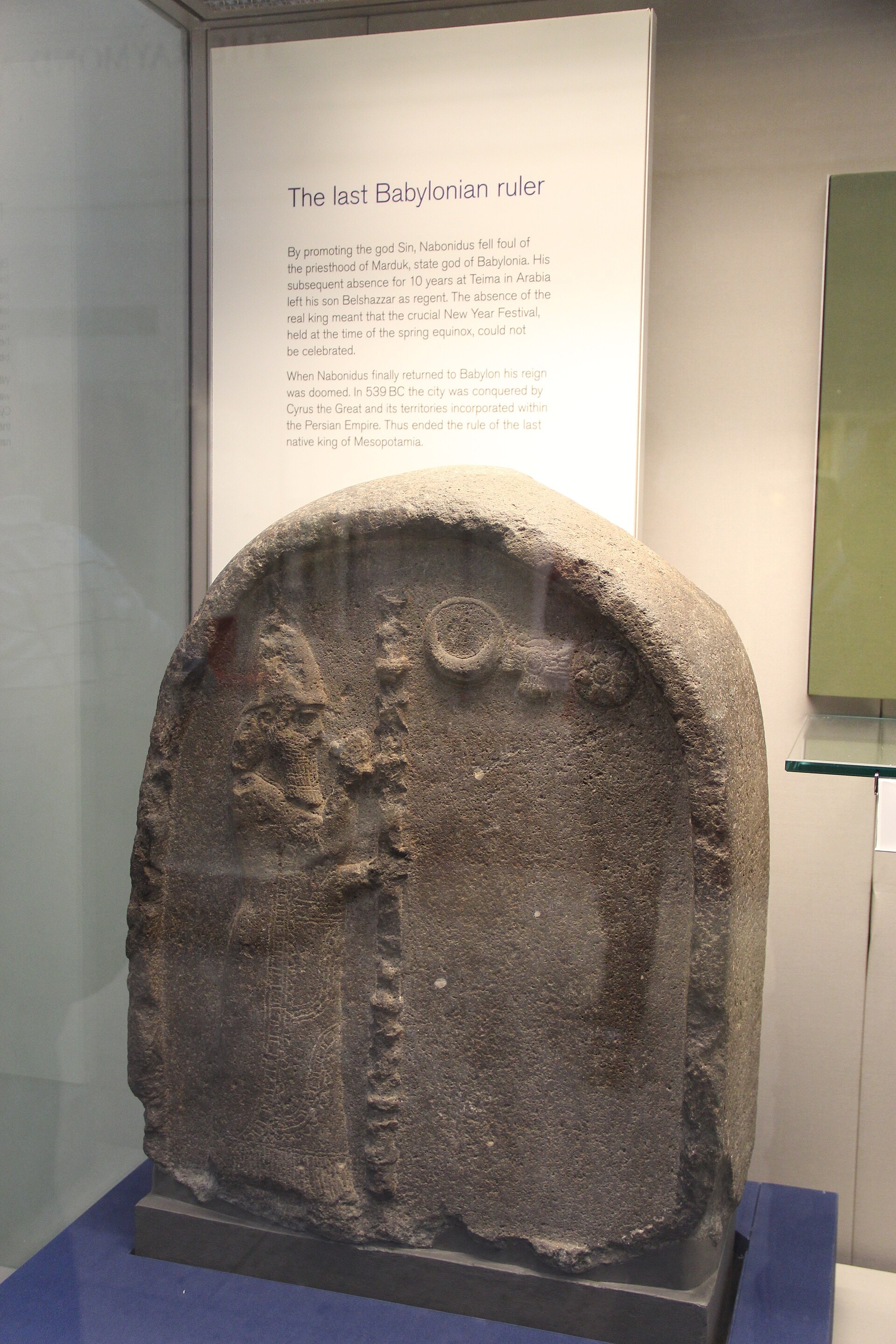
Basalt stele of Nabonidus from Babylon, 556-539 BC; the king faces the symbols of the moon god Sin, the sun god Shamash and the goddess Ishtar. British Museum, London. Photo: Gary Todd, CC0 (Flickr), via Wikimedia Commons, resized.

The 30-second version:
Nabonidus was the last native king of Babylon, 556 to 539 BC. He spent about ten years at Tayma in Arabia and left his son Belshazzar ruling in Babylon, which is the setting of Daniel 5. His own inscriptions, the Nabonidus Chronicle, a hostile Persian-era poem and the Cyrus Cylinder all describe him. A Dead Sea Scroll, the Prayer of Nabonidus, tells of his long illness at Tayma and his healing through a Jewish exile, a story many scholars compare with Daniel 4.
See this page's graph and discover linked topics
In full
Nabonidus (Babylonian Nabû-naʾid, "Nabu is praised") seized the throne in 556 BC after the murder of the boy-king Labashi-Marduk. He was not of Nebuchadnezzar's family; his mother, Adad-guppi, was a devotee of the moon god Sin at Harran, and her funerary autobiography survives on stelae from Harran. His reign is documented by his own building inscriptions (among them the cylinders from the ziggurat at Ur that name "Belshazzar, the eldest son"), stelae from Babylon and Harran, the Nabonidus Chronicle (BM 35382), the Verse Account of Nabonidus (BM 38299), the Cyrus Cylinder, and inscriptions found at Tayma itself. Around his third year he left for north-west Arabia, conquered Tayma and stayed about ten years, "entrusting the kingship" to his firstborn, while the Chronicle records year after year that the New Year festival of Marduk was not celebrated. He returned around 543 BC; in 539 Cyrus defeated the Babylonian army at Opis, Sippar fell, and Babylon was taken without a battle. The Chronicle says Nabonidus was captured; Berossus (in Josephus, Against Apion 1.20) says Cyrus spared him and sent him to Carmania. Nabonidus is not named in the Hebrew Bible, but Daniel 5 presupposes his regency arrangement, and the Aramaic Prayer of Nabonidus from Qumran (4Q242) preserves a Jewish tradition about him.
In the Bible
- Daniel 5. Not named. Belshazzar is called "the king," and his offer to make the interpreter "the third ruler in the kingdom" (5:7, 16, 29) fits a regency in which Nabonidus remained king. The queen mother's speech and Daniel's reply call Nebuchadnezzar Belshazzar's "father" (5:2, 11, 18), which most interpreters read in the broad sense of royal predecessor; see Belshazzar.
- Daniel 7:1 and 8:1. Visions dated to "the first year of Belshazzar" and "the third year of the reign of king Belshazzar," years that fall within Nabonidus' reign.
- Daniel 4. Many scholars think the story of Nebuchadnezzar's seven years of madness is related to the Nabonidus tradition preserved at Qumran (see below). Others defend it as an independent account about Nebuchadnezzar. The canonical text names Nebuchadnezzar throughout.
- Isaiah 13-14, 21, 46-47 and Jeremiah 50-51. The oracles of Babylon's fall were fulfilled in his reign, when the city fell to the Medes and Persians in 539 BC.
Family and lineage
- Mother: Adad-guppi, a votary of the moon god Sin at Harran, whose autobiographical stele claims she lived to a great age through the reigns of Assyrian and Babylonian kings.
- Father: Nabû-balāssu-iqbi, named in Nabonidus' inscriptions as a governor or prince; little else is known.
- Son: Belshazzar (Bel-šarra-uṣur), crown prince and regent in Babylon.
- Daughter: Ennigaldi-Nanna, whom he installed as high priestess of the moon god at Ur.
- Relation to Nebuchadnezzar: No blood relation is documented. Some historians have suggested a marriage tie to Nebuchadnezzar's family to explain Daniel 5's language; this is a conjecture.
Historical and archaeological evidence
- The Ur cylinders. Foundation cylinders found by J. E. Taylor at the ziggurat of Ur in 1854 record his restoration of the moon god's temple and end with a prayer for himself and "Belshazzar, the eldest son" (British Museum 91128). Grade: direct. See Nabonidus Cylinder and Belshazzar.
- The Nabonidus Chronicle (BM 35382). A Babylonian chronicle tablet in the British Museum recording that "the king (was) in Tayma" while "the prince, the officers, and his army (were) in Akkad" (Grayson's translation), and narrating Cyrus' capture of Babylon in 539 BC. Grade: direct.
- The Verse Account of Nabonidus (BM 38299). A hostile poem written under Persian rule accusing him of impiety and saying he "entrusted the kingship" to his firstborn before setting out for Tayma (Oppenheim's translation in ANET). Grade: direct, though propagandistic.
- The Cyrus Cylinder. Cyrus' own proclamation presents Nabonidus as a king who neglected Marduk, so that Marduk chose Cyrus. Grade: direct, propagandistic. See Cyrus Cylinder.
- Stelae from Babylon and Harran. The basalt stele pictured above (British Museum) and the Harran stelae show Nabonidus facing the emblems of Sin, Shamash and Ishtar, with Sin's crescent given pride of place. The Harran stelae also carry the autobiography of his mother.
- Tayma. Excavations at Tayma in Saudi Arabia by the German Archaeological Institute and the Saudi authorities have recovered inscriptions naming Nabonidus, confirming his stay in Arabia.
- The Prayer of Nabonidus (4Q242). An Aramaic fragment from Qumran Cave 4, first published by J. T. Milik (1956), in which Nabonidus says he was struck with an evil disease for seven years at Teman (Tayma) until a Jewish diviner among the exiles forgave his sin and told him to honor the Most High God. It shows that Jews of the Second Temple period remembered Nabonidus, his illness and his long stay in Arabia. Grade: a later Jewish tradition, not a contemporary record. See Dead Sea Scrolls.
Scholarly consensus
- Existence and reign: settled. Nabonidus is one of the best documented Neo-Babylonian kings.
- Daniel 5 and the regency. That Belshazzar exercised royal authority in Babylon during his father's absence is accepted from the Chronicle and the Verse Account. Alan Millard and others argue this explains Daniel's calling Belshazzar king; critics such as John J. Collins reply that the book still calls Nebuchadnezzar his father and does not mention Nabonidus, which they take as a sign of later composition. See Daniel Was Written in the 2nd Century Objection Defeater.
- Daniel 4 and 4Q242. Collins and many critical scholars hold that Daniel 4 reworks a tradition originally about Nabonidus. Conservative commentators regard the two as independent, pointing out that the Qumran prayer differs in the king's name, the illness, the place and the role of the Jewish healer. The question remains open.
- His fate. The Chronicle's report of capture and Berossus' report of exile in Carmania are compatible; no source says he was killed.
Theological significance
- The kingdom given to another. The writing on the wall announced that Babylon's kingdom was numbered and "given to the Medes and Persians" (Daniel 5:28, ASV). Nabonidus was the king whose dynasty ended that night, as Isaiah and Jeremiah had foretold.
- The third ruler. The detail that Belshazzar could offer only the third place is the most often cited sign that Daniel 5 reflects real knowledge of the late Babylonian court, knowledge the Greek historians had lost.
- A pagan king and the Most High. If the Qumran tradition is related to Daniel 4, it shows how Jews of the period told stories of proud Babylonian kings humbled until they honored the God of Israel, the theme Daniel 4:34-37 develops for Nebuchadnezzar.
See also
- Belshazzar, his son and regent in Babylon
- Nabonidus Cylinder and Belshazzar, the Ur cylinders and the companion texts
- Cyrus the Great, the Persian king who took Babylon from him
- Cyrus Cylinder, Cyrus' propaganda against him
- Daniel 2 and 7 Prophecy Argument, the succession of empires
- Daniel Was Written in the 2nd Century Objection Defeater, the dating debate
- Dead Sea Scrolls, where the Prayer of Nabonidus was found
- People of the Bible, every person on the hub, grouped by book of first mention
Common questions this page answers
Q: Is Nabonidus mentioned in the Bible?
Not by name in the Protestant Bible. He is the father of Belshazzar, the king in Daniel 5, and the arrangement in which Nabonidus remained king while Belshazzar ruled Babylon explains why Belshazzar offered Daniel the third place in the kingdom.
Q: Why did Nabonidus leave Babylon for Arabia?
His own inscriptions and the Verse Account say he went to Tayma in north-west Arabia around his third year and stayed about ten years. Historians suggest religious motives (his devotion to the moon god Sin), trade routes and political tension with Babylon's priests; the sources do not settle it.
Q: What is the Prayer of Nabonidus?
It is an Aramaic text from Qumran Cave 4 (4Q242) in which Nabonidus says he suffered an evil disease for seven years at Tayma until a Jewish exile forgave his sin and told him to honor the Most High God. Many scholars compare it with Nebuchadnezzar's madness in Daniel 4.
Q: What happened to Nabonidus when Babylon fell?
The Nabonidus Chronicle says he was captured after Cyrus took Babylon in 539 BC. Berossus, quoted by Josephus, says Cyrus spared him and sent him to live in Carmania. Neither source says he was killed.