Concept
Moral Motivation vs Moral Grounding
motivational internalism, motivational externalism, reasons internalism, reasons externalism, internalism and externalism about normativity, internalism vs externalism in ethics, moral motivation, moral grounding, Humean theory of reasons, does morality obligate by definition, what makes a moral obligation bindingIntro
When people argue about whether morality needs God, two different questions often get tangled together. One question asks why people act on their moral beliefs, or fail to. The other asks what makes a moral duty binding in the first place, even on someone who has no wish to keep it. The first is about motivation. The second is about grounding.
Picture a referee and a player. The rulebook says a foul is a foul whether or not the player feels like obeying it. Asking why one player plays clean and another cheats is a question about the players. Asking where the rulebook gets its authority is a question about the rulebook. A debate about morality goes in circles until both sides agree which of those two questions they are answering.
This page sorts out the terms that usually cause the confusion, internalism and externalism, and shows where the Christian claim about God actually lands.
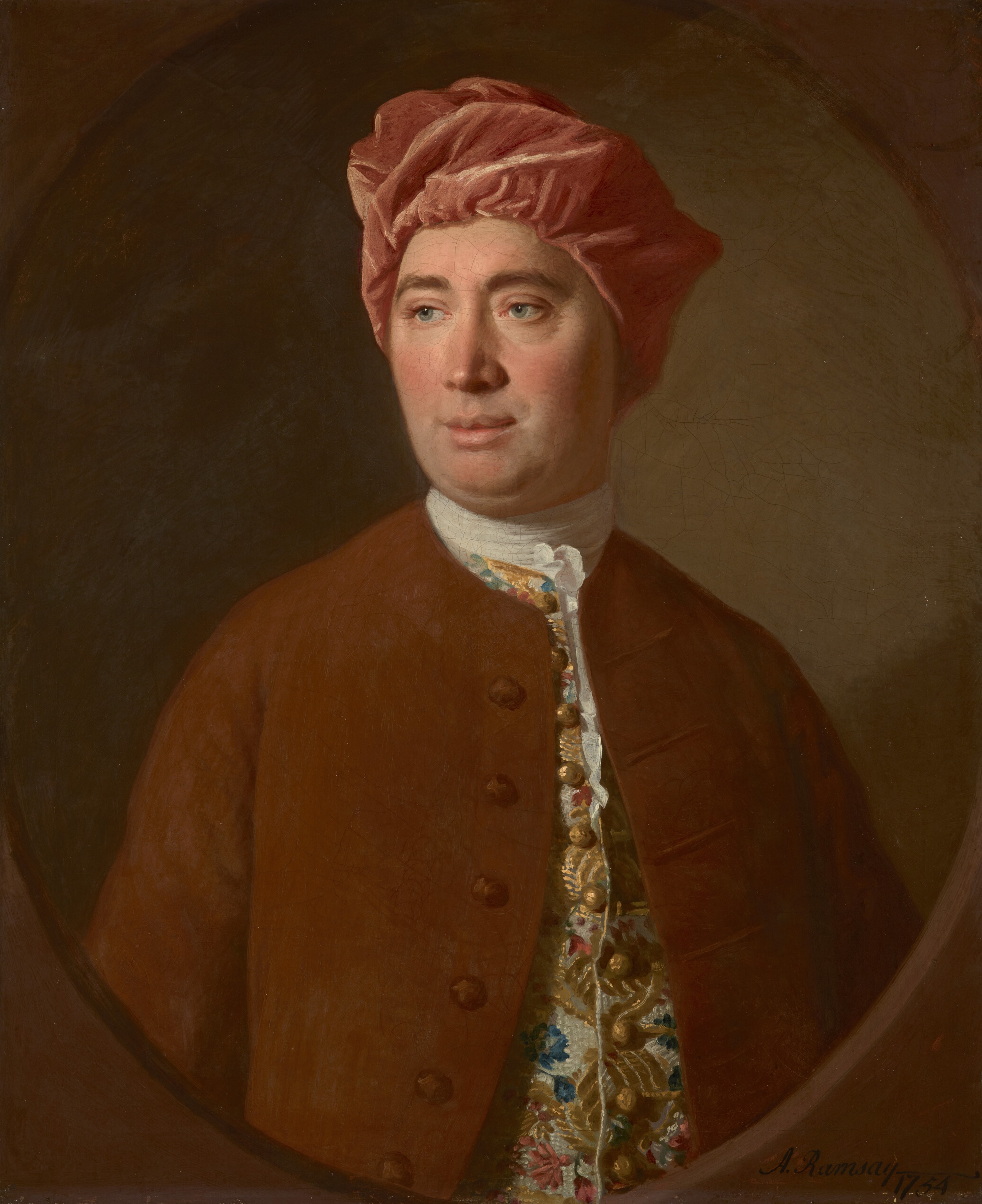 David Hume, painted by Allan Ramsay in 1766. Hume's claim that reason alone never moves us to act is the root of the modern "Humean" theory of motivation and reasons. Public domain.
See this page's graph and discover linked topics
In full
Metaethics separates at least three questions:
- Moral ontology: what, if anything, makes a moral obligation real and authoritative?
- Moral epistemology: how does anyone come to know what is right and wrong?
- Moral psychology: what is the relation between judging that one ought to do something and being moved to do it?
The labels internalism and externalism belong to two debates that sit mostly at the third level and partly at the second. Neither one answers the first question. Motivational internalism holds that sincerely judging "I ought to do X" necessarily carries at least some motivation to do X, at least in a rational agent. Motivational externalism holds that a person can sincerely judge that he ought to do X and feel no pull at all; the link between judgment and motive is contingent. Reasons internalism, set out by Bernard Williams in "Internal and External Reasons" (1979, reprinted in Moral Luck, Cambridge, 1981), holds that a person has a reason to do X only if X connects, by sound deliberation, to something in his existing "subjective motivational set". Reasons externalism holds that some reasons apply to a person whatever his desires happen to be.
The moral argument for God is an argument about ontology. It asks what grounds the categorical authority of moral obligation, the kind of authority Kant contrasted with merely hypothetical imperatives ("if you want X, do Y"). Pointing out that one is an internalist or an externalist does not answer that question, because Christian theists, atheist moral realists and anti-realists are found on both sides of both debates. Reasons internalism does bear on the dispute in one way: a thoroughgoing reasons internalist denies that any obligation binds a person who has no motive to keep it, which is a substantive and costly thesis, and that is where the conversation should go.
The three questions, side by side
| Question | Level | Sample answers |
|---|---|---|
| What makes an obligation binding? | Ontology (grounding) | God's nature and commands; brute moral facts; rational agency; nothing (error theory) |
| How do we know what is right? | Epistemology | Conscience, intuition, natural law, revelation, reflective equilibrium |
| Why do we act, or not act, on what we judge right? | Psychology (motivation) | Desire, love, fear, habit, character, grace |
A full moral theory needs an answer at every level. Confusing the levels produces the most common stalemate in moral-argument debates: one side asks the first question, the other answers the third.
The four positions
| Position | Core claim | Who holds it |
|---|---|---|
| Motivational internalism | A sincere moral judgment carries some motivation with it, necessarily | Many expressivists; some realists, with qualifications |
| Motivational externalism | A person can sincerely judge he ought and feel no pull; the link is contingent | David Brink (Moral Realism and the Foundations of Ethics, 1989) and other naturalist realists; many classical theists |
| Reasons internalism | Every genuine reason a person has traces to his own motivational set | Bernard Williams (1979); Humean theorists of reasons |
| Reasons externalism | Some reasons bind a person regardless of his desires | Kantians, most moral realists, classical Christian ethics |
Michael Smith, The Moral Problem (Blackwell, 1994), shows why these positions are hard to combine. Three attractive claims pull against each other: that moral judgments express beliefs, that moral judgments motivate, and the Humean view that belief alone never motivates without a desire. Smith's book is the standard map of that tension.
Where Hume comes in
David Hume wrote that reason "is, and ought only to be the slave of the passions" (A Treatise of Human Nature, II.iii.3). On the Humean theory of motivation, a belief moves no one to act without an accompanying desire. On the stronger Humean theory of reasons, a person's reasons for acting are fixed by what he desires. The second thesis does real work in metaethics. If it is true, a categorical duty, one that binds a man who wants nothing it requires, is impossible by definition.
That is the point where a Christian should press. The Humean theory of reasons is a theory of grounding in disguise: it locates the source of all practical authority inside the agent's desires. It therefore inherits every problem of moral subjectivism. A man with no desire to spare the innocent would have no reason to spare them. See Desire Grounds Moral Obligation Objection Defeater.
Why "by definition" is a weak answer
A common shortcut answers the grounding question by definition: "morality just is a system of obligations, so of course it obligates." That is conceptual analysis. It tells us what the word obligation means. It says nothing about whether anything in reality answers to the word, or what gives it authority. Error theorists such as J.L. Mackie accept the definition completely and conclude that, since nothing has that kind of authority, every positive moral claim is false. A definition the error theorist can grant without cost cannot settle the dispute with him.
The Christian account, placed on the map
Classical Christian theism answers each question separately:
- Ontology. Moral value is grounded in God's perfectly good nature; moral obligation is grounded in the commands of that good God, who has rightful authority over his creatures. This is the "modified" divine command account defended by Robert Merrihew Adams (Finite and Infinite Goods, Oxford, 1999) and the natural-law tradition in which Aquinas describes the natural law as the rational creature's participation in the eternal law (Summa Theologiae I-II q.91 a.2). See Divine Command Theory.
- Epistemology. God's law is known through conscience and creation (Romans 2:14-15) and, more fully, through revelation. See Conscience.
- Motivation. Fallen desire resists the good; grace reorders it. Augustine defined virtue, briefly and truly, as rightly ordered love (City of God XV.22). Regeneration changes what a person wants, so that the believer comes to delight in the law (Psalm 40:8; Ezekiel 36:26-27). See Sanctification.
On this map the Christian is a reasons externalist about moral obligation. The command to love God and neighbour binds the person who loves God and the person who does not. Christians may still disagree about motivational internalism; nothing in the moral argument depends on settling it.
Debate use
- Name the level. "When you say internalism, do you mean the link between judging and wanting, or the source of the reason itself? I am asking what makes the obligation binding."
- Force the fork. "Are moral obligations grounded in a person's motivational set, or do they hold independently of it?"
- If in the motivational set, ask how the theory handles a duty that binds someone who has no desire to keep it, and whether it can still call the cruel man wrong rather than merely unmotivated.
- If independently, ask what gives those independent reasons their authority. An atheist moral realist may answer that they are basic, irreducible normative truths. That is a real position, and the reply is to test its explanatory adequacy; see Godless Normative Realism and Atheist Moral Realism Defeater.
- Keep the grounding question in front. Both sides can agree that atheists act morally. The disagreement is about what makes the acts required. See Moral Argument.
Tensions
- Duty and happiness within Christian ethics. The classical tradition is eudaimonist: Augustine and Aquinas hold that every person seeks happiness and that happiness is finally found only in God (Aquinas, Summa Theologiae I-II q.2 a.8). John Piper's "Christian Hedonism" (Desiring God, 1986) presses the same theme for a popular audience. Other Christian moralists stress duty owed whether or not it brings any joy. Both strands hold that the command binds independently of desire, so both are externalist about obligation. They differ on how closely duty and delight are tied, and the codex records both rather than ranking them. See Desire Grounds Moral Obligation Objection Defeater for where the eudaimonist strand is misused.
Scholarship
Published academic works this page draws on, each matched to a publisher, index or library catalog record.
- Robert Merrihew Adams, Finite and infinite goods (1999). Open Library
- David Owen Brink, Moral Realism and the Foundations of Ethics (Cambridge University Press, 1989). doi:10.1017/cbo9780511624612
- John Piper, Desiring God: meditations of a Christian hedonist (1986). Open Library
- Michael Smith, The moral problem (1995). Open Library
- Bernard Williams, Moral Luck: Philosophical Papers 1973-1980 (Cambridge University Press, 1981). doi:10.1017/cbo9781139165860
See also
- Desire Grounds Moral Obligation Objection Defeater, the reply when desire or satisfaction is offered as the ground of duty
- Moral Argument, the argument whose first premise this distinction protects
- Godless Normative Realism, the strongest secular externalist rival
- Divine Command Theory, the Christian account of what makes obligation binding
- Robert Merrihew Adams, the leading modern defender of a theistic account of obligation
- Is-Ought Fallacy, the descriptive-to-prescriptive gap behind the grounding question
- Argument from Epistemic Normativity, the same structure applied to the norms of belief
- Kantian Ethics Without God Defeater, categorical imperatives without a lawgiver
- Virtue Ethics, the tradition that treats rightly ordered desire as the shape of the good life
- Morality, the parent hub
Common questions this page answers
Q: What is the difference between moral motivation and moral grounding?
Moral motivation is about why people act, or fail to act, on what they judge to be right. Moral grounding is about what makes an obligation binding in the first place, even on someone who does not want to keep it. The moral argument for God is about grounding.
Q: What is motivational internalism?
Motivational internalism is the view that sincerely judging "I ought to do this" necessarily carries some motivation to do it. Motivational externalism says a person can sincerely recognize a duty and feel no pull to keep it. Both are theories about the psychology of moral judgment.
Q: What is reasons internalism?
Reasons internalism, associated with Bernard Williams, holds that a person has a reason to act only if the action connects to something in his own desires or motivations. Reasons externalism holds that some reasons apply to a person whatever he wants. Classical Christian ethics is externalist about moral obligation.
Q: Does being an internalist or externalist answer the moral argument?
No. Christians, atheist moral realists and anti-realists are found on both sides of both debates, so the labels do not say what makes an obligation binding. The useful follow-up is whether the person thinks obligations depend on an agent's desires or hold independently of them.
Q: Can you say morality obligates us by definition?
That answer tells you what the word "obligation" means but not whether anything real has that kind of authority. An error theorist like J. L. Mackie accepts the definition and concludes that all moral claims are false, so the definition cannot settle the debate.
Q: What is the Humean theory of reasons?
It is the view, rooted in Hume's claim that reason is the slave of the passions, that a person's reasons to act are fixed by his desires. If it were true, no duty could bind someone who wanted nothing it required, which makes it a version of moral subjectivism.