Person
Monica of Hippo
Monica, Saint Monica, Monnica, Monica of Thagaste, Mother of AugustineIntro
Monica was the African mother of Augustine, the most influential theologian of the Western church. She was a Christian woman from a small town in what is now Algeria, married to a pagan husband with a quick temper, and she spent years praying with tears for a brilliant son who had rejected her faith.
Her son eventually came to Christ, and he wrote about her in his Confessions, which is why we know her at all. In that book she appears as a real woman with faults and strengths: a girl who once drank too much wine in secret, a patient wife, a stubborn and hopeful mother, and a woman who shared with her son, shortly before her death, a moment of joy in God that he never forgot.
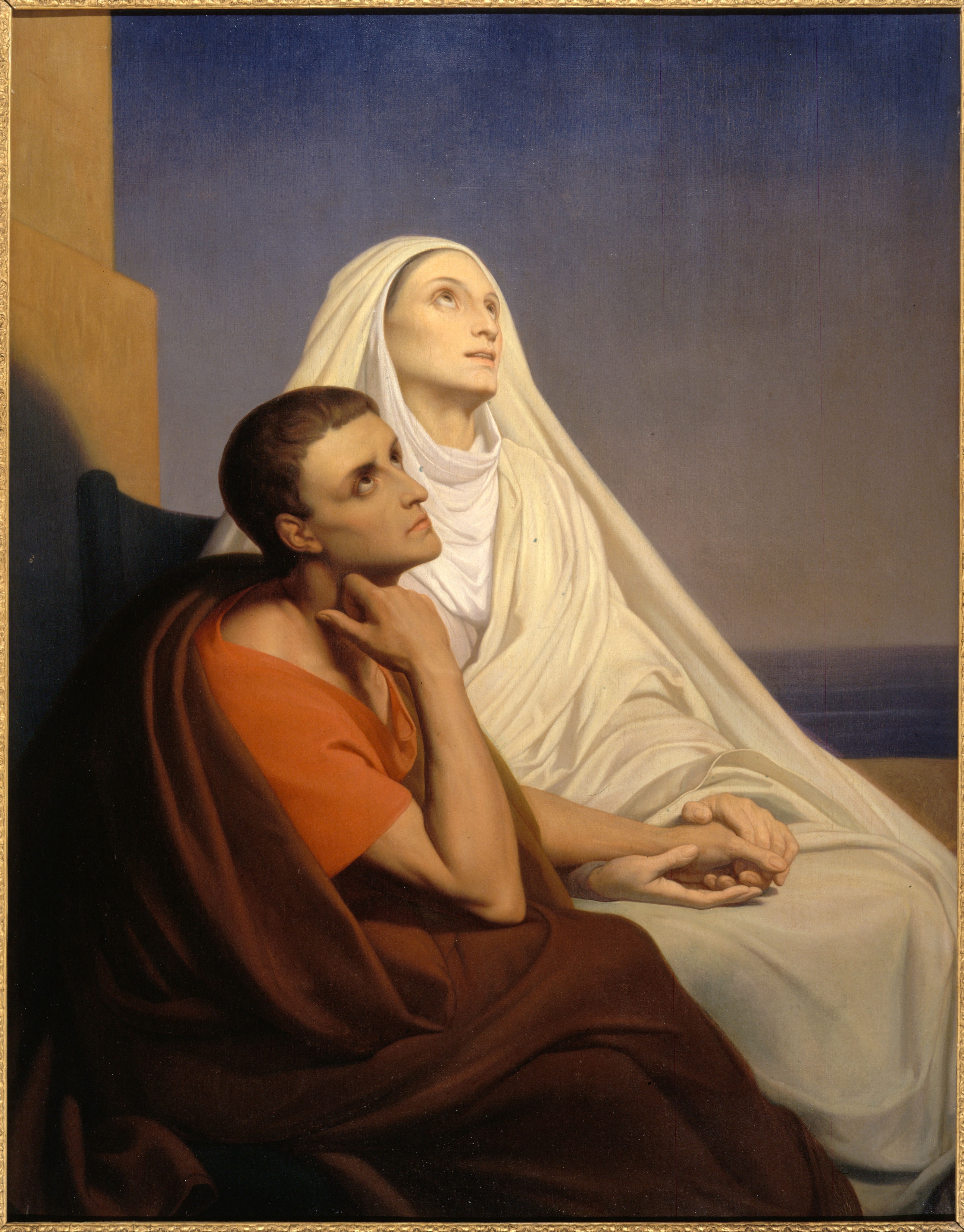 Ary Scheffer, Saint Augustine and Saint Monica (1846), Musée de la Vie romantique, Paris. Public domain (Wikimedia Commons), resized.

See this page's graph and discover linked topics
In full
Monica (also spelled Monnica, c. 331-387) was born to a Christian family in Thagaste, Numidia (modern Souk Ahras, Algeria), married the pagan town councillor Patricius, and bore at least three children: Augustine, Navigius and a daughter. Nearly everything known of her comes from Augustine's Confessions, chiefly Books 3, 5, 6 and 9, where she is the human instrument of grace in his story. She followed Augustine to Italy, was present in Milan at the time of his conversion and baptism under Ambrose of Milan in 387, and died later that year at Ostia, the port of Rome, aged 56, while the family waited to sail back to Africa. Confessions 9.8.17 to 9.13.37 is a memorial to her, including the account of the "vision at Ostia" (9.10.23-26), a shared contemplative ascent that is one of the most celebrated passages in Christian literature. Her name, with the Berber-rooted form "Monnica", has been taken by many scholars as a sign of her indigenous African (Numidian) background.
Life, as Augustine tells it
- A Christian upbringing. Raised strictly by an old servant woman who had cared for her father, she was taught restraint. As a girl sent to draw wine from the cellar, she fell into the habit of sipping and then drinking whole cups, until a maid in a quarrel called her a drunkard. Stung, she stopped at once (Confessions 9.8.17-18).
- Wife of Patricius. Married to a man who was kind but hot-tempered and unfaithful, she never answered his anger in the moment and won him by patience. Other wives with bruised faces, Augustine says, wondered how she had never been beaten. Patricius was baptized shortly before his death around 371 (9.9.19-22).
- Peacemaker. She refused to repeat gossip between quarreling women and worked instead to reconcile them (9.9.21).
- The praying mother. When Augustine joined the Manichees, she wept over him "more than mothers weep the bodily deaths of their children." She dreamed she stood on a wooden rule and was told that where she was, he would be also (3.11.19-20). A bishop she begged to argue her son out of error declined but sent her away with the words that it was impossible that "the son of these tears" should perish (3.12.21).
- Left on the shore. When Augustine sailed for Rome in 383, he deceived her and slipped away at night while she prayed at a shrine to Cyprian by the harbor at Carthage (5.8.15).
- Milan. She followed him to Italy, came to revere Ambrose, and accepted his correction when he discouraged the African custom of bringing food and wine to the shrines of the martyrs (6.2.2).
- Ostia. After Augustine's conversion and baptism, mother and son stood at a window overlooking a garden at Ostia and spoke together of eternal life, rising in mind beyond all created things until, for a moment, they touched eternal Wisdom (9.10.23-26).
- Death (387). A few days later she fell ill with fever. She had once wanted to be buried beside her husband in Africa; now she told her sons to lay her body anywhere and asked only that they remember her at the altar of the Lord (9.11.27). She died on the ninth day of her illness, in her 56th year, when Augustine was 33 (9.11.28).
Why she matters
- An African mother of the church. Monica shows Christian faith already rooted in family life in inland Numidia in the early 300s, two generations before her son's fame. See Africa and Christianity and African Christianity Pre-Colonial.
- Persevering prayer. Her years of intercession for a wayward son made her a model for parents in every Christian tradition. See Prayer.
- A window on ordinary African Christianity. Her devotion to the martyrs' shrines, her customs and her piety show what lay Christianity looked like in 4th-century North Africa, the world of Cyprian of Carthage and the Donatist Controversy.
- Grace in a family. In the Confessions God works through a mother's tears, a husband's late conversion and a son's slow surrender. The story is ordinary and therefore universal.
Later memory
- Epitaph. A fragment of her verse epitaph, known from medieval manuscripts and attributed to the consul Anicius Auxilius Bassus, was found at Ostia in 1945, near the church of Sant'Aurea.
- Relics. Her remains were moved from Ostia to Rome in 1430 and rest in the church of Sant'Agostino.
- Feast. The Roman calendar keeps her feast on 27 August, the day before Augustine's; many Orthodox churches commemorate her on 4 May.
Tensions
- Portrait or person? Everything comes from her son's theological autobiography. Augustine shapes her as a figure of the church's patient love, and some historians caution that we see Monica only through his eyes. Others reply that the Confessions records her faults as well as her virtues, which tells against pure idealization.
- Was she Berber? "Monnica" is often connected to a local Libyan or Berber deity name, Mon, and Thagaste lay in Numidian country. Many scholars regard an indigenous African background as likely; it cannot be proven from the sources. Either way she was a North African Christian.
See also
- Augustine, her son
- Ambrose of Milan, the bishop she came to revere in Milan
- Cyprian of Carthage, at whose harbor shrine she prayed the night Augustine sailed
- Perpetua and Felicity, earlier African Christian women whose memory her church kept
- Prayer, the discipline for which she is chiefly remembered
- Africa and Christianity, the master hub
- How Africa Shaped the Christian Mind, the wider argument about African contributions to Christian thought
Common questions this page answers
Q: Who was Saint Monica?
The mother of Augustine of Hippo, a Christian woman from Thagaste in Roman North Africa (modern Algeria), remembered for years of tearful prayer for her son's conversion. She died at Ostia in 387.
Q: Was Saint Monica African?
Yes. She was born and raised in Thagaste in Numidia, in present-day Algeria. Her name has been linked by many scholars to the local Berber culture, and she lived most of her life in Africa.
Q: What did the bishop tell Monica about Augustine?
When she begged a bishop to argue with her son, he declined but assured her that it was impossible that the son of these tears should perish (Confessions 3.12.21).
Q: What happened at Ostia between Augustine and Monica?
Shortly before her death, mother and son talked together at a window about eternal life and, in Augustine's account, rose in spirit beyond all created things to touch eternal Wisdom for a moment. It is known as the vision at Ostia (Confessions 9.10).
Q: Was Monica's husband a Christian?
Patricius was a pagan for most of their marriage and had a fierce temper. Through her patience he became a catechumen and was baptized shortly before his death around 371.
Q: Where is Saint Monica buried?
She died and was buried at Ostia in 387. Her remains were moved to Rome in 1430 and are kept in the church of Sant'Agostino.
Q: Why is Saint Monica the patron of mothers?
Because her persistent prayer for a wayward son, recorded in the Confessions, has made her a model for parents praying for their children across Christian traditions.