Concept
Monarch Butterfly
monarch butterfly, monarch migration, monarch butterfly evolution, monarch butterfly navigation, Danaus plexippusIntro
Each autumn, monarch butterflies in eastern North America fly up to three thousand miles to a few specific fir forests in the mountains of central Mexico, often roosting on the very same trees their ancestors used. The astonishing part is that no individual makes the round trip. The butterflies that fly south are three or four generations removed from the ones that flew south the year before. They have never seen Mexico, no parent leads them, and yet they find a grove the size of a few football fields from a continent away, using a built-in sun compass corrected for the time of day and a backup magnetic sense. A precise navigation program that has to work correctly the first time, with no chance to learn it, has to be written into the insect in advance. Built-in instructions point to an author.
See this page's graph and discover linked topics
In full
The eastern population of Danaus plexippus completes a multi-generational migration of up to roughly 3,000 miles to overwintering sites in the oyamel fir forests of Michoacán, Mexico. The southbound migrants are a long-lived "super generation" that lives about eight months, several times longer than the summer generations, and they descend from individuals that never made the journey. Orientation uses a time-compensated sun compass: a circadian clock housed partly in the antennae corrects the sun's shifting position read by the compound eyes, so the butterfly holds a steady heading through the day. A light-dependent, inclination-based magnetic compass serves as a backup under cloud. The route, the heading, and the destination are inherited, not learned, and the program must function correctly on the first attempt, leaving no room for trial-and-error refinement within a lifetime. Encoding a precise, multi-cue navigation algorithm together with a destination into a genome is a feat of built-in information (Information Argument for Design, Specified Complexity).
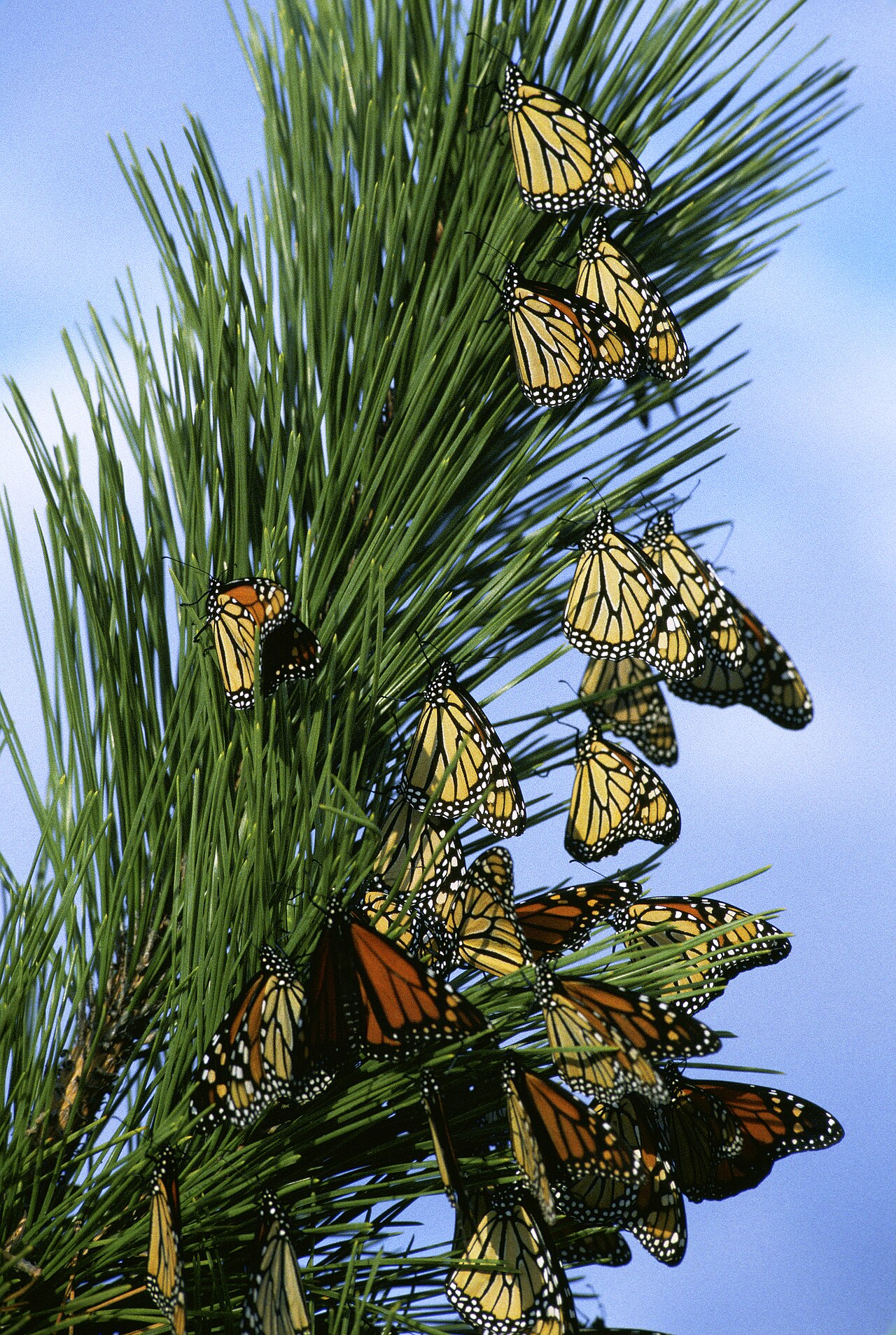
Monarch butterflies clustered at an overwintering roost. Image: public domain, via Wikimedia Commons.
The mechanism
- The multi-generation relay. Summer monarchs live only a few weeks across several generations moving north. The final autumn super generation lives about eight months, flies all the way to Mexico, overwinters, and starts the return north in spring.
- No learning, no leader. The southbound migrants have never been to the wintering grounds and follow no experienced guide. The route and destination are inherited.
- Time-compensated sun compass. A circadian clock, with key components in the antennae, adjusts for the sun's movement across the sky so the butterfly keeps a constant heading rather than chasing the sun.
- Magnetic backup. A light-dependent magnetic compass that reads the inclination of Earth's field holds the course when the sun is hidden.
- Pinpoint destination. The butterflies converge on a handful of small high-altitude groves with the right cool, moist microclimate, and cluster in dense masses on the same stands of trees year after year.
Why this points to design
A migrating monarch cannot learn its route by trial and error within its life; it gets one attempt, and it succeeds. That means the navigation program, the clock, the sun-azimuth correction, the magnetic backup, and an inherited sense of direction, distance, and destination, must be encoded in advance and function correctly the first time it is used. Information that is in place before it is ever tested, and that specifies a precise multi-step procedure plus a target, is not the kind of thing random variation accumulates by lucky increments; it is the kind of thing minds write. The monarch carries a working set of instructions for a journey it has never taken, which is exactly the signature of design. See Information Argument for Design and Specified Complexity.
The evolutionary account, and why it falls short
The standard reply is that the cues are common (circadian clocks, sun-compass orientation, and magnetoreception are widespread) and that the route lengthened gradually as breeding and wintering ranges separated after the last ice age, with selection favoring better orientation and slightly longer journeys over time.
The reply lists the parts and assumes their assembly. The hard problem is not that monarchs use a clock or sense magnetism; it is that a clock-corrected sun compass, a magnetic backup, and an inherited heading, distance, and stopping rule are integrated into one program that delivers a never-been-there insect to a specific grove on its first try. A gradually lengthening route still has to keep that program coherent at every stage, and a half-wired navigation system does not guide an insect partway to Mexico, it loses it. Naming familiar components and a plausible historical trend is not the same as exhibiting the genetic encoding of the integrated, first-time-correct algorithm or the selectable advantage of each intermediate. That a complete, working instruction set must be present before its first and only use is what points to a designer.
See also
- Animals That Defy Evolution, the hub this spoke belongs to
- Information Argument for Design, the information case behind inherited navigation
- Specified Complexity, functional information as a design signature
- Edge of Evolution, the empirical reach of random mutation
Common questions this page answers
Q: How do monarch butterflies know where to migrate if they've never been there?
The route and destination are inherited, not learned. The autumn super generation that flies to Mexico is several generations removed from the previous year's migrants and has never seen the wintering grounds, yet it navigates with a built-in sun compass corrected for the time of day, plus a magnetic compass as a cloudy-day backup. A working navigation program that must be present before the insect's first and only attempt is a striking case of built-in biological information.
Q: Why is the monarch migration a problem for evolution?
Because the navigation program has to work correctly the first time, with no chance to learn or refine it within a lifetime. That means a precise, multi-cue algorithm plus an inherited destination must be encoded in advance, and a half-wired version does not guide the insect partway, it strands it. Information that specifies a complete procedure and target before it is ever used is the kind of thing minds produce, not the kind of thing lucky mutations accumulate piece by piece.
Q: How does a monarch butterfly navigate thousands of miles?
It uses a time-compensated sun compass: a circadian clock, with components in its antennae, adjusts for the sun's changing position so the butterfly holds a steady heading all day. When the sun is hidden, a light-dependent magnetic compass that reads the inclination of Earth's field keeps it on course. Together these cues guide it to a few small high-altitude fir groves with exactly the right microclimate.
Q: Couldn't the monarch's migration have evolved gradually?
The usual story notes that clocks, sun compasses, and magnetism are common and that the route could lengthen over time, but that lists the parts without explaining their integration. A clock-corrected compass, a magnetic backup, and an inherited heading and stopping rule have to form one coherent program that works on the first try, and a partly wired system loses the insect rather than guiding it. The genetic encoding of that integrated, first-time-correct algorithm has never been demonstrated, which is what points to design.