Concept
Molech
Moloch, Molek, Molech worship, Moloch worship, did the Israelites worship Molech, child sacrifice to Molech, pass through the fire to Molech, who was Molech, was Molech a god, statutes that were not goodIntro
Molech is the name the Old Testament gives to the rite, or the god, connected with burning children in fire. The law of Moses bans it with the death penalty. The prophets call it the worst thing Judah ever did. And the history books say some Israelites did it anyway, including two kings of Judah who "made his son to pass through the fire."
So yes, some Israelites worshiped Molech, and the Bible says so plainly. The Bible tells the story against its own people, and the law and the prophets condemn the practice without exception. Jeremiah quotes God saying it was something "which I commanded not, neither came it into my mind."
Scholars still argue about who or what Molech was: a god with a name, a title meaning "the king," or a word for a kind of sacrifice. This page sets out each view fairly, works through the hardest texts a skeptic will raise, and shows where the evidence actually stands.
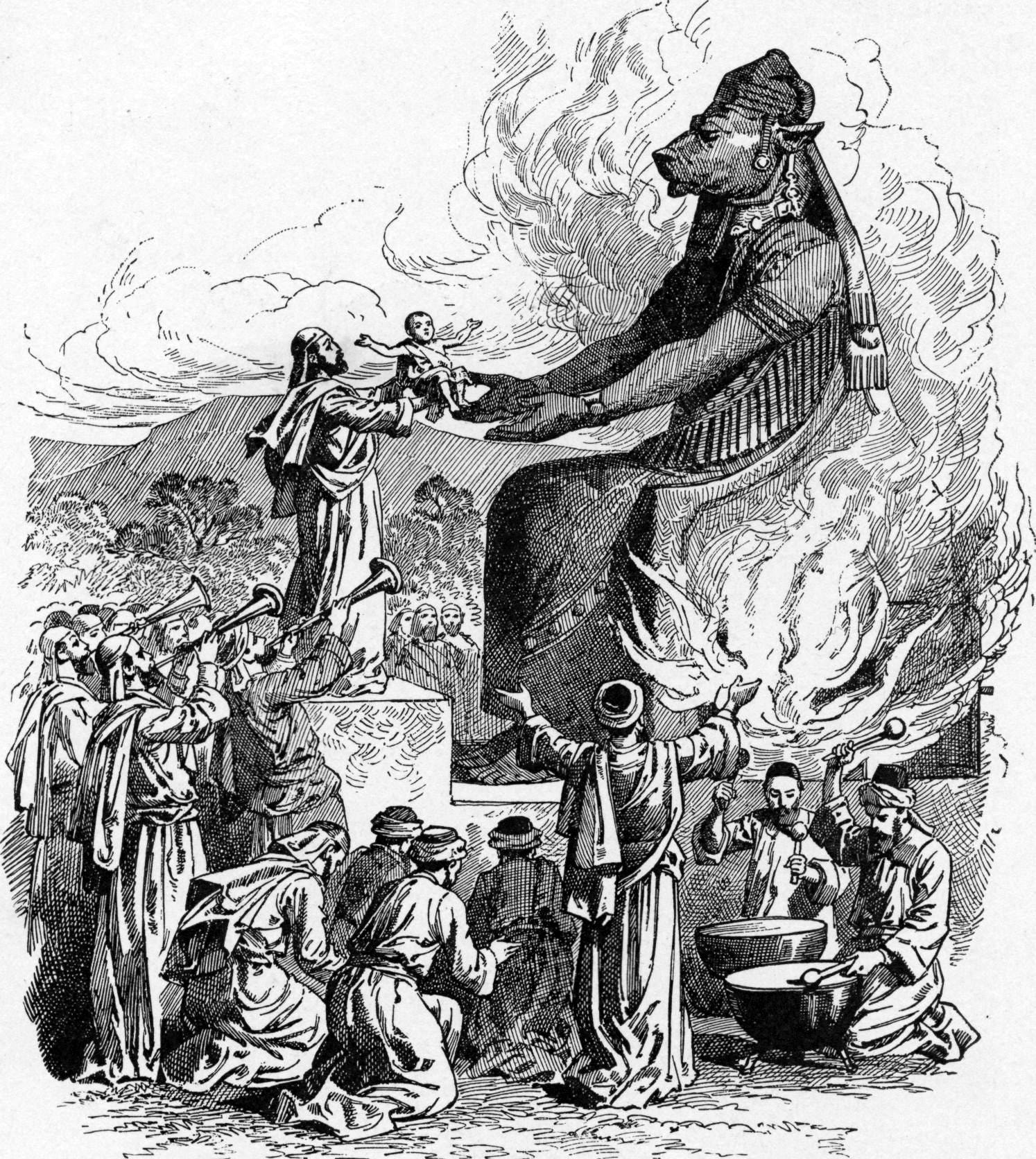 Offering to Molech, from Charles Foster's Bible Pictures and What They Teach Us (1897). The bull-headed bronze idol is a later artistic tradition; the Bible never describes Molech's appearance. Public domain, via Wikimedia Commons.
See this page's graph and discover linked topics
In full
The Hebrew Molek (Strong's H4432) occurs eight times in the Hebrew Bible: Leviticus 18:21; 20:2-5 (four times); 1 Kings 11:7; 2 Kings 23:10; and Jeremiah 32:35. The characteristic idiom is causing a son or daughter "to pass through the fire" (Hebrew ha'avir ba'esh), which also appears without the name Molech in Deuteronomy 18:10, 2 Kings 16:3, 17:17 and 21:6. The same practice is described as burning sons and daughters at Topheth in the Valley of Ben-hinnom (Jeremiah 7:31; 19:5).
Three questions organize the evidence. What was Molech: a deity, a royal title, or a technical term for an offering? To whom were the children offered: to a foreign god, or, in the minds of some worshipers, to Yahweh? What do the hardest texts mean: Ezekiel 20:25-26, which speaks of "statutes that were not good," and Exodus 22:29, "The first-born of thy sons shalt thou give unto me"? The biblical writers' own verdict is uniform and severe; the historical and lexical questions are open, and the page presents them as open.
The biblical texts
The law. "Thou shalt not give any of thy seed to make them pass through the fire to Molech; neither shalt thou profane the name of thy God: I am Jehovah" (Leviticus 18:21, ASV). Leviticus 20:2-5 prescribes stoning for any Israelite or resident foreigner who does it, and divine judgment on the family and community that shield him. Deuteronomy 12:31 forbids imitating the nations who "burn in the fire to their gods" their sons and daughters, and does so with the words "Thou shalt not do so unto Jehovah thy God," which anticipates the temptation to bring the rite into Israel's own worship.
The history. Solomon built a high place for Molech (1 Kings 11:7). Ahaz (2 Kings 16:3; 2 Chronicles 28:3) and Manasseh (2 Kings 21:6; 2 Chronicles 33:6) each "made his son to pass through the fire." The fall of the northern kingdom is explained in part by the same practice (2 Kings 17:17). Josiah "defiled Topheth ... that no man might make his son or his daughter to pass through the fire to Molech" (2 Kings 23:10, ASV).
The prophets. Jeremiah condemns the burning of sons and daughters three times, each time with a divine disavowal: "which I commanded not, neither came it into my mind" (Jeremiah 7:31, ASV; 19:5; 32:35). Ezekiel calls the children offered "my children" (Ezekiel 16:20-21) and reports worshipers who "had slain their children to their idols" and then "came the same day into my sanctuary" (Ezekiel 23:39, ASV). The psalmist names it as Israel's defilement of the land: they "sacrificed their sons and their daughters unto demons" (Psalm 106:37-38, ASV).
The New Testament. Stephen, quoting Amos 5:26 in its Greek form, says Israel in the wilderness "took up the tabernacle of Moloch" (Acts 7:43, ASV). The Hebrew of Amos 5:26 reads "the tabernacle of your king" (malkekhem), so the identification of the royal word with Molech is already present in the Greek tradition Stephen cites.
What was Molech? Three scholarly positions
1. A deity named Molech
The traditional view, held by most interpreters through the centuries and defended in detail by George C. Heider (The Cult of Molek, 1985) and John Day (Molech: A God of Human Sacrifice in the Old Testament, 1989), is that Molech was a god.
- Its strongest evidence is the language of worship. Leviticus 20:5 speaks of those who "play the harlot after him, to play the harlot with Molech" (ASV). Elsewhere the Old Testament uses that idiom for going after other gods, which is hard to apply to a type of offering.
- 1 Kings 11:7 lists Molech beside Chemosh, a named deity of Moab, as "the abomination of the children of Ammon."
- Comparative evidence. Heider and Day both compare a divine name built on the same consonants, mlk, attested in texts from Ugarit, and the god Malik known from Mesopotamian and Syrian sources, and associate the figure with the underworld and the dead. On this reading Molech was a Canaanite god of the dead, which fits the sacrifice's setting in a valley outside the city.
- The weakness is that no inscription outside the Bible names a god "Molech" who receives child sacrifice, so the identification rests on comparison.
2. A technical term for a kind of offering
In 1935 Otto Eissfeldt argued (Molk als Opferbegriff im Punischen und Hebräischen, und das Ende des Gottes Moloch) that mlk in Phoenician and Punic inscriptions from North Africa is a word for a type of sacrifice, and that the Hebrew lammolek should be read "as a molk-offering" rather than "to Molech."
- Its strongest evidence is the Punic usage itself: votive stelae that use mlk as a sacrificial term, including formulas some scholars read as an animal offered in a child's place.
- It explains the article. The Hebrew usually reads "the molek," which suits a technical term, though Hebrew also uses the article with divine names such as "the Baal."
- The weakness is Leviticus 20:5, "to play the harlot with Molech," which reads naturally of a deity, and 1 Kings 11:7, which places Molech in a list of gods. Day's book is in large part a reply to Eissfeldt on these grounds.
3. A title, "the king," vocalized as an insult
A third proposal, associated with Abraham Geiger in the nineteenth century, holds that the consonants mlk are the ordinary word melek, "king," a title that could be used of a god, and that the Masoretic scribes gave it the vowels of boshet, "shame," producing Molek, a deliberate distortion of the kind the tradition also applies to Baal names.
- Its strongest evidence is the royal element in related divine names, such as Milcom, the god of Ammon, and Adrammelech and Anammelech, gods to whom the Sepharvites "burnt their children in the fire" (2 Kings 17:31, ASV), together with the reading "your king" at Amos 5:26.
- The weakness is that the vowel pattern can be explained in more than one way, so the proposal is suggestive rather than demonstrable.
Where it stands. The three positions are not all mutually exclusive: a deity could bear a royal title, and a deity's name could also name the rite offered to him. None of them affects the biblical verdict, which condemns the practice whatever the word denoted.
Milcom and Molech in 1 Kings 11
1 Kings 11:5 says Solomon went after "Milcom the abomination of the Ammonites"; 11:7 says he built a high place "for Molech the abomination of the children of Ammon"; 11:33 names "Milcom the god of the children of Ammon"; and 2 Kings 23:13 again speaks of the high place Solomon built "for Milcom the abomination of the children of Ammon" (ASV).
- One reading: 11:7 originally read "Milcom," matching 11:5, 11:33 and 2 Kings 23:13, and "Molech" is a scribal change or confusion. Many commentators take this view.
- A second reading: the two names were identified or confused in Israelite memory because both are built on the royal root, and the text reflects that.
- What follows: the traditional label "Molech, god of the Ammonites" rests largely on this one verse. Day in particular argues that Molech was a Canaanite deity distinct from the Ammonite Milcom. The codex records the verse as it stands and notes the dispute.
Were the children offered to Yahweh?
The Old Testament is explicit that the practice was foreign in origin (Deuteronomy 12:31; 2 Kings 16:3, "according to the abominations of the nations"). It also records that some Israelites folded it into their worship of Yahweh.
- Jeremiah's disavowal implies a claim being answered. "Which I commanded not, nor spake it, neither came it into my mind" (Jeremiah 19:5, ASV) is the kind of denial a prophet makes when someone has claimed the opposite. Many scholars, across the theological spectrum, read the triple disavowal this way.
- Ezekiel describes the same people at Topheth and the temple on the same day (Ezekiel 23:39).
- Deuteronomy forbids doing it "unto Jehovah thy God" (Deuteronomy 12:31).
What this establishes is a distinction the debate often blurs. That some Israelites believed Yahweh wanted their children is a historical claim about popular religion, and the Bible itself reports it. That Yahweh commanded or accepted it is a theological claim, and every text that speaks to it denies it, often in God's own voice.
The hardest texts
Ezekiel 20:25-26, "statutes that were not good"
- Moreover also I gave them statutes that were not good, and ordinances wherein they should not live; 26. and I polluted them in their own gifts, in that they caused to pass through the fire all that openeth the womb, that I might make them desolate, to the end that they might know that I am Jehovah. (Ezekiel 20:25-26, ASV)
The skeptic's reading. God admits He gave Israel a bad law, the demand for firstborn sacrifice. Jon D. Levenson (The Death and Resurrection of the Beloved Son, 1993) argues that a strand of Israelite religion did understand the firstborn law as a call for child sacrifice, and that Ezekiel 20:25-26 reflects that history.
The reading from Ezekiel 20 itself.
- The phrasing answers verse 11. God first "gave them my statutes ... which if a man do, he shall live in them" (20:11, ASV), repeated at 20:13 and 20:21. Verse 25 is a pointed inversion: statutes "wherein they should not live." The chapter sets God's life-giving statutes against the death-dealing ones the people embraced.
- "Their own gifts" are identified six verses later. "When ye offer your gifts, when ye make your sons to pass through the fire, do ye pollute yourselves with all your idols unto this day?" (20:31, ASV). The gifts of verse 26 are idolatrous offerings, condemned in the same speech, and 20:39 calls them gifts that "profane" God's holy name.
- The purpose clause is judicial. "That I might make them desolate" places the verse among the judgments of the chapter. On this reading, giving "statutes that were not good" is God handing a rebellious people over to the customs they chose, the pattern of Psalm 81:12 ("So I let them go after the stubbornness of their heart"), Acts 7:42 ("God turned, and gave them up to serve the host of heaven") and Romans 1:24.
- Ezekiel's own theology rules out divine approval. The same prophet calls the sacrificed children "my children" and the act whoredom (Ezekiel 16:20-21).
The judicial-handing-over reading is widely held among commentators who read Ezekiel 20 as a unit; the historical claim behind Levenson's reading, that some Israelites thought the rite Yahwistic, is one the biblical text itself supports. The two can both be true: Israelites believed it, and God, through Ezekiel, calls it a judgment and a defilement.
Exodus 22:29, "the first-born of thy sons shalt thou give unto me"
- Thou shalt not delay to offer of thy harvest, and of the outflow of thy presses. The first-born of thy sons shalt thou give unto me. (Exodus 22:29, ASV)
The skeptic's reading. A bare command to give the firstborn son, with no mention of redemption, looks like a demand for sacrifice.
The reading from the Torah's own firstborn law.
- The same law corpus specifies redemption every time it explains the claim. "All the first-born of man among thy sons shalt thou redeem" (Exodus 13:13, ASV); "All the first-born of thy sons thou shalt redeem" (Exodus 34:20, ASV); "the first-born of man shalt thou surely redeem ... for the money of five shekels" (Numbers 18:15-16, ASV).
- The Levites stand in for the firstborn. "I have taken the Levites ... instead of all the first-born that openeth the womb" (Numbers 3:12-13, ASV). The firstborn belong to God and serve Him through a substitute.
- "Give" is consecration language. Exodus 13:2 states the principle as "Sanctify unto me all the first-born ... it is mine," and the Levites are later said to be "given" to God in the same sense.
- The canon reads it the same way. Micah 6:7 asks "shall I give my first-born for my transgression?" in order to reject it, and the Akedah ends with a substituted ram.
What is conceded. Exodus 22:29 on its own does not mention redemption, and critical scholars who date the law codes separately read the absence as significant. The codex's reading rests on the Torah as it stands, where the claim of God on the firstborn is defined three times, each with redemption. See Substitutionary Principle in the OT.
The archaeological question: the Carthage tophet
The main external evidence for Phoenician and Punic child sacrifice is the tophet precinct at Carthage, where thousands of urns of cremated infants and young animals were buried under inscribed stelae. Greek writers also describe Carthaginian child sacrifice, most famously Diodorus Siculus (Library of History 20.14) on a crisis in 310 BC.
How to read the site is disputed:
- Sacrifice. Patricia Smith, Lawrence E. Stager and colleagues ("Cemetery or Sacrifice? Infant Burials at the Carthage Tophet," Antiquity, 2013) argued that the age profile and the inscriptions support ritual sacrifice.
- Cemetery. Jeffrey H. Schwartz and colleagues ("Skeletal Remains from Punic Carthage Do Not Support Systematic Sacrifice of Infants," PLoS ONE, 2010) argued that many of the infants were stillborn or died naturally and that the precinct was a special burial ground.
The codex's position follows the evidence: the Carthage findings are consistent with the biblical and classical report that child sacrifice was practiced in the Phoenician world, and the scale and nature of the practice at Carthage remain contested. The biblical case for the practice in Judah rests on the biblical texts themselves, which report it against their own nation's honor. See Children in OT Theology for the fuller treatment.
Why it matters
- The Bible is the main witness against Molech. The texts a skeptic quotes to show that Israelites sacrificed children are the texts that condemn it, legislate against it on pain of death, and record a king tearing down its shrine.
- The honest concession is cheap. Some Israelites did it, some may have believed Yahweh wanted it, and the Bible says both. What the evidence does not show is a text in which God approves it.
- It anchors the New Testament's imagery of judgment. The valley where children were burned became Gehenna, the name Jesus used for final judgment. See Topheth and the Valley of Hinnom and G1067 - geenna.
- It sharpens the contrast with the cross. The rite offered a child to a god to secure favor. The gospel proclaims God giving His own Son. See Jesus is Not a Human Sacrifice (Defeater).
Tensions
- 1 Kings 11:7. Whether "Molech" there is original or a substitution for "Milcom" is disputed; the page presents both readings.
- The nature of Molech. Deity (Heider, Day), sacrifice term (Eissfeldt) and royal title with a polemical vocalization (Geiger) all have defenders. The codex does not adjudicate beyond the evidence set out above.
- The Carthage tophet. Sacrifice versus special cemetery remains contested in the archaeological literature (Smith, Stager et al. 2013; Schwartz et al. 2010). Earlier wording on Topheth and the Valley of Hinnom presented the Carthage evidence as settled corroboration; it has been aligned with the disputed framing used here and on Children in OT Theology.
- Ezekiel 20:25-26. The judicial-handing-over reading and Levenson's historical reading are both recorded above.
Scholarship
Published academic works this page draws on, each matched to a publisher, index or library catalog record.
- Otto Eissfeldt, Molk als opferbegriff im punischen und hebräischen, und das ende des gottes Moloch (Niemeyer, 1935). Open Library
- George C. Heider, The Cult of Molek (1985). Open Library
- Jon D. Levenson, The Death and resurrection of the beloved son (1993). Open Library
- Jeffrey H. Schwartz et al., "Skeletal Remains from Punic Carthage Do Not Support Systematic Sacrifice of Infants," PLoS ONE 5 (2010). doi:10.1371/journal.pone.0009177 PubMed 20174667 open access
- Patricia Smith et al., "Cemetery or sacrifice? Infant burials at the Carthage Tophet," Antiquity 87 (2013). doi:10.1017/s0003598x00049954
See also
- Human Sacrifice in the Old Testament, the Akedah, Jephthah and the devoted-things law
- Topheth and the Valley of Hinnom, the place where the rite was performed, and its afterlife as Gehenna
- Children in OT Theology, the ban on child sacrifice and the archaeological debate
- God and the Killing of Children, the wider cluster of hard texts about children
- Substitutionary Principle in the OT, the redemption of the firstborn
- Akedah, the binding of Isaac and the ram provided in his place
- Yahweh Borrowed From the Canaanites Objection Defeater, the broader claim that Israel's religion grew out of Canaanite cult
- Mesha Stele, the Moabite king whose sacrifice of his son is recorded in 2 Kings 3:27
- H4432 - Molek, the lexicon entry
Common questions this page answers
Q: Did the Israelites worship Molech?
Some did. The Bible records Solomon building a high place for Molech, Kings Ahaz and Manasseh making their sons "pass through the fire," and Josiah destroying the site at Topheth so no one could do it again. The law and the prophets condemn it without exception.
Q: Who was Molech?
Scholars hold three main views: a Canaanite god associated with the underworld (George Heider, John Day), a technical term for a kind of offering found in Punic inscriptions (Otto Eissfeldt), or the word for "king" given the vowels of the Hebrew word for "shame" as an insult (Abraham Geiger). The Bible itself describes Molech in the language used for other gods.
Q: Did God command child sacrifice?
No. The law punishes it with death (Leviticus 20:2), and Jeremiah three times quotes God saying of it, "which I commanded not, neither came it into my mind" (Jeremiah 7:31; 19:5; 32:35). The firstborn law requires the firstborn son to be redeemed (Exodus 13:13; 34:20).
Q: What does Ezekiel 20:25 mean by "statutes that were not good"?
Read in its chapter, it inverts verse 11, where God's statutes are those a man may "live in," and the "gifts" of verse 26 are identified in verse 31 as idolatrous offerings. Many commentators read it as God handing a rebellious people over to the practices they chose, the pattern of Psalm 81:12 and Acts 7:42.
Q: Does Exodus 22:29 command sacrificing the firstborn son?
The Torah defines God's claim on the firstborn three times, and each time requires the son to be redeemed: Exodus 13:13, Exodus 34:20 and Numbers 18:15-16. The Levites served in place of the firstborn (Numbers 3:12-13).
Q: Is Moloch the same as Molech?
Yes. "Moloch" is the Greek and Latin form of the name, used in Acts 7:43 when Stephen quotes Amos 5:26, and it is the spelling common in older English literature.