Person
Merodach-baladan
Merodach-baladan II, Berodach-baladan, Marduk-apla-iddina II, Merodach-baladan son of Baladan, Merodach Baladan, MardokempadosIntro
Merodach-baladan was a Chaldean chieftain who twice made himself king of Babylon in defiance of Assyria, from 722 to 710 BC and again briefly in 703 BC. The Bible remembers him for one diplomatic visit. After King Hezekiah recovered from a deadly illness, "Merodach-baladan the son of Baladan, king of Babylon, sent letters and a present to Hezekiah" (Isaiah 39:1, ASV). Hezekiah proudly showed the envoys all his treasures, and Isaiah warned that one day everything in his house would be carried off to Babylon.
Merodach-baladan appears often in Assyrian records, as the persistent enemy whom Sargon II and Sennacherib could never quite destroy.
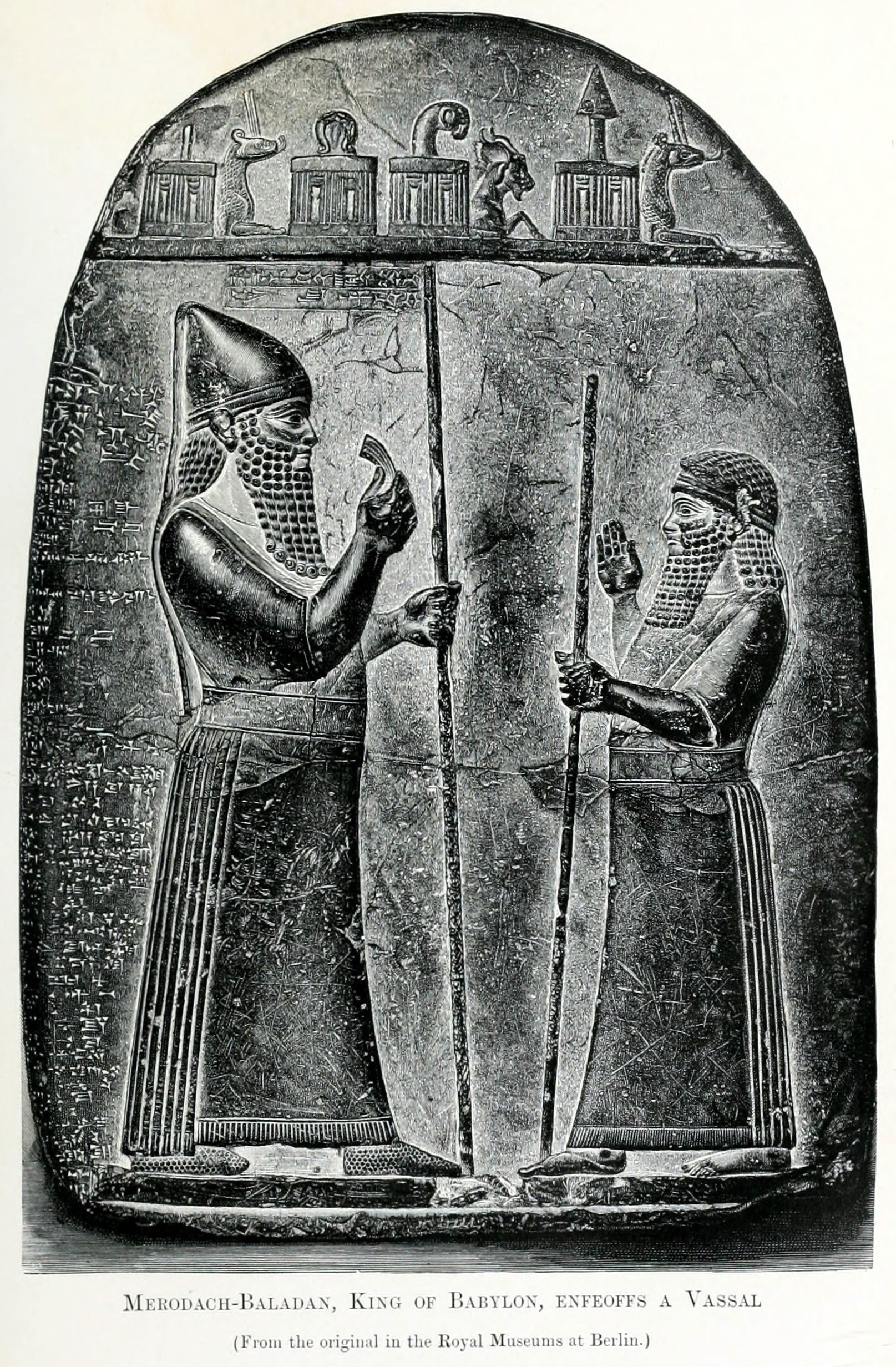 Boundary stone (kudurru) of Merodach-baladan II showing the king granting land to an official, Vorderasiatisches Museum, Berlin, as reproduced in a historical work of the early twentieth century. Public domain, via Wikimedia Commons.

The 30-second version:
Merodach-baladan, in Babylonian Marduk-apla-iddina, was a Chaldean leader who seized the throne of Babylon in 722 BC, held it against Assyria for twelve years, was driven out by Sargon II, came back in 703, and was driven out again by Sennacherib. The Bible says he sent envoys to Hezekiah after his illness. Babylonian king lists, chronicles, Assyrian annals and his own boundary stone all confirm him, and his embassy fits a man building an anti-Assyrian coalition.
See this page's graph and discover linked topics
In full
Marduk-apla-iddina II ("Marduk has given an heir") was head of Bit-Yakin, the most powerful of the Chaldean tribes in the marshlands of southern Babylonia. On the death of Shalmaneser V in 722 BC he took the throne of Babylon, and with the help of Elam he fought the Assyrians to a standstill at Der in 720. He ruled for twelve years until Sargon II invaded in 710 and he fled to the marshes. When Sargon died in 705, he returned and in 703 again proclaimed himself king, but Sennacherib defeated his forces near Kish within months. He fled to Elam, and Sennacherib's later campaigns hunted his followers through the marshes; he seems to have died in exile. Throughout, he sought allies among Assyria's enemies, from Elam to the western kingdoms.
In the Bible
- 2 Kings 20:12-19. "At that time Berodach-baladan the son of Baladan, king of Babylon, sent letters and a present unto Hezekiah; for he had heard that Hezekiah had been sick" (2 Kings 20:12, ASV). Hezekiah shows the envoys "the house of his precious things... and all that was found in his treasures" (20:13, ASV).
- Isaiah 39:1-8. The parallel account, with the spelling Merodach-baladan. Isaiah's verdict: "Behold, the days are coming, when all that is in thy house... shall be carried to Babylon: nothing shall be left, saith Jehovah" (Isaiah 39:6, ASV), and Hezekiah's descendants will serve "in the palace of the king of Babylon" (39:7).
- 2 Chronicles 32:31. The Chronicler adds that the envoys came "to inquire of the wonder that was done in the land," and that "God left him, to try him, that he might know all that was in his heart" (ASV).
The spelling "Berodach" in Kings and "Merodach" in Isaiah reflect the interchange of b and m; Merodach is the Hebrew form of Marduk, Babylon's chief god.
Family and lineage
- Father: called "Baladan" in Kings and Isaiah. Assyrian texts describe him as "son of Yakin," naming the ancestor of his tribe, Bit-Yakin; his actual father is not otherwise recorded.
- Ancestry claimed: in his own inscriptions he traced his line to the earlier Babylonian king Eriba-Marduk.
- Sons: several are named in Assyrian records of Sennacherib's campaigns against Bit-Yakin and later rebellions in the south.
Historical and archaeological evidence
| Source | What it says | Date | Findspot and current home | Grade |
|---|---|---|---|---|
| Babylonian Chronicle (ABC 1) | Records his accession in Babylon in 722/721 BC, the battle of Der in 720, and his flight before Sargon in 710 | compiled later from records | British Museum | Direct |
| Babylonian King List A and Ptolemy's Canon | List his two reigns; the Canon calls him Mardokempados | later compilations | British Museum; Almagest tradition | Direct |
| Sargon II's annals | Describe him as a rebel Chaldean who ruled Babylon twelve years against the will of the gods and was expelled in 710 | about 707 BC | Khorsabad; Louvre and other collections | Direct |
| Sennacherib's annals | The first campaign (703 BC) against him and his allies, his flight, and later operations against Bit-Yakin | 702-689 BC | Nineveh; British Museum | Direct |
| Kudurru of Marduk-apla-iddina II | Boundary stone recording a royal land grant, with his portrait | about 715 BC | Babylon; Vorderasiatisches Museum, Berlin | Direct |
| Building inscriptions | Clay cylinder from Uruk recording his work on the temple of Eanna | 720s-710s BC | Uruk; British Museum | Direct |
Grade: direct. Lawrence Mykytiuk lists Merodach-baladan II among his 53 confirmed Hebrew Bible figures, attested in Sennacherib's inscriptions, Babylonian chronicles and king lists. See Biblical Figures Confirmed by Archaeology.
Scholarly consensus
- Identification. Universal. Name, title and setting all match.
- The date of the embassy. Kings and Isaiah place it "at that time," after Hezekiah's illness, which 2 Kings 20:6 links to the fifteen years added to his life, so in or around his fourteenth year. Two main views:
- About 703 BC, when Merodach-baladan had just retaken Babylon and was gathering allies for the revolt that Sennacherib crushed in 703 to 701. The envoys' interest in Hezekiah's armory fits this.
- About 713-711 BC, during his first reign, when he could also have been seeking western partners while Sargon dealt with Ashdod. Both fit his known career of building coalitions against Assyria. The narrative's placement of the story after the 701 BC deliverance is generally taken as topical rather than chronological.
- Isaiah 39 and the exile. Critical scholars commonly treat the prediction of exile to Babylon as written after the event. Conservative scholars note that Babylon in Hezekiah's day was a real and recurring rival of Assyria, so the oracle names a known power, and that the prophecy is fulfilled more than a century later in the deportations of Nebuchadrezzar.
Theological significance
- The test of Hezekiah's heart. Chronicles reads the embassy as a test: "God left him, to try him" (2 Chronicles 32:31, ASV). After a great deliverance, Hezekiah displays his wealth to foreign allies rather than giving glory to God.
- The first word of Babylonian exile. Isaiah 39 is the hinge of the book. It closes the Assyrian chapters and opens the horizon of Babylon, preparing for the comfort of Isaiah 40.
- Babylon as the coming power. Merodach-baladan's brief kingdom is the first appearance in Kings of Babylon as an actor, and it points ahead to the Babylon that would end the kingdom of Judah.
Church Fathers
No verified patristic comment on Merodach-baladan as a historical figure is cited here.
See also
- People of the Bible, every person in this series grouped by the book of first mention
- Biblical Figures Confirmed by Archaeology, Mykytiuk's list of confirmed persons
- Hezekiah, the king who received his envoys
- Sargon II, who drove him out of Babylon in 710 BC
- Sennacherib, who defeated him in 703 BC
- Isaiah the Prophet, who rebuked Hezekiah for receiving his envoys
- Nebuchadrezzar, the Babylonian king who fulfilled Isaiah's warning
- Babylonian Chronicle and the Capture of Jerusalem
Common questions this page answers
Q: Who was Merodach-baladan in the Bible?
A Chaldean king of Babylon, Marduk-apla-iddina II, who reigned 722-710 BC and again in 703 BC. 2 Kings 20:12 and Isaiah 39:1 say he sent letters and a gift to Hezekiah after Hezekiah recovered from illness.
Q: Why is he called both Berodach-baladan and Merodach-baladan?
2 Kings 20:12 spells the name with b and Isaiah 39:1 with m. The interchange of the two sounds is common in Semitic names, and Merodach is the Hebrew form of Marduk.
Q: Is Merodach-baladan mentioned outside the Bible?
Yes. Babylonian king lists and chronicles record his reigns, Sargon II and Sennacherib describe their wars against him, and a boundary stone with his portrait is in the Vorderasiatisches Museum in Berlin.
Q: Why did Merodach-baladan send envoys to Hezekiah?
The Bible says he had heard of Hezekiah's illness and recovery, and Chronicles adds the wonder in the land. Historians think he was also seeking allies against Assyria, which he fought for most of his life.