Argument
Mere Lack of Belief Defense Defeater
Mere Lack of Belief Defense, Epistemic Accountability Argument, I just lack belief in God, lack of belief is not evidence, God vs Bigfoot, Bigfoot objection, is not believing in God like not believing in Bigfoot, insufficient evidence by what standardIntro
Many atheists today define their position as a simple lack of belief. "I'm not claiming God doesn't exist. I just don't believe He does, the same way I don't believe in Bigfoot. I didn't choose this. The evidence just doesn't convince me." That description can be completely honest, and a Christian should take it at face value.
But notice what usually comes right after it: "...because there isn't enough evidence." That second half changes things. "I am not convinced" is a report about a person. "The evidence is insufficient" is a judgment about the evidence. A judgment about evidence uses a standard, and a standard can be asked about. Insufficient by what measure? Why that measure? Would it be fair if applied to everything else you believe?
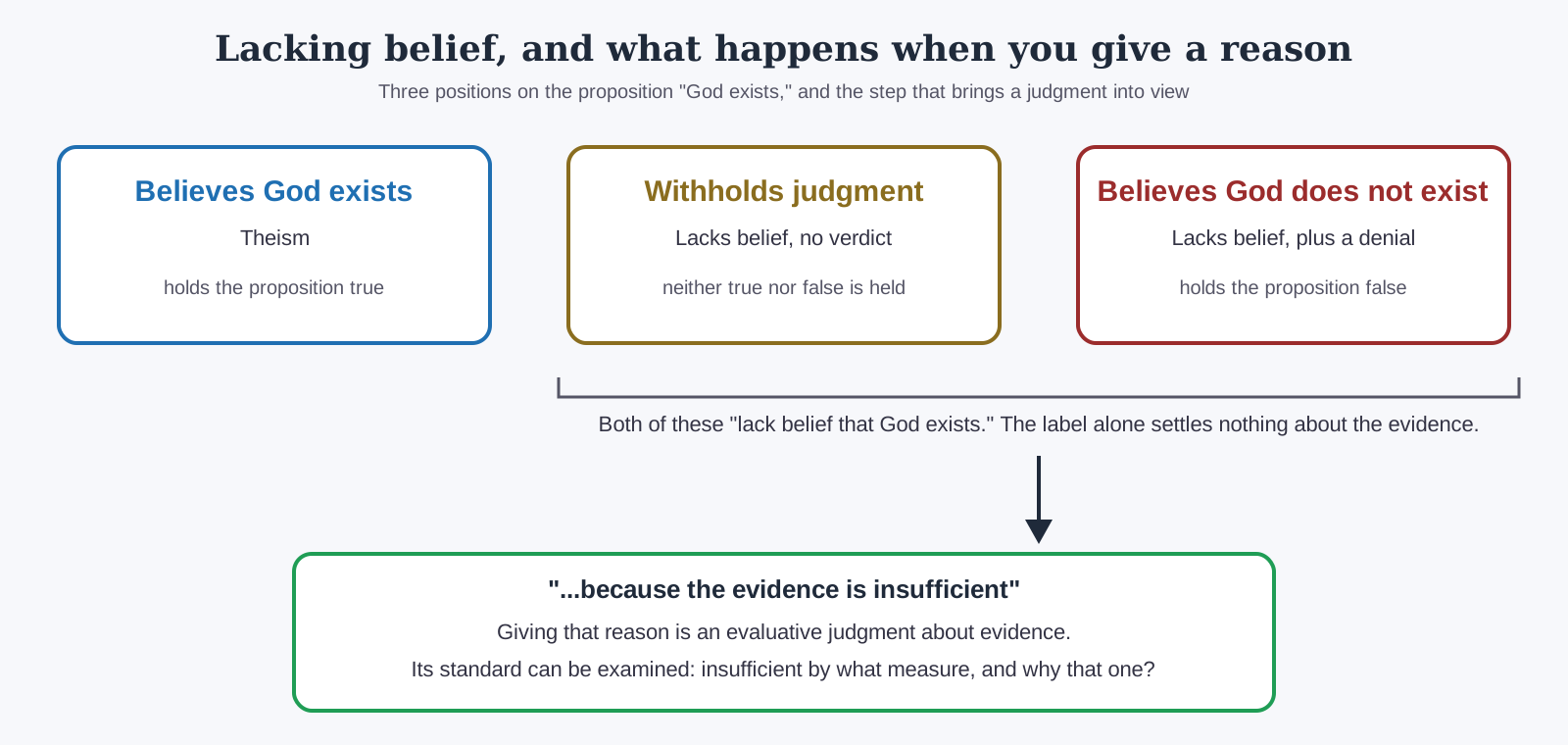
Three positions on "God exists," and the step that turns a lack of belief into a judgment that can be examined. Diagram drawn for the codex.
This page does not try to prove that atheists secretly believe in God, and it does not argue that thinking about God proves He exists. Those arguments are weaker than they sound, and the Bigfoot reply defeats the second one. The point here is narrower and harder to escape: your lack of belief tells me what you think. It does not tell me whether what you think is justified. Once you give a reason, we can talk about the reason.
There is also the Bigfoot comparison itself. Bigfoot would be one more animal inside the world, and the evidence for an animal is bones, tracks and DNA. God is proposed as the reason there is a world at all, and as the ground of the logic and reasoning we use to argue about Bigfoot. Those are different kinds of claims, and treating them as if they need the same kind of evidence is itself a choice that needs defending.
See this page's graph and discover linked topics
Cheatsheet
The 30-second reply:
I'll accept that you lack belief, and I'm not going to tell you that you secretly believe. But you said you lack belief because the evidence is insufficient. That's not a report about you anymore; it's a judgment about the evidence. Insufficient by what standard? Your not being convinced tells me where you are. It doesn't tell me the evidence is weak. If you want to rebut the case, you'll have to show what's wrong with the evidence or the reasoning, not just that you're unpersuaded. And God isn't Bigfoot. Bigfoot would be an animal in the world. God is proposed as the reason there's a world, and as the ground of the reasoning we're using right now.
The fast facts:
- Lacking belief is not believing the opposite. "Not believing God exists" and "believing God does not exist" are different states. Grant the definition; it costs nothing.
- A reason turns a report into a judgment. "I'm not convinced" describes the speaker. "The evidence is insufficient" describes the evidence and invokes a standard.
- Standards can be examined. What counts as sufficient, why, and is it applied consistently?
- Non-conviction is not counter-evidence. Two people can look at the same evidence and reach opposite convictions. Personal non-conviction alone cannot settle whether evidence is adequate.
- Belief is not directly chosen, but inquiry is. What to investigate, which objections to pursue and which standards to apply are largely within a person's control.
- God and Bigfoot are different kinds of claims. One is a contingent creature inside the universe; the other is the proposed ground of the universe and of rational thought.
- Do not run "you must affirm God to deny Him." Conceiving of something is not affirming it. The Bigfoot reply is correct against that argument.
The 3 strongest counter-moves:
- "Are you describing your psychological state, or claiming the evidence is objectively inadequate?" If the first, it is not a rebuttal of anything. If the second, the standard is now on the table.
- "Insufficient according to what standard? Apply it to your belief in other minds, the past, or the reliability of your own reasoning." Inconsistent standards are the usual weak point.
- "Is God the same kind of thing as Bigfoot, a being inside the universe, or the proposed explanation of the universe and of reason?" Forces the category distinction.
Reciprocal concessions (grant the small point, then collect a bigger one):
- Grant: you lack belief, and I won't accuse you of hiding a belief you don't have. Now collect: then my lack of belief in naturalism carries exactly the same weight as yours in theism, which is none, until one of us gives reasons.
- Grant: you cannot make yourself believe on command. Now collect: you can choose what you examine and how fairly you weigh it, and that is what this conversation is about.
- Grant: disbelieving in Bigfoot does not make Bigfoot exist. Now collect: and disbelieving in God does not make the evidence for God go away; it still has to be answered.
The closing line:
Your lack of belief tells me what you think. It doesn't tell me whether what you think is justified. Give me your reason, and we can test it.
In full
The lack-of-belief definition of atheism, popularized by Antony Flew's "The Presumption of Atheism" (1972), distinguishes the absence of a belief, ¬B(G), from belief in a negation, B(¬G). This page grants the distinction and argues it does not deliver the dialectical immunity often claimed for it. When the absence of belief is defended by appeal to insufficient evidence, the speaker has made an evaluative epistemic judgment that presupposes a criterion of sufficiency, and such criteria are subject to rational scrutiny for justification and consistent application (the epistemic accountability argument). A reductio shows that personal non-conviction cannot by itself establish evidential inadequacy, since it would make the same evidence both adequate and inadequate across observers. The page also distinguishes three objects of voluntary control, belief, inquiry and evaluation, to answer "I didn't choose this," and draws a category distinction between contingent intra-mundane posits (Bigfoot) and a proposed necessary ground of reality and intelligibility (God), which undercuts the assumption that the two demand the same type of evidence. It explicitly rejects the inference "to deny God one must first affirm God," which confuses conceiving with affirming, and routes the legitimate version of that intuition to the necessary-being and transcendental arguments.
Argument structure
| Premise | Notes | |
|---|---|---|
| P1 | A person's lack of belief in a proposition does not, by itself, show that the proposition is false or poorly supported | Grants the definition and isolates what it can and cannot do |
| P2 | An atheist who appeals to insufficient evidence to justify lacking belief makes an evaluative judgment about the evidence | The report-vs-judgment distinction |
| P3 | Evaluative judgments offered as rational justifications are open to examination of their standards and reasoning | Includes the reductio on non-conviction |
| P4 | The Bigfoot comparison assumes God and Bigfoot are the same kind of claim, which they are not | Category distinction, with the transcendental supplement |
| C | An atheist who justifies unbelief by appeal to insufficient evidence cannot use "I merely lack belief" to exempt that justification from scrutiny |
The argument not to run
Some Christians argue: "To deny God you must first conceive of God; to conceive of God you must affirm God exists; so denying God presupposes God." The second premise is false. Conceiving of a unicorn does not commit anyone to unicorns, and the Bigfoot reply is correct against this argument.
The intuition behind it has two sound descendants, and they are the ones to use:
- The necessary-being fork. A contingent thing like Bigfoot can simply be absent. A necessary being cannot be merely absent; it either exists or is impossible. So the atheist about the classical God owes an impossibility argument, not just a shrug. See Trap 2 of Define the God You Deny (Debate Traps) and Performative Self-Refutation of Atheist Denial.
- The transcendental argument. The claim is not that thinking about God proves God, but that rational thought itself requires God as its precondition. See Transcendental Argument for God.
Premise 1, Lack of belief is not evidence
Affirmative case
- Grant the definition. ¬B(G) is not B(¬G). A newborn, a person who has never heard of God, and a philosopher who has suspended judgment all lack belief without denying anything.
- What the definition gives and what it doesn't. It describes the speaker's mind. It says nothing about God, and nothing about the quality of the evidence for God.
- It cuts both ways. If lacking belief needs no defense, the Christian's lack of belief in naturalism needs none either. The definition cannot make one side's position the free default.
Anticipated objections
- "The default position is non-belief. You're the one making a claim, so the burden is all yours."
- "I'm not making any claim, so there's nothing for you to examine."
Rebuttals
- A burden to give reasons does not create a right to dismiss them unexamined. The Christian who offers evidence carries the burden of presenting it. The listener who rejects it as insufficient now owes an account of why. See Burden of Proof. Failure mode: treating "the burden is yours" as "my verdict on your evidence needs no reasons."
- Then there is nothing to rebut. If the atheist truly makes no claim, including no claim that the evidence is weak, the conversation can proceed to the evidence itself, and the atheist's silence is not counted against it. The moment a reason for rejection is given, that reason is a claim. Failure mode: making a claim while denying one is being made.
Premise 2, Appealing to insufficient evidence is an evaluative judgment
Affirmative case
- Report versus judgment. "I'm not convinced" is autobiography. "There isn't enough evidence" is a verdict on the evidence. The two sentences are often run together, and they do different work.
- A verdict requires a criterion. Calling evidence insufficient compares it to some threshold of sufficiency. Clifford's famous rule, "it is wrong always, everywhere, and for anyone, to believe anything upon insufficient evidence" (1877), is one such criterion, and it is a philosophical thesis, not a neutral fact.
- The cross-examination. Ask whether the speaker is describing a psychological state or claiming the evidence is objectively inadequate. Either answer clarifies the debate: the first concedes that nothing has been rebutted; the second puts the standard on the table.
Anticipated objections
- "I just mean it doesn't convince me. That's all."
- "I don't need a formal standard. I know weak evidence when I see it."
Rebuttals
- Then I accept that, and it doesn't touch the evidence. "Your lack of conviction, by itself, tells us nothing about whether God exists or whether the evidence is adequate. Correct?" Once granted, the objector's state is no longer a rebuttal, and the evidence stands until someone explains what is wrong with it. Failure mode: using a report about oneself as an argument about the world.
- "I know it when I see it" is a standard, just an unstated one. Unstated standards are the ones most likely to be applied inconsistently. Ask what the same intuition says about evidence for other minds, the reliability of memory, or historical events no one alive witnessed. Failure mode: hiding the criterion so it cannot be tested.
Premise 3, Evaluative standards are open to examination
Affirmative case
- Every rational justification is answerable. A judge, a scientist and a historian are all expected to state and defend their standards of evidence. There is no exemption for judgments about God.
- The reductio on non-conviction. Suppose personal non-conviction is enough to establish that evidence is inadequate. Two people examine the same evidence; one is convinced and one is not. Then the same evidence is both adequate and inadequate under what is supposed to be a single objective standard. So personal non-conviction cannot establish objective inadequacy. The person remains free to report honestly that they are unconvinced; what they cannot do is treat that report as a refutation.
- Belief, inquiry and evaluation are different. Belief itself is not usually chosen directly. Inquiry, deciding what to investigate and which objections to follow up, is substantially voluntary. Evaluation, choosing the methods and standards used to weigh evidence, is partly voluntary and partly shaped by prior commitments. The accountability lies in the second and third. See Belief-Choice Objection Defeater.
| What | Meaning | How voluntary |
|---|---|---|
| Belief | Being convinced a proposition is true | Usually not directly |
| Inquiry | Deciding what evidence to examine | Substantially |
| Evaluation | Choosing standards for weighing evidence | Partly, shaped by prior commitments |
Anticipated objections
- "I didn't choose to be unconvinced, so you can't hold my unbelief against me."
- "Examining my standards is just a way of calling me dishonest."
Rebuttals
- Agreed that you didn't flip a switch; that isn't the question. The question is whether the standard you use is rationally defensible, and whether you can choose what you examine and how fairly. "Can you choose what evidence you look at, which objections you investigate, and whether to reconsider the standards you apply?" is much harder to dismiss than "you chose not to believe." Failure mode: answering an argument about standards as if it were an accusation about motives.
- No. Honest people use bad standards all the time. Examining a standard implies nothing about the sincerity of the person holding it. The Christian should say so explicitly. Failure mode: treating a methodological question as a moral charge.
Premise 4, God is not the same kind of claim as Bigfoot
Affirmative case
- Bigfoot is a contingent animal inside the universe. If it existed, it would leave bones, tracks, scat and DNA, and its absence from all of them is real evidence against it.
- God is proposed as the ground of the universe. The evidence relevant to that claim is the kind the classical arguments appeal to: that anything contingent exists at all, that the universe began, that it is ordered and intelligible, that there are objective moral facts, that minds can reason. Asking for God's footprints is asking for the wrong kind of evidence.
- The transcendental supplement. Van Til and Bahnsen argue that the laws of logic, the uniformity of nature and the reliability of reason presuppose God. If that is right, the atheist uses what only theism accounts for in the very act of comparing God to Bigfoot. See Transcendental Argument for God and Presuppositionalism.
Anticipated objections
- "Special pleading. You've defined God so that no evidence could count against Him."
- "The category difference doesn't prove God exists."
Rebuttals
- No. The claim is that different kinds of claims need different kinds of evidence, which everyone already accepts. Nobody tests a mathematical theorem with a microscope or a historical event with a lab experiment. Evidence against God would be evidence against the classical arguments' premises, and atheist philosophers offer exactly that kind of argument. Failure mode: calling a category distinction special pleading.
- Agreed, and it doesn't need to. Its job is to remove an analogy, not to finish the case. Once the analogy is gone, "I lack belief in God the way I lack belief in Bigfoot" needs to be replaced by an argument. Failure mode: treating a defeater as if it were offered as a proof.
Conclusion
Grant the definition, and the definition grants nothing in return. A lack of belief is a fact about a person. The moment it is defended with "there's not enough evidence," it becomes a judgment that answers to a standard, and the standard has to be named, defended and applied fairly. The Bigfoot comparison does not rescue it, because God and Bigfoot are not the same kind of claim.
Tactical opening / closing
- Opening: "I'll take your definition. You lack belief. Can I ask what you mean when you say the evidence isn't sufficient?"
- Closing: "You don't have to prove God doesn't exist. But you do have to tell me why the evidence I've given fails, because 'I'm not convinced' is a fact about you, not about the evidence."
Connection to Scripture
- Romans 1:19-21, Paul's account of humanity before God: what may be known of God is "manifest in them," His "everlasting power and divinity" are "clearly seen, being perceived through the things that are made, that they may be without excuse." Scripture places the issue at the level of how revelation is received.
- Psalm 14:1, "The fool hath said in his heart, There is no God," the heart as the seat of the judgment.
- Acts 17:11, the Bereans "examining the scriptures daily, whether these things were so," the model of open inquiry the page invites.
- 1 Peter 3:15, a reason for the hope, given "with meekness and fear," the register for the whole exchange.
Romans 1 is a diagnosis of the human race, not a tool for reading an individual's motives in a live conversation. The cross-examination on this page works without accusing anyone of insincerity.
Patristic / scholarly note
- W. K. Clifford, "The Ethics of Belief" (1877): the evidentialist maxim that frequently sits unstated behind "insufficient evidence."
- Antony Flew, "The Presumption of Atheism" (1972): the proposal to define atheism negatively and assign the burden to the theist. Flew later became a theist (There Is a God, 2007).
- Alvin Plantinga, Warranted Christian Belief (2000): a sustained case that classical evidentialism is too strict to be applied consistently. See Reformed Epistemology.
- William Alston, on direct versus indirect control of belief, the basis of the belief/inquiry/evaluation distinction.
- Cornelius Van Til and Greg Bahnsen: the transcendental argument that reasoning presupposes God. See Cornelius Van Til and Greg Bahnsen.
Live-cite kit
Scripture:
- Romans 1:20 ("that they may be without excuse")
- Acts 17:11 ("examining the scriptures daily, whether these things were so")
- 1 Peter 3:15 ("a reason concerning the hope that is in you")
Scholarly:
- Clifford (1877): "It is wrong always, everywhere, and for anyone, to believe anything upon insufficient evidence."
- Plantinga, Warranted Christian Belief (2000), on why that standard cannot be applied consistently
Aphorism:
- "Your lack of belief tells me what you think. It doesn't tell me whether what you think is justified."
- "Not being convinced is a fact about you, not about the evidence."
- "Bigfoot would leave footprints. God is the reason there is ground to leave them on."
Tactical notes
- Order of deployment. Grant the definition first, warmly (Premise 1). Then separate the report from the judgment (Premise 2). Ask for the standard and test it for consistency (Premise 3). Use the Bigfoot distinction only when the comparison is raised (Premise 4).
- Force-commit move. "Is your lack of conviction a description of you, or a claim about the evidence?" Both answers move the conversation forward.
- Deflection to watch for. After conceding non-conviction is not counter-evidence, objectors often return to "well, I'm still not convinced." Agree, and move to the evidence itself. The win is that the evidence is now being discussed on its merits.
- What NOT to defend. Do not argue that atheists secretly believe in God, and do not argue that conceiving of God proves God exists. The first is unprovable about an individual and the second falls to the Bigfoot reply. Do not claim the atheist chose unbelief like flipping a switch.
- Pastoral pivot. Many people who say "I just lack belief" are honestly unsure. Invite them to examine the evidence together rather than to defend a position. Polemical on the position, tender on the person.
Scholarship
Published academic works this page draws on, each matched to a publisher, index or library catalog record.
- Antony Flew, "The Presumption of Atheism," Canadian Journal of Philosophy 2 (1972). doi:10.1080/00455091.1972.10716861
- Antony Flew, There is a God (2007). Open Library
- Alvin Plantinga, Warranted Christian Belief (Oxford University Press, 2000). doi:10.1093/0195131932.001.0001
See also
- Atheism is a Belief, the companion argument that contests the definition itself
- Belief-Choice Objection Defeater, on "I didn't choose this"
- Agnostic Retreat Defeater, the related retreat to "I don't know"
- Burden of Proof, who owes what in the exchange
- Cant Prove a Negative Objection Defeater, the sibling slogan
- Define the God You Deny (Debate Traps), the necessary-being fork
- Performative Self-Refutation of Atheist Denial, the stronger form of the presupposition intuition
- Transcendental Argument for God, the argument from the preconditions of reason
- Evidentialism, the epistemology behind "insufficient evidence"
- Epistemic Standards for Theism, what standards fit the question
- Atheism, master hub
Common questions this page answers
Q: Is atheism just a lack of belief in God?
Many atheists define it that way, and the definition can be granted. But once an atheist says they lack belief because the evidence is insufficient, they have made a judgment about the evidence, and the standard behind that judgment can be fairly examined.
Q: Is not believing in God like not believing in Bigfoot?
No. Bigfoot would be an animal inside the universe and would leave physical traces like bones and DNA. God is proposed as the explanation of the universe itself and of the reasoning we use, so the relevant evidence is of a different kind.
Q: Does not being convinced prove there is no good evidence for God?
No. Two people can look at the same evidence and reach opposite conclusions, so one person's lack of conviction cannot show the evidence is inadequate. To rebut evidence you have to show what is wrong with it.
Q: Do you have to believe God exists in order to deny Him?
No. Conceiving of something is not the same as affirming it exists, which is why that argument fails. The stronger related arguments are the necessary-being argument and the transcendental argument, which do not depend on that mistake.
Q: Can atheists choose not to believe in God?
Belief itself is not usually chosen directly. But people do choose what evidence they examine, which objections they pursue, and what standards they apply, and those choices shape belief over time.