Person
Menelik II
Emperor Menelik II, Menelik, Menelik the Second, Sahle Maryam, Battle of Adwa, AdwaIntro
Menelik II was Emperor of Ethiopia from 1889 to 1913. In 1896, at the Battle of Adwa in the mountains of northern Ethiopia, his armies destroyed an invading Italian force. At the height of the European "Scramble for Africa," when almost the whole continent was being carved up into colonies, an African Christian empire defeated a European power in open battle and kept its independence. Adwa became a symbol of African freedom around the world.
Menelik was a member of an Orthodox Christian dynasty that claimed descent from King Solomon and the Queen of Sheba, and Ethiopian tradition remembers Adwa as a Christian as well as a national victory: the battle fell on the feast of Saint George, and the sacred tablet of a Saint George church was carried with the army. His record is not simple. The same campaigns that built modern Ethiopia also conquered southern peoples such as the Oromo with great violence, and slavery persisted in his empire. Menelik matters to the story of African Christianity because he shows an ancient African church and state defending their independence against colonial Europe.
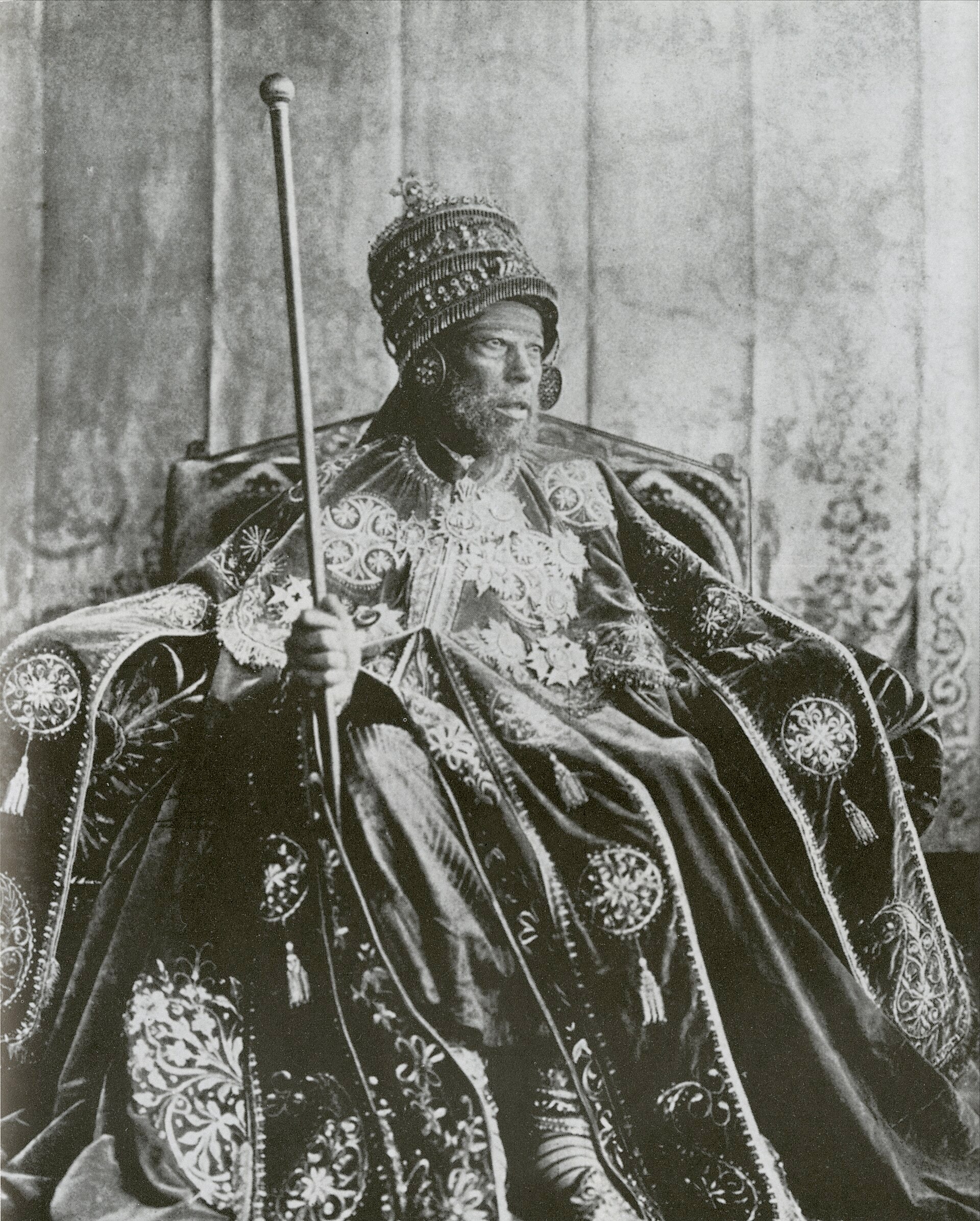 Emperor Menelik II on the throne in coronation dress, photograph of the late nineteenth or early twentieth century. Public domain, via Wikimedia Commons.

See this page's graph and discover linked topics
In full
Menelik II, born Sahle Maryam at Ankober in Shewa on 17 August 1844 and named Menelik by his grandfather after Menelik I, the legendary son of Solomon and the Queen of Sheba, was held captive as a boy by Emperor Tewodros II at Magdala, escaped in 1865, and ruled Shewa as king from 1866. Submitting to Emperor Yohannes IV in 1878, he built a power base in the south through conquest of Oromo, Gurage, Wolayta and other peoples and through the purchase of modern firearms. After Yohannes died at the Battle of Metemma (1889), Menelik was crowned emperor by Abuna Mattewos on 3 November 1889 at the church of Mary on Mount Entoto, claiming legitimacy through Solomonic descent in the male line. The same year he signed the Treaty of Wuchale with Italy, whose Article 17 read in the Amharic as permitting Ethiopia to use Italy for foreign relations and in the Italian as requiring it, which Italy used to claim a protectorate. Menelik repudiated the treaty in 1893 (formal denunciation is often dated 1891-1893), and when Italy invaded from Eritrea his army, with forces led by Empress Taytu Betul and regional lords, defeated General Oreste Baratieri at Adwa on 1 March 1896. The Treaty of Addis Ababa (October 1896) recognized Ethiopian independence. Menelik founded Addis Ababa, introduced railways, telegraph, schools and a modern state apparatus, and expanded the empire to roughly its modern extent. He was incapacitated by strokes from about 1906 and died on 12 December 1913.
Faith and the crown
- Orthodox kingship. Menelik was crowned by the Ethiopian church's bishop, ruled as a Solomonic emperor, and married Taytu Betul in a full church ceremony, making their marriage canonical in a way his earlier unions had not been.
- The Solomonic claim. His name and title rest on the tradition recorded in the Kebra Nagast that Ethiopia's kings descend from Solomon and the Queen of Sheba. The codex treats that descent as tradition, not established history.
- Adwa and Saint George. Tradition holds that the tabot (consecrated altar tablet) of a Saint George church was carried to Adwa and that the victory came on the feast of Saint George. Menelik afterwards built St. George's Cathedral in Addis Ababa, completed in 1911, to commemorate the battle.
- Church and modernization. Menelik's modernizing reforms worked alongside the Ethiopian Orthodox Church, which remained the established church, still under a bishop sent from the Coptic patriarchate of Alexandria.
The Battle of Adwa
| Ethiopia | Italy | |
|---|---|---|
| Commander | Emperor Menelik II, with Empress Taytu, Ras Makonnen, Ras Mengesha, Ras Alula, Ras Mikael and others | General Oreste Baratieri |
| Force | Commonly estimated at about 100,000 | About 17,000-20,000, including Eritrean ascari |
| Losses (estimates vary) | Several thousand killed | Some 5,000-7,000 killed (Italians and ascari), with about 2,000 or more captured |
| Outcome | Decisive Ethiopian victory | Italian retreat; fall of the Crispi government |
The figures are approximate and the sources differ. What is not in doubt is the result: Italy recognized Ethiopia's independence, and Ethiopia remained free of colonial rule until Fascist Italy's invasion in 1935-1936.
Significance
1. African Christian independence in the age of empire
At Adwa an African Christian state, with a church older than most in Europe, defended itself successfully against a European colonial army. It refutes the claim that African Christianity was simply the religion of the colonizer: here it was the religion of the colonized nation that won. See Christianity and Colonialism in Africa and Christianity Is the White Mans Religion Objection Defeater.
2. A symbol beyond Ethiopia
Adwa became a touchstone for Pan-Africanists and for black churches in Africa and the diaspora, where "Ethiopia" had long stood for Africa redeemed, drawing on Psalm 68:31: "Ethiopia shall soon stretch out her hands unto God" (Psalm 68:31, KJV). The "Ethiopianist" independent church movements in southern Africa in the 1890s drew on the same imagery.
3. An honest record
- Southern conquests. Menelik's expansion conquered the Oromo, Sidama, Wolayta, Kaffa and other peoples, often with great loss of life, and imposed a landholding system (gult and neftenya) on the conquered. Many Oromo remember him as a conqueror, not a liberator, and regard Adwa with ambivalence.
- Slavery. Slave-raiding and the slave trade continued in Menelik's empire and helped fund his armies, despite decrees against it. Ethiopia abolished slavery in stages, finally in 1942.
- Christian expansion and coercion. Church-building and settlement followed conquest in the south. The codex distinguishes the gospel from the use of state power to spread a church.
Tensions
- Liberator or conqueror? Both. The codex records the anti-colonial victory and the conquests of the south without letting either cancel the other.
- The Wuchale dispute. Italian sources described a mistranslation; Ethiopian sources described deception. The two texts of Article 17 plainly differ; motive is disputed.
See also
- Ethiopian Orthodox Church, the church of Menelik's empire
- Kebra Nagast, the source of the Solomonic claim behind his name
- Kingdom of Aksum, the ancient Christian kingdom his dynasty claimed to continue
- Christianity and Colonialism in Africa, the wider context of the Scramble for Africa
- Most of the World Was Colonized by Christians Objection Defeater, where Ethiopia's resistance is relevant
- Queen of Sheba, the figure at the root of the dynasty's tradition
- Africa and Christianity, master hub
Common questions this page answers
Q: Who was Menelik II?
Emperor of Ethiopia from 1889 to 1913, a member of the Orthodox Christian Solomonic dynasty. He defeated Italy at the Battle of Adwa in 1896, preserving Ethiopian independence, and founded Addis Ababa.
Q: What happened at the Battle of Adwa?
On 1 March 1896 Menelik's Ethiopian army defeated an invading Italian force under General Baratieri near Adwa in northern Ethiopia. Italy recognized Ethiopia's independence in the Treaty of Addis Ababa later that year.
Q: Was Ethiopia ever colonized?
Ethiopia was never made a colony in the Scramble for Africa thanks to the victory at Adwa. Fascist Italy occupied it from 1936 to 1941, and that occupation ended with Ethiopia's liberation during the Second World War.
Q: Was Menelik II a Christian?
Yes. He was an Ethiopian Orthodox emperor, crowned by the church's bishop, and tradition holds that the sacred tablet of a Saint George church went with his army to Adwa. He built St. George's Cathedral in Addis Ababa to commemorate the victory.
Q: Why is Menelik II controversial?
Because his empire-building conquered the Oromo and other southern peoples with great violence, imposed a harsh land system, and tolerated slave-raiding. He is celebrated as a defender of African independence and criticized as a conqueror.