Person
Menahem
Menahem son of Gadi, Menahem the son of Gadi, Menahem king of Israel, Menahem of Samaria, King MenahemIntro
Menahem son of Gadi seized the throne of Israel by killing the usurper Shallum, who had reigned only a month. He ruled from Samaria for about ten years. When the Assyrian king Pul (Tiglath-Pileser III) came west, Menahem paid him a thousand talents of silver, raised by a tax of fifty shekels on every wealthy man, so that Assyria would back his hold on the throne.
The Assyrian side of the same story survives. Tiglath-Pileser III's own inscriptions list "Menahem of Samaria" among the kings who paid him tribute.
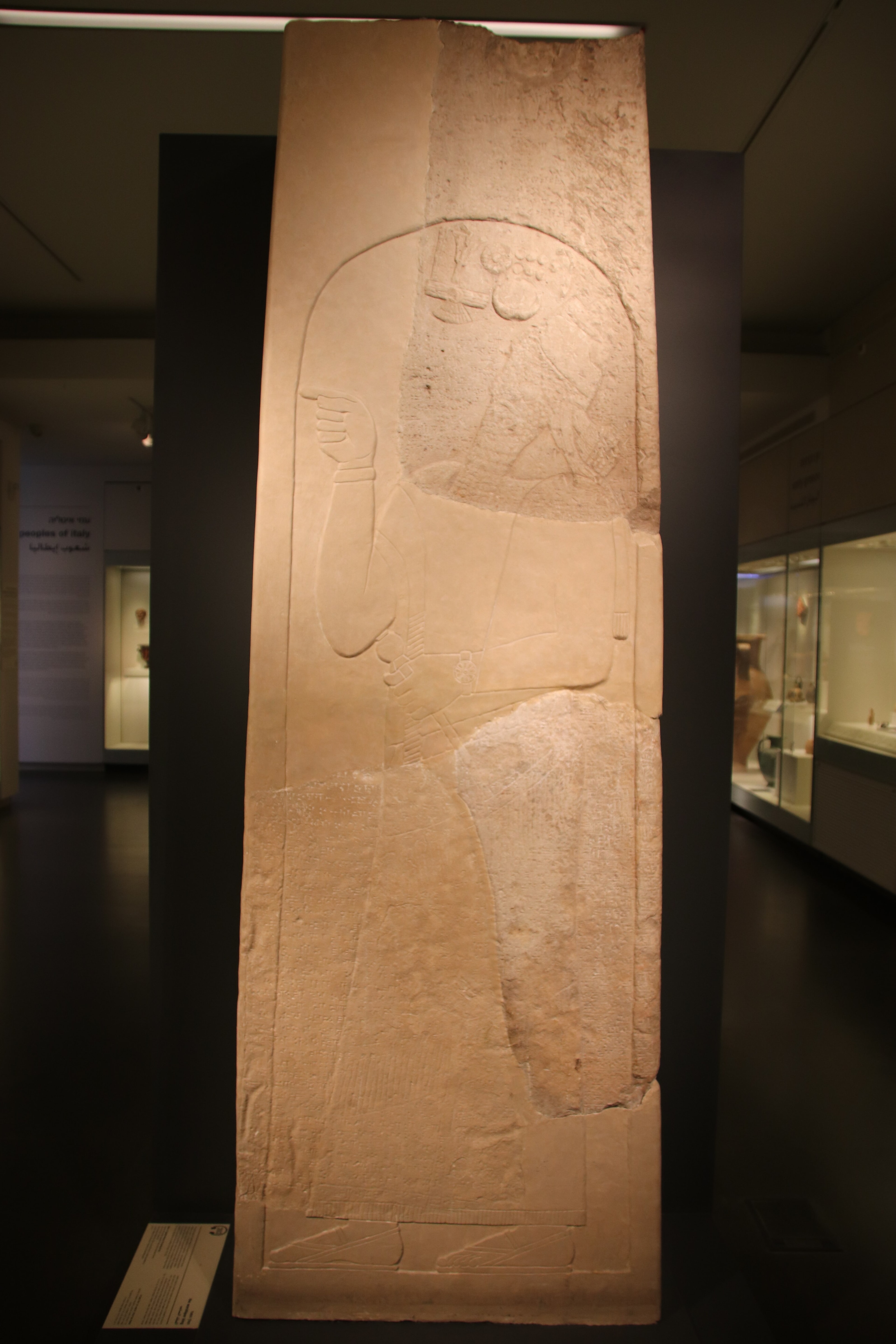
The Iran Stele of Tiglath-Pileser III, from western Iran, about 737 BC, now in the Israel Museum, Jerusalem. Its tribute list names "Menahem of Samaria." Photo: Gary Todd, CC0, via Wikimedia Commons, resized.

The 30-second version:
Menahem took Israel's throne by assassination and held it for about ten years. When the Assyrian king Pul came against the land, Menahem paid him a thousand talents of silver to keep his crown. Pul is Tiglath-Pileser III, and that king's own annals and a stele now in the Israel Museum list "Menahem of Samaria" among his tribute payers. Two independent records, Israelite and Assyrian, tell the same transaction from opposite sides.
See this page's graph and discover linked topics
In full
After the death of Jeroboam II the northern kingdom fell into a cycle of coups. Zechariah was murdered by Shallum after six months, and Shallum by Menahem after one (2 Kings 15:8-14). Menahem came "up from Tirzah," the old capital, which suggests a power base among the army or the older northern establishment. Kings gives him ten years in Samaria (15:17); Mykytiuk dates him 749 to 738 BC, Thiele 752 to 742 BC.
The payment to Pul (15:19-20) is the hinge of his reign. "Pul" is the Babylonian throne name of Tiglath-Pileser III, who ruled Babylon as Pulu; 1 Chronicles 5:26 and the Babylonian king lists support the equation, and it is now standard. Tiglath-Pileser's own records list Menahem among the western rulers who paid tribute, so the biblical and Assyrian sources confirm one another. The usual date for that tribute list is 738 BC, though some scholars place it a few years earlier, and the question affects how the regnal figures of Israel's last kings are fitted together.
In the Bible
- The coup. "Menahem the son of Gadi went up from Tirzah, and came to Samaria, and smote Shallum the son of Jabesh in Samaria, and slew him, and reigned in his stead" (2 Kings 15:14, ASV).
- Tiphsah. He sacked Tiphsah "because they opened not to him," and committed atrocities against pregnant women there (15:16).
- His reign. Ten years in Samaria; "he departed not all his days from the sins of Jeroboam the son of Nebat" (15:17-18, ASV).
- The tribute. "There came against the land Pul the king of Assyria; and Menahem gave Pul a thousand talents of silver, that his hand might be with him to confirm the kingdom in his hand. And Menahem exacted the money of Israel, even of all the mighty men of wealth, of each man fifty shekels of silver, to give to the king of Assyria" (15:19-20, ASV).
- Death. He "slept with his fathers; and Pekahiah his son reigned in his stead" (15:22). Pekahiah was murdered two years later by his officer Pekah (15:23-25).
Family and lineage
- Father: Gadi (2 Kings 15:14). Nothing more is known of the family; "son of Gadi" may point to a clan or regional origin, possibly from Gad, but that is a conjecture.
- Son and successor: Pekahiah, killed in a coup by Pekah son of Remaliah.
Historical and archaeological evidence
- Tiglath-Pileser III's annals from Calah (Nimrud). The annals, carved on wall slabs of his palace and known partly from copies made by nineteenth-century excavators, list the kings who brought tribute in his western campaign, including "Menahem of Samaria" (Me-ni-hi-im-me of the city of Samaria). Grade: direct.
- The Iran Stele. A stele of Tiglath-Pileser III found in western Iran, now in the Israel Museum, Jerusalem, carries a parallel tribute list that again names Menahem of Samaria alongside Rezin of Damascus, Hiram of Tyre (a later Hiram, not the friend of Solomon) and others. Grade: direct.
- Mykytiuk's list. Lawrence Mykytiuk counts Menahem among the 53 securely identified Hebrew Bible persons on the basis of these two inscriptions.
Scholarly consensus
Menahem's existence and his tribute to Tiglath-Pileser III are uncontested. Scholars differ on the exact date of the tribute (738 BC on the majority reading of the annals, with some arguing for 740 or earlier) and on how the per-head tax of fifty shekels relates to the total of a thousand talents. A common calculation, offered by several commentators, is that a thousand talents at fifty shekels a head implies some sixty thousand landowners, which would make the levy a broad tax on the propertied class rather than a few nobles.
Theological significance
- A throne for sale. Kings presents Menahem as a king who buys the backing of a foreign power to secure what he took by violence. The pattern of trusting Assyria instead of God recurs with Ahaz in Judah and ends with the fall of Samaria under Hoshea.
- Prophetic background. Hosea, who prophesied in these years, speaks of Israel going to Assyria for help and of kings set up "but not by me" (Hosea 8:4; 7:11). The chaos of coups from Shallum to Hoshea is the setting of much of his book.
Church Fathers
No patristic comment on Menahem with a verified locator is cited here.
See also
- People of the Bible, every person on the codex's list, by the book that first names them
- Biblical Figures Confirmed by Archaeology, Mykytiuk's list, where Menahem is number 17
- Tiglath-Pileser III, the Assyrian king he paid
- Jeroboam II, whose dynasty ended in the coups before Menahem
- Pekah, who killed Menahem's son and took the throne
- Hosea, the prophet of these years
Common questions this page answers
Q: Who was Menahem in the Bible?
Menahem son of Gadi was a king of the northern kingdom of Israel who took the throne by killing Shallum and reigned about ten years in Samaria. He is best known for paying a thousand talents of silver to the Assyrian king Pul (2 Kings 15:19-20).
Q: Who was Pul king of Assyria?
Pul is Tiglath-Pileser III, who ruled Assyria from 745 to 727 BC. He took the throne of Babylon as well and was known there as Pulu, which is why the Bible can call him by either name.
Q: Is Menahem mentioned outside the Bible?
Yes. Tiglath-Pileser III's annals from his palace at Calah and his stele found in western Iran, now in the Israel Museum, both list "Menahem of Samaria" among the kings who paid him tribute.
Q: Why did Menahem pay tribute to Assyria?
2 Kings 15:19 says he paid so that the Assyrian king's "hand might be with him to confirm the kingdom in his hand." Having seized the throne in a coup, he bought Assyrian backing to secure it, raising the money with a tax of fifty shekels on each wealthy man.