Concept
Matheus Vianna (Carlo Acutis 2013)
Matheus Vianna, Mattheus Vianna, Carlo Acutis beatification miracle, Carlo Acutis miracle Brazil, Acutis annular pancreas healingIntro
Matheus Vianna was born in Brazil in 2009 with annular pancreas, a birth defect in which the pancreas wraps around the first part of the small intestine and squeezes it. He could not keep food down. He vomited constantly, was often in hospital with pneumonia, and was badly underweight.
On 12 October 2013, at a Mass in Campo Grande where a relic of Carlo Acutis was shown, the boy touched the relic and asked out loud to stop vomiting. His family says he ate a full meal that night and kept it down, and that he never had the old vomiting again. A later scan found nothing wrong with his pancreas.
The Catholic Church investigated the case through a church tribunal in Brazil and a medical board in Rome. Pope Francis approved it as a miracle in February 2020, and Carlo Acutis was beatified in Assisi on 10 October 2020. It is filed in the documented tier because it passed the formal Vatican process.
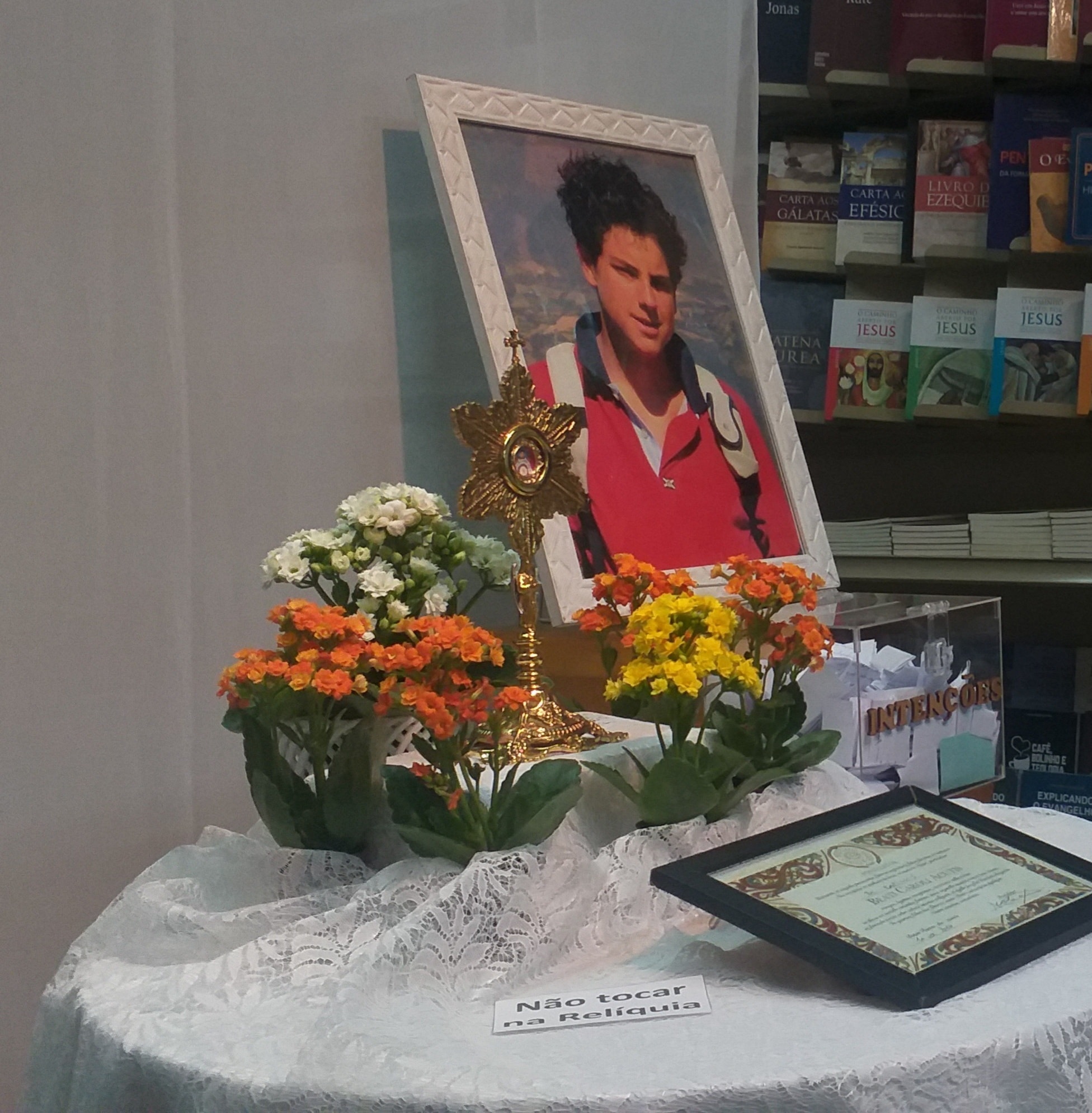
A relic of Carlo Acutis displayed for veneration in Rio de Janeiro, Brazil, September 2025. Photo: Sir Velpertex di Crantx, CC0, via Wikimedia Commons, resized.

The 30-second version:
Matheus Vianna, a Brazilian boy born in 2009 with annular pancreas, vomited nearly everything he ate and was severely underweight. On 12 October 2013 he touched a relic of Carlo Acutis at a Mass in Campo Grande and asked to stop vomiting. His family says he ate a full meal that night without vomiting and never relapsed, and a scan months later found no sign of the anomaly. A church tribunal in Brazil gathered testimony and medical evidence, the Vatican's medical board gave a positive opinion in November 2019, and Pope Francis authorized the decree on 21 February 2020. Carlo Acutis was beatified on 10 October 2020. The medical file is not public, and the accounts differ on some details, so the case rests mainly on the Vatican process.
See this page's graph and discover linked topics
In full
The case is the beatification miracle of Carlo Acutis (born in London on 3 May 1991, died in Monza on 12 October 2006), an Italian teenager known for cataloguing eucharistic miracles online. The Holy See Press Office bulletin of 22 February 2020 records that on 21 February 2020 Pope Francis received Cardinal Angelo Becciu, prefect of the Congregation for the Causes of Saints, and authorized the promulgation of the decree on "the miracle attributed to the intercession of the Venerable Servant of God Carlo Acutis". The press reported that the miracle was the 2013 healing of a Brazilian child with "a rare congenital anatomic anomaly of the pancreas", and that the Congregation's Medical Council had given a positive opinion the previous November (CNA, via Angelus News, February 2020). The patient, Matheus Vianna of Campo Grande, had annular pancreas (Aleteia, October 2020; Gazeta do Povo, April 2025). On 12 October 2013, during a Mass at which Father Marcelo Tenório exposed a relic of Acutis, the boy touched it and asked to stop vomiting; his family reports that he ate solid food that evening without vomiting and did not relapse (National Catholic Register, October 2020; Gazeta do Povo, 2025). A later ultrasound found no abnormality (Gazeta do Povo, 2025). Acutis was beatified in Assisi on 10 October 2020. A second miracle, the recovery of Valeria Valverde, a Costa Rican woman gravely injured in a bicycle accident in Florence in 2022, was approved on 23 May 2024, and Acutis was canonized on 7 September 2025. Conflicts among the published accounts are recorded under Tensions. Under the Miracles schema the case is Tier 1 on Vatican ratification.
Summary
Matheus Vianna, born in Brazil in 2009, was diagnosed with annular pancreas after years of vomiting, pneumonia and poor weight gain. On 12 October 2013, at a Mass in the parish of São Sebastião in Campo Grande where Father Marcelo Tenório exposed a relic of Carlo Acutis, he touched the relic and asked to stop vomiting. By his family's account he ate a normal meal that night without vomiting, never returned to the old pattern, and gained weight, and a follow-up ultrasound found nothing wrong. A tribunal in the Archdiocese of Campo Grande gathered testimony and medical evidence, the Medical Council of the Congregation for the Causes of Saints gave a positive opinion in November 2019, and Pope Francis authorized the decree on 21 February 2020. Acutis was beatified on 10 October 2020.
The event
- The condition. Matheus was born in 2009 (National Catholic Register, 2020). From his first years he vomited repeatedly, was hospitalized several times with pneumonia, and stayed below the expected weight curve. Examinations including an ultrasound gave the diagnosis of annular pancreas (Gazeta do Povo, 2025).
- How ill he was. The National Catholic Register reports that at nearly four he weighed about 20 pounds, lived mainly on a vitamin and protein shake, and was not expected to live long. Another Brazilian report gives his weight as nine kilograms at age two (TNH1). His grandmother, Solange Vianna, recalls, "Eu percebi que ele estava magro demais, muito fraco" ("I noticed he was far too thin, very weak") (Gazeta do Povo, 2025). He carried a small towel because of the vomiting (ChurchPOP, 2024).
- The relic. Father Marcelo Tenório, a family friend who had begun praying for Acutis's beatification after learning of him online, obtained a relic from Acutis's mother in 2013 and arranged a Mass and blessing at his parish (National Catholic Register, 2020). The relic was a piece of Acutis's clothing (Aleteia, 2020; Gazeta do Povo, 2025). His mother, Luciana Vianna, had prayed a novena to Acutis in the days before (National Catholic Register, 2020).
- 12 October 2013. At the Mass, the boy touched the relic and asked, aloud, to stop vomiting (Gazeta do Povo, 2025; ChurchPOP, 2024). Father Tenório places the event in the chapel of Our Lady of Aparecida in the parish of São Sebastião, Campo Grande (ChurchPOP, 2024). The date was the seventh anniversary of Acutis's death.
- That evening. On the way home he said he was already cured. At home he asked for a full meal and ate it without vomiting (National Catholic Register, 2020). His grandmother remembers broth with rice and a banana: "Ele comeu e não vomitou" ("He ate and did not vomit") (Gazeta do Povo, 2025).
- Afterward. He stopped having frequent vomiting and gained weight (Gazeta do Povo, 2025). Father Tenório's account says new tests in February 2014 confirmed full recovery (ChurchPOP, 2024). His grandmother says a repeat ultrasound, more than a year after the diagnosis, found that "não tinha nada, estava tudo certinho" ("there was nothing, everything was fine") (Gazeta do Povo, 2025).
- Later life. In 2024 his grandmother described him as an ordinary teenager who enjoys food and games (ChurchPOP, 2024).
Witnesses + documentation
- Matheus Vianna, the patient.
- Luciana Vianna, his mother, who prayed the novena (National Catholic Register, 2020).
- Solange Vianna, his grandmother, who has given detailed interviews to the Brazilian press (Gazeta do Povo, 2025; ChurchPOP, 2024, citing UOL).
- Father Marcelo Tenório of the parish of São Sebastião, Campo Grande, who brought the relic, celebrated the Mass and has given his own account (National Catholic Register, 2020; ChurchPOP, 2024).
- Father Nicola Gori, postulator of the Acutis cause, who described the healing to the Italian press and said that the physiology of the affected organ had changed (National Catholic Register, 2020).
- The treating physicians, who examined him before and after. They are not named in the published reports reviewed here.
- A diocesan tribunal in the Archdiocese of Campo Grande, which gathered testimony and medical evidence and sent its acts to Rome (ChurchPOP, 2024).
- The Medical Council of the Congregation for the Causes of Saints, positive opinion, November 2019 (CNA, via Angelus News, 2020).
- Pope Francis, who authorized the decree on 21 February 2020 (Holy See Press Office bulletin, 22 February 2020).
Verification
What was checked:
- The official recognition. The Holy See Press Office bulletin confirms the decree on a miracle attributed to Acutis's intercession, authorized on 21 February 2020. That the miracle in question is the healing of a Brazilian child in 2013 is reported consistently by the Catholic press.
- The process. A miracle for beatification must pass a diocesan inquiry, the Congregation's medical board, its theological consultors and its cardinals before the Pope approves it. The press reports place the medical board's positive opinion in November 2019, some six years after the event.
- The diagnosis. Every account names annular pancreas, a real congenital anomaly, and the family reports diagnostic imaging before and after.
Naturalistic explanations considered:
- Misdiagnosis. Annular pancreas is usually confirmed by CT, MRI, contrast studies or at surgery; ultrasound alone can miss or mimic it. If the original diagnosis was wrong, a normal later scan would prove nothing. Against this, the clinical picture of constant vomiting and failure to thrive was severe and long-standing, and the case was reviewed by the Vatican's medical board with the medical records.
- Spontaneous improvement. The symptoms of a partial duodenal narrowing can vary over time. Against this, the reported change was immediate, on the day of the prayer, and lasting. An anatomical ring of pancreatic tissue is not known to resolve on its own; the usual treatment for an obstructing ring is surgery.
Caveats and remaining uncertainties:
- The medical file is not public. None of the sources reviewed prints the imaging reports, the names of the physicians, or the report of the Vatican medical board.
- The detailed narrative comes from the family and the priest. The Vatican documents confirm the recognition but give no clinical detail.
- No independent skeptical analysis was found. A search turned up no published critique of this case, and no independent medical reanalysis either.
Tensions
The published accounts differ on several points. They are recorded here, attributed, without choosing a winner.
- The year. Most sources, including the Vatican-reported description and the grandmother's interview, give 12 October 2013. An Aleteia feature (October 2020) and a Brazilian shrine site give 12 October 2010. Aleteia's own figures (a boy aged 10 in 2020, diagnosed at two) do not fit 2010, and the 2013 date is the one the record supports.
- Who took him. ChurchPOP (2024) and Aleteia (2020) say his grandfather brought him and told him what to ask. The National Catholic Register (2020) emphasizes his mother's novena and says family members attended.
- Surgery. Aleteia (2020) says doctors had concluded he needed surgery but feared he would not survive it. His grandmother told Gazeta do Povo (2025) that surgery had been ruled out because of his condition, and that he was treated with medication and special milk.
- The place. Father Tenório names the chapel of Our Lady of Aparecida in the parish of São Sebastião (ChurchPOP, 2024); Gazeta do Povo (2025) speaks of the parish of São Sebastião.
- The date of recognition. Father Tenório gives 14 November 2019 as the date the miracle was officially recognized (ChurchPOP, 2024). CNA reports a positive opinion from the Medical Council in November 2019, and the papal decree itself came on 21 February 2020. The November date most likely refers to the medical stage.
Apologetic value
- A child, a specific request, an immediate change. The claim is narrow and checkable: a boy with a documented congenital obstruction asked, in front of a congregation, to stop vomiting, and the vomiting stopped that day. Narrow claims are harder to explain away than vague ones.
- Answered prayer, read in biblical terms. Scripture records healings connected with objects associated with a servant of God: "God wrought special miracles by the hands of Paul: insomuch that unto the sick were carried away from his body handkerchiefs or aprons, and the diseases departed from them" (Acts 19:11-12, ASV). The text credits God, not the cloth. See Acts 19.11-12.
- Honest limits. The medical record is not public, the diagnosis rested in part on ultrasound, and the narrative comes from the family and priest. The case should be deployed as one strand in a cumulative case, not as a stand-alone proof. See Argument from Miracles.
- How to deploy it. Lead with the facts the Vatican and the press agree on: the diagnosis, the 2013 date, the immediate and lasting change, the medical board's opinion and the 2020 decree. Concede the variations in the accounts. The recognition is Catholic and attributes the healing to Acutis's intercession; for a Protestant audience, present the medical facts and a family's answered prayer, and let the audience weigh the setting.
See also
- Miracles, master hub
- _schema, the vetting standard this entry follows
- Lucas Maeda de Oliveira (Marto 2013), another Brazilian child's recovery from 2013 accepted as a canonization miracle
- Marcilio Andrino (Mother Teresa 2008), a Brazilian canonization miracle in which a relic was placed on the patient
- Jake Finkbonner (Kateri Tekakwitha 2006), a child's recovery after a relic was brought to him
- Argument from Miracles, the argument this case supports
- David Hume, whose standard for credible miracle testimony this case presses on
- Naturalism, the worldview such cases press against
Common questions this page answers
Q: What miracle led to the beatification of Carlo Acutis?
It was the healing of Matheus Vianna, a Brazilian boy with annular pancreas, a congenital defect that made him vomit almost everything he ate. On 12 October 2013 he touched a relic of Carlo Acutis at a Mass in Campo Grande and asked to stop vomiting, and his family says he never vomited that way again. Pope Francis authorized the decree on 21 February 2020, and Acutis was beatified on 10 October 2020.
Q: What is annular pancreas?
It is a rare birth defect in which a ring of pancreatic tissue wraps around the duodenum, the first part of the small intestine, and can narrow or block it. In children it can cause vomiting and failure to gain weight, and an obstructing ring is usually treated with surgery.
Q: How did the Church investigate the Matheus Vianna healing?
A church tribunal in the Archdiocese of Campo Grande collected testimony and medical evidence and sent it to Rome. The Medical Council of the Congregation for the Causes of Saints gave a positive opinion in November 2019, and after review by theologians and cardinals, Pope Francis authorized the decree in February 2020.
Q: Could the healing have a natural explanation?
The main possibilities are a mistaken original diagnosis or a natural easing of symptoms. Against them, the change was reported as immediate and lasting, a later scan found nothing wrong, and the Vatican's medical board reviewed the records. The medical file has not been published, so outside readers cannot check it directly.
Q: Was this the only miracle attributed to Carlo Acutis?
No. A second miracle, the recovery of Valeria Valverde, a Costa Rican woman gravely injured in a bicycle accident in Florence in 2022, was approved on 23 May 2024 and cleared the way for his canonization on 7 September 2025.