Person
Manasseh of Judah
King Manasseh, Manasseh king of Judah, Manasseh son of Hezekiah, Manasses king of Judah, Menasi of JudahIntro
Manasseh son of Hezekiah was king of Judah for fifty-five years, the longest reign of any king of Judah or Israel. He undid his father's reforms, rebuilt the high places, set up altars to Baal and to the stars in the Temple courts, practiced sorcery, sacrificed his son, and filled Jerusalem with innocent blood. Kings names his sins as the reason Judah would later go into exile. Chronicles adds that the Assyrians took him in chains to Babylon, where he humbled himself and prayed, and that God brought him back to his kingdom.
Assyrian inscriptions of Esarhaddon and Ashurbanipal name "Manasseh king of Judah" among their vassal kings.
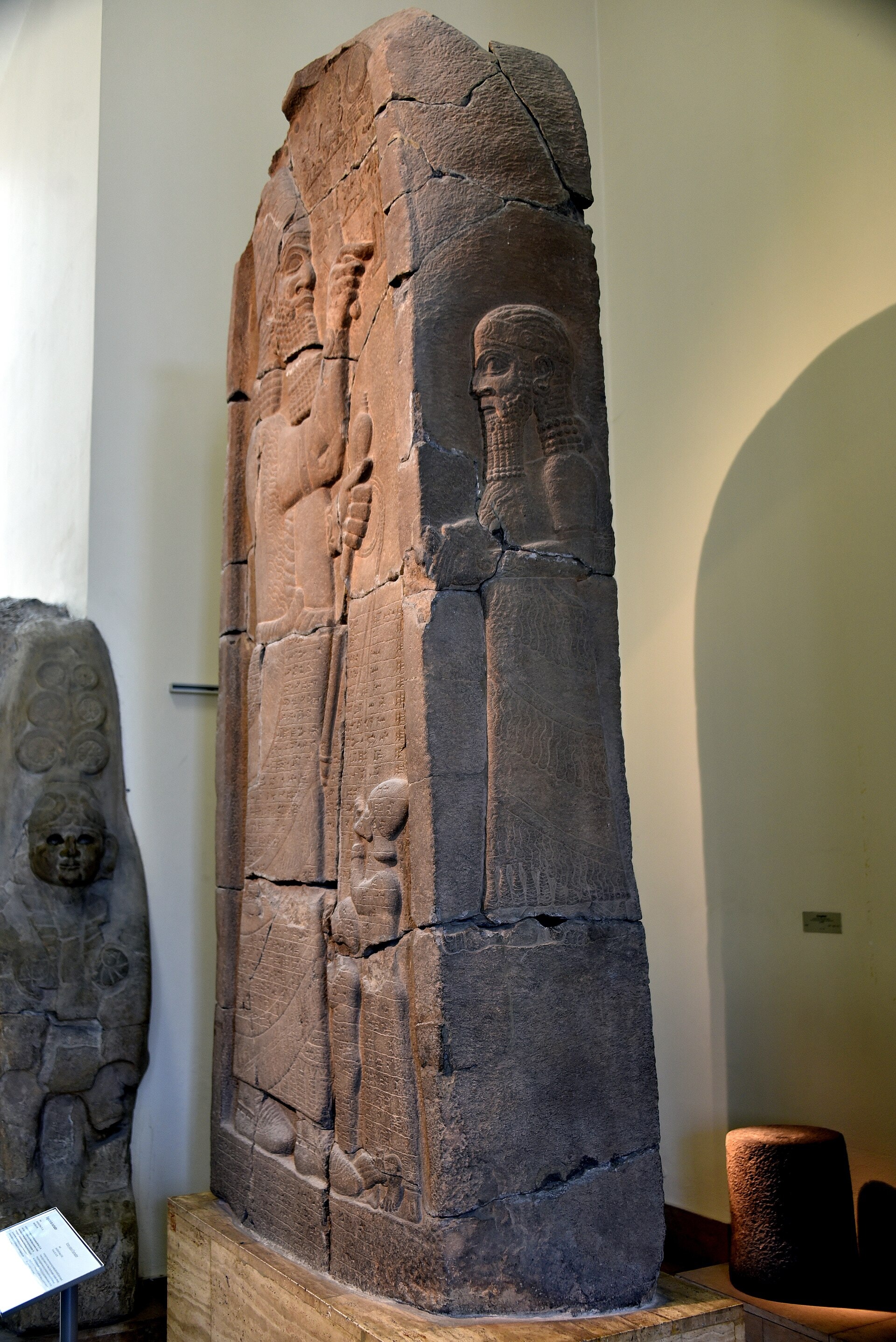
The victory stele of Esarhaddon from Sam'al (Zincirli), 671 BC, Pergamon Museum, Berlin. The king holds ropes that pass through the lips of two small captives. Esarhaddon is the Assyrian overlord whose inscription lists Manasseh among his vassals. Photo: Osama Shukir Muhammed Amin FRCP(Glasg), CC BY-SA 4.0, via Wikimedia Commons, resized.

The 30-second version:
Manasseh reigned fifty-five years and was, by the Bible's account, the most wicked king of Judah: idols in the Temple, child sacrifice, sorcery, and innocent blood. Kings says his sins sealed Judah's exile. Chronicles adds that he was taken to Babylon in chains, repented, and was restored. Assyrian prisms of Esarhaddon and Ashurbanipal list "Manasseh king of Judah" among the kings who served them, which is exactly the vassal status the Bible implies.
See this page's graph and discover linked topics
In full
Manasseh came to the throne at twelve (2 Kings 21:1). The fifty-five years of Kings most likely include a co-regency with Hezekiah; Mykytiuk dates him 697/696 to 642/641 BC, and Thiele 697 to 642 BC with a co-regency to 687/686. His reign falls in the decades when Assyria under Sennacherib, Esarhaddon and Ashurbanipal reached its greatest extent, including the conquest of Egypt. Judah survived as a loyal vassal, and the Assyrian records show Manasseh supplying building materials and troops on demand.
The two biblical accounts differ in emphasis. Kings presents an unrelieved picture and makes Manasseh the decisive cause of the Babylonian exile (2 Kings 21:10-15; 23:26; 24:3-4). Chronicles includes the same sins but adds his capture, repentance, return and partial reform (2 Chronicles 33:11-17), offering him as an example that no one is beyond repentance. The repentance account has no parallel in Kings, and its historicity is debated (see below).
In the Bible
- Accession. "Hezekiah slept with his fathers; and Manasseh his son reigned in his stead" (2 Kings 20:21, ASV). "Manasseh was twelve years old when he began to reign; and he reigned five and fifty years in Jerusalem: and his mother's name was Hephzibah" (21:1, ASV).
- The apostasy. "He built again the high places which Hezekiah his father had destroyed; and he reared up altars for Baal, and made an Asherah, as did Ahab king of Israel, and worshipped all the host of heaven" (21:3, ASV). He built altars to the host of heaven in both Temple courts, "made his son to pass through the fire, and practised augury, and used enchantments, and dealt with them that had familiar spirits," and set the image of Asherah in the Temple (21:4-7, ASV).
- Worse than the Amorites. "Manasseh seduced them to do that which is evil more than did the nations whom Jehovah destroyed before the children of Israel" (21:9, ASV).
- Innocent blood. "Moreover Manasseh shed innocent blood very much, till he had filled Jerusalem from one end to another" (21:16, ASV).
- The judgment announced. "I will stretch over Jerusalem the line of Samaria, and the plummet of the house of Ahab; and I will wipe Jerusalem as a man wipeth a dish, wiping it and turning it upside down" (21:13, ASV).
- Captivity and repentance (Chronicles). "Jehovah brought upon them the captains of the host of the king of Assyria, who took Manasseh in chains, and bound him with fetters, and carried him to Babylon. And when he was in distress, he besought Jehovah his God, and humbled himself greatly... and he was entreated of him, and heard his supplication, and brought him again to Jerusalem into his kingdom. Then Manasseh knew that Jehovah he was God" (2 Chronicles 33:11-13, ASV). Afterward he built an outer wall for the city of David, removed the foreign gods from the Temple, and restored the altar of the LORD (33:14-16).
- Death and burial. He "was buried in the garden of his own house, in the garden of Uzza" (2 Kings 21:18, ASV).
- Remembered as the cause of exile. Josiah's reform did not avert judgment "because of all the provocations wherewith Manasseh had provoked him" (2 Kings 23:26, ASV); see also 24:3-4 and Jeremiah 15:4, "because of Manasseh, the son of Hezekiah, king of Judah, for that which he did in Jerusalem" (ASV).
- Genealogies. 1 Chronicles 3:13; Matthew 1:10.
Family and lineage
- Father: Hezekiah. Mother: Hephzibah (2 Kings 21:1).
- Son and successor: Amon, assassinated after two years (2 Kings 21:19-23).
- Grandson: Josiah, the great reforming king.
- Line of David: "Hezekiah begat Manasseh; and Manasseh begat Amon; and Amon begat Josiah" (Matthew 1:10, ASV).
Historical and archaeological evidence
- Esarhaddon's Prism B (Nineveh). A building inscription of Esarhaddon, about 673 to 672 BC, lists twenty-two kings of "Hatti" (the west) whom he ordered to transport timber and stone for his palace at Nineveh. Among them is "Manasseh king of Judah" (Me-na-si-i king of the city of Judah), named alongside the kings of Tyre, Edom, Moab, Gaza, Ashkelon, Ekron, Byblos and others. Grade: direct.
- Ashurbanipal's Prism C. Ashurbanipal's account of his first campaign against Egypt (about 667 BC) lists the western kings who brought tribute and sent forces with his army, again including Manasseh king of Judah. Grade: direct.
- Mykytiuk's list. Lawrence Mykytiuk counts Manasseh among the 53 securely identified persons on the strength of these two inscriptions.
- The capture to Babylon. No Assyrian text records Manasseh's capture. Defenders of the Chronicles account point out that Babylon was then under Assyrian control, that Esarhaddon rebuilt it and Ashurbanipal ruled it after crushing his brother Shamash-shum-ukin's revolt (652 to 648 BC), and that an Assyrian summons of a suspect vassal to Babylon would fit that period. Ashurbanipal's inscriptions also record the similar treatment and later restoration of the Egyptian ruler Necho I. This shows the account is plausible in its setting; it does not prove it.
Scholarly consensus
Manasseh's long reign and vassalage to Assyria are secure. Two questions divide scholars:
- The repentance. Many critical scholars regard 2 Chronicles 33:11-17 as the Chronicler's theological explanation of how so wicked a king reigned so long, since Chronicles generally ties long life to faithfulness. Others, including H. G. M. Williamson in his commentary, allow that the Chronicler may have drawn on a genuine tradition, noting the plausible Assyrian context and the building notice of 33:14. The codex records both.
- The portrait. Some historians, such as Israel Finkelstein and Neil Asher Silberman, argue that Manasseh's reign was a time of economic recovery after 701 BC under Assyrian integration, and that Kings' portrait reflects the religious judgment of the Deuteronomistic historians. Kings itself makes no claim about the economy; its verdict is religious.
Theological significance
- The sin that sealed the exile. Kings treats Manasseh as the point of no return. Even Josiah's wholehearted reform did not turn back the judgment (2 Kings 23:25-26). The theme is accumulated guilt and the patience of God reaching its limit.
- Grace for the worst of sinners. Chronicles makes the same king the Bible's most striking case of repentance: "Then Manasseh knew that Jehovah he was God" (2 Chronicles 33:13). The two accounts together hold judgment on a nation and mercy to a person side by side. See Repentance.
- The Prayer of Manasseh. A short penitential prayer attributed to him, alluded to in 2 Chronicles 33:18-19 ("his prayer unto his God"), survives in Greek. It is in the Septuagint tradition of some churches, among the Apocrypha in the 1611 King James Bible, and is not part of the Hebrew or Protestant canon.
- Child sacrifice. Manasseh's worship in the valley of Hinnom (2 Chronicles 33:6) is part of the background of Jeremiah's oracles against Topheth. See Molech and Topheth and the Valley of Hinnom.
- Isaiah's death. Later Jewish tradition (the Ascension of Isaiah, and the Babylonian Talmud, Yevamot 49b) says Manasseh had Isaiah sawn in two. The Bible does not record Isaiah's death; Hebrews 11:37 mentions martyrs who "were sawn asunder" without naming them.
Church Fathers
- Apostolic Constitutions 2.22 presents David, the Ninevites, Hezekiah and Manasseh as examples of repentance, tells Manasseh's story from Chronicles, and gives the full text of his prayer, beginning "O Lord, almighty God of our fathers."
- Justin Martyr, Dialogue with Trypho 120, speaks of "the death of Isaiah, whom you sawed asunder with a wooden saw," reflecting the tradition later attached to Manasseh, though Justin does not name him.
See also
- People of the Bible, every person on the codex's list, by the book that first names them
- Biblical Figures Confirmed by Archaeology, Mykytiuk's list, where Manasseh is number 25
- Esarhaddon and Ashurbanipal, the Assyrian kings who name him
- Hezekiah, his father, whose reforms he undid
- Isaiah the Prophet, whom tradition says he killed
- Molech, on the child sacrifice in his reign
- Repentance, the theme of the Chronicles account
Common questions this page answers
Q: Who was the most wicked king of Judah?
The Bible's verdict falls hardest on Manasseh. 2 Kings 21 says he rebuilt the high places, put idols and altars to the stars in the Temple, sacrificed his son, practiced sorcery and filled Jerusalem with innocent blood, and it names his sins as the reason Judah went into exile.
Q: Did Manasseh repent?
2 Chronicles 33:11-13 says the Assyrians took him in chains to Babylon, where he humbled himself and prayed, and God restored him to his kingdom. 2 Kings does not mention the repentance, and scholars debate whether the Chronicler drew on an older source.
Q: Is King Manasseh mentioned in Assyrian records?
Yes. Esarhaddon's Prism B lists "Manasseh king of Judah" among twenty-two western kings who supplied materials for his palace at Nineveh, and Ashurbanipal's Prism C lists him among the kings who supported his campaign against Egypt.
Q: Did Manasseh kill Isaiah?
The Bible does not say. Jewish tradition, in the Ascension of Isaiah and the Talmud (Yevamot 49b), says Manasseh had Isaiah sawn in two, and Justin Martyr knew the tradition of Isaiah being sawn asunder. Hebrews 11:37 mentions martyrs who were "sawn asunder" without naming them.
Q: What is the Prayer of Manasseh?
It is a short penitential prayer in Greek attributed to Manasseh during his captivity, connected with "his prayer unto his God" in 2 Chronicles 33:18. It appears among the Apocrypha of the 1611 King James Bible and in some Orthodox Bibles, and is not part of the Hebrew or Protestant canon.