Concept
Luigina Traverso (Lourdes 1965)
Luigina Traverso, Sister Luigina Traverso, Suor Luigina Traverso, 68th Lourdes miracle, Lourdes 68th miracle, Traverso Lourdes healingIntro
Luigina Traverso was an Italian nun, a Salesian sister, born in 1934. From about the age of thirty her left leg was paralysed by a painful condition of the lower spine and the sciatic nerve. She had several operations, and none of them worked. In July 1965 she went to Lourdes lying on a stretcher, because she could neither walk nor stand.
On 23 July 1965, during the procession of the Blessed Sacrament, she felt a strong warmth go through her body and an urge to get up. The pain left, she began to move the foot that had been paralysed, and she went home walking.
The doctors at Lourdes opened a file on her a year later. In 2011 an international panel of doctors found that her cure could not be explained, and on 11 October 2012 her bishop's decree declaring it a miracle was made public at Lourdes. It is the 68th miracle officially recognized there. The case is filed in the documented tier because it passed the full Lourdes medical process.
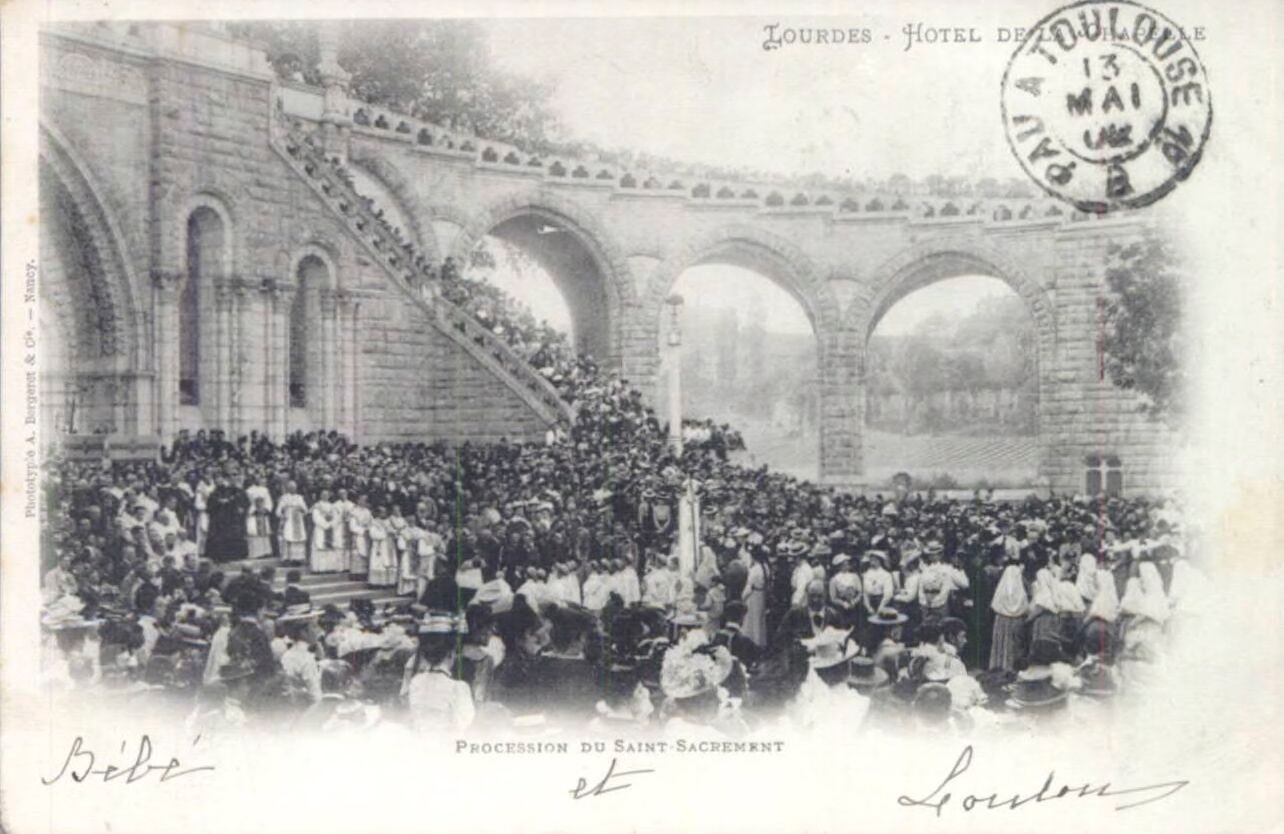
The procession of the Blessed Sacrament at Lourdes, on a postcard of about 1902, the same daily procession during which Sister Luigina reported her cure in 1965. Photo: A. Bergeret & Cie, public domain, via Wikimedia Commons.

The 30-second version:
Sister Luigina Traverso, an Italian Salesian nun born in 1934, had a paralysed left leg from a lumbosciatica that several operations failed to fix. She went to Lourdes in July 1965 on a stretcher. On 23 July, as the Blessed Sacrament passed in procession, she felt intense warmth and an urge to stand; the pain went, the paralysed foot moved, and she went home on her own feet. The Lourdes Medical Bureau opened her file in 1966, the International Medical Committee of Lourdes found the cure unexplained in 2011, and her bishop declared it the 68th Lourdes miracle in October 2012. In 2022, at 87, she was still telling the story and saying the medical records hold no rational explanation for it.
See this page's graph and discover linked topics
In full
Luigina Traverso was born on 22 August 1934 in Novi Ligure, in the province of Alessandria, and became a Salesian sister (Blitz Quotidiano, 11 October 2012; FSSPX.News, 23 November 2012). From about the age of thirty she suffered a paralysing lumbosciatica that left her left leg paralysed and was not relieved by several surgical interventions (Le Quotidien du Médecin, 12 October 2012; Allo Docteurs). She made the pilgrimage to Lourdes from 20 to 26 July 1965 lying on a stretcher at every ceremony (FSSPX.News). On 23 July 1965, during the Eucharistic procession, as the Blessed Sacrament passed, she felt a strong sensation of warmth and well-being and an urge to stand; the pain disappeared and she began to move her legs, and she returned home walking (FSSPX.News; Blitz Quotidiano). The Lourdes Medical Bureau opened its file on 28 July 1966 (FSSPX.News). The International Medical Committee of Lourdes (CMIL), meeting in Paris, judged the cure unexplained (Le Quotidien du Médecin; Independent Catholic News, 11 October 2012). Bishop Alceste Catella of Casale Monferrato signed a decree recognizing the cure of 23 July 1965 as miraculous, and it was made public at Lourdes on Thursday 11 October 2012, the opening day of the Year of Faith (Le Quotidien du Médecin; Independent Catholic News). The Sanctuary's official list of recognized cures enters her as number 68, "Sister Luigina TRAVERSO from Casale Monferrato (Italy)," recognized 11 October 2012. Under the Miracles schema the case is Tier 1 on medical-bureau ratification. The Bureau's and the CMIL's reports are not published online, and the published accounts differ on some details, set out under Tensions below.
Summary
Sister Luigina Traverso (born 1934), a Salesian sister of the diocese of Casale Monferrato, Italy, had a paralysing lumbosciatica with paralysis of the left leg, unrelieved by several operations. On 23 July 1965, while on pilgrimage at Lourdes on a stretcher, she reported intense warmth and an urge to stand as the Blessed Sacrament passed in procession, after which the pain ceased and movement returned. The Lourdes Medical Bureau opened a file in July 1966, the International Medical Committee of Lourdes judged the cure unexplained in 2011, and Bishop Alceste Catella of Casale Monferrato declared it miraculous by a decree made public on 11 October 2012. It is the 68th cure recognized as a miracle at Lourdes.
The event
- The illness. From about thirty she had a paralysing lumbosciatica that paralysed her left leg; several operations failed (Le Quotidien du Médecin, 2012; Allo Docteurs). Italian reports describe the diagnosis as "lombosciatalgia paralizzante" with a meningocele and the left leg and foot paralysed, so that she was bedridden (Blitz Quotidiano, 2012; Libero, 2022).
- The journey. She went to Lourdes in July 1965 with the pilgrimage of the diocese of Tortona, the diocese of her birthplace. "Viaggiai in barella, non riuscivo a muovermi" ("I travelled on a stretcher, I could not move"), she said in 2022, and she recalled being passed through a train window (Libero, 2022). At Lourdes, from 20 to 26 July, she lay on a stretcher at every ceremony (FSSPX.News, 2012).
- 23 July 1965. During the Eucharistic procession, as the celebrant carrying the Blessed Sacrament passed, she felt "un forte calore penetrare nel suo corpo" ("a strong warmth penetrating her body") and an urge to stand (Blitz Quotidiano, 2012). The pain disappeared and the foot that had been paralysed began to move (FSSPX.News, 2012; Libero, 2022).
- Home. She went home walking on her own feet, and on her return the doctors recognized that she had fully recovered (FSSPX.News; Blitz Quotidiano).
- The Bureau. The Lourdes Medical Bureau opened a file on 28 July 1966 (FSSPX.News), about a year after the cure (Allo Docteurs).
- The CMIL. The International Medical Committee of Lourdes met in Paris and judged the cure unexplained in the present state of scientific knowledge (Le Quotidien du Médecin, 2012; Independent Catholic News, 2012).
- The decree. Bishop Alceste Catella of Casale Monferrato signed the decree on a Tuesday, and on Thursday 11 October 2012 it was announced at Lourdes by Bishop Nicolas Brouwet of Tarbes and Lourdes, with Dr Alessandro de Franciscis, head of the Medical Bureau, beside him (Le Quotidien du Médecin; Independent Catholic News). The Sanctuary's statement announced "the recognition of the 68th miracle attributed to the intercession of Our Lady of Lourdes" (Independent Catholic News).
- Afterward. In March 2022, at 87, she gave an interview to Il Messaggero and was due to speak at a Rome parish: "Bisogna sempre credere ai miracoli. Io ne sono la prova" ("We must always believe in miracles. I am the proof of it"), and "Basta vedere le cartelle cliniche o parlare coi medici, non ci sono spiegazioni razionali a quel che è accaduto" ("It is enough to look at the medical records or talk with the doctors: there is no rational explanation for what happened") (Libero, 11 March 2022).
Witnesses + documentation
- Sister Luigina Traverso, the patient, interviewed in 2012 coverage and again in 2022.
- The pilgrims and clergy of the 1965 Tortona pilgrimage, unnamed in the published accounts.
- Her doctors in Italy, who are reported to have recognized the recovery on her return but are not named in any account found.
- The Lourdes Medical Bureau, which opened her file on 28 July 1966; Dr Alessandro de Franciscis was its president at the time of the recognition.
- The International Medical Committee of Lourdes (CMIL), which judged the cure unexplained.
- Bishop Alceste Catella of Casale Monferrato, who signed the decree of recognition.
- Bishop Nicolas Brouwet of Tarbes and Lourdes, who announced it at Lourdes on 11 October 2012.
Verification
What was checked:
- The recognition. The Sanctuary of Lourdes' official list of recognized cures enters "Sister Luigina TRAVERSO from Casale Monferrato (Italy)" as number 68, recognized 11 October 2012. Independent Catholic News (11 October 2012) and Le Quotidien du Médecin (12 October 2012) report the decree of Bishop Alceste Catella and its announcement at Lourdes.
- The date of the cure. Le Quotidien du Médecin reports the bishop's judgment that the cure "survenue le 23 juillet 1965" was miraculous; FSSPX.News and Blitz Quotidiano give the same date.
- The illness and failed surgery. Le Quotidien du Médecin and Allo Docteurs both report a paralysing lumbosciatica "malgré plusieurs interventions chirurgicales" (despite several operations).
- The Bureau file. The opening date of 28 July 1966 comes from FSSPX.News (2012), which cites the Sanctuary.
- Durability. She was walking and speaking publicly in 2022, fifty-seven years after the cure.
Naturalistic explanations considered:
- Spontaneous resolution of a disc or nerve-root problem. Sciatica from the lower spine often improves without treatment. Against this, the published accounts describe a paralysis that had lasted and resisted several operations, and a change reported at a single moment. The Medical Bureau, which followed the case, and the CMIL, which reviewed it, judged the cure unexplained.
- Delayed benefit from surgery. An operation can relieve a compressed nerve slowly. The accounts say the operations brought no improvement before the pilgrimage, but they do not give the dates of the surgeries.
- Functional (psychogenic) paralysis. An emotionally charged moment can release a paralysis that has no structural cause. This is the strongest general objection to cures reported during the processions. The Lourdes criteria require an organic disease established by medical records, and the CMIL's review was meant to test exactly this, but its report is not published, so an outside reader cannot check the reasoning.
Caveats and remaining uncertainties:
- No published report. No medical case report, Bureau file or CMIL report on this case has been found online. The clinical picture rests on press summaries of the Sanctuary's information.
- Thin clinical detail. No imaging, neurological findings, surgeon or treating physician is named in the accounts found.
- A long gap. Forty-six years passed between the cure and the CMIL's verdict, and much of the medical history had to be reconstructed from old records.
Tensions
The published accounts differ on several points. They are recorded here, attributed, without choosing a winner.
- Where the moment came. Blitz Quotidiano (2012) and FSSPX.News (2012) place the cure during the Eucharistic procession, as the Blessed Sacrament passed. In her 2022 interview, as reported by Libero, she placed the moment in front of the Grotto, describing a jolt like an electric current that shook the stretcher. Both may describe parts of the same day; the sources do not say.
- The diagnosis. French reports give a paralysing lumbosciatica (Le Quotidien du Médecin); Italian reports add "in meningocele" (Blitz Quotidiano, Libero). A meningocele is usually a congenital defect, and the accounts do not explain how it related to an illness that began around age thirty.
- When the CMIL met. Le Quotidien du Médecin (October 2012) says the committee met "en décembre" in Paris, which by the article's date means December 2011. The CMIL's meeting that judged the Danila Castelli case is dated 19 November 2011, and some summaries give that date for this case too. The codex records late 2011.
- Who prompted her to stand. Blitz Quotidiano reports that a monsignor told her, "if you want to receive the blessing, get up and come and kneel to pray." No other account found mentions this.
Apologetic value
- A paralysis that ended at a specific moment. The cure is dated to one day and one event, and she went home walking after travelling on a stretcher. That before-and-after is easy for anyone to follow.
- Durable for more than half a century. She was still walking and speaking publicly in 2022, fifty-seven years later. A temporary remission or a suggestion effect does not usually last that long.
- Passed the strictest filter available. Lourdes has recognized only about seventy cures in more than a century and a half, and this one went through the Medical Bureau and the CMIL before the bishop acted.
- Read in biblical terms. A paralysed woman walking echoes Jesus' own summary of his works, "the lame walk" (Matthew 11:5), the lame man at the temple gate who "stood, and began to walk" (Acts 3:8), and the promise that "the lame man leap as a hart" (Isaiah 35:6). Catholic recognition attributes the cure to the intercession of Our Lady of Lourdes; Protestant readers will attribute it to God answering prayer, and both agree that the healing comes from God.
- Honest limits. The case files are not public and the published clinical detail is thin. Use it as one strand in a cumulative case, not as a stand-alone proof. See Argument from Miracles.
- How to deploy it. Lead with the stretcher on the way there and the walk home, the date, and the half-century of follow-up. Then concede that the files are unpublished, and ask the skeptic which natural explanation fits a paralysis that resisted several operations and ended in one afternoon for good.
See also
- Miracles, master hub
- _schema, the vetting standard this entry follows
- Lourdes Medical Bureau, the body that investigated the case, and the CMIL above it
- Bernadette Soubirous, the visionary of Lourdes
- Danila Castelli (Lourdes 1989), the 69th Lourdes miracle, another Italian cure reviewed by the CMIL in 2011
- Gabriel Gargam (Lourdes 1901), another paralysis reversed during the Blessed Sacrament procession
- Sister Bernadette Moriau (Lourdes 2018), the 70th Lourdes miracle, a nun whose spinal-nerve paralysis also ended suddenly
- Argument from Miracles, the argument this case supports
- David Hume, whose standard for credible miracle testimony this case presses on
- Naturalism, the worldview such cases press against
Common questions this page answers
Q: What was the 68th miracle of Lourdes?
It was the cure of Sister Luigina Traverso, an Italian Salesian nun born in 1934. Paralysed in the left leg by a lumbosciatica that several operations failed to relieve, she reported a sudden cure during the Blessed Sacrament procession at Lourdes on 23 July 1965. Her bishop, Alceste Catella of Casale Monferrato, declared it a miracle, and the decree was made public at Lourdes on 11 October 2012.
Q: Who is Sister Luigina Traverso?
She is an Italian Salesian sister, born on 22 August 1934 in Novi Ligure, of the diocese of Casale Monferrato. She went to Lourdes on a stretcher in July 1965 and came home walking. Her cure is the 68th officially recognized at Lourdes, and in 2022, at 87, she was still speaking publicly about it.
Q: How long did it take the Church to recognize Luigina Traverso's cure?
About forty-seven years. The cure was on 23 July 1965, the Lourdes Medical Bureau opened a file in July 1966, the International Medical Committee of Lourdes found it unexplained in 2011, and the bishop's decree was made public on 11 October 2012.
Q: Could Sister Luigina's paralysis have healed naturally?
Back and sciatic-nerve problems can improve on their own, and some paralyses have no structural cause. Those are the main natural explanations. Against them, her paralysis had lasted and resisted several operations, the change came at one moment, and the cure held for more than fifty years. The Lourdes doctors and the international committee, who saw the records, judged it unexplained, though their reports are not published.