Concept
Kingdom of Kongo Christianity
Kongo Christianity, Christianity in the Kingdom of Kongo, Kongolese Christianity, Kongolese Catholicism, Kingdom of KongoIntro
The Kingdom of Kongo was a large and well-organized African state in what is now northern Angola, the western Democratic Republic of the Congo and the Republic of the Congo. In 1491, eight years after Portuguese ships first reached the mouth of the Congo River, its king chose to be baptized. His son, Afonso I, made Christianity the faith of the kingdom and ruled as a Catholic king for more than thirty years. For the next two centuries Kongo was a Christian kingdom by its own choice, with its own nobles serving as teachers of the faith, its own ambassadors in Rome, and its own way of being Catholic.
Kongo's story is also a hard one. It became entangled with the Atlantic slave trade, which Kongolese rulers both took part in and protested against. It fought wars with Portuguese Angola, split in civil war after 1665, and produced the prophetess Kimpa Vita, burned for heresy in 1706. Kongo shows two truths at once: Christianity in Central Africa was adopted and shaped by Africans, not simply imposed, and the age of Christian contact was also the age of the slave trade.
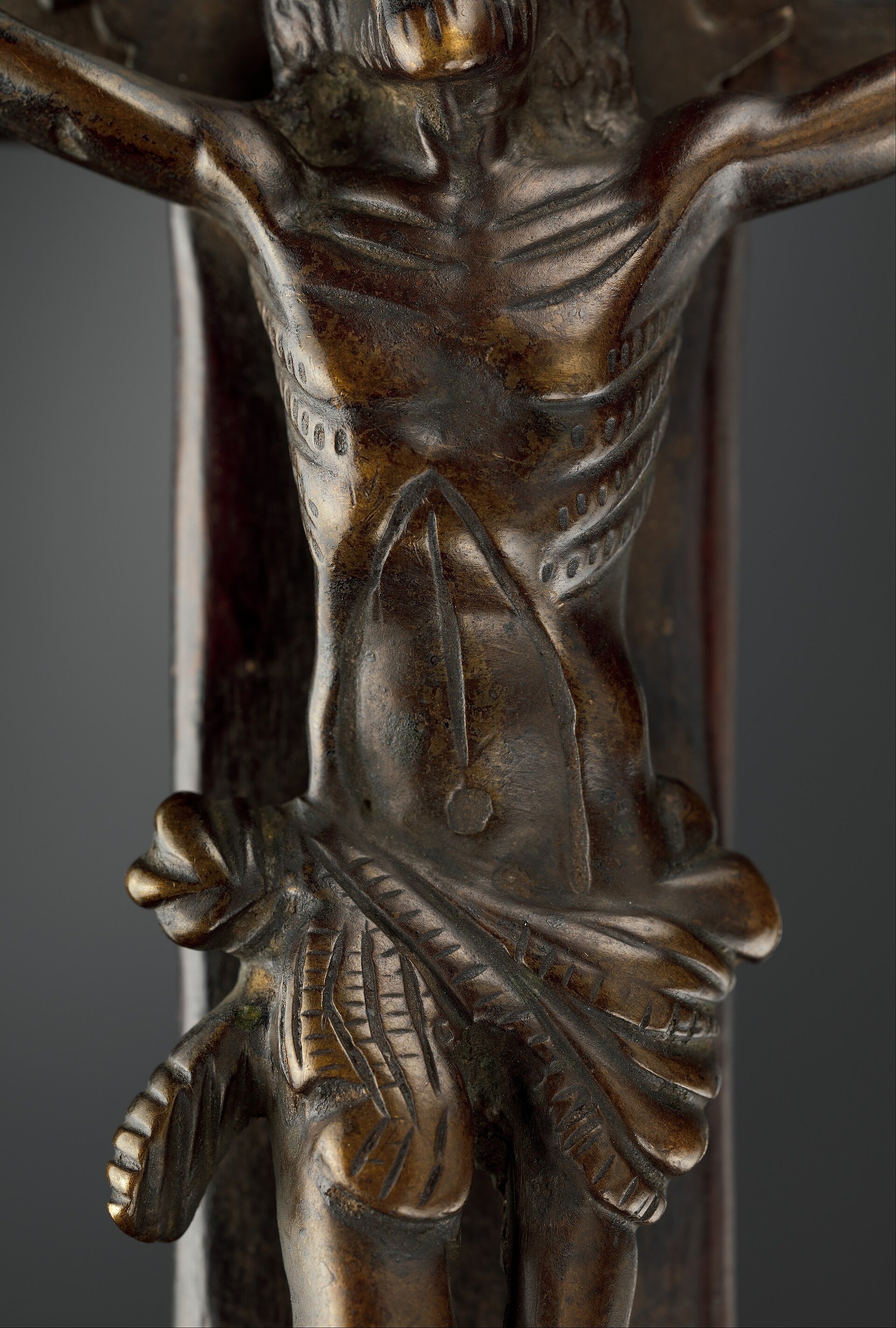 A Kongo brass crucifix, sixteenth to seventeenth century with later additions. The Metropolitan Museum of Art, CC0, via Wikimedia Commons.

See this page's graph and discover linked topics
In full
Portuguese navigators under Diogo Cão reached the Congo estuary in 1483 and made contact with the Kingdom of Kongo, whose king, the mwene Kongo Nzinga a Nkuwu, ruled from Mbanza Kongo. After an exchange of envoys, some of whom spent years in Portugal studying Christianity and literacy, Nzinga a Nkuwu was baptized on 3 May 1491 as João I, with members of his family. His son Mvemba a Nzinga, baptized Afonso, won a succession struggle (dated 1506 in older works and 1509 in more recent reconstructions) and ruled until 1542 or 1543 as Afonso I of Kongo, making Catholicism the royal religion, building schools and churches, sending young nobles to Portugal, and securing the appointment of his son Henrique as titular bishop of Utica in 1518, the first sub-Saharan African bishop. The capital was renamed São Salvador, and in 1596 Rome erected it as a diocese. Because ordained clergy were always few, Kongo's church rested on a lay network of noble teachers (mestres) who taught the faith in Kikongo, and on royal patronage. Jesuits arrived in 1548 and Italian Capuchins in 1645. John Thornton has argued influentially that Kongo developed a genuinely African Catholicism, rendering Christian concepts with Kikongo religious vocabulary and accepted by Rome as orthodox; other scholars, such as Wyatt MacGaffey, have stressed how much traditional cosmology shaped the way Kongolese understood the faith. The slave trade expanded alongside the church, through São Tomé and later Luanda. After the Portuguese defeated and killed King António I at the Battle of Mbwila in 1665, the kingdom fell into decades of civil war, out of which came the Antonian movement of Kimpa Vita and the restoration of the monarchy under Pedro IV in 1709. A Christian monarchy, increasingly nominal in power, continued into the nineteenth century.
How Kongo became Christian
| Date | Event | Evidence |
|---|---|---|
| 1483 | Diogo Cão reaches the Congo estuary; Kongolese envoys go to Portugal | Portuguese chronicles |
| 1491 | Portuguese priests and craftsmen arrive; the governor of Soyo is baptized first, then King Nzinga a Nkuwu on 3 May as João I | Portuguese chronicles; Rui de Pina |
| 1490s | João I's commitment cools, partly over monogamy; his son Afonso, governing Nsundi, protects the priests | Later accounts and Afonso's letters |
| 1506/1509 | Afonso defeats his brother Mpanzu a Kitima at Mbanza Kongo and attributes the victory to a vision of the cross and Saint James | Afonso's own letters; Kongo coat of arms used until at least 1860 |
| 1512-1540s | Afonso's correspondence with Portuguese kings and popes; schools, churches, Kongolese students in Lisbon | Afonso's letters, published by António Brásio |
| 1518 | Afonso's son Henrique named titular bishop of Utica; returns to Kongo in the 1520s, dies about 1531 | Papal and Portuguese records |
| 1548 | First Jesuit mission | Jesuit records |
| 1596 | São Salvador erected as a diocese | Papal bull |
| 1645 | Italian Capuchins arrive | Capuchin reports, including Giovanni Cavazzi |
Three features stand out in the sources:
- The choice was Kongolese. No conquest preceded the baptism. Kongo's kings invited priests, sent embassies and set the terms. Afonso himself explained his faith in his letters.
- The church was largely lay-led. With few priests, noble mestres, paid and appointed by the crown, catechized in Kikongo. A Kikongo catechism was printed in 1624.
- The kings controlled the church's money. Clergy were paid from royal revenue, and Kongo's kings at times withheld support from bishops who favoured Portuguese Angola.
Faith, power and the slave trade
- Slavery before contact. Kongo already enslaved war captives and moved them to the capital. Portuguese demand, first for the sugar plantations of São Tomé and then for Brazil, turned an internal institution into an export trade.
- Afonso's protest. In 1526 Afonso wrote to João III of Portugal that Portuguese merchants were seizing free Kongolese, including nobles and relatives, and threatened to end the trade. He set up a board to check whether each person sold was lawfully enslaved.
- Afonso's participation. The same letters show that Afonso sold war captives to the Portuguese and paid for goods and education in slaves. He sought to regulate the trade, not to abolish it.
- The long result. After Mbwila (1665), civil wars between rival royal lineages fed large numbers of Kongolese captives into the Atlantic trade.
The codex's position, consistent with African Participation in the Atlantic Slave Trade, is that both things are true: Kongo's Christian rulers produced some of the earliest African Christian protests against abuses of the trade, and Kongolese elites, Christian and not, also profited from it. See also Papal Bulls and Slavery and Most of the World Was Colonized by Christians Objection Defeater.
Conflict with Portuguese Angola
- 1575 onward. Portugal founded Luanda and began the conquest of Ndongo to the south. See Queen Njinga.
- 1622. A Portuguese army invaded southern Kongo; King Pedro II defeated it at Mbanda Kasi, wrote to the pope and the king of Spain to denounce the governor, and sought a Dutch alliance.
- 1641-1648. Kongo allied with the Dutch, who held Luanda.
- 1665. At Mbwila, Portuguese forces killed King António I. A Luso-African Capuchin, Manuel Roboredo, who had tried to prevent the war, died in the battle.
A Christian African kingdom thus fought, wrote to Rome against, and allied with Protestants against a Catholic colonial power. That history complicates any simple equation of Christianity with colonial conquest.
The Antonian movement and its aftermath
During the civil wars, a young noblewoman, Kimpa Vita (Dona Beatriz), claimed in 1704 to be possessed by Saint Anthony. She taught that Christ and the holy family were Kongolese, called the kingdom to reunite and reoccupy São Salvador, and rejected the European missionaries' authority. She was burned as a heretic in 1706 under King Pedro IV, with the counsel of Capuchin friars. Pedro IV restored the monarchy at São Salvador in 1709. See Kimpa Vita and, for the later prophetic tradition in the same region, Simon Kimbangu.
Legacy
- Kongo crucifixes. Brass crucifixes made in Kongo from the sixteenth century onward, often showing Christ with African features, were used both in church and as emblems of authority. Later Kongo traditions said the cathedral of São Salvador had been built by angels.
- Atlantic Christianity. Many enslaved Kongolese carried Catholic faith to the Americas. Thornton and others have argued that some participants in the Stono Rebellion in South Carolina (1739) and in the Haitian Revolution came from Christian Kongo.
- Mbanza Kongo today. The old capital, with the ruins of its cathedral (Kulumbimbi), was inscribed by UNESCO as a World Heritage Site in 2017.
Tensions
- Authentic African Catholicism or syncretism? Thornton argues that Kongolese Christianity was orthodox Catholicism expressed in Kongo terms, accepted as such by Rome. MacGaffey and others stress continuity with the older religion and see a reinterpretation of Christianity within Kongo cosmology. Missionaries at the time disagreed among themselves. The codex records both views; see also African Traditional Religion and Christianity.
- Afonso's accession date. Older works give 1506; Thornton and others give 1509.
Scholarship
Published academic works this page draws on, each matched to a publisher, index or library catalog record.
- António Brásio, Monumenta missionaria africana: Africa ocidental (1952). Open Library
- Cécile Fromont, Art of Conversion: Christian Visual Culture in the Kingdom of Kongo (University of North Carolina Press, 2014). doi:10.5149/northcarolina/9781469618739.001.0001
- John Thornton, "The Development of an African Catholic Church in the Kingdom of Kongo, 1491-1750," The Journal of African History 25 (1984). doi:10.1017/s0021853700022830
- John K. Thornton, A History of West Central Africa to 1850 (Cambridge University Press, 2020). doi:10.1017/9781316411568
See also
- Afonso I of Kongo, the king who made Kongo Christian
- Queen Njinga, the queen of neighbouring Ndongo and Matamba
- Kimpa Vita, the Kongolese prophetess of the Antonian movement
- Christianity and Colonialism in Africa, the wider question of missions and empire
- African Participation in the Atlantic Slave Trade, the codex's account of the trade
- Black Christian Agency, African Christians as actors, not only recipients
- Catholic Church, the church to which Kongo belonged
- Africa and Christianity, master hub
Common questions this page answers
Q: When did the Kingdom of Kongo become Christian?
King Nzinga a Nkuwu was baptized on 3 May 1491 as João I, eight years after first contact with the Portuguese. His son Afonso I, who ruled from 1506 or 1509 to about 1542, made Catholicism the established faith of the kingdom.
Q: Was Kongo forced to become Christian by the Portuguese?
No. Kongo was an independent kingdom that invited priests, sent envoys to Lisbon and Rome, and ran its own church largely through Kongolese lay teachers. It later fought wars against Portuguese Angola.
Q: Did Afonso I of Kongo oppose the slave trade?
He protested strongly in 1526 that Portuguese traders were enslaving free Kongolese and threatened to end the trade, and he set up checks on who could be sold. His letters also show that he sold war captives himself, so he sought to regulate the trade rather than abolish it.
Q: Who was the first black African Catholic bishop?
Henrique, son of King Afonso I of Kongo, named titular bishop of Utica in 1518. He returned to Kongo in the 1520s and died around 1531.
Q: What was Kongolese Catholicism like?
It used Kikongo words for Christian ideas, relied on noble lay teachers called mestres, and was supported by the king. Historian John Thornton calls it a genuinely African Catholic church; others stress how much older Kongo beliefs shaped it.
Q: What happened to Christianity in Kongo after the Battle of Mbwila?
The kingdom split into rival factions and decades of civil war. Christianity remained the faith of all sides, and the crisis produced Kimpa Vita's Antonian movement before King Pedro IV reunited the kingdom in 1709.