Concept
Kingdom of Aksum
Aksum, Axum, Kingdom of Axum, Aksumite Kingdom, Aksumite Empire, Axumite KingdomIntro
Aksum was a powerful African kingdom in what is now northern Ethiopia and Eritrea. At its height, between about AD 300 and 600, it controlled trade on the Red Sea, minted its own gold coins, and raised giant stone monuments that still stand today. In the 300s its king, Ezana, turned from the old gods to Christ. That made Aksum one of the first states in the world to adopt Christianity as its royal religion, decades before the Roman Empire made the same move.
We do not have to take that on trust. Ezana's own stone inscriptions and his coins show the change happening. His early inscriptions thank the war god Mahrem. His later ones thank "the Lord of Heaven" and, in one Greek text, the Father, the Son and the Holy Spirit. His early coins carry a pagan disc and crescent. His later coins carry the cross. A Roman historian, Rufinus, tells the story of how it happened, and a letter from a Roman emperor, preserved by Athanasius, confirms the key names. Christianity in Ethiopia is not a colonial import. It is about as old as Christian Rome.
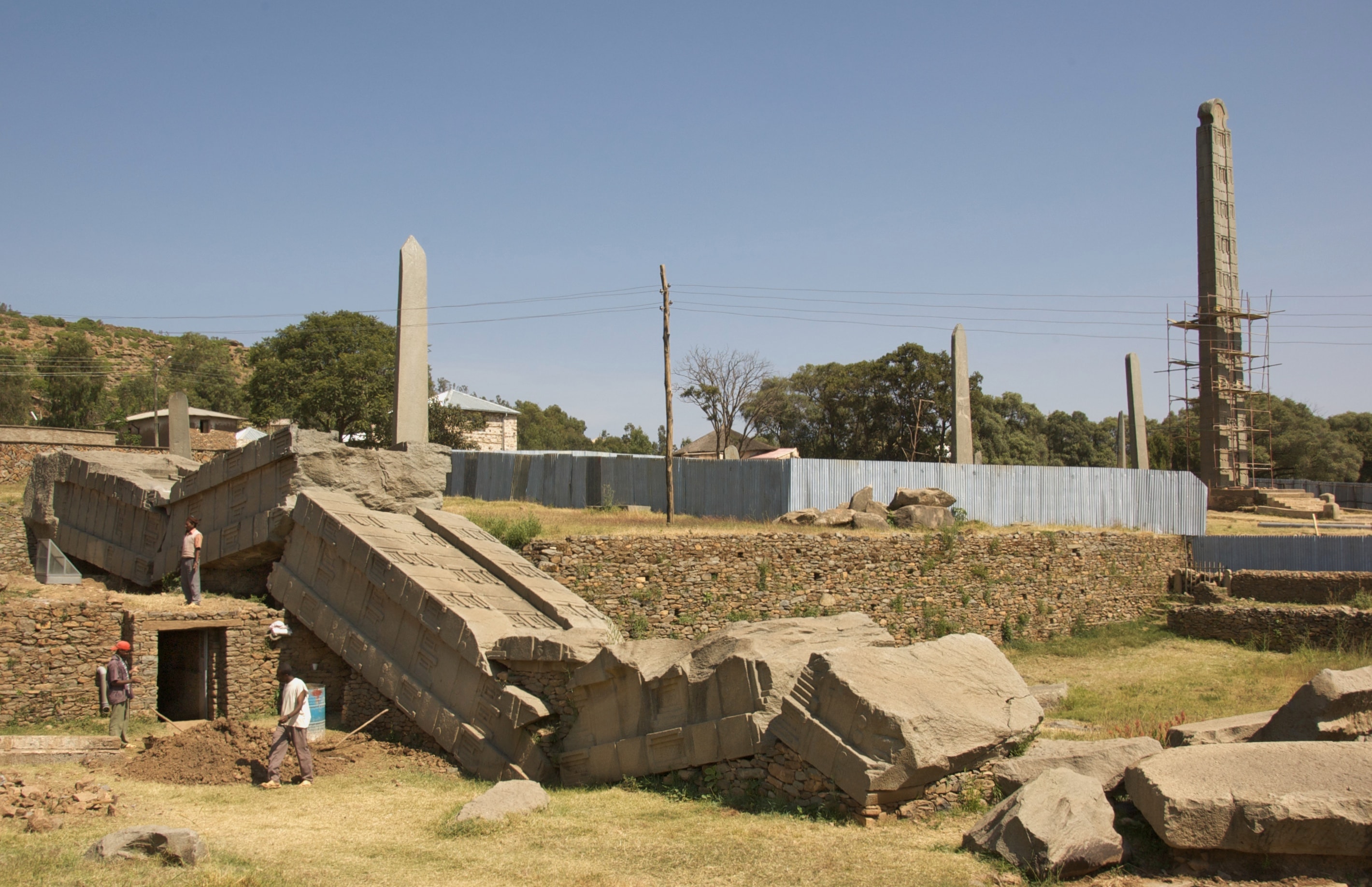 The stelae field at Aksum, with the fallen Great Stela in the foreground and standing stelae behind. Photo: A. Davey, CC BY 2.0 (Wikimedia Commons), resized.

See this page's graph and discover linked topics
In full
The Kingdom of Aksum (also spelled Axum) was a Late Antique state of the northern Ethiopian and Eritrean highlands, centred on the city of Aksum and its Red Sea port of Adulis. Its prosperity rested on the trade between the Roman Mediterranean, South Arabia and India in ivory, gold, incense and other goods. Aksum minted gold, silver and bronze coins from around AD 270 (beginning with King Endybis) to the early seventh century, and its rulers recorded campaigns in Ge'ez, Greek and South Arabian inscriptions.
The kingdom's formal turn to Christianity came under King Ezana in the second quarter of the fourth century. Three independent lines of evidence converge on it:
- Literary: Rufinus of Aquileia (Ecclesiastical History 10.9-10, sometimes cited as 1.9-10, written c. 402), who says he heard the story from Aedesius, brother of Frumentius, describes two Christian youths from Tyre taken into the Aksumite court, Frumentius's work among resident Christian merchants, and his consecration as bishop by Athanasius of Alexandria.
- Documentary: Athanasius's Apology to Constantius (c. 356) preserves a letter from Emperor Constantius II to "Aizanas and Sazanas," the rulers of Aksum, demanding that Frumentius be sent to Alexandria to be examined. This is a contemporary document naming both Ezana and Frumentius.
- Archaeological: Ezana's inscriptions move from the pagan god Mahrem to a monotheistic "Lord of Heaven" and, in a Greek inscription found at Aksum in 1969, to an explicitly Trinitarian formula; his gold coins switch from the disc-and-crescent symbol to the cross. See Ezana Stone and Aksumite Coins.
Aksum's Christianity was tied from the start to the see of Alexandria, which consecrated its chief bishop (the abun) for some sixteen centuries. In the fifth and sixth centuries monks remembered in tradition as the Nine Saints spread monasticism; the Gospels were translated into Ge'ez, as the Garima Gospels show; and King Kaleb of Aksum (c. 520s) projected Christian power across the Red Sea to defend the Christians of Najran in South Arabia. The kingdom faded from the seventh century as Red Sea trade shifted after the rise of Islam, but the church it founded continued without break, through the Zagwe kings of Lalibela to the Solomonic emperors and Menelik II.
How Aksum became Christian
The story Rufinus tells
- A philosopher from Tyre named Meropius sailed the Red Sea with two boys, Frumentius and Aedesius. At a port on the African coast the ship's company was killed; the boys were spared and brought to the king.
- Aedesius became the king's cupbearer and Frumentius his secretary and treasurer. When the king died, the queen asked them to stay and help govern while the young heir grew up.
- Frumentius sought out Roman Christian merchants in the kingdom, encouraged them to meet for prayer, and helped them find places to worship.
- When the heir came of age, the brothers left. Aedesius went home to Tyre. Frumentius went to Alexandria and asked Athanasius to send a bishop to Aksum. Athanasius consecrated Frumentius himself.
- Frumentius returned as bishop. Ethiopian tradition remembers him as Abba Salama, "Father of Peace," and Kesate Birhan, "Revealer of Light."
The date of the consecration is disputed. Older reckonings put it around 328; many historians prefer a date in the 330s or early 340s, after Athanasius became bishop and between his exiles. The conversion of Ezana followed the consecration. See Frumentius.
What the king's own records add
| Evidence | Pagan phase | Christian phase |
|---|---|---|
| Royal titles | Ezana styles himself "son of Mahrem" (a war god the Greek text equates with Ares) | Ezana gives thanks to the "Lord of Heaven" and, in a Greek inscription, invokes the Father, the Son and the Holy Spirit |
| Coins | Disc-and-crescent symbol above the king's bust | Cross in place of the disc and crescent; crosses worked into the legends |
| Foreign correspondence | none | Constantius II writes to Ezana and his brother about their bishop (c. 356) |
The shift on the coins and stones is the reason historians treat the conversion as secure, even where the details of Rufinus's story are debated. Some scholars note that the Ge'ez "Lord of Heaven" inscriptions are monotheistic without naming Christ, and read them as a cautious public transition; the Greek Trinitarian text published in 1970 by Francis Anfray, André Caquot and Pierre Nautin settles that the king himself made a Christian confession.
What the conversion was, and was not
- A royal and court conversion first. As in many ancient kingdoms, the king and court converted before the countryside. Rural Christianization took centuries and is credited in tradition to later monks, including the Nine Saints of the late fifth and sixth centuries.
- Not a Roman conquest. No Roman army or governor was involved. The faith came through traders, captives who became royal officials, and a bishop sent from an African church, Alexandria.
- Nicene from the start. When Constantius II, who favoured the Arian party, demanded that Frumentius be replaced, the Aksumite rulers kept their Athanasian bishop. See Arianism.
Christian Aksum after Ezana
- Ge'ez Scripture. The Gospels and much of the Bible were translated into Ge'ez from Greek. The radiocarbon-dated Garima Gospels show a Ge'ez Gospel book being copied and illuminated by the fifth or sixth century.
- Monasticism. Tradition credits the Nine Saints, monks from the Roman East, with founding monasteries such as Debre Damo and Abba Garima and with evangelizing the countryside.
- Chalcedon. With Alexandria, the Aksumite church did not accept the Council of Chalcedon (451) and belongs to the Oriental Orthodox family. See Miaphysitism vs Dyophysitism.
- Kaleb and Najran. Around 525 King Kaleb of Aksum invaded Himyar (Yemen) after the massacre of Christians at Najran, an event recorded by Procopius, Syriac sources and South Arabian inscriptions.
- The first hijra. Muslim tradition (Ibn Ishaq) records that early followers of Muhammad, persecuted in Mecca, took refuge with the Christian king of Abyssinia, the Najashi, around 615, and that he protected them.
Decline and continuity
Aksum's coinage ends in the early seventh century and its political centre moved south over the following centuries. Historians link the decline to changes in Red Sea trade, environmental pressure and the rise of new powers. Ethiopian tradition remembers a destructive queen named Gudit in the tenth century, though the details are uncertain. What did not end was the church. The Zagwe dynasty, builders of the Rock-Hewn Churches of Lalibela, ruled a Christian kingdom from the twelfth century, and from 1270 the Solomonic dynasty claimed Aksum's legacy through the Kebra Nagast. Emperors continued to be crowned at Aksum's church of Mary of Zion.
Why it matters for the story of African Christianity
- It answers the "white man's religion" charge from the record. A sub-Saharan African kingdom adopted Christianity in the 330s or 340s, before Theodosius made it the official religion of the Roman Empire (380) and more than a thousand years before European colonial contact. See Christianity Is the White Mans Religion Objection Defeater.
- It is independently verifiable. Coins and inscriptions do not depend on later church memory.
- It links Africa to Africa. Aksum's bishop came from Alexandria, an African see, through Athanasius, an African theologian.
- It is continuous. The Ethiopian Orthodox Church that Ezana's conversion began has never ceased to exist.
Tensions
- Date of conversion. Coin-weight evidence has led some numismatists to argue for an early date (before or near 324), while many historians date Frumentius's consecration to the 330s or 340s. The codex states "the 330s or 340s" as the commonly cited window and records the earlier proposal as a minority view.
- "First Christian state." Armenia is usually dated earlier (traditionally 301, though some scholars prefer c. 314). Aksum is fairly called one of the first Christian kingdoms, not the very first.
Scholarship
Published academic works this page draws on, each matched to a publisher, index or library catalog record.
- Francis Anfray, André Caquot and Pierre Nautin, "Une nouvelle inscription grecque d'Ezana, roi d'Axoum," Journal des savants 4 (1970). doi:10.3406/jds.1970.1235 open access
- Sergew Hable-Selassie, Ancient and medieval Ethiopian history to 1270 (1972). Open Library
- David W. Phillipson, Foundations of an African Civilisation: Aksum and the northern Horn, 1000 BC - AD 1300 (Boydell and Brewer, 2012). doi:10.1515/9781846158735
See also
- Ezana of Axum, the king whose conversion is recorded on stone and coin
- Frumentius, first bishop of Aksum
- Ezana Stone and Aksumite Coins, the physical evidence
- Kaleb of Aksum, the sixth-century Christian king who intervened in Yemen
- Garima Gospels, early Ge'ez Gospel books from an Aksumite-era monastery
- Ethiopian Orthodox Church, the church Aksum founded
- Kebra Nagast, the later Solomonic tradition about Aksum
- Christian Nubia, the Christian kingdoms of the Nile to Aksum's west
- African Christianity Pre-Colonial, the wider pre-colonial picture
- Africa and Christianity, master hub
Common questions this page answers
Q: When did the Kingdom of Aksum become Christian?
Under King Ezana, in the 330s or 340s. His coins switch from a pagan disc and crescent to the cross, his later inscriptions invoke the Lord of Heaven and the Trinity, and a letter of Emperor Constantius II from about 356 names him alongside his bishop Frumentius.
Q: Was Ethiopia Christian before Rome?
Aksum adopted Christianity as the royal religion decades before Theodosius made it the official religion of the Roman Empire in 380. Constantine had converted earlier (312) and legalized the faith in 313, so Aksum was not ahead of Rome's first Christian emperor, but it was ahead of Rome's establishment of Christianity.
Q: Who converted King Ezana?
Frumentius, a Christian from Tyre who arrived at the Aksumite court as a captive, rose to high office, and was later consecrated bishop of Aksum by Athanasius of Alexandria. Ethiopians call him Abba Salama.
Q: What evidence is there that King Ezana was really a Christian?
His own inscriptions and coins. Early inscriptions call him son of the war god Mahrem; later ones thank the Lord of Heaven, and a Greek inscription found at Aksum in 1969 invokes the Father, Son and Holy Spirit. His later gold coins carry the cross.
Q: Where was the Kingdom of Aksum?
In the northern highlands of modern Ethiopia and Eritrea, centred on the city of Aksum, with its main port at Adulis on the Red Sea. At times it also ruled parts of South Arabia across the water.
Q: Why did the Kingdom of Aksum decline?
Historians point to shifts in Red Sea trade after the seventh-century Arab expansion, environmental strain on the highlands, and the movement of political power southward. The church it founded did not decline with it and continues as the Ethiopian Orthodox Tewahedo Church.
Q: Is Christianity a European religion brought to Africa by colonizers?
Aksum shows otherwise. Its king converted in the fourth century through a bishop sent from Alexandria in Africa, more than a thousand years before European colonial contact, and the church he founded has existed ever since.