Person
Kimpa Vita
Dona Beatriz, Beatriz Kimpa Vita, Dona Beatriz Kimpa Vita, Kimpa Mvita, Antonian Movement, Antonianism, Kongolese Saint AnthonyIntro
Kimpa Vita, baptized Dona Beatriz, was a young noblewoman of the Christian Kingdom of Kongo who in 1704 announced that Saint Anthony of Padua had entered her and given her a mission. Kongo had been Catholic for two centuries but was torn apart by civil war, and its old capital, São Salvador, lay in ruins. Beatriz preached that God was angry at the endless fighting, that Kongo must unite under one king, and that Jesus, Mary and the saints were themselves Kongolese. Thousands followed her, and she led them to resettle the abandoned capital.
Her movement, called Antonianism, alarmed both the rival kings and the Italian Capuchin missionaries. She was captured, tried and burned as a heretic in 1706. Some remember her as a heretic, others as a martyr and an early voice for African dignity in the church. For historians she matters because her movement is one of the best-documented episodes in Kongo's history, and because it shows Africans taking Christianity so seriously that they argued over what it meant for them.
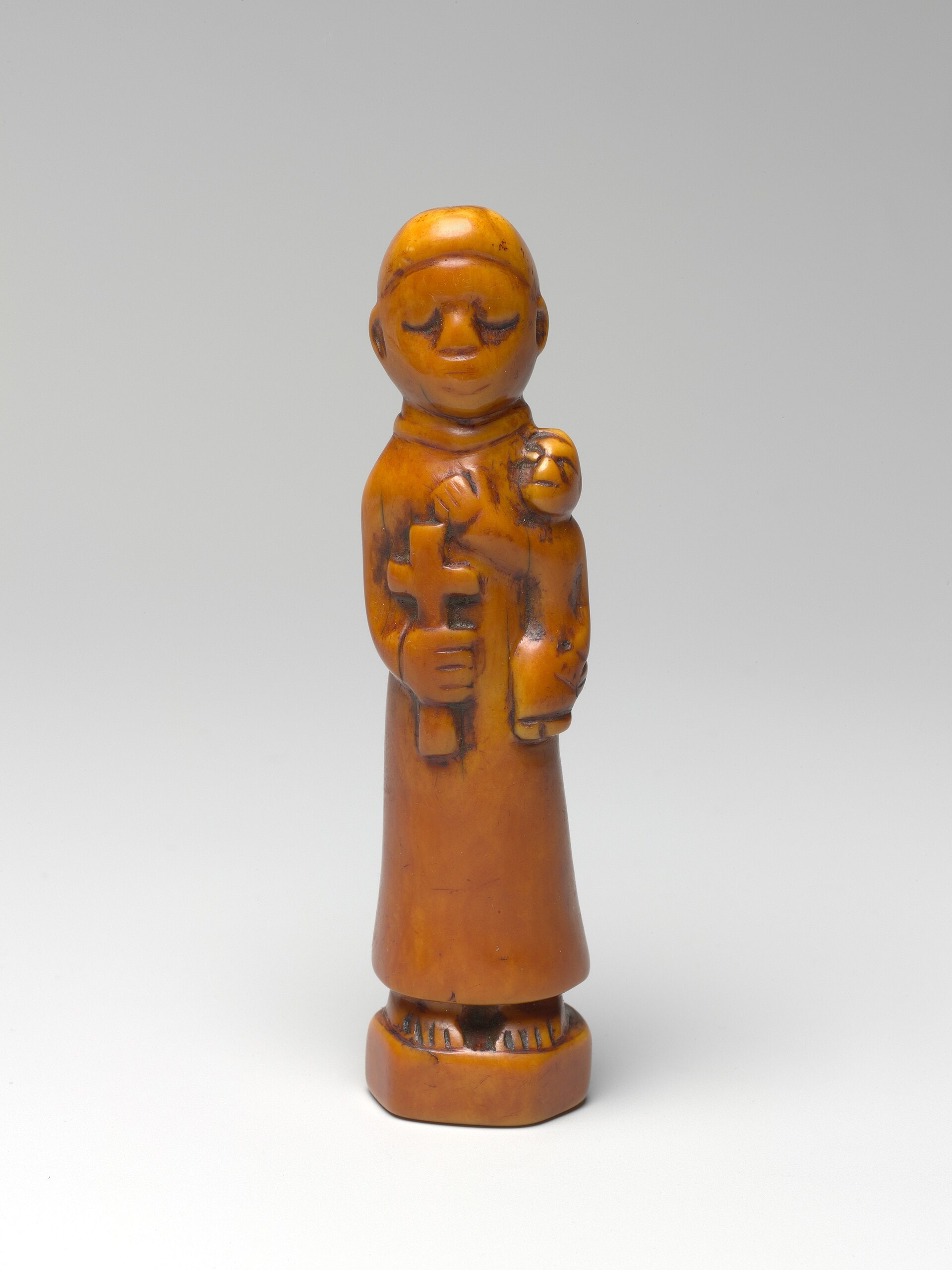 A Kongo figure of Saint Anthony (Toni Malau), carved ivory, holding a cross and the Christ child. Images like this show the saint's central place in Kongo devotion. The Metropolitan Museum of Art, CC0, via Wikimedia Commons.

See this page's graph and discover linked topics
In full
Kimpa Vita (c. 1684-1706) was born near Mount Kibangu into the Kongo nobility and baptized Beatriz. She had trained as a traditional medium (nganga marinda) before abandoning that role. In 1704, during a grave illness, she reported dying and being possessed by Saint Anthony, after which she preached as his vessel. Her teaching, known chiefly from the reports of the Capuchin missionaries Bernardo da Gallo and Lorenzo da Lucca, included: that the civil wars since the Battle of Mbwila (1665) had angered God; that Kongo must be reunited and São Salvador reoccupied; that Christ was born in São Salvador (Mbanza Kongo) and baptized in Nsundi, and that Mary and Saint Francis were also Kongolese; that God looks to the intention of the heart rather than to the sacraments or works alone; and that Saint Anthony was a "second God," a phrase recorded in the movement's prayer, the Salve Antoniana, adapted from the Salve Regina. She destroyed both traditional charms (minkisi) and crosses she judged to be misused, denounced the Capuchins for opposing black saints, and in 1705 led followers to reoccupy São Salvador, winning support from a general of King Pedro IV, Pedro Constantinho da Silva Kibenga. She bore a child, which undermined her own teaching on chastity. Captured near her home, she was tried under Kongo law with the counsel of the Capuchins and burned at Evululu on 2 July 1706, together with the child's father, João Barro, according to Thornton. The movement outlived her until Pedro IV, having defeated Kibenga, reoccupied São Salvador and restored a united monarchy in 1709.
How Kimpa Vita is known
| Source | Nature | Bias to keep in mind |
|---|---|---|
| Bernardo da Gallo's report | Eyewitness Capuchin who interviewed her and opposed her | Hostile; framed her as possessed by the devil |
| Lorenzo da Lucca's letters | Capuchin present at her trial and execution | Hostile, but records details of her teaching and death |
| Later Kongolese and missionary tradition | Memory of the movement | Shaped by later politics |
| John K. Thornton, The Kongolese Saint Anthony (1998) | Modern scholarly reconstruction from these sources | Sympathetic to Kongo's context; careful with evidence |
Almost everything about her comes from men who condemned her. Her own words survive only as they reported them. That is a reason to read with care, not a reason to dismiss either the reports or her.
What she taught, in context
- Kongo as a holy land. By locating Christ's birth in São Salvador, Beatriz claimed the Christian story for Kongo. Thornton reads this as an intensification of a long Kongolese belief that Kongo was a central Christian kingdom, not a rejection of Christianity.
- Intention over sacrament. The Salve Antoniana taught that God values intention over sacraments and good works, a challenge to the missionaries' sacramental authority.
- Black saints. She accused the Capuchins of withholding African saints from Kongo, a protest that anticipates later African demands for an indigenous church.
- Anti-idol, not anti-Christian. She burned minkisi and attacked practices she called idolatrous, and also rejected some Catholic objects. She was a Christian reformer by her own lights.
An orthodox assessment
From the standpoint of historic Christian teaching, central parts of her message cannot be accepted: Saint Anthony as a "second God," the relocation of the incarnation to Kongo, and the claim of ongoing possession by a saint conflict with the Bible's teaching on the one God (Deuteronomy 6:4; 1 Timothy 2:5) and on the historical incarnation in Bethlehem of Judea (Matthew 2:1; Luke 2:4-7). Catholic, Orthodox and Protestant readers would agree on that. Recognising this does not justify her execution, which many Christians today regard as a grave wrong.
Significance
1. An early African-initiated Christian movement
Antonianism is often treated as a forerunner of the prophetic and independent churches of the twentieth century, including the movement of Simon Kimbangu in the same Lower Congo region. See African Initiated Churches.
2. Christianity owned, not merely received
The Antonian controversy was an argument inside Kongolese Christianity about what it meant to be both Kongolese and Christian. That is evidence of how deeply the faith had taken root.
3. Church, state and violence
Her death was decided by a Kongolese king under Kongo law, with missionary counsel. It belongs to the long, painful history of Christians using state power to punish dissent, a history that Protestants, Catholics and Orthodox alike now repudiate.
Tensions
- Heretic, prophet or nationalist? Missionary sources call her a heretic; some modern writers call her a proto-nationalist or anti-colonial martyr; Thornton calls her a Kongolese Christian prophet working within Kongo's own Catholic tradition. The codex records all three framings.
- Contested details. Some popular accounts add claims about her personal life that rest on thin or hostile evidence. The codex includes only the outline that Thornton's reconstruction supports.
Scholarship
Published academic works this page draws on, each matched to a publisher, index or library catalog record.
- Cécile Fromont, Art of Conversion: Christian Visual Culture in the Kingdom of Kongo (University of North Carolina Press, 2014). doi:10.5149/northcarolina/9781469618739.001.0001
- John Thornton, The Kongolese Saint Anthony: Dona Beatriz Kimpa Vita and the Antonian Movement, 1684-1706 (Cambridge University Press, 1998). doi:10.1017/cbo9780511572791
See also
- Kingdom of Kongo Christianity, the Christian kingdom in which she lived
- Afonso I of Kongo, the king who made Kongo Christian two centuries earlier
- Queen Njinga, the Christian queen of neighbouring Matamba
- Simon Kimbangu, the twentieth-century Kongo prophet often compared with her
- African Initiated Churches, the later independent church movements
- African Traditional Religion and Christianity, the wider question of continuity and change
- Africa and Christianity, master hub
Common questions this page answers
Q: Who was Kimpa Vita?
A Kongolese noblewoman, baptized Dona Beatriz, who in 1704 claimed to be possessed by Saint Anthony and led a mass movement to reunite the Christian Kingdom of Kongo. She was burned as a heretic on 2 July 1706.
Q: What did Kimpa Vita teach?
That God was angry at Kongo's civil wars, that the kingdom must reunite and reoccupy São Salvador, that Jesus was born in São Salvador and Mary and Saint Francis were Kongolese, and that God values intention more than sacraments. Her prayer, the Salve Antoniana, called Saint Anthony a second God.
Q: Why was Kimpa Vita burned at the stake?
King Pedro IV of Kongo, with the counsel of Italian Capuchin missionaries, had her tried and condemned as a heretic and witch, partly for her teaching and partly because her movement threatened his claim to the throne.
Q: What was the Antonian movement?
A Kongolese Christian revival and political movement led by Kimpa Vita from 1704 to 1706, named for Saint Anthony. It resettled the ruined capital São Salvador and outlived her until the kingdom was reunited in 1709.
Q: Is Kimpa Vita considered a saint or a heretic?
The Catholic missionaries who judged her called her a heretic. Some modern writers see her as a martyr or forerunner of African independence and of African-initiated churches. Historians such as John Thornton describe her as a Kongolese Christian prophet working within Kongo's own Catholic tradition.