Person
Kaleb of Aksum
Kaleb, King Kaleb, Kaleb of Axum, Ella Asbeha, Elesbaan, Saint Elesbaan, HellestheaiosIntro
Kaleb was a Christian king of Aksum, in what is now Ethiopia and Eritrea, in the early sixth century. He is best known for crossing the Red Sea around 525 to stop a king in Yemen who had massacred Christians at the town of Najran. Writers in Constantinople, Syria and Arabia all recorded the war, and Kaleb's own coins and an inscription at Aksum name him.
Kaleb shows that by the 500s, two centuries after King Ezana's conversion, Aksum was a confident Christian power that saw itself as a protector of Christians beyond its borders. Ethiopian tradition says he later gave up his crown and became a monk. Both the Ethiopian Orthodox Church and the Catholic Church remember him as a saint, the Catholic calendar under the name Elesbaan.
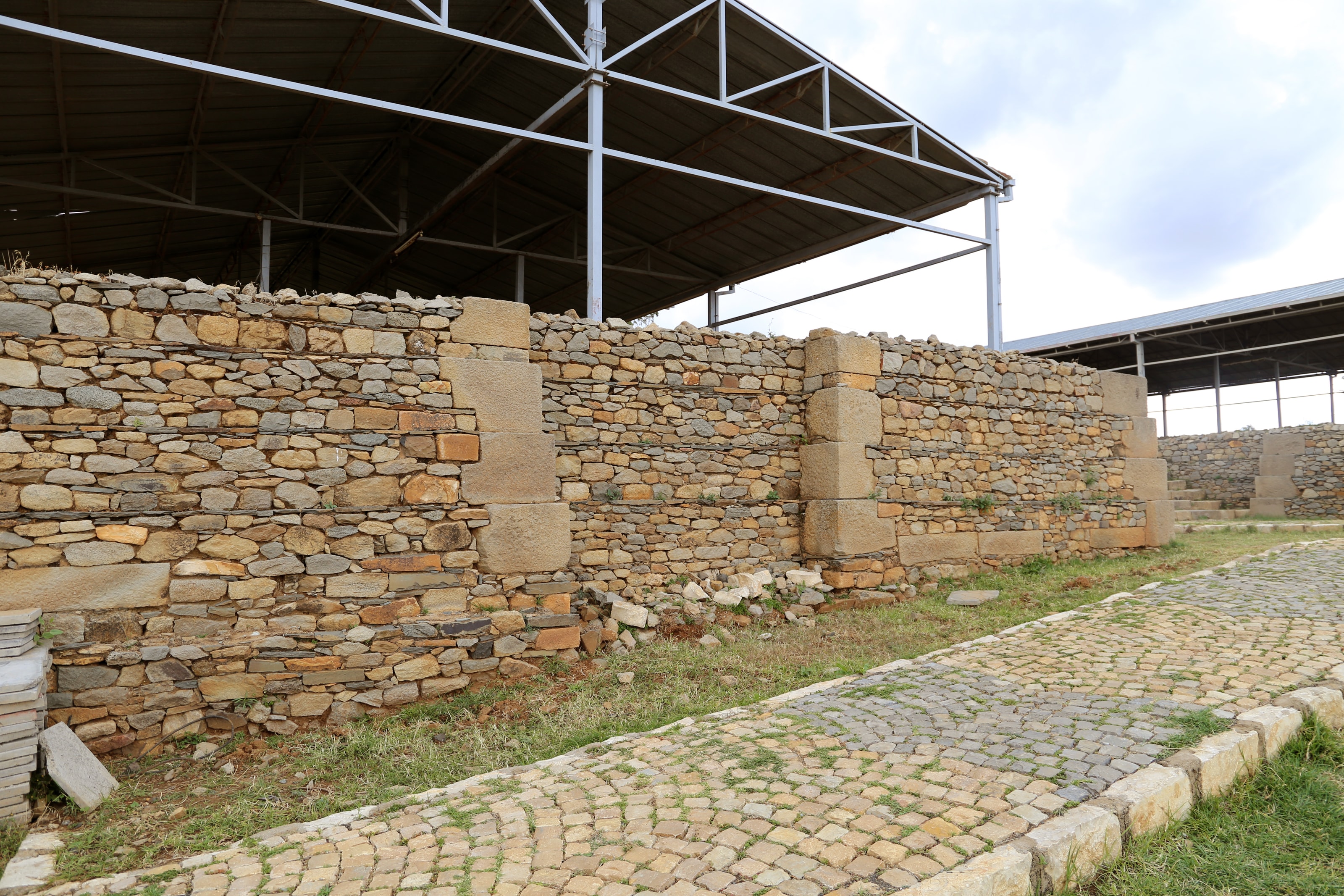 The site traditionally called the tombs of King Kaleb and his son Gebre Meskel, near Aksum. Photo: Sailko, CC BY 3.0 (Wikimedia Commons), resized.

See this page's graph and discover linked topics
In full
Kaleb, with the throne name Ella Asbeha (rendered by Procopius as Hellestheaios), ruled the Kingdom of Aksum in the first half of the sixth century. His Ge'ez inscription at Aksum (catalogued as RIE 191) names him "Kaleb Ella Asbeha, son of Tazena," and he issued coins in his name. Around 520-525, after the Himyarite king Yusuf As'ar Yath'ar (known in Arabic tradition as Dhu Nuwas), a convert to Judaism, attacked the Christians of Zafar and Najran, Kaleb led an expedition across the Red Sea, defeated Yusuf, and installed a Christian viceroy, Sumyafa Ashwa. The Aksumite general Abraha later deposed that viceroy and ruled Himyar himself, eventually acknowledging Aksum's overlordship by tribute. The episode is attested in Procopius (Wars 1.20), in Syriac sources such as the Book of the Himyarites and the letters attributed to Simeon of Beth Arsham, in the Greek Martyrdom of Arethas, and in South Arabian inscriptions recording Yusuf's campaigns. Ethiopian tradition holds that Kaleb abdicated, sent his crown to the Church of the Holy Sepulchre in Jerusalem, and ended his life as a monk.
How Kaleb's Christianity is known
| Source | What it says | Kind of evidence |
|---|---|---|
| Kaleb's inscription at Aksum (RIE 191) | Names him Kaleb Ella Asbeha, son of Tazena, and refers to the Himyar campaign | Inscription, contemporary |
| Kaleb's coins | Gold, silver and bronze in his name, in the Christian coinage tradition begun by Ezana | Numismatic, contemporary |
| Procopius, Wars 1.20 | The Aksumite king Hellestheaios invades Himyar on behalf of Christians, installs Esimiphaios (Sumyafa Ashwa), later loses control to Abraha | Byzantine historian, sixth century |
| South Arabian inscriptions | Yusuf As'ar Yath'ar's own campaign records against Aksumite and Christian targets | Inscriptions from the other side, contemporary |
| Syriac martyr texts | The killing of Christians at Najran and the Aksumite response | Near-contemporary church sources |
| Ethiopian hagiography and king lists | Kaleb's piety, his abdication, his sons | Later tradition |
Unlike the conversion of Aksum under Ezana of Axum, Kaleb's faith was not a conversion. He was born into a kingdom that had been officially Christian for nearly two centuries. His name itself is the biblical Caleb (Numbers 13-14; Joshua 14).
The Najran crisis
- The persecution. Around 523 (some sources reckon 524) the Himyarite king Yusuf besieged Najran, a Christian town in what is now southwestern Saudi Arabia. When it surrendered, those who would not renounce Christ were killed, including the community's leader al-Harith (Arethas). Syriac and Greek sources, and the Quran's reference to the "people of the ditch" (Surah 85:4-8) as understood by many classical commentators, preserve the memory.
- The response. Kaleb crossed the Red Sea with a fleet. Procopius links the expedition to a request from the Byzantine emperor Justin I; Syriac sources emphasize the appeal of persecuted Christians. Yusuf was defeated and killed.
- The aftermath. Kaleb installed a Christian Himyarite, Sumyafa Ashwa, as viceroy. Within a few years Abraha, an Aksumite commander, took power in Himyar. Procopius says Kaleb's attempts to remove him failed. Stuart Munro-Hay calls the campaign Aksum's "swan-song as a great power in the region."
Tradition and memory
- Abdication and monastic life. Ethiopian tradition holds that Kaleb gave his crown to the Church of the Holy Sepulchre and retired to a monastery. The Martyrdom of Arethas also has him end as a monk. There is no independent inscription confirming the abdication.
- Sainthood. He is commemorated as a saint by the Ethiopian Orthodox Church, and the Catholic Church entered him in the Roman Martyrology as Saint Elesbaan through Cardinal Caesar Baronius in the sixteenth century.
- The tombs. Twin underground tombs outside Aksum are traditionally called the tombs of Kaleb and his son Gebre Meskel. The attribution is tradition; the structures were examined by Henry Salt in the nineteenth century, by the German Aksum Expedition in 1906, and by the British Institute in Eastern Africa in 1973.
- The Kebra Nagast. The fourteenth-century Kebra Nagast ends with a prophecy that Kaleb will subdue the Jews of Najran and make his son Gebre Meskel his heir, folding Kaleb into the Solomonic story.
Significance
1. Christian Africa as a protector of Christians abroad
Kaleb's campaign is a rare ancient case of an African Christian state using its power to defend a persecuted Christian minority in Asia. Whatever mix of faith, trade and politics drove it, contemporaries on all sides understood it as a Christian intervention.
2. A test case for honest history
The war was also about control of Red Sea trade, and Aksumite rule in Yemen did not last. A fair account holds both together: genuine religious motive and ordinary imperial interest. See The Crusades for the codex's handling of a later and much-debated case of religiously framed war.
3. A link to the Ge'ez Bible
Curt Niccum, building on an observation of Michael Knibb, notes that the Gospel wording quoted in Ge'ez inscriptions from Kaleb's time matches the old text found in the Garima Gospels rather than later Ethiopic manuscripts, evidence that a Ge'ez Gospel translation was in use by the 520s.
Tensions
- Dates. Sources and scholars differ on whether the main invasion fell in 518, 520 or 525, partly because there may have been more than one expedition. The codex gives "around 525" with the range.
- Justin I's role. Procopius frames the war as Byzantine diplomacy; Syriac sources frame it as a response to martyrdom. These are compatible but differently weighted.
Scholarship
Published academic works this page draws on, each matched to a publisher, index or library catalog record.
- Taddesse Tamrat, Church and state in Ethiopia, 1270-1527 (1972). Open Library
See also
- Kingdom of Aksum, the kingdom Kaleb ruled
- Ezana of Axum, the fourth-century king who first adopted Christianity
- Ezana Stone and Aksumite Coins, the coin and inscription tradition Kaleb continued
- Ethiopian Orthodox Church, which venerates Kaleb as a saint
- Garima Gospels, Ge'ez Gospel books of roughly Kaleb's era
- Kebra Nagast, which folds Kaleb into the Solomonic epic
- Africa and Christianity, master hub
Common questions this page answers
Q: Who was King Kaleb of Aksum?
A Christian king of Aksum, in modern Ethiopia and Eritrea, in the early sixth century, also called Ella Asbeha. He is known for invading Yemen around 525 to end the persecution of Christians at Najran, and is venerated as a saint.
Q: What happened at Najran?
Around 523 the Himyarite king Yusuf As'ar Yath'ar, a convert to Judaism, captured the Christian town of Najran and killed those who refused to renounce Christianity, including their leader al-Harith. The massacre prompted Kaleb's invasion.
Q: Is King Kaleb a saint?
Yes. The Ethiopian Orthodox Church venerates him, and the Catholic Church lists him in the Roman Martyrology as Saint Elesbaan. Ethiopian tradition says he ended his life as a monk after giving his crown to the Church of the Holy Sepulchre.
Q: How do historians know about King Kaleb?
From his own inscription and coins at Aksum, from the Byzantine historian Procopius, from Syriac and Greek accounts of the Najran martyrs, and from South Arabian inscriptions left by his enemy Yusuf. Later Ethiopian tradition adds the story of his abdication.
Q: What is the connection between King Kaleb and Abraha?
Abraha was an Aksumite commander who, after Kaleb's conquest of Himyar, overthrew Kaleb's appointed Christian viceroy and ruled Yemen himself. He later acknowledged Aksum's authority by paying tribute.