Concept
Juvenile Macular Degeneration Healing (Romez 2020)
Macular Degeneration Healing, Blind Woman Healed by Husband's Prayer, Juvenile Macular Degeneration Case Report, Romez Macular Degeneration Case, GMRI Blindness Case Report, Stargardt Healing Case ReportIntro
In 1959 an 18-year-old woman lost most of the sight in the center of both eyes over about three months. When doctors examined the back of her eyes in 1960, they could see the damage plainly: patches of wasted tissue in the small spot each eye uses for sharp, straight-ahead vision. She was diagnosed with juvenile macular degeneration and declared legally blind. She learned to read braille and to walk with a white cane.
Thirteen years later, in 1972, her husband knelt beside her one night before bed, read two Bible verses and prayed for her sight. When the prayer ended she opened her eyes and saw him kneeling in front of her. Her later eye records show the change held. By 1974 she could see 20/100 without glasses, and from 2001 to 2017 her corrected vision was recorded at 20/30 to 20/40.
In 2020 a team of researchers published her medical records and her account in a peer-reviewed medical journal. That is why this entry sits in the top tier. Her name and hometown were withheld, as is normal for a medical case report.
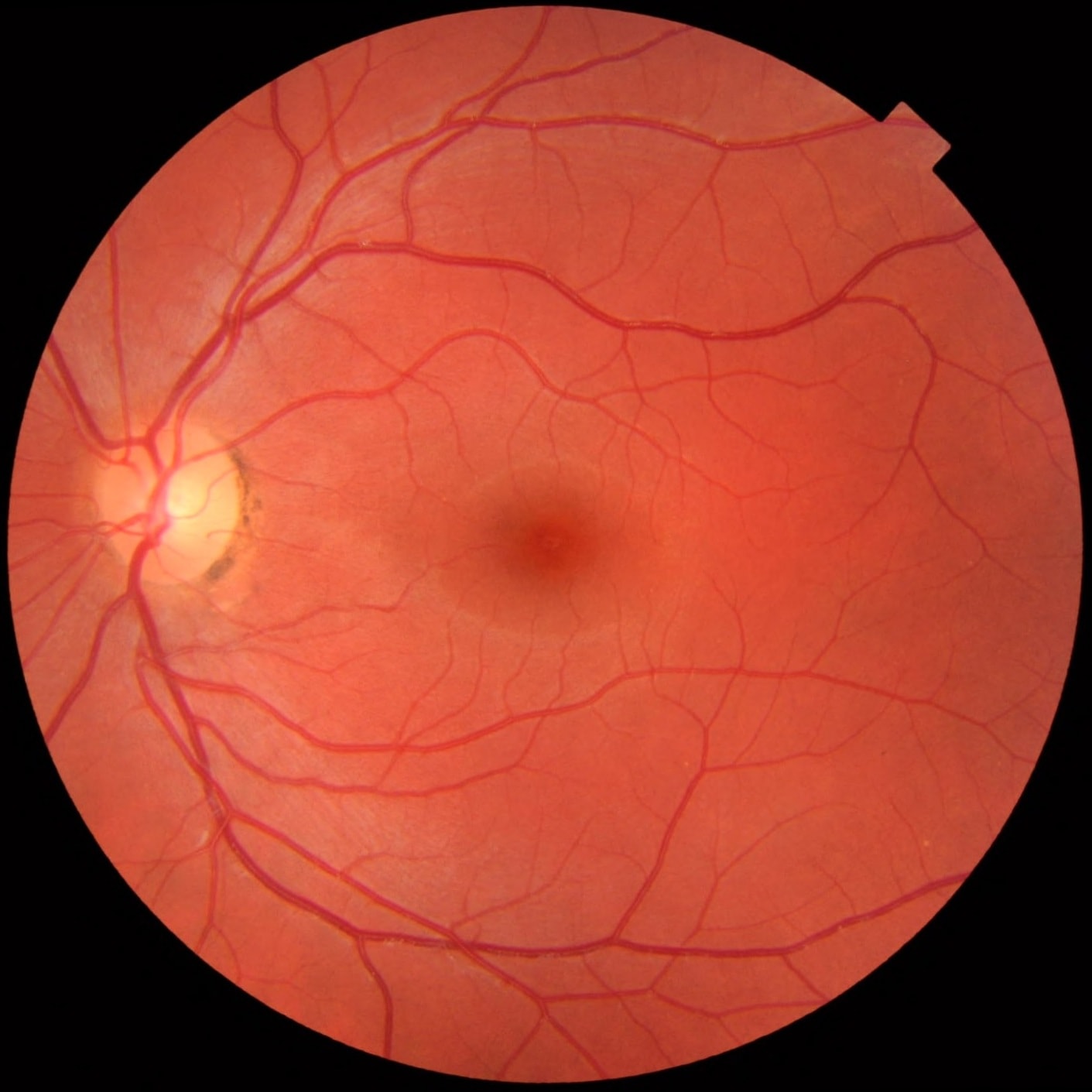
The back of a healthy eye. The darker spot at the center is the macula, with the fovea in its middle, the area where the 1960 examination found atrophy in both of her eyes. Photo: Mikael Häggström, CC0, via Wikimedia Commons, resized.

The 30-second version: A woman went legally blind from juvenile macular degeneration at 18 in 1959, and doctors saw the damage at the center of both retinas. Thirteen years later her husband prayed for her one night and she opened her eyes able to see him. Her records show 20/100 vision without glasses by 1974 and 20/30 to 20/40 with glasses from 2001 to 2017. The case was published in the medical journal Explore in 2020, records included.
See this page's graph and discover linked topics
In full
Clarissa Romez, Kenn Freedman (Texas Tech University Health Sciences Center), David Zaritzky and Joshua W. Brown (Indiana University), working through the Global Medical Research Institute (GMRI), published the case in the journal Explore (volume 17, issue 1, 2021, pages 79-83; first online 28 February 2020; full citation under Sources). The report rests on medical records spanning about six decades. Records from 1960 give visual acuity below 20/400 in both eyes, with dense yellowish-white areas of atrophy in each fovea on fundus examination, and a diagnosis of juvenile macular degeneration; the authors describe the condition as appearing to be a severe form of Stargardt disease. A 1971 examination recorded uncorrected acuity of finger counting in the right eye and hand motion in the left, and she was declared legally blind. In 1972 she reported regaining her sight immediately after proximal intercessory prayer, that is, hands-on petitionary prayer by someone physically present, offered by her husband. Subsequent records show uncorrected acuity of 20/100 in each eye in 1974 and corrected acuity of 20/30 to 20/40 from 2001 to 2017; at publication her sight had held for forty-seven years. The authors judged a conversion (psychogenic) disorder unlikely because the original examination found organic disease of the macula. The case meets the Tier 1 standard as a peer-reviewed report with primary medical data. Its limits are real and are stated below: the instant of healing rests on the couple's testimony, the first post-healing record is from 1974, and the journal publishes complementary and integrative medicine.
Summary
An anonymous woman, legally blind since 1959 from juvenile macular degeneration confirmed by fundus examination in 1960 and again in 1971, regained her sight in 1972 (August, per Christian Post coverage) after her husband prayed for her at home. Medical records from 1974 through 2017 document the recovery and its persistence. The case was investigated and published by the Global Medical Research Institute in the peer-reviewed journal Explore (online 2020; print 2021).
The event
The loss of sight. According to the published report, the woman lost the majority of her central vision over three months in 1959, at age 18. Her 1960 records give visual acuity of less than 20/400 in both eyes, the range of legal blindness. Fundus examination, a direct look at the retina through the pupil, showed dense yellowish-white areas of atrophy in each fovea. She was diagnosed with juvenile macular degeneration.
Thirteen years blind. Her sight did not return. A 1971 examination recorded uncorrected acuity of finger counting in the right eye and hand motion in the left: she could count fingers held near her face with one eye and only detect movement with the other. She was again diagnosed with macular degeneration and declared legally blind. News reports of the case note that she had recently finished a program to learn the white cane and braille; the Christian Post quotes her: I read braille and walked with a white cane.
The prayer. The Christian Post, reporting on the paper, gives the date as August 1972 and describes her as a Baptist whose husband was a pastor. CBN News quotes her telling researchers, The only healings we knew about were in the Bible. McDowell, summarizing the article, notes that her husband had never heard of a miraculous present-day healing and did not follow practices associated with Pentecostal or charismatic circles. One night they went to bed after midnight, later than usual for them. He read two Bible verses, knelt with his hand on her shoulder and prayed, in words the Christian Post quotes from the study: Oh, God! You can restore [...] eyesight tonight, Lord. I know You can do it! As Sean McDowell quotes the article, At the close of the prayer, his wife opened her eyes and saw her husband kneeling in front of her. It was her first clear sight in almost thirteen years.
Afterward. Her later records show 20/100 vision in each eye without correction in 1974, and corrected vision of 20/30 to 20/40 at examinations from 2001 to 2017. At publication, the authors reported her eyesight had remained intact for forty-seven years, with only the common eye problems of age.
Witnesses + documentation
- The patient, whose account of the night of the healing is reported in the paper. Her identity is withheld, as is standard in a medical case report.
- Her husband, who prayed and saw her open her eyes.
- Examining physicians, whose records from 1960, 1971, 1974 and 2001 to 2017 form the paper's data. They are not named in the published report.
- The investigating team: Clarissa Romez (GMRI), Kenn Freedman (Texas Tech University Health Sciences Center, Lubbock, ophthalmology), David Zaritzky (GMRI; a retired radiologist per the Christian Post) and Joshua W. Brown (GMRI; Department of Psychological and Brain Sciences, Indiana University).
- Publication: Explore: The Journal of Science and Healing (Elsevier), indexed in MEDLINE, 17(1): 79-83, DOI 10.1016/j.explore.2020.02.011, published open access.
Verification
- Organic disease, observed. The diagnosis did not rest on her reported symptoms. The 1960 fundus examination found visible atrophy at both foveas, a physical finding a doctor sees, not a patient's report.
- Blindness measured twice, eleven years apart. Acuity below 20/400 in 1960 and finger counting and hand motion in 1971 show the condition was not fading on its own before the prayer.
- Recovery measured over decades. The 1974 acuity of 20/100 and the 2001 to 2017 acuities of 20/30 to 20/40 come from medical records, not from memory, and show the change lasted forty-plus years.
- Peer review and full disclosure. The paper went through review at a MEDLINE-indexed journal and is free to read, so any reader can check the data against the conclusions.
Naturalistic explanations considered:
- Conversion (psychogenic) blindness. The authors judged this unlikely because the original examination showed physical damage to the macula, which a psychological condition does not produce. As McDowell summarizes them, a conversion disorder could explain neither the atrophy at each fovea nor its resolution in the retinal images taken after her sight returned.
- Placebo or expectation. The authors could not rule it out entirely, but, as McDowell summarizes them, it is unclear how a placebo could improve visual acuity in a retina with structural disease.
- Spontaneous remission. Stargardt disease and related juvenile macular dystrophies are inherited and progressive. McDowell reports that the article identifies no other known case of spontaneous recovery from the condition.
- Misdiagnosis. Even if the precise label were wrong, the measured blindness and the visible foveal atrophy are what changed, and those are findings, not labels.
Caveats and remaining uncertainties:
- The moment of healing rests on testimony. No examination was recorded between the prayer in 1972 and 1974. The records prove the before and the after; the claim that the change was instantaneous comes from the couple.
- Anonymity and location. The patient, her physicians and her location are not named in the published report. That is normal for a case report but means outside readers cannot interview them.
- The journal and the institute. Explore publishes complementary and integrative medicine, and PZ Myers ("CAM and credulity," Pharyngula, 13 March 2023) dismissed it as not a science journal and called the paper an anecdote drawn from old files. Edzard Ernst ("Resolution of blindness after prayer?", 18 February 2021) questioned the value of a case reported forty-seven years after the fact. GMRI states that its mission is to investigate prayer in conditions with a poor prognosis. These are fair points about weight and framing; neither critic offers a medical explanation of the recovery or disputes the records.
- One case. A single case report cannot establish how often such recoveries occur. It establishes that this one did, on the record.
Apologetic value
- A Protestant case in the medical literature. Most peer-reviewed or bureau-reviewed healings in this collection come through Lourdes or the Vatican canonization process. This one comes from a Baptist home, an untrained husband's prayer and no shrine, and still reached a peer-reviewed journal with records attached.
- The Gospel pattern. Restored sight is the sign Jesus himself pointed to when John the Baptist's disciples asked who he was (Matthew 11:5, Luke 7:22), and the healed man of John 9 put the evidential point simply: though I was blind, now I see (John 9:25, KJV). The prayer itself fits James 5:14-16.
- An answer to Hume. David Hume argued that testimony to a miracle can never outweigh uniform experience. Here the testimony is not alone: the medical record on both sides of the event is what makes the claim, and the testimony fills only the gap between 1972 and 1974.
- How to deploy it. Lead with the numbers (below 20/400, finger counting and hand motion, then 20/100 and 20/30 to 20/40) and the visible foveal atrophy. Concede the testimony gap and the journal's orientation before the listener raises them. Pair it with STEPP Mozambique Study (Brown 2010) for the controlled-study side of the same research program on proximal prayer, and with Lourdes cases for formal bureau review.
Scholarship
Published academic works this page draws on, each matched to a publisher, index or library catalog record.
- Clarissa Romez, David Zaritzky and Joshua W. Brown, "Case Report of gastroparesis healing: 16 years of a chronic syndrome resolved after proximal intercessory prayer," Complementary Therapies in Medicine 43 (2019). doi:10.1016/j.ctim.2019.03.004 PubMed 30935546 open access
- Clarissa Romez et al., "Case report of instantaneous resolution of juvenile macular degeneration blindness after proximal intercessory prayer," Explore 17 (2021). doi:10.1016/j.explore.2020.02.011 PubMed 32234287
See also
- Miracles, master hub
- _schema, the vetting standard this entry follows
- STEPP Mozambique Study (Brown 2010), peer-reviewed study of proximal intercessory prayer on vision and hearing
- Barbara Cummiskey Snyder (Wheaton 1981), another Protestant healing with physician documentation
- Vittorio Micheli (Lourdes 1962), Tier 1 bureau-reviewed healing for comparison
- Argument from Miracles, the argument this case supports
- David Hume, whose argument against miracle testimony this case presses
- Naturalism, the worldview such cases press against
Common questions this page answers
Q: Is there a peer-reviewed case of a blind person healed by prayer?
Yes. In 2020 the journal Explore published a case report by Romez, Freedman, Zaritzky and Brown on a woman legally blind from juvenile macular degeneration since 1959 who regained her sight after her husband prayed for her in 1972. Her medical records before and after are part of the report.
Q: How blind was the woman in the macular degeneration prayer case?
Her 1960 records show vision below 20/400 in both eyes, with visible atrophy at the center of each retina. In 1971 she could only count fingers with her right eye and see hand motion with her left, and she was declared legally blind.
Q: How good was her vision after the prayer?
Her records show 20/100 in each eye without glasses in 1974, and 20/30 to 20/40 with glasses at examinations from 2001 to 2017. At publication her sight had lasted forty-seven years.
Q: Could the macular degeneration healing have been psychological or a placebo?
The authors judged a psychological cause unlikely because the 1960 examination found physical damage to the macula. They could not rule out placebo completely but noted it is unclear how a placebo could restore acuity in a structurally diseased retina.
Q: What are the weaknesses of the macular degeneration healing case?
No eye examination was recorded between the 1972 prayer and 1974, so the instant of healing rests on the couple's word. The patient is anonymous, and the journal publishes complementary medicine, which critics such as PZ Myers and Edzard Ernst point to. Neither critic offers a medical explanation for the recovery.