Argument
Joshua's Long Day Objection Defeater
Joshua's Long Day, Sun Stood Still Objection, Sun Stood Still Objection Defeater, Joshua 10 Sun Standing Still, Did the Sun Stand Still, NASA Missing Day, Joshua's Missing Day, Joshuas Long Day Objection DefeaterIntro
"Joshua 10 says the sun stood still for a whole day. That is scientifically impossible. If the earth stopped spinning, everything on it would be flung off at over a thousand miles an hour. So the Bible is false."
The objection sounds like physics, but it rests on a reading of the text. It assumes the passage is telling us the earth's rotation stopped. The passage never says that. It says Joshua prayed, the sun and moon "stood," the day did not end before Israel's victory, and the LORD listened to a man. That is how the event looked from a battlefield, told partly in a quoted poem, and it is how anyone describes the sky. We still say "sunrise."
Bible-believing scholars read the event in several ways: a true miracle of extended daylight, an optical effect, a darkening of the sun that brought relief to a tired army, a sign in the sky, or even a solar eclipse. Each takes the text seriously, and none requires the earth to stop. If someone insists on the most literal version, the objection still only says "miracles cannot happen," which is the question being argued, not an answer to it.
One more thing: the popular story that "NASA computers found Joshua's missing day" is false. Christians should never use it.
See this page's graph and discover linked topics
Cheatsheet
The 30-second reply:
The text does not say the earth stopped rotating. It describes what Israel saw from the battlefield, quotes a poem from the Book of Jashar, and uses verbs that mean "be still," "be silent" and "stand." Serious readers take it as a miracle of light, a darkening, a sign or an eclipse, and none of those needs the earth to stop. And if you insist on the earth stopping, your real objection is "miracles are impossible," which assumes the very thing we are debating.
The fast facts:
- The command verb is dom, "be still, be silent." The KJV margin at Joshua 10:12 reads "Heb. be silent." The same root describes Aaron holding his peace (Leviticus 10:3).
- The narrator flags a poem. "Is not this written in the book of Jashar?" (Joshua 10:13, ASV) cites a collection of poetry also quoted for David's lament in 2 Samuel 1:18.
- "About a whole day" is approximate. The Hebrew keyom tamim is "like a complete day"; YLT renders it "as a perfect day." It does not say "twenty-four extra hours."
- Verse 14 names what was unique: "there was no day like that... that Jehovah hearkened unto the voice of a man" (Joshua 10:14, ASV). The singularity is answered prayer, not astronomy.
- The NASA missing-day story is an urban legend. It traces to a 1969 newspaper story about Harold Hill and recycles an 1890 book by Charles Totten. No such computation exists or could exist.
The 3 strongest counter-moves:
- "Show me where the text says the earth stopped rotating." It describes the sun and moon as seen from Gibeon, the same way every human language does.
- "Is your objection to Joshua, or to miracles?" If the latter, the burden is to show God does not exist or cannot act; physics describes what happens when no one intervenes.
- "Which reading are you refuting?" Five readings are on the table. The objection refutes, at most, one version of one.
Reciprocal concessions (grant the small point, then collect a bigger one):
- Grant: if the earth's rotation halted abruptly under ordinary physics, the result would be catastrophic. Now collect: then the objection is not about Joshua at all but about whether miracles can happen; a God able to stop the earth is not limited to stopping it the clumsy way, and you must show the text requires a halted earth before the physics matters.
- Grant: no extra-biblical record confirms a long day. Now collect: then admit no Late Bronze Age record of a local battle-day in the Judean hills was ever likely to survive, so silence is not evidence; and admit that the leading eclipse proposal, if right, would be an independent astronomical anchor for the text, not a refutation of it.
- Grant: the NASA "missing day" story is false, and Christians who spread it were wrong. Now collect: then the question is decided on the text and the evidence, and you must engage the text's own markers, the poetic citation, the verb dom, "about a whole day," rather than the cartoon version.
- Grant: Christian scholars disagree on what happened. Now collect: then "the Bible is false" needs every coherent reading to fail, and at least four of the five do not involve any physical impossibility at all.
The closing line:
You came to refute a stopped planet. The text gives you a praying general, a poem, a darkened or lingering sun, and a God who listened. Argue with that.
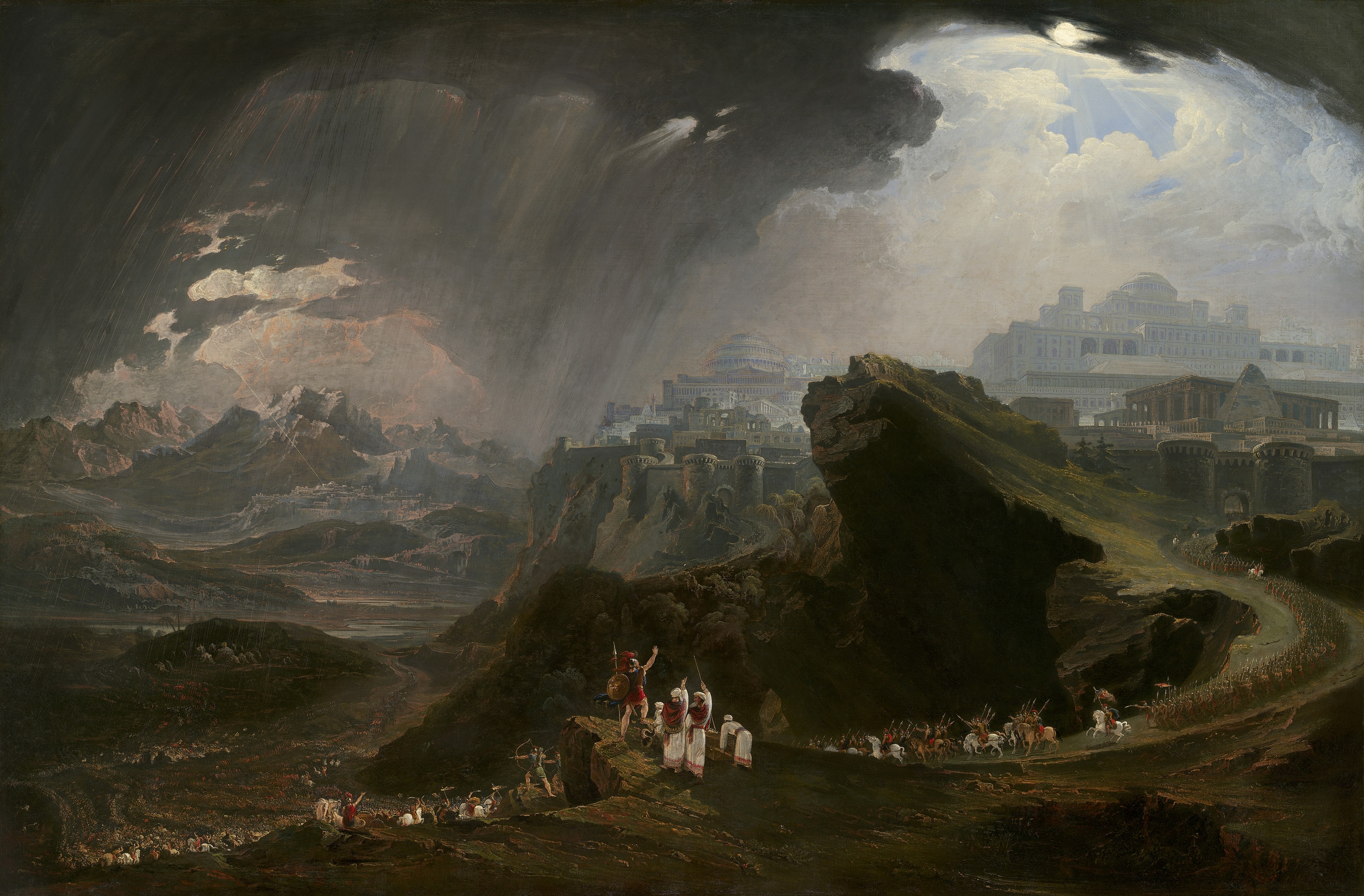
Joshua commands the sun to stand still upon Gibeon (Joshua 10:12-13). John Martin, 1816, National Gallery of Art, Washington. CC0, via Wikimedia Commons.
In full
Defeater for: "Joshua 10:12-14 says the sun stood still for about a whole day. Halting the earth's rotation is physically impossible (or would have destroyed life on earth), so the account is false and the Bible errs."
The defeat runs on five moves. (1) The objection imports a mechanism, the arrest of the earth's rotation, that the text does not assert; the language is observational, as all ordinary language about the sky is. (2) The Hebrew vocabulary (dom, "be still, silent"; 'amad, "stand, stop"; lo-'ats lavo, "did not hurry to go in"; keyom tamim, "about a whole day") and the narrator's explicit citation of the Book of Jashar leave several readings open. (3) On the strongest literal reading the objection reduces to the claim that miracles are impossible, which begs the question against theism. (4) Four of the five live interpretations (optical prolongation, darkening, omen, eclipse) involve no violation of physics at all, and the fifth (direct miracle) is impossible only on naturalism. (5) Several popular Christian defences, the NASA "missing day," galactic or orbital "parallax," and gravitational lensing, fail by orders of magnitude or are fabrications, and must be dropped; dropping them costs the case nothing. The objection fails as a defeater of biblical truthfulness.
Grammar and hermeneutics
The objection falls before any appeal to theology is made, on what the words mean and what kind of sentence they sit in.
- The command is dom, "be still / be silent," not a verb of rotation. Joshua says shemesh begiv'on dom (Joshua 10:12). Dom is the imperative of damam (Strong's H1826), whose range is "be silent, be still, wait, cease." The KJV translators printed the literal sense in the margin: "Heb. be silent." The root describes Aaron's silence ("And Aaron held his peace," Leviticus 10:3, ASV), waiting in place (Jonathan's "Tarry until we come to you," 1 Samuel 14:9, ASV), and a sword coming to rest ("rest, and be still," Jeremiah 47:6, ASV). The verb tells the sun to stop doing what it does. It does not say what the sun does, and it says nothing about the earth.
- 'Amad, "stood," describes position as seen, and the text pairs it with dom. In Joshua 10:13 "the sun stood still" is wayyiddom (from damam), "the moon stayed" is 'amad (H5975), and "the sun stayed in the midst of heaven" is 'amad again. The two verbs sit together elsewhere as near-synonyms for staying put: 1 Samuel 14:9 has dommu, "tarry," then "we will stand still in our place" ('amad). These are the words for holding a position, applied from where the observer stands.
- The narrator marks the core lines as a quotation from poetry. "Is not this written in the book of Jashar?" (Joshua 10:13, ASV). The Book of Jashar is cited again for David's lament over Saul and Jonathan, a poem (2 Samuel 1:18). The quoted lines are in Hebrew parallelism: "Sun, stand thou still upon Gibeon; And thou, Moon, in the valley of Aijalon" (Joshua 10:12, ASV). Interpreters differ on whether the quotation covers only verses 12b-13a or also 13b (YLT prints 13b inside the quotation marks), but the genre marker is supplied by the text, not imposed on it. Poetry that describes what an observer sees is not a mechanics report.
- The prose summary uses observer verbs: the sun "hasted not to go down." The phrase is lo-'ats lavo, "did not hurry to go in," using bo', the ordinary Hebrew verb for sunset (the sun "goes in"). The same observer-relative idiom appears in "The sun also ariseth, and the sun goeth down, and hasteth to its place" (Ecclesiastes 1:5, ASV). Nobody reads Ecclesiastes as asserting geocentric mechanics.
- "About a whole day" is approximate and comparative. Keyom tamim combines the preposition ke- ("like, about, as") with yom tamim, "a complete day"; YLT: "as a perfect day." The phrase fixes neither a duration of twenty-four extra hours nor a mechanism. Readers have taken it as "for about the length of a full day" or as "as on a full day," and the grammar supports a range, not a stopwatch.
- The geography in verse 12 matters. The sun is "upon Gibeon" and the moon "in the valley of Aijalon," which lies to the west, down the Beth-horon road along which the Amorites fled. Interpreters, John Walton among them, have noted that a sun in the east and a moon in the west fits an early-morning setting, not noon. That observation shapes every serious reading below.
- Verse 14 states what was unprecedented. "And there was no day like that before it or after it, that Jehovah hearkened unto the voice of a man: for Jehovah fought for Israel" (Joshua 10:14, ASV). The text locates the uniqueness in God heeding a human command, and in God fighting, as He already had with the hailstones of verse 11. The narrator's interest is the LORD's action, not the sky's mechanics.
- The poetic parallel confirms the idiom. Habakkuk 3:11 says "The sun and moon stood still ('amad) in their habitation" in a hymn celebrating God's power in battle. Biblical poetry uses the motionless sun and moon as an image of the Divine Warrior's dominance.
- Hermeneutics: phenomenological language is not error. A sentence is true or false relative to what it is about. Observer-relative description ("sunrise," "the sun stood still") is about what is seen from a standpoint, and modern astronomers use it daily. Charging it with geocentrism measures the reader's expectation, not the text's accuracy. See Bible Scientific Errors Objection Defeater.
On grammar (the verb dom and its range, 'amad as position-holding, the Jashar citation formula, the sunset idiom bo', the approximate keyom tamim) and hermeneutics (observer-relative reference and the poetic genre marker) alone, the objection's premise, that the text asserts a halted earth, is not in the text.
Argument structure
| Premise | Notes | |
|---|---|---|
| P1 | The text describes the event as observed and as answered prayer; it asserts no mechanism, and certainly not the arrest of the earth's rotation. | Phenomenological language |
| P2 | The Hebrew vocabulary and the cited poem leave several readings open, and the most literal-sounding English is not the only faithful one. | Lexical and genre disambiguation |
| P3 | On a direct-miracle reading, "physically impossible" means only "impossible without God," so the objection begs the question against theism. | Miracle question-begging |
| P4 | Four of the five live readings involve no violation of physical law, and each has textual support; the fifth is a coherent miracle reading. | Interpretive-options survey |
| P5 | The popular Christian defences that fail (NASA missing day, orbital or galactic parallax, gravitational lensing) must be dropped, and dropping them costs the case nothing. | Housecleaning |
| C | The objection either attacks a reading the text does not require or assumes naturalism; either way it fails to show the Bible is false. |
Premise 1, The text describes what was seen, not a mechanism
Affirmative case
- All ordinary language about the sky is observer-relative. "Sunrise," "sunset," "the sun climbed higher" are true statements about appearances from a standpoint. Joshua 10 speaks the same way: the sun "upon Gibeon," the moon "in the valley of Aijalon."
- The account names no mechanism. It does not mention the earth, rotation, or any cause other than the LORD responding to prayer. A text that asserts no mechanism cannot be falsified by a mechanism it never claimed.
- The narrator's focus is theological. Verse 14 states the point: the LORD "hearkened unto the voice of a man" and "fought for Israel." Verse 11 has already shown Him fighting with hailstones.
- The church has read Scripture's nature-language this way for sixteen centuries. Augustine warned against making Scripture pronounce on natural questions it does not address (De Genesi ad litteram), long before any modern conflict.
Anticipated objections
- "The original author believed the sun moves around the earth, so the text asserts geocentrism."
- "Phenomenological language is a modern apologetic escape hatch."
Rebuttals
- What an author may have believed about cosmology is not what the sentence asserts. A modern speaker who says "the sun set at 6:42" asserts a time, not a model; the author's background picture is not the content of the claim. The text's assertion is that the sun remained visible and the battle was won before it set, which is a statement about appearances and outcome. Failure mode: confusing an author's assumed background with the proposition asserted.
- It is the oldest reading strategy in the church and the ordinary practice of every language. Augustine applied it c. AD 415; astronomers use "sunrise" in their own almanacs. Failure mode: dating a principle by when the objector first met it.
Premise 2, The Hebrew and the poem leave several readings open
Affirmative case
- The verb dom means "be silent, still, wait, cease" (see Grammar and hermeneutics). "Stop shining" and "stop moving" are both within its range; the English "stand still" picks one.
- The core lines are quoted from the Book of Jashar, a poetic collection, and are cast in parallelism. Poetry permits imagery that prose would state differently.
- "About a whole day" is approximate (keyom tamim), and the morning geography of verse 12 complicates the assumption that the sun stopped at noon.
- The interpretive question is internal to conservative scholarship. Robert Dick Wilson, John Walton, and Colin Humphreys (a Cambridge scientist and Christian) all hold the text historical while disagreeing about what was seen.
Anticipated objections
- "You are inventing meanings for dom to escape the plain sense."
- "If it is poetry, then you admit it never happened."
Rebuttals
- The range is in the lexicons and in the Bible's own usage, not invented: Aaron "held his peace" (Leviticus 10:3), "Tarry until we come" (1 Samuel 14:9), the sword told to "rest, and be still" (Jeremiah 47:6). The KJV of 1611 printed "be silent" in its margin, centuries before anyone needed an escape. Failure mode: treating one English rendering as the Hebrew.
- Poetry about an event is not fiction about an event. The Song of Deborah (Judges 5) celebrates the victory narrated in prose in Judges 4; David's lament in the same Book of Jashar mourns real deaths. The prose of Joshua 10 asserts a real battle and a real answer to prayer; the poem describes it. Failure mode: equating poetic form with non-historical content.
Premise 3, On the miracle reading, the objection begs the question
Affirmative case
- A miracle is, by definition, an event natural causes alone would not produce. Pointing out that natural causes would not produce it restates the definition.
- If God exists, He is not confined to one way of acting. A God able to halt the earth's rotation is able to govern the consequences (atmosphere, oceans, inertia); the objection pictures God as a brake on a car rather than the sustainer of every physical process. See Divine Conservationism.
- Laws of nature describe what happens when nothing outside the system acts. C. S. Lewis made the point in Miracles (1947): a miracle does not break the laws, it feeds a new event into the system, which the laws then carry forward.
- The question is therefore whether God exists and acts, which is argued on other grounds. See Argument from Miracles and Miracles.
Anticipated objections
- "Extraordinary claims require extraordinary evidence. Without it, I am entitled to disbelieve."
- "Appealing to God's power makes the account unfalsifiable."
Rebuttals
- That is a different objection, about the evidence for a miracle, not about its possibility, and it concedes the "impossible" charge. Weigh the account as history; do not rule it out in advance. Hume's argument against miracles (see David Hume) has the same structure and the same weakness: it assumes the uniformity it needs to prove. Failure mode: shifting from "impossible" to "unproven" without admitting the shift.
- The account is falsifiable as history (was there a battle at Gibeon, an Amorite coalition, a rout down the Beth-horon road?) and the miracle question is settled with the God question. Unfalsifiability would follow only if every event were explained by appeal to God; the text appeals to Him once, for an answered prayer. Failure mode: treating one appeal to agency as a universal escape clause.
Premise 4, The five readings, stated fairly
Each reading is held by interpreters who take the text as historical. None is the codex's official position; each is presented with its strengths and its weaknesses.
(a) Direct miracle: the sun's apparent course was halted or slowed
- Reading: God halted or slowed the earth's rotation, or otherwise kept the sun visible, and governed the consequences.
- Strengths: the most straightforward English sense; honours the narrator's emphasis on a unique day; requires nothing more than the God the text already presupposes.
- Weaknesses: it maximises the physical consequences that must be governed, and it reads the poetic citation in the most prosaic way. It is a coherent reading, but not the only faithful one.
(b) Prolonged light by refraction or another optical effect
- Reading: the sun's light lingered, perhaps by an atmospheric effect, so that daylight outlasted its normal span over the battlefield.
- Strengths: keeps the "lingering sun" sense of verse 13b without requiring the earth to stop.
- Weaknesses: ordinary refraction near the horizon lifts the sun's image by only about half a degree, delaying sunset by a few minutes. The Novaya Zemlya mirage, first recorded by Willem Barentsz's crew in 1597, shows the sun when it is geometrically below the horizon, but it depends on polar geometry where the sun skims the horizon; at Gibeon's latitude (about 32° N) the sun sets steeply. An optical effect lasting hours would itself need to be a miracle, and it must also account for the moon "staying."
(c) The sun "be silent": darkening, relief, a "long night"
- Reading: taking dom as "be silent," Joshua prayed for the sun to stop shining. After an all-night march from Gilgal ("for he went up from Gilgal all the night," Joshua 10:9, ASV), an army in the heat would be helped by cloud and darkness, and verse 11 records a hailstorm. Robert Dick Wilson of Princeton ("What Does 'The Sun Stood Still' Mean?", 1918) argued from comparison with Babylonian astronomical vocabulary that the words point to the sun being darkened, an eclipse-type event; other commentators have connected the darkening with the storm of verse 11.
- Strengths: takes the primary sense of dom seriously; ties the prayer to the hailstorm actually narrated; fits the morning geography.
- Weaknesses: verse 13b, "hasted not to go down about a whole day," reads most naturally as extended light, and the darkening reading must take it as "did not hurry to set," or as relief lasting about a day, which some find strained.
(d) John Walton: a celestial omen
- Reading: in "Joshua 10:12-15 and Mesopotamian Celestial Omen Texts" (1994), Walton reads the passage against Mesopotamian omen literature, where the relative positions of sun and moon on particular days of the month were read as favourable or unfavourable signs. On this view Joshua asks for the sun and moon to "wait" and "stand" in a configuration that would be a bad omen for the Amorites, and God grants it, turning the enemy's own sky-reading against them. See John Walton.
- Strengths: grounded in real ancient Near Eastern vocabulary; explains why the sun and moon are named together; fits the morning setting; makes the event a public sign the Amorites would have understood.
- Weaknesses: depends on reading Israelite war-poetry through Mesopotamian omen technique, and on a specific calendar alignment that the text does not state; critics find the link to verse 13b's lingering sun loose.
(e) Humphreys and Waddington: an annular solar eclipse, 30 October 1207 BC
- Reading: in Astronomy & Geophysics (2017), Colin Humphreys and Graeme Waddington argued that dom should be read as "stop shining," that the sun and moon both "stopped" doing their normal work as in an eclipse, and that the only annular eclipse visible from Canaan between 1500 and 1050 BC occurred on the afternoon of 30 October 1207 BC. They used the date to refine the chronology of the pharaohs Merneptah and Ramesses the Great. See Merneptah Stele.
- Strengths: an independent, calculable astronomical anchor; uses the primary sense of dom; peer-reviewed in a Royal Astronomical Society journal.
- Weaknesses: in an eclipse the sun and moon stand together in the same part of the sky, which sits awkwardly with verse 12 placing them over Gibeon and over Aijalon, and "hasted not to go down" reads more naturally as lingering light; a 1207 BC date requires a particular (late) chronology of the conquest that many conservative scholars, who favour an earlier exodus, reject; and the reading of dom as "be eclipsed" is contested.
Anticipated objections
- "Five readings means nobody knows, which means the Bible is unreliable."
- "The naturalistic readings are just ways of explaining the miracle away."
Rebuttals
- Uncertainty about mechanism is not uncertainty about occurrence. Historians disagree about the mechanics of many well-attested events. The objection needs every reading to fail; it has engaged, at most, one. Failure mode: inferring falsehood from interpretive plurality.
- None of the readings removes God from the account. On every one, Joshua prays, the LORD answers, and the LORD fights for Israel; a timed darkening, a hailstorm on cue, or an omen granted at the moment of battle is no less an act of God than a halted sun. Failure mode: assuming that an event with a describable mechanism cannot be providential.
Premise 5, Drop the defences that fail
Affirmative case
- The "galactic or orbital parallax" idea fails by many orders of magnitude. The sun's daily motion across the sky comes from the earth's rotation, about 15 degrees per hour. The earth's orbit shifts the sun against the stars by about 1 degree per day, roughly 0.04 degrees per hour, and in the direction that slightly lengthens the solar day, not one that cancels it. The solar system's orbit around the galaxy, at about 230 km/s, is shared by the earth and the sun together, so it does not change the sun's direction as seen from earth at all; its own angular rate (one circuit in roughly 230 million years) is about a hundred billion times slower than the earth's rotation. No alignment of these motions can hold the sun still for minutes, let alone hours.
- Gravitational lensing is real but tiny here. Light grazing the sun's edge is bent by about 1.75 arcseconds, the effect measured in the eclipse expeditions of 1919. The earth bends grazing light by well under a thousandth of an arcsecond. Holding the sun's image still for one hour would require a steadily growing deflection of 15 degrees, which is 54,000 arcseconds, about thirty thousand times the sun's maximum and a hundred million times the earth's. Any mass able to do that would wreck the earth's orbit.
- The NASA "missing day" story is false. It surfaced in 1969 in a newspaper in Spencer, Indiana, attributed to Harold Hill, a Baltimore company president whose firm was said to have done contract work for the space programme, and spread through churches and later email for decades. The tale claims Goddard Space Flight Center computers found a day missing, 23 hours 20 minutes for Joshua plus 40 minutes for Hezekiah's sundial (2 Kings 20:8-11). NASA has denied that any such computation was run. The arithmetic recycles Charles A. L. Totten's Joshua's Long Day and the Dial of Ahaz (1890). And the computation is impossible in principle: positions of planets in the past are calculated backward from present positions and known motions, so there is no independent record against which a "missing" day could show up.
Anticipated objections
- "If Christians spread the NASA story, that shows believers will accept anything."
- "By dropping these, you concede you have no scientific explanation."
Rebuttals
- Christians debunked it too. Christian writers and organisations have warned against the story for decades, and this page does the same. A movement that corrects its own legends is behaving like a truth-seeking one. Failure mode: judging a view by its worst popularisers.
- The text never asked for a scientific explanation. Four of the five readings need no exotic physics, and the fifth is a miracle, which by definition has no natural mechanism. Dropping bad arguments removes liabilities; it removes nothing the case depends on. Failure mode: treating the loss of a weak argument as the loss of the conclusion.
Master objections to the whole argument
MO1: "You are just multiplying readings until one survives."
- The readings are not ad hoc; each is grounded in Hebrew usage (dom), the text's own genre marker (Jashar), its geography (sun east, moon west), or ancient Near Eastern evidence. Several were proposed by scholars with no apologetic need for them (the Humphreys-Waddington paper is a chronology paper in an astronomy journal). And Augustine was reading Scripture's nature-language this way long before any scientific pressure existed.
MO2: "Paine already showed the Book of Jashar is a lost book, so the citation proves nothing."
- A citation of a source the first readers could check is evidence that the writer was appealing to known tradition, not inventing; see The Age of Reason Objection Defeater. That the book is lost to us does not make it imaginary; David's lament is quoted from it too.
MO3: "Whatever the mechanism, the God of Joshua 10 is a war god, and the moral problem remains."
- That is a separate objection, about the conquest, not about science. See Canaanite Conquest Objection Defeater and Canaanite Conquest and Herem.
Live-cite kit
Scripture:
- "Sun, stand thou still upon Gibeon; And thou, Moon, in the valley of Aijalon" (Joshua 10:12, ASV), with the KJV margin "Heb. be silent"
- "Is not this written in the book of Jashar?" (Joshua 10:13, ASV)
- "There was no day like that before it or after it, that Jehovah hearkened unto the voice of a man" (Joshua 10:14, ASV)
- "The sun also ariseth, and the sun goeth down, and hasteth to its place" (Ecclesiastes 1:5, ASV), the same observer idiom
Scholarly:
- John H. Walton, "Joshua 10:12-15 and Mesopotamian Celestial Omen Texts" (1994): the sun and moon as an omen against the Amorites
- Colin Humphreys and Graeme Waddington, Astronomy & Geophysics (2017): annular eclipse of 30 October 1207 BC
- Robert Dick Wilson (1918): the verbs point to the sun's darkening
- C. S. Lewis, Miracles (1947): a miracle feeds a new event into nature; it does not break the laws
Aphorism:
- "You came to refute a stopped planet. The text gives you a praying general and a poem."
- "Uncertain mechanism is not uncertain history."
- "If your objection is that miracles are impossible, say so, and we can argue about God."
Tactical notes
- Order of deployment. Open with P1 (no mechanism is asserted), then the verb dom and the Jashar citation from the Grammar section. Offer the five readings only if pressed; one or two is usually enough. Hold P3 (miracle question-begging) for the objector who insists on a halted earth.
- Force-commit move. "Read me the words that say the earth stopped." Then: "Is your problem the text, or the possibility of God acting?"
- What NOT to defend. Do not cite the NASA missing day. Do not argue from galactic motion, parallax or gravitational lensing. Do not insist that only one interpretation is faithful; the strength of the defeater is that the objection must defeat them all. Do not claim an extra-biblical record of the long day exists.
- Pivot. The text's own climax is "Jehovah hearkened unto the voice of a man." The real question for the objector is not whether the sun can stand still but whether there is a God who hears.
See also
- Bible Scientific Errors Objection Defeater, the parent defeater on phenomenological language and genre
- Bible Scientific Errors Objection, the concept hub for the wider objection
- Joshua 10.12-14, the passage itself, with the four translations and a theological reading
- Evidence Behind the Bible's Most Incredible Stories, where the eclipse proposal is graded alongside other miracle accounts
- John Walton, whose omen reading is option (d)
- Pool of Gibeon, the archaeology of the battle's setting
- Argument from Miracles, the case for miracles as historical events
- The Age of Reason Objection Defeater, Paine's older attack on Joshua and the Book of Jashar
- Quantum Entanglement and God, a parallel case of using physics honestly in apologetics
Common questions this page answers
Q: Did the sun really stand still in Joshua 10?
The text says the sun and moon "stood" and the day did not end before Israel's victory, described as seen from the battlefield and partly in a quoted poem. Interpreters who take it as historical read it as a direct miracle, an optical prolongation of light, a darkening of the sun, a celestial omen, or a solar eclipse; none of the last four involves the earth stopping.
Q: Wouldn't the earth stopping have destroyed everything?
Under ordinary physics an abrupt halt would be catastrophic. But the text never says the earth stopped, and on a direct-miracle reading the God who stopped it would also govern the consequences. The objection then becomes "miracles are impossible," which assumes what it needs to prove.
Q: Did NASA find Joshua's missing day?
No. The story traces to a 1969 newspaper account attributed to Harold Hill and recycles an 1890 book by Charles Totten. NASA has denied it, and the computation is impossible in principle, because past planetary positions are calculated backward from present ones with no independent record to show a gap.
Q: What does the Hebrew word dom mean in Joshua 10:12?
Dom is the imperative of damam, "be silent, be still, wait, cease." The KJV margin gives "Heb. be silent." The same root is used for Aaron holding his peace and for waiting in place, so the command tells the sun to stop doing what it does without specifying how.
Q: What is the Book of Jashar?
A lost collection of Israelite poetry cited twice in the Old Testament, for Joshua's command to the sun and moon (Joshua 10:13) and for David's lament over Saul and Jonathan (2 Samuel 1:18). Its citation marks the sun-and-moon lines as quoted verse.
Q: Was Joshua's long day a solar eclipse?
Colin Humphreys and Graeme Waddington argued in 2017 that it was the annular eclipse of 30 October 1207 BC. The proposal is serious and peer-reviewed but contested, because verse 12 places the sun and moon in different parts of the sky, and the date depends on a late chronology of the conquest.
Q: Could gravitational lensing or the earth's orbit explain the sun standing still?
No. The earth's orbit moves the sun about 0.04 degrees an hour against the earth's rotation of 15 degrees an hour, and the galactic orbit is shared by earth and sun. Gravitational lensing by the sun bends light by under two arcseconds, tens of thousands of times too little.