Person
Joshua Son of Nun
Joshua son of Nun, Joshua the son of Nun, Hoshea son of Nun, Yehoshua bin Nun, Joshua (person), Joshua the leader of IsraelJoshua son of Nun, of the tribe of Ephraim, was Moses' assistant and successor, the commander who led Israel across the Jordan into the land of Canaan and divided it among the tribes. Moses changed his name from Hoshea, "salvation," to Yehoshua, "YHWH saves" (Numbers 13:16). In Greek that name is Iēsous, the same name the New Testament gives to Jesus.
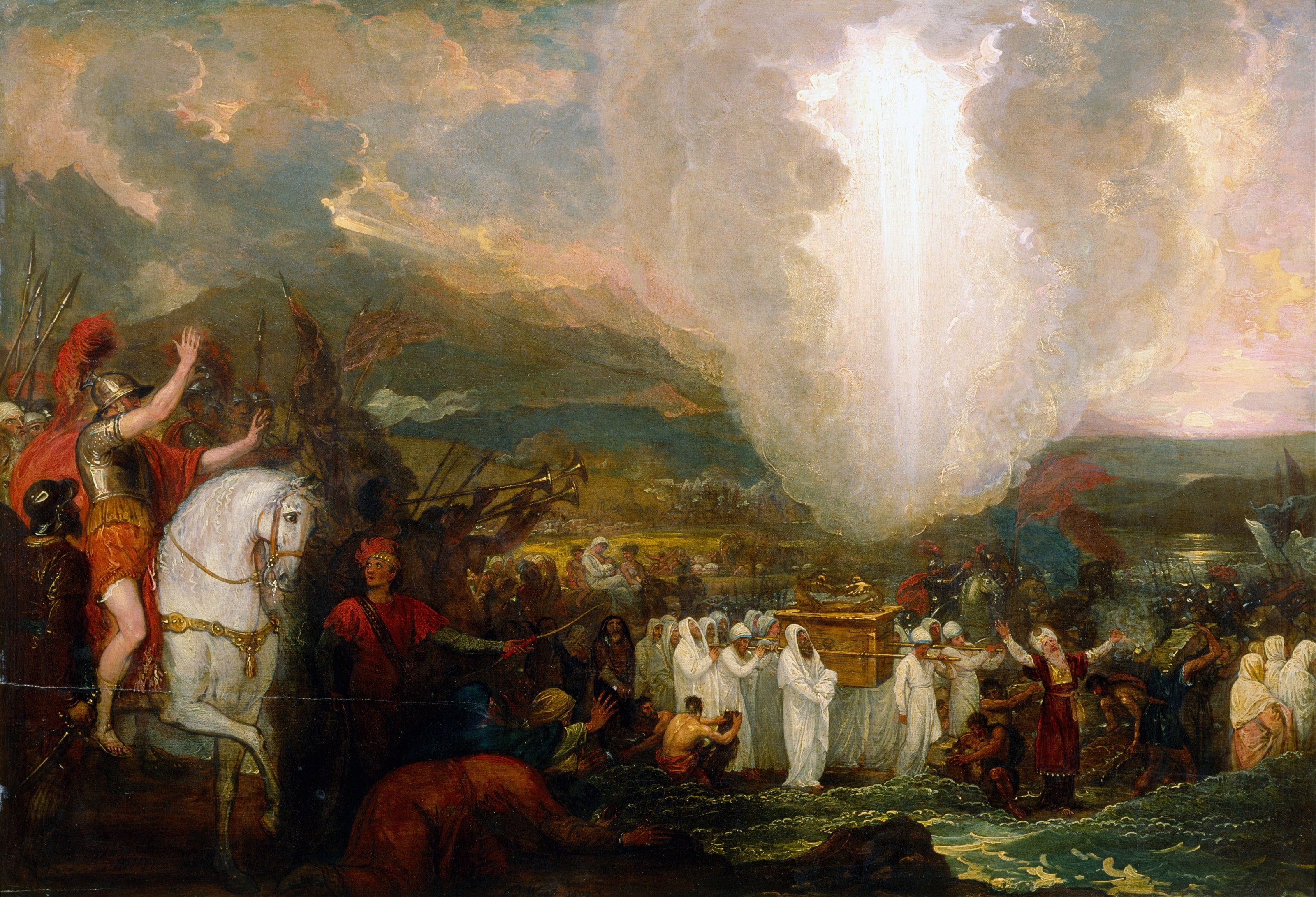
Benjamin West, Joshua Passing the River Jordan with the Ark of the Covenant (1800), Art Gallery of New South Wales. Public domain, via Wikimedia Commons.
The 30-second version:
Joshua was Moses' servant and successor. Moses brought Israel out of Egypt and gave the Law; Joshua brought them into the promised land after Moses died, crossing the Jordan on dry ground and dividing the land as God had sworn. His name, Yehoshua, means "YHWH saves," and in Greek it is the same name as Jesus. Hebrews draws the line: if Joshua had given Israel the final rest, God would not have spoken later of another day. Joshua gave a real but partial rest; Jesus gives the rest that remains.
Life at a glance
- Commander against Amalek. His first appearance: Moses tells him, "Choose us out men, and go out, fight with Amalek" (Exodus 17:9, ASV).
- Moses' minister. He goes up the mountain with Moses (Exodus 24:13) and stays at the tent of meeting: "his minister Joshua, the son of Nun, a young man, departed not out of the Tent" (Exodus 33:11, ASV).
- Renamed. "Moses called Hoshea the son of Nun Joshua" (Numbers 13:16, ASV).
- Faithful spy. With Caleb he urged Israel to trust God and enter the land (Numbers 14:6-9); of that generation only the two of them would enter (Numbers 14:30).
- Commissioned. God calls him "a man in whom is the Spirit" and has Moses lay hands on him (Numbers 27:18, ASV). Afterward "Joshua the son of Nun was full of the spirit of wisdom; for Moses had laid his hands upon him" (Deuteronomy 34:9, ASV).
- Successor. "Moses my servant is dead; now therefore arise, go over this Jordan, thou, and all this people, unto the land which I do give to them" (Joshua 1:2, ASV).
- The Jordan crossing. When the priests' feet touched the flooded river, "the waters which came down from above stood, and rose up in one heap," and "all Israel passed over on dry ground" (Joshua 3:14-17, ASV).
- Conquest and division. After Jericho (Joshua 6) and the southern and northern campaigns, "Joshua took the whole land... and Joshua gave it for an inheritance unto Israel according to their divisions by their tribes. And the land had rest from war" (Joshua 11:23, ASV).
- Covenant renewal at Shechem. "As for me and my house, we will serve Jehovah" (Joshua 24:15, ASV). He "wrote these words in the book of the law of God" (Joshua 24:26, ASV), and died at 110.
See this page's graph and discover linked topics
God kept His word
The book of Joshua closes its account of the land with a summary of God's faithfulness:
So Jehovah gave unto Israel all the land which he sware to give unto their fathers; and they possessed it, and dwelt therein. And Jehovah gave them rest round about, according to all that he sware unto their fathers... There failed not aught of any good thing which Jehovah had spoken unto the house of Israel; all came to pass. (Joshua 21:43-45, ASV)
Moses saw the land but was told he would not cross into it (Deuteronomy 34:4). Joshua led the people in. The promise to Abraham's descendants was kept in history, by name and by boundary, which is the ground for trusting the promises that remain.
Moses, Joshua and Jesus
The early church saw in Joshua a type, an Old Testament figure whose role points ahead to Christ. The pattern is laid out by the text itself rather than imposed on it.
| Moses | Joshua | Jesus | |
|---|---|---|---|
| Work | Brings Israel out of bondage | Brings Israel into the land | Brings His people into God's rest |
| Gift | The Law at Sinai | The inheritance in Canaan | The new covenant and eternal inheritance |
| Limit | Sees the land but does not enter (Deuteronomy 34:4) | Gives rest, but not the final rest (Hebrews 4:8) | "A sabbath rest for the people of God" (Hebrews 4:9) |
| Name | Moshe | Yehoshua, "YHWH saves" | Yeshua / Iēsous, "he shall save his people" (Matthew 1:21) |
- The Law does not bring Israel into the land. Moses, the lawgiver, dies outside it. The man who leads the people in bears the name that means "YHWH saves." Early Christian writers read this as a picture: the Law points the way, and salvation brings God's people home. John's Gospel states the contrast plainly: "the law was given through Moses; grace and truth came through Jesus Christ" (John 1:17, ASV).
- Hebrews makes the comparison explicit. "For if Joshua had given them rest, he would not have spoken afterward of another day. There remaineth therefore a sabbath rest for the people of God" (Hebrews 4:8-9, ASV). The argument runs from Psalm 95: long after Joshua, David still warns Israel, "To-day... they should not enter into my rest." So the land was a real fulfillment, but not the last one. The final rest is entered by faith in Christ (Hebrews 4:1-11).
- Justin Martyr drew the line in the second century, arguing to a Jewish interlocutor that Moses' renaming of Hoshea as Joshua, who then led the people into the land, foreshadowed Jesus who leads His people into the true inheritance (Dialogue with Trypho 113).
The same name
- Hebrew. Yehoshua (H3091 - Yehoshua) joins the divine name with the verb yasha, "to save." In later books the shortened form Yeshua appears.
- Greek. The Septuagint renders the name Iēsous (G2424 - Iesous), and the New Testament uses the same word both for Joshua and for Jesus of Nazareth.
- English Bibles show it. The KJV keeps the Greek form in two places where the person is Joshua: "For if Jesus had given them rest" (Hebrews 4:8, KJV, with the margin "that is, Joshua") and "brought in with Jesus into the possession of the Gentiles" (Acts 7:45, KJV). The ASV and most modern versions print "Joshua" in both places.
- The meaning carries over. The angel tells Joseph, "thou shalt call his name JESUS; for it is he that shall save his people from their sins" (Matthew 1:21, ASV). The name Joshua bore as a promise, Jesus bears as a description.
In the codex's apologetic
- Historicity of the conquest. See Jericho Conquest and Joshuas Altar at Mount Ebal for the archaeological discussion.
- The moral objection. See Canaanite Conquest and Herem for the ethics of the conquest commands.
- The long day. See Joshua's Long Day Objection Defeater for the sun standing still at Gibeon.
- Scripture after Moses. Joshua's writing "in the book of the law of God" is evidence that Israel's scripture grew after Moses by authorized hands. See Deuteronomy 4.2 Forbids Later Scripture Objection Defeater.
See also
- Moses, his master and predecessor
- Joshua, the book that bears his name
- H3091 - Yehoshua and G2424 - Iesous, the name in Hebrew and Greek
- Typological Fulfillment, how Old Testament figures point to Christ
- Sabbath, the rest that Hebrews 4 says remains
- Jericho Conquest, the first city taken
- Canaanite Conquest and Herem, the conquest and its moral questions
- Joshua's Long Day Objection Defeater, the battle at Gibeon
Common questions this page answers
Q: Who led the Israelites into the promised land?
Joshua son of Nun. Moses led Israel out of Egypt and through the wilderness but died before crossing the Jordan; God commanded Joshua to lead the people across (Joshua 1:2), and he divided the land among the tribes.
Q: Are the names Joshua and Jesus the same?
Yes. Joshua's Hebrew name, Yehoshua, means "YHWH saves," and its Greek form is Iēsous, the same name the New Testament gives Jesus. That is why the KJV reads "Jesus" in Hebrews 4:8 and Acts 7:45, where the person meant is Joshua.
Q: What does Hebrews 4:8 mean about Joshua and rest?
It argues that Joshua's conquest gave Israel a real but not final rest, because God spoke of "another day" of rest long afterward in Psalm 95. "There remaineth therefore a sabbath rest for the people of God" (Hebrews 4:9), entered through faith in Christ.
Q: Why couldn't Moses enter the promised land but Joshua could?
God barred Moses from entering because of his failure at Meribah, and he saw the land only from Mount Nebo (Deuteronomy 34:4). Christian interpreters have long seen a picture in it: the lawgiver brings the people to the border, and the one named "YHWH saves" brings them in.
Q: How is Joshua a type of Christ?
He bears the same name, succeeds the lawgiver, leads God's people through the waters into the inheritance, and gives them rest from their enemies. Hebrews shows that the rest he gave was partial, pointing to the greater rest Christ gives.