Passage
Joshua 10.12-14
12. Then spake Joshua to Jehovah in the day when Jehovah delivered up the Amorites before the children of Israel; and he said in the sight of Israel, Sun, stand thou still upon Gibeon; And thou, Moon, in the valley of Aijalon. 13. And the sun stood still, and the moon stayed,... (ASV)Book: Joshua · NASB95
Immediate context (±2 verses)
ASV
10. And Jehovah discomfited them before Israel, and he slew them with a great slaughter at Gibeon, and chased them by the way of the ascent of Beth-horon, and smote them to Azekah, and unto Makkedah. 11. And it came to pass, as they fled from before Israel, while they were at the descent of Beth-horon, that Jehovah cast down great stones from heaven upon them unto Azekah, and they died: they were more who died with the hailstones than they whom the children of Israel slew with the sword.
12. Then spake Joshua to Jehovah in the day when Jehovah delivered up the Amorites before the children of Israel; and he said in the sight of Israel, Sun, stand thou still upon Gibeon; And thou, Moon, in the valley of Aijalon. 13. And the sun stood still, and the moon stayed, Until the nation had avenged themselves of their enemies. Is not this written in the book of Jashar? And the sun stayed in the midst of heaven, and hasted not to go down about a whole day. 14. And there was no day like that before it or after it, that Jehovah hearkened unto the voice of a man: for Jehovah fought for Israel.
- And Joshua returned, and all Israel with him, unto the camp to Gilgal. 16. And these five kings fled, and hid themselves in the cave at Makkedah. (Joshua 10:10-16, ASV)
WEB
10. Yahweh confused them before Israel. He killed them with a great slaughter at Gibeon, and chased them by the way of the ascent of Beth Horon, and struck them to Azekah and to Makkedah. 11. As they fled from before Israel, while they were at the descent of Beth Horon, Yahweh hurled down great stones from the sky on them to Azekah, and they died. There were more who died from the hailstones than those whom the children of Israel killed with the sword.
12. Then Joshua spoke to Yahweh in the day when Yahweh delivered up the Amorites before the children of Israel. He said in the sight of Israel, “Sun, stand still on Gibeon! You, moon, stop in the valley of Aijalon!” 13. The sun stood still, and the moon stayed, until the nation had avenged themselves of their enemies. Isn’t this written in the book of Jashar? The sun stayed in the middle of the sky, and didn’t hurry to go down about a whole day. 14. There was no day like that before it or after it, that Yahweh listened to the voice of a man; for Yahweh fought for Israel.
- Joshua returned, and all Israel with him, to the camp to Gilgal. 16. These five kings fled, and hid themselves in the cave at Makkedah. (Joshua 10:10-16, WEB)
KJV
10. And the LORD discomfited them before Israel, and slew them with a great slaughter at Gibeon, and chased them along the way that goeth up to Bethhoron, and smote them to Azekah, and unto Makkedah. 11. And it came to pass, as they fled from before Israel, and were in the going down to Bethhoron, that the LORD cast down great stones from heaven upon them unto Azekah, and they died: they were more which died with hailstones than they whom the children of Israel slew with the sword.
12. Then spake Joshua to the LORD in the day when the LORD delivered up the Amorites before the children of Israel, and he said in the sight of Israel, Sun, stand thou still upon Gibeon; and thou, Moon, in the valley of Ajalon. stand: Heb. be silent 13. And the sun stood still, and the moon stayed, until the people had avenged themselves upon their enemies. Is not this written in the book of Jasher? So the sun stood still in the midst of heaven, and hasted not to go down about a whole day. Jasher: or, the upright? 14. And there was no day like that before it or after it, that the LORD hearkened unto the voice of a man: for the LORD fought for Israel.
- And Joshua returned, and all Israel with him, unto the camp to Gilgal. 16. But these five kings fled, and hid themselves in a cave at Makkedah. (Joshua 10:10-16, KJV)
YLT
10. and Jehovah doth crush them before Israel, and it smiteth them, a great smiting, at Gibeon, and pursueth them the way of the ascent of Beth-Horon, and smiteth them unto Azekah, and unto Makkedah. 11. And it cometh to pass, in their fleeing from the face of Israel, they [are] in the descent of Beth-Horon, and Jehovah hath cast upon them great stones out of the heavens, unto Azekah, and they die; more are they who have died by the hailstones than they whom the sons of Israel have slain by the sword.
12. Then speaketh Joshua to Jehovah in the day of Jehovah's giving up the Amorites before the sons of Israel, and he saith, before the eyes of Israel, 'Sun, in Gibeon stand still; and moon, in the valley of Ajalon;' 13. and the sun standeth still, and the moon hath stood, till the nation taketh vengeance [on] its enemies; is it not written on the Book of the Upright, 'and the sun standeth in the midst of the heavens, and hath not hasted to go in, as a perfect day?' 14. And there hath not been like that day before it or after it, for Jehovah's hearkening to the voice of a man; for Jehovah is fighting for Israel.
- And Joshua turneth back, and all Israel with him, unto the camp at Gilgal. 16. And these five kings flee, and are hidden in a cave at Makkedah, (Joshua 10:10-16, YLT)
See this page's graph and discover linked topics
Setting
- Speaker: Joshua son of Nun, addressing the LORD and, "in the sight of Israel," the sun and moon (10:12); the narrator then cites the Book of Jashar (10:13) and comments (10:14)
- Audience: Israel's army in the field, who witness the command; the book's readers, who are pointed to the Book of Jashar as a known source
- Location: the hill country north of Jerusalem, at Gibeon (modern el-Jib), with the valley of Aijalon lying to the west down the Beth-horon road along which the Amorites fled
- Time period: the conquest of Canaan under Joshua, Late Bronze Age; dated c. 1400 BC on the early chronology of the exodus or in the thirteenth century BC on the late chronology
- Narrative context: five Amorite kings, led by Adoni-zedek of Jerusalem, besiege Gibeon for making peace with Israel (10:1-5). Gibeon appeals to Joshua, who marches "all the night" from Gilgal and surprises the coalition (10:6-9). The LORD routs them, and on the descent of Beth-horon casts down hailstones that kill more than the sword (10:10-11). Verses 12-14 are Joshua's prayer and its answer; the campaign continues with the capture of the five kings at Makkedah (10:16-27).
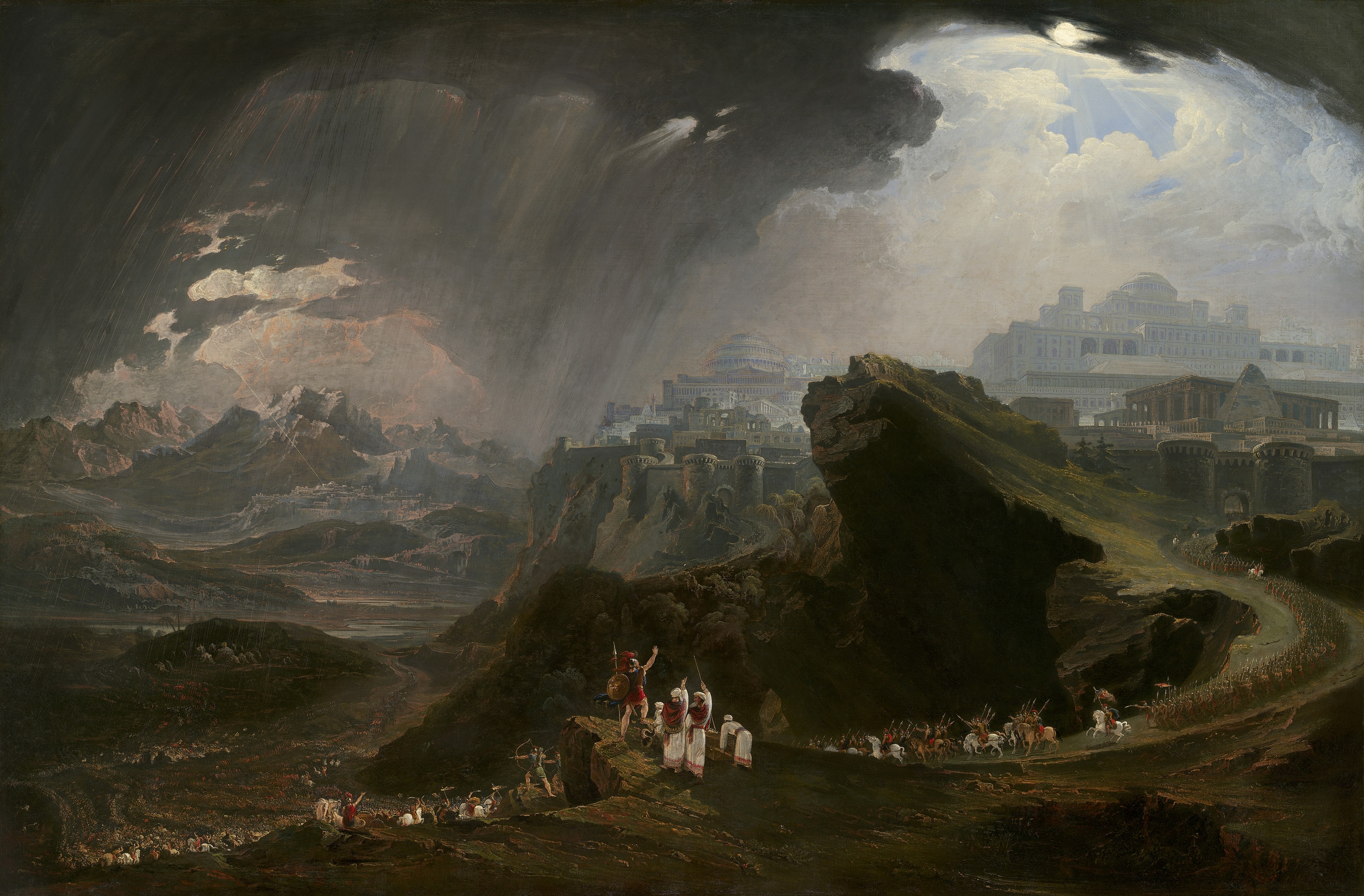
Joshua commands the sun to stand still upon Gibeon (Joshua 10:12-13). John Martin, 1816, National Gallery of Art, Washington. CC0, via Wikimedia Commons.
Theological reading
Joshua 10:12-14 is the Bible's best-known "sun stood still" text, and it is usually argued about as astronomy. The passage itself is interested in something else: a man spoke, and the LORD listened. The narrator's own summary is that "there was no day like that before it or after it, that Jehovah hearkened unto the voice of a man: for Jehovah fought for Israel" (10:14).
A prayer spoken to God and to the sky
Verse 12 says Joshua "spake... to Jehovah," and then addresses the sun and moon directly: "Sun, stand thou still upon Gibeon; And thou, Moon, in the valley of Aijalon." The prayer and the command are one act. Joshua does not ask the sky for help; he asks the LORD, and speaks to the sky in the LORD's name. The sun and moon, worshipped as gods across the ancient Near East, here obey the word of Israel's God spoken through His servant. The scene is a polemic as much as a battle report: the powers the Amorites revered serve the God they opposed.
The verbs: "be still," "stood"
The command verb is dom, from damam, "be silent, be still, wait." The KJV margin on this page gives "Heb. be silent." Verse 13 answers with the same root for the sun (wayyiddom, "stood still") and with 'amad, "stood, stayed," for the moon and again for the sun "in the midst of heaven." Both verbs describe holding a position as an observer sees it. The language is the ordinary language of the sky, the same idiom as "the sun goeth down, and hasteth to its place" (Ecclesiastes 1:5, ASV), and it asserts what was seen, not how the heavens move.
"Is not this written in the book of Jashar?"
The narrator interrupts to cite a source, the Book of Jashar ("the Upright," as YLT renders it), a lost collection of Israelite poetry quoted again for David's lament over Saul and Jonathan (2 Samuel 1:18). The command of verse 12 is in Hebrew parallelism, sun matched with moon and Gibeon with Aijalon. The citation identifies the core lines as quoted verse and appeals to a record the first readers could consult. The closest biblical echo, Habakkuk 3:11, "The sun and moon stood still in their habitation," uses the same image in a hymn to God as Divine Warrior.
"About a whole day"
The sun "hasted not to go down about a whole day" (10:13). The Hebrew keyom tamim is "like a complete day"; YLT renders it "as a perfect day." The phrase is approximate. Readers who take the event as a direct miracle understand roughly a day's worth of extended light; others, reading dom as "be silent," understand a darkening that relieved an army that had marched all night, joined to the hailstorm of verse 11; John Walton reads the sun-and-moon configuration as an omen against the Amorites; Colin Humphreys and Graeme Waddington have proposed an annular solar eclipse. The text names no mechanism, and none of these readings removes God from the event. The options are set out with their strengths and weaknesses in Joshua's Long Day Objection Defeater.
What made the day unique
The narrator does not say the day was unique because the sky did something it never did again. He says it was unique because the LORD "hearkened unto the voice of a man." Elsewhere in Scripture God commands and men obey; here a man commands, in prayer, and God acts. The clause that follows, "for Jehovah fought for Israel," ties the day back to the hailstones of verse 11 and forward to the promise of 10:42, that Joshua took the land "because Jehovah, the God of Israel, fought for Israel." The victory is the LORD's.
How the church has read it
- As a sign of answered prayer. Preachers in every period have read the passage with James 5:17-18 in view, where Elijah's prayer shuts and opens the heavens: the point is the power of a righteous man's prayer, not the mechanics of the sky.
- As a type of Christ's victory. Joshua bears the same name as Jesus (Yehoshua, "the LORD saves"), and the church fathers read his campaigns as figures of Christ's conquest of sin and death. Origen's Homilies on Joshua follow this line throughout the book.
- In the Galileo controversy. The passage was cited in the seventeenth-century debate over heliocentrism as proof that the sun moves. Galileo replied in his Letter to the Grand Duchess Christina (1615) that Scripture speaks in the language of appearances, a principle Augustine had already laid down. See Bible Scientific Errors Objection Defeater.
Apologetic use
The objection "the sun cannot stand still, so the Bible is false" assumes the passage asserts that the earth stopped rotating. It asserts no mechanism at all. It reports what Israel saw, quotes a poem, and states what God did. The popular claim that "NASA computers found Joshua's missing day" is an urban legend and should never be used. See Joshua's Long Day Objection Defeater and Evidence Behind the Bible's Most Incredible Stories.
Key words
Theologically-loaded Greek or Hebrew words in this verse may have entries in the lexicon. Curated to roughly 100 contested terms across the corpus, not every word.
- H3091 - Yehoshua, Yehoshua, Strong's H3091
- H8085 - shama, shama, Strong's H8085
- H1121 - ben, ben, Strong's H1121
- H3068 - YHWH, YHWH, Strong's H3068
Quoted in
Arguments and defeaters:
- Bible Scientific Errors Objection Defeater, via Joshua 10.12-13, Joshua 10.13
- Joshua's Long Day Objection Defeater
- The Age of Reason Objection Defeater, via Joshua 10.13
- The Bible Is Just Second-Hand Sources Objection Defeater, via Joshua 10.13
Concepts:
- Bible Scientific Errors Objection, via Joshua 10.13
- Evidence Behind the Bible's Most Incredible Stories
People:
Notes
Your annotations.
Why these four translations
ris3n chose ASV, WEB, KJV, and YLT for two reasons together. They are the most literal English translations available (formal-equivalence: word-for-word renderings that preserve the Hebrew and Greek grammar rather than smoothing it into modern dynamic-equivalence idiom). And they are in the public domain in the United States, which means fair-use quotation at any length requires no publisher license. Modern licensed translations (NASB95, ESV, NIV) restrict volume of quotation under their copyright terms, so they are not used at stub-level coverage here. NASB95 appears only on hand-curated rich passage hubs under Lockman Foundation's fair-use allowance.
The four:
- ASV (American Standard Version, 1901). The basis of the modern critical-text English tradition.
- WEB (World English Bible, contemporary). Public-domain revision in the ASV line, in current English.
- KJV (King James Version, 1611). Reformation-era, Textus Receptus base.
- YLT (Young's Literal Translation, Robert Young, 1862). Hyper-literal preservation of Hebrew and Greek grammar; useful for word-study work even where English reads stiff.
See Bibles for the full per-translation history, translators, textual basis, strengths, and weaknesses.