Person
John the Baptist
John the Baptizer, John son of Zacharias, John son of Zechariah, The Baptist, Yohanan the Baptizer, YahyaIntro
John the Baptist was a Jewish prophet who preached in the wilderness near the Jordan River, called Israel to repent, and baptized the people who came to him. He was the son of an old priest, Zacharias, and his wife Elisabeth, a relative of Mary. All four Gospels open Jesus' public ministry with John, and John points away from himself to Jesus: "Behold, the Lamb of God, that taketh away the sin of the world!" (John 1:29, ASV).
Herod Antipas, the ruler of Galilee, arrested John after John told him his marriage to his brother's wife was unlawful, and later had him beheaded. The Jewish historian Josephus, writing about sixty years later, independently tells the same story from another angle: John was "a good man," the crowds hung on his words, and Herod killed him at the fortress of Machaerus.
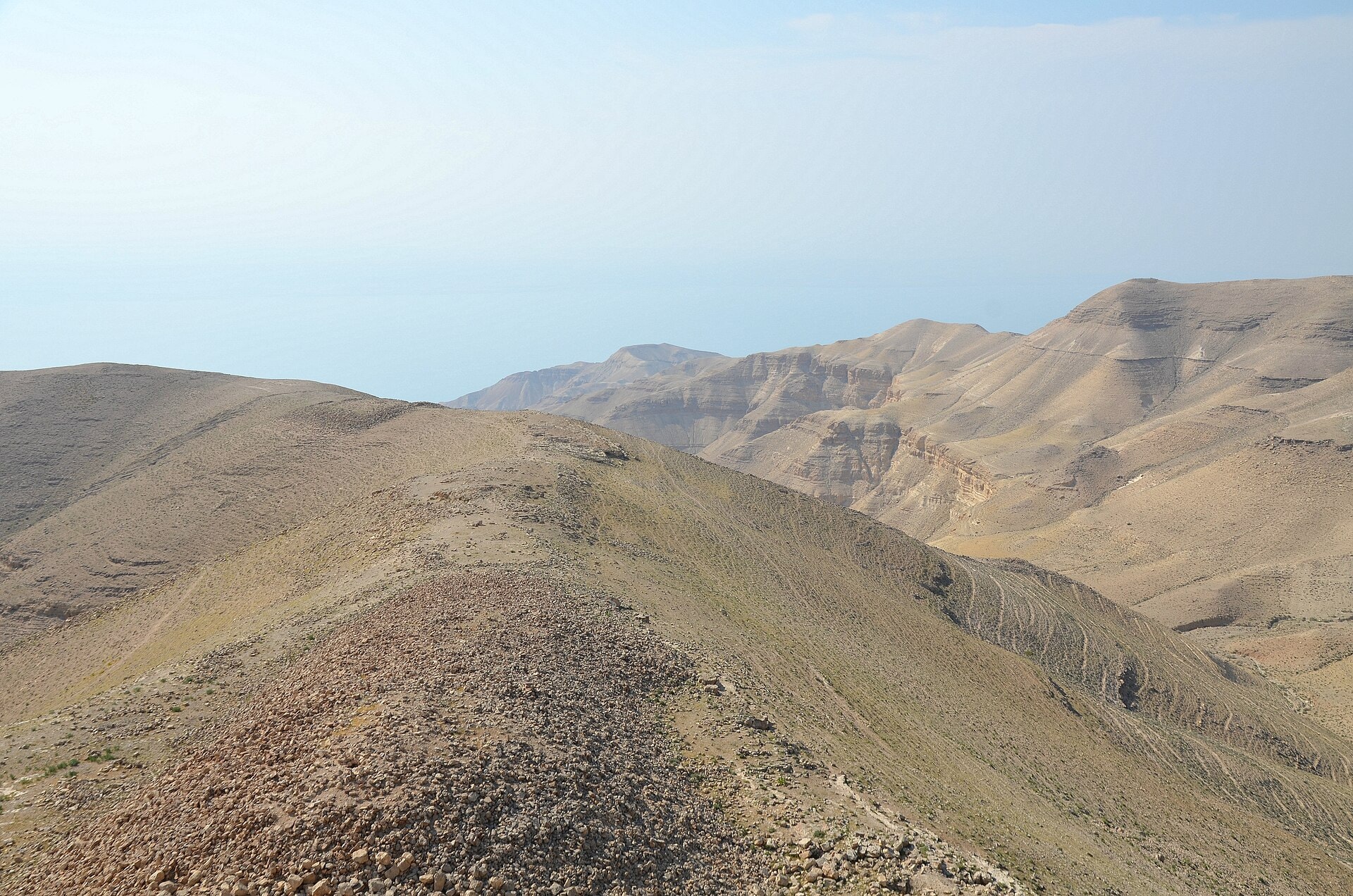
The hill of Machaerus (modern Mukawir, Jordan), the Herodian fortress where Josephus says John was imprisoned and put to death. Photo: Carole Raddato, CC BY-SA 2.0, via Wikimedia Commons, resized.

The 30-second version:
John the Baptist was the prophet who prepared the way for Jesus. He preached repentance by the Jordan, baptized the crowds, and named Jesus the Lamb of God. Herod Antipas jailed him for condemning his marriage to Herodias and had him beheaded. Josephus, a Jewish historian with no Christian sympathies, confirms that John was a popular preacher who baptized, that Herod feared his influence, and that he was killed at the fortress of Machaerus. Jesus called him the Elijah who was to come.
See this page's graph and discover linked topics
In full
John (Hebrew Yohanan, "YHWH has been gracious") was born into a priestly family of the course of Abijah (Luke 1:5) a few months before Jesus (Luke 1:36). He lived in the Judean wilderness "till the day of his showing unto Israel" (Luke 1:80, ASV) and began a public ministry, dated by Luke to "the fifteenth year of the reign of Tiberius Cæsar" (Luke 3:1, ASV), most likely AD 28-29. He preached imminent judgment and the coming of one mightier than himself, administered a once-for-all immersion "of repentance unto remission of sins" (Mark 1:4, ASV), and gathered disciples, two of whom left him to follow Jesus (John 1:35-37). Herod Antipas imprisoned him for denouncing his marriage to Herodias and executed him, probably around AD 28-30.
John is one of the best-attested figures of the Gospels outside the New Testament. Josephus devotes a full paragraph to him (Jewish Antiquities 18.116-119), and nearly all historians, including those skeptical of much of the Gospel tradition, treat his baptism of Jesus as one of the most secure facts about Jesus' life. Lawrence Mykytiuk counts him among the 30 New Testament figures confirmed outside the Bible (see Biblical Figures Confirmed by Archaeology). His movement outlived him: Apollos at Ephesus knew "only the baptism of John" (Acts 18:25, ASV), and Paul met a group of John's disciples there (Acts 19:1-7).
In the Bible
| Book | Passage | What happens |
|---|---|---|
| Matthew | 3:1-17 | John preaches in the wilderness of Judea, wears camel's hair, baptizes Jesus |
| Matthew | 11:2-19 | From prison John asks "Art thou he that cometh?"; Jesus calls him "much more than a prophet" and "Elijah, that is to come" |
| Matthew | 14:1-12 | Herod beheads John at Herodias' prompting; his disciples bury him |
| Matthew | 17:10-13 | Jesus says Elijah "is come already," and the disciples understand he means John |
| Matthew | 21:23-32 | Jesus answers the chief priests with a question about John's baptism |
| Mark | 1:2-11; 6:14-29 | The forerunner's ministry; the fullest account of his death |
| Luke | 1:5-25, 57-80 | The announcement to Zacharias, John's birth and Zacharias' song |
| Luke | 3:1-22 | The dated start of his ministry; his ethical preaching to crowds, tax collectors and soldiers |
| Luke | 7:18-35 | "Among them that are born of women there is none greater than John" (7:28, ASV) |
| John | 1:6-42 | "A man, sent from God"; he denies being the Christ or Elijah; "Behold, the Lamb of God" |
| John | 3:22-36 | Baptizing at Aenon near Salim; "He must increase, but I must decrease" (3:30, ASV) |
| John | 5:33-36; 10:40-42 | Jesus calls him "the lamp that burneth and shineth" (5:35, ASV) |
| Acts | 1:5, 22; 10:37; 13:24-25; 18:25; 19:1-7 | John's baptism as the starting point of the apostolic preaching, and its continuing followers |
The Gospels describe him in deliberately prophetic terms. Mark 1:6 says he "was clothed with camel's hair, and had a leathern girdle about his loins" (ASV), the dress of Elijah, who "was a hairy man, and girt with a girdle of leather about his loins" (2 Kings 1:8, ASV). All four Gospels apply to him Isaiah's "voice of one that crieth" in the wilderness (Isaiah 40:3), and Mark and Matthew add Malachi's messenger who prepares the way (Malachi 3:1).
Family and lineage
- Father. Zacharias, a priest "of the course of Abijah" (Luke 1:5), one of the 24 priestly divisions of 1 Chronicles 24. He was serving in the temple when the angel announced John's birth.
- Mother. Elisabeth, "of the daughters of Aaron" (Luke 1:5), so John was of priestly descent on both sides.
- Relation to Jesus. The angel calls Elisabeth Mary's "kinswoman" (Luke 1:36, ASV). The exact relationship is not stated; the common description of John and Jesus as cousins is an inference from that word.
- Vow. He was to "drink no wine nor strong drink" (Luke 1:15, ASV), language close to the Nazirite rule of Numbers 6.
- No wife or children are mentioned anywhere.
Historical and archaeological evidence
Josephus, Jewish Antiquities 18.116-119
Josephus wrote in the 90s AD. In explaining why the army of Herod Antipas was destroyed by the Nabatean king Aretas IV around AD 36, he records what many Jews believed:
Now some of the Jews thought that the destruction of Herod's army came from God: and that very justly, as a punishment of what he did against John, that was called the baptist. For Herod slew him; who was a good man, and commanded the Jews to exercise virtue; both as to righteousness towards one another, and piety towards God; and so to come to baptism. (Josephus, Antiquities 18.116-117, Whiston)
He goes on to say that crowds came to John because "they were very greatly moved [or pleased] by hearing his words," that Herod feared "the great influence John had over the people might put it into his power and inclination to raise rebellion," and that John "was sent a prisoner, out of Herod's suspicious temper, to Macherus; the castle I before mentioned; and was there put to death" (Ant. 18.118-119, Whiston).
What it confirms. John's name and title ("the baptist"), his preaching of righteousness and piety, his practice of baptism, his popularity, Herod Antipas as his executioner, and the place of death.
Authenticity. The passage appears in all manuscripts of Antiquities and is accepted as genuine by nearly all scholars, including John P. Meier in A Marginal Jew, vol. 2 (1994). A Christian interpolator would not have written it this way: it never connects John with Jesus, and it describes his baptism differently from the Gospels.
Where Josephus and the Gospels differ.
- Motive. Mark and Luke say Herod arrested John for condemning his marriage to Herodias (Mark 6:17-18; Luke 3:19-20). Josephus gives a political motive, fear of an uprising. Most historians read these as complementary: a prophet publicly condemning the ruler's marriage, before large crowds, was exactly the kind of political danger Josephus describes. Josephus himself tells the Herodias story a few paragraphs earlier (Ant. 18.109-115), since it caused the war with Aretas.
- The meaning of baptism. Mark calls it "the baptism of repentance unto remission of sins" (Mark 1:4, ASV). Josephus says the washing was acceptable to God "not in order to the putting away, [or the remission] of some sins [only,] but for the purification of the body: supposing still that the soul was thoroughly purified beforehand by righteousness" (Ant. 18.117, Whiston). Many scholars think Josephus is recasting John in terms a Greco-Roman reader would find respectable. Both accounts agree that the washing was tied to a changed life, which is the substance of Luke 3:10-14.
- Timing. The defeat by Aretas came around AD 36, several years after John's death. Josephus does not date the execution to the defeat; he says the people later interpreted the defeat as God's judgment for it, which implies John's death was remembered as a notorious wrong years afterward.
Origen, Eusebius and others cited this passage from the second century on (see Church Fathers below).
Machaerus
Machaerus (modern Mukawir, Jordan) is a fortified hilltop east of the Dead Sea, in Perea, the part of Antipas' tetrarchy beyond the Jordan. It was fortified by Alexander Jannaeus, destroyed by the Roman general Gabinius, and rebuilt as a palace-fortress by Herod the Great. The Romans under Lucilius Bassus took it in AD 72 after the Jewish War (Josephus, Jewish War 7.163-209).
- Excavations. Virgilio Corbo of the Studium Biblicum Franciscanum excavated the palace from 1978 to 1981. Since 2009 the Hungarian archaeologist Győző Vörös has led renewed excavations and published the site in a multi-volume final report.
- The royal courtyard. Vörös identified a peristyle courtyard and an apsidal niche he interprets as a throne niche, and he has proposed it as the setting of the banquet and dance of Mark 6:21-28. This is his reconstruction; the archaeology confirms a Herodian royal palace in use in Antipas' time, not the specific event.
- What the site shows. Josephus' "castle" existed where he says, was a Herodian royal residence in Perea, and was a place where a prisoner of the tetrarch could be held and executed. The Gospels do not name the fortress; Josephus does.
Other evidence
- Bethany beyond the Jordan. John 1:28 places his baptizing at "Bethany beyond the Jordan." The traditional site on the east bank, Al-Maghtas (Wadi al-Kharrar) in Jordan, has Byzantine churches and pilgrim remains and was inscribed by UNESCO in 2015 as the "Baptism Site 'Bethany Beyond the Jordan'." That establishes an ancient tradition, not a proof of the exact spot.
- Wilderness Judaism. The Dead Sea Scrolls community also read Isaiah 40:3 as its own charter: the Rule of the Community (1QS 8.13-14) cites "prepare in the wilderness the way" to explain withdrawing to the desert to study the Law. Some scholars have proposed that John had contact with the Qumran group; others note sharp differences (John's public, once-for-all baptism for all Israel versus Qumran's repeated washings for members). The parallel shows that John's language and setting fit first-century Judea. See Essene Origin of Christianity Objection Defeater.
- No artifact names him. No inscription, coin or ossuary bearing John's name is known. That is normal for a non-elite prophet of the period.
Grade. Very strong. Mykytiuk confirms John through Josephus, an independent, non-Christian, near-contemporary writer who names him, his title and his executor.
Scholarly consensus
- Existence and baptism of Jesus. Virtually all historians accept that John existed and that he baptized Jesus. The baptism is a standard example of the criterion of embarrassment, because early Christians would not have invented their Lord submitting to a lesser figure's "baptism of repentance." E. P. Sanders lists Jesus' baptism by John among the almost indisputable facts about Jesus (Jesus and Judaism, 1985); John P. Meier devotes most of A Marginal Jew, vol. 2, to John and reaches the same conclusion.
- Relationship with Jesus. Scholars debate how long Jesus was associated with John's circle before his own ministry, and how John's expectation of a coming judge relates to Jesus' preaching. The Gospels themselves record John's question from prison (Matthew 11:2-3), a detail no one would invent to flatter either man.
- The infancy narrative. Luke 1 is treated by critical scholars as more theologically shaped than the ministry accounts, and its historicity is debated. Conservative scholars defend its core as early family tradition.
- Dissent. Doubts about John's existence are essentially absent from scholarship; the debate is over the meaning of his baptism, his relation to Qumran and to Jesus, and how far the Gospels shaped his portrait to fit their theology.
Theological significance
- The forerunner. Malachi promised: "Behold, I will send you Elijah the prophet before the great and terrible day of Jehovah come" (Malachi 4:5, ASV). The angel says John will go "in the spirit and power of Elijah, to turn the hearts of the fathers to the children" (Luke 1:17, ASV), quoting the next verse of Malachi. Jesus makes the identification explicit: "if ye are willing to receive it, this is Elijah, that is to come" (Matthew 11:14, ASV).
- "I am not." In John 1:21 the Baptist denies being Elijah. Christian interpreters have long harmonized this with Matthew 11:14: John denies being the Tishbite returned in person, which is what his questioners meant, while Jesus identifies him as the Elijah of Malachi's promise in role and power, as Luke 1:17 says. The conditional "if ye are willing to receive it" signals a fulfillment that is real but not literal. See Elijah.
- The bridge between covenants. Jesus places John at the hinge of history: "Among them that are born of women there hath not arisen a greater than John the Baptist: yet he that is but little in the kingdom of heaven is greater than he" (Matthew 11:11, ASV). John is the last and greatest prophet of the old order, and the least in the kingdom stands in the fuller light John only announced.
- Pointing away from himself. His ministry is defined by self-effacement: "He must increase, but I must decrease" (John 3:30, ASV). His witness, "Behold, the Lamb of God" (John 1:29), is the first public identification of Jesus in John's Gospel and frames the cross as sacrifice from the outset.
- Baptism. John's baptism anticipates Christian baptism but is distinguished from it: "I indeed baptize you in water unto repentance: but he that cometh after me... shall baptize you in the Holy Spirit and in fire" (Matthew 3:11, ASV). Acts 19:1-7 shows the difference in practice. See Baptism.
- A martyr for public righteousness. John died for saying to a ruler, "It is not lawful for thee to have thy brother's wife" (Mark 6:18, ASV). Christian tradition has honored him as a model of courage before the powerful.
- In other traditions. The Quran honors John as the prophet Yahya, son of Zechariah (Quran 3:39; 19:7, 12-15), and the Mandaeans of Iraq and Iran revere him (as Yahya or Yuhana) as their great prophet.
Church Fathers
- Justin Martyr (c. AD 155) answers Trypho's objection that Elijah has not yet come by arguing that Scripture foretold two advents of Christ, and that the Spirit of God who was in Elijah came in John as the herald of the first advent, while Elijah himself will come before the second (Dialogue with Trypho 49).
- Origen (c. AD 248) answers Celsus by pointing to Josephus: "in the 18th book of his Antiquities of the Jews, Josephus bears witness to John as having been a Baptist, and as promising purification to those who underwent the rite" (Against Celsus 1.47, ANF translation).
- Eusebius (c. AD 320) summarizes the Josephus account, noting that Josephus names Herodias, records the war with Aretas, and "confesses... that John the Baptist was an exceedingly righteous man, and thus agrees with the things written of him" in the Gospels (Church History 1.11.1-3, NPNF translation).
- Augustine (c. AD 407) reads "He must increase, but I must decrease" through the calendar: "Christ was born when the days were just beginning to lengthen; John was born when they began to shorten," and John was "lessened by the Head" while Christ "was exalted on the cross" (Tractates on the Gospel of John 14.5, NPNF translation). This is why the Western church kept John's birth at midsummer, six months before Christmas.
Scholarship
Published academic works this page draws on, each matched to a publisher, index or library catalog record.
- John P. Meier, A Marginal Jew: Rethinking: The Historical Jesus: Mentor, Message, and Miracles (Yale University Press, 1994). doi:10.5040/9780300288100
- E. P. Sanders, Jesus and Judaism (1985). Open Library
See also
- Elijah, the prophet whose spirit and power John came in
- Malachi, the book that promised Elijah before the day of the LORD
- Herod Antipas, the tetrarch who imprisoned and executed him
- Herodias, whose marriage John condemned
- Josephus, the historian who independently records his ministry and death
- Baptism, John's baptism and Christian baptism
- Jesus, the one John announced
- Andrew the Apostle, a disciple of John who followed Jesus
- Apollos, who knew only the baptism of John
- Typological Fulfillment, how Old Testament figures and promises are fulfilled in the New
- Dead Sea Scrolls, the wilderness community that also claimed Isaiah 40:3
- Historicity of Jesus, the baptism as a fixed point in the life of Jesus
- Biblical Figures Confirmed by Archaeology, where John stands on Mykytiuk's list
- People of the Bible, every person on the list, by book of first mention
Common questions this page answers
Q: Is there evidence outside the Bible that John the Baptist existed?
Yes. The Jewish historian Josephus, writing in the 90s AD, describes "John, that was called the baptist," calls him a good man who urged righteousness and baptism, and says Herod Antipas had him imprisoned and killed at the fortress of Machaerus (Antiquities 18.116-119). Nearly all scholars accept the passage as genuine.
Q: Why was John the Baptist killed?
The Gospels say he condemned Herod Antipas for marrying Herodias, his brother's wife, and Herodias pressed for his death (Mark 6:17-28). Josephus says Herod feared John's influence over the crowds might spark a revolt. The two explanations fit together: a popular prophet publicly condemning the ruler was a political threat.
Q: Where was John the Baptist beheaded?
Josephus names Machaerus, a Herodian palace-fortress east of the Dead Sea in modern Jordan. The Gospels do not name the place. Excavations there have uncovered the Herodian palace in use in Antipas' day.
Q: Was John the Baptist Elijah?
Jesus said that if his hearers would receive it, John "is Elijah, that is to come" (Matthew 11:14), and Luke says John came "in the spirit and power of Elijah" (Luke 1:17). When asked if he was Elijah, John said no (John 1:21), meaning he was not the old prophet returned in person. He fulfilled Malachi's promise in role and power.
Q: Were John the Baptist and Jesus cousins?
Luke calls John's mother Elisabeth Mary's "kinswoman" (Luke 1:36). They were relatives, and John was about six months older, but the exact relationship is not specified.
Q: What was the difference between John's baptism and Christian baptism?
John's was a baptism of repentance preparing for the coming one. John himself said the one coming after him would baptize "in the Holy Spirit and in fire" (Matthew 3:11), and in Acts 19:1-7 Paul baptizes in the name of Jesus some disciples who had received only John's baptism.