Concept
John Smith Ice Drowning (Lake Saint Louis 2015)
John Smith drowning, John Smith ice drowning, John Smith Lake Saint Louis, Breakthrough true story, Joyce Smith prayer, Lake Sainte Louise drowning 2015Intro
On Monday, 19 January 2015, three 14-year-old boys were walking on the frozen Lake Sainte Louise, in the town of Lake Saint Louis, Missouri, when the ice gave way. Two were pulled out quickly. The third, John Smith, was underwater for about 15 minutes before firefighters found him.
Rescuers and then the hospital's emergency team gave him CPR for about 45 minutes, and his heart never started. The emergency doctor was about to call it. John's mother, Joyce Smith, was brought in to see him. She stood at his bed and prayed out loud, and within a minute or two the team found a pulse. John was flown to a children's hospital, woke up within days, and walked out sixteen days after the accident with normal brain function.
Both of his doctors called the recovery a miracle, while also naming the cold water as the one medical factor in his favor. The case is filed as witnessed (Tier 2): many named witnesses, two of them physicians, and news reports within days, but no medical-bureau review and no published case report.
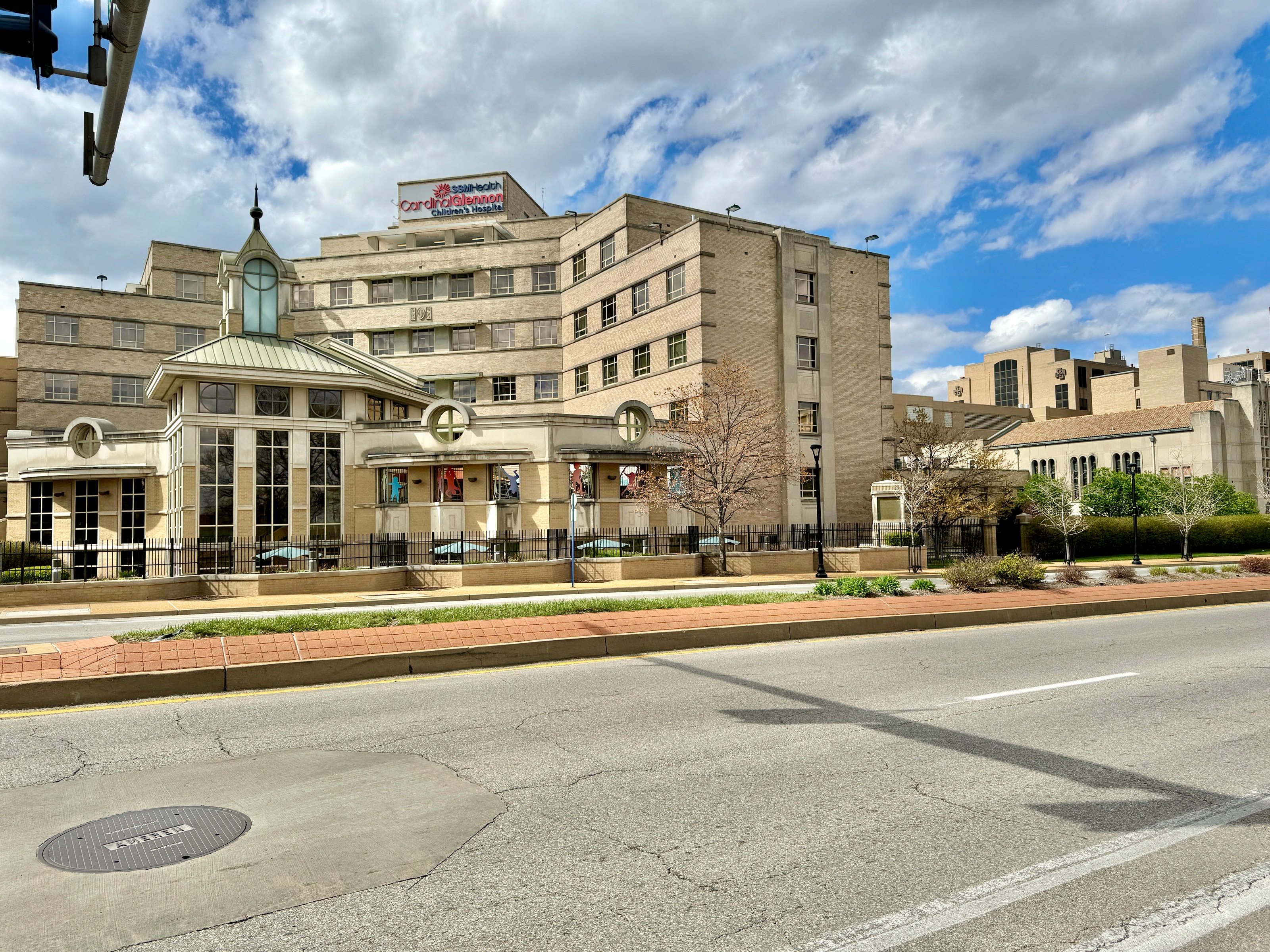
SSM Health Cardinal Glennon Children's Hospital, St. Louis, where John Smith recovered in intensive care. Photo: w_lemay, CC BY-SA 2.0, via Wikimedia Commons, resized.

The 30-second version:
In January 2015 a 14-year-old Missouri boy, John Smith, fell through a frozen lake and was underwater about 15 minutes. He had no pulse through roughly 45 minutes of CPR. When his mother prayed aloud at his bedside, his heart started within a minute or two. He left the hospital sixteen days later with his brain intact. His emergency doctor said he had been dead for 45 minutes; his intensive-care doctor called it a bona fide miracle, while crediting the cold water as the one thing in his favor.
See this page's graph and discover linked topics
In full
The case rests on contemporaneous reporting by KSDK (the NBC affiliate in St. Louis), the St. Louis Post-Dispatch, NBC News and Today in January and February 2015, on named statements by two treating physicians, Kent Sutterer of SSM St. Joseph Hospital West and Jeremy Garrett, a SLUCare pediatric intensivist at SSM Cardinal Glennon Children's Hospital, and on a 2019 profile in Catholic Health World, the publication of the Catholic Health Association of the United States. The family's account is told in Joyce Smith's book The Impossible (FaithWords, 2017, with Ginger Kolbaba; later reissued as Breakthrough) and in the 2019 film Breakthrough. The reported facts are a submersion of about 15 minutes in water of about 40°F, a core temperature of 88°F on arrival, about 15 minutes of CPR by rescuers followed by about 27 minutes in the emergency department (roughly 43 to 45 minutes without a pulse), return of circulation within a minute or two of the mother's audible prayer, and discharge on 4 February 2015 with normal brain function. The physicians' own explanation runs both ways: cold-water drowning is the recognized reason such patients sometimes survive prolonged arrest, and both men still called the outcome miraculous. The medical records have not been published and no formal body has reviewed them, which is why the case is Tier 2 and not Tier 1 under the Miracles schema.
Summary
John Smith, 14, fell through the ice on Lake Sainte Louise in Lake Saint Louis, Missouri, on 19 January 2015 and was underwater about 15 minutes. After roughly 43 to 45 minutes of CPR without a pulse, his heart restarted within a minute or two of his mother, Joyce Smith, praying aloud at his bedside in the emergency department of SSM St. Joseph Hospital West. He was transferred to SSM Cardinal Glennon Children's Hospital, recovered with normal brain function, and was discharged sixteen days after the accident. His treating physicians, Kent Sutterer and Jeremy Garrett, described the outcome as a miracle, while naming cold-water drowning as the medical factor in his favor.
The event
- The ice. On 19 January 2015, Martin Luther King Jr. Day, John Smith and two friends, both named Josh, were on the frozen Lake Sainte Louise, the smaller of the two lakes in Lake Saint Louis, Missouri, when the ice broke. The two other boys were rescued quickly and treated for hypothermia.
- The search. The Lake St. Louis fire service had practiced ice rescue days before. First responder Tommy Shine found John after about 15 minutes under the water. Shine has said that a voice told him to go back to a spot he had already searched.
- No pulse. Crews gave CPR for about 15 minutes on the way to SSM St. Joseph Hospital West in Lake Saint Louis. There, Dr. Kent Sutterer's team continued for about 27 more minutes, including eight doses of epinephrine. His body temperature was 88°F.
- The prayer. With no pulse after more than 40 minutes, the doctors called his mother, Joyce Smith, into the room to say goodbye. She prayed aloud for her son. Moments later, she has said, she heard the staff calling out that they had a pulse. Sutterer told KSDK that within a minute or two his heart started again.
- Intensive care. John was airlifted to SSM Cardinal Glennon Children's Hospital in St. Louis, under Dr. Jeremy Garrett. On 21 January the Post-Dispatch reported him awake and recognizing people. Garrett tested his thinking by asking him to treat his hands as Michael Jordan and LeBron James and answer questions; John got them right.
- Home. He was discharged on Wednesday, 4 February 2015, sixteen days after the accident, with normal brain function. He still had a cough and needed several weeks of outpatient therapy for the movement of his hands.
The family's church. Joyce Smith's congregation was First Assembly Church in St. Peters, Missouri, an Assemblies of God church. Its pastor, Jason Noble, new to the church at the time, led a prayer vigil for John.
Witnesses + documentation
- Joyce Smith, his mother: eyewitness to the emergency room, the prayer and the return of the pulse. Author of The Impossible (2017).
- Kent Sutterer MD, emergency physician at SSM St. Joseph Hospital West: led the resuscitation. Told KSDK, "He was dead for 45 minutes," and, "Within a matter of a minute or two, his heart started again." Newser and Fox News also reported his written note that John's heart "was jump started by the Holy Spirit listening to the request of his praying mother."
- Jeremy Garrett MD, SLUCare pediatric intensivist at SSM Cardinal Glennon Children's Hospital: oversaw his recovery. Told KSDK that the only factor medically in John's favor was that it was a cold-water drowning, and called the recovery "a bonafide miracle."
- Dr. Nancy Bauer and nurse Wendy Hoff, quoted by Today (February 2015) as members of the team that treated him. Bauer: "He was gone." Hoff called it a miracle.
- Tommy Shine, the first responder who found John under the water.
- Jason Noble, pastor of First Assembly Church, St. Peters, who was with the family during the crisis.
- Published record:
- St. Louis Post-Dispatch, "Boy who fell through ice at Lake Saint Louis is awake, recognizing people, officials say," 21 January 2015.
- KSDK (NBC, St. Louis), interviews with the family and both physicians at discharge, early February 2015.
- Erik Ortiz, "Missouri Teen Submerged in Icy Lake for 15 Minutes Makes 'Miracle' Recovery," NBC News, 5 February 2015.
- Today, "'God wanted me to live': Missouri teen's 'miracle' recovery," February 2015.
- Ellen Futterman, "SSM Health patient's miraculous recovery is the stuff of movies," Catholic Health World, 15 May 2019.
- Bobby Ross Jr., "Meet the real-life pastor portrayed in the Easter film Breakthrough," Religion Unplugged, April 2019.
- Joyce Smith with Ginger Kolbaba, The Impossible: The Miraculous Story of a Mother's Faith and Her Child's Resurrection (FaithWords, 2017).
Verification
What was checked:
- The core facts are on record within days. The accident, the long resuscitation and the recovery were reported by the Post-Dispatch two days later and by KSDK and NBC News at discharge, before any book, film or ministry retelling.
- The physicians speak for themselves. The resuscitation and the timing of the restored pulse come from the doctors who were there, by name, on camera, not only from the family.
- A checkable outcome. John's discharge with normal brain function was reported at the time, and he has since spoken publicly about the event.
Naturalistic explanations considered:
- Cold-water drowning. This is the strongest natural explanation, and Garrett named it himself. Cold water cools the body and slows the brain's need for oxygen, and survival with good recovery after long resuscitation is recorded in cold-water drowning, especially in children. It explains why recovery was possible. It does not explain the timing, a pulse returning within a minute or two of the prayer after more than 40 minutes without one, and both physicians still judged the outcome miraculous.
- The timing is coincidence. The pulse could have returned at that moment by chance, near the end of a long resuscitation that included repeated epinephrine. That cannot be ruled out, and an honest presentation grants it. The case's weight lies in the doctors' own judgment that recovery was not expected, not in any proof that the prayer caused it.
- The durations grow in the retelling. They do. Reports in 2015 give about 15 minutes underwater and about 43 to 45 minutes of CPR. Later family and media accounts speak of "over an hour," which adds the time underwater. This entry uses the 2015 figures.
Caveats and remaining uncertainties:
- No published records. The medical chart has not been published, and no case report or medical-bureau review exists. That keeps the case at Tier 2.
- Minor reporting conflicts. Accounts differ on the exact length of CPR (27 minutes in hospital, 43 or 45 in total) and on which hospital a given doctor served; this entry follows NBC News, KSDK and Catholic Health World.
- Not a skeptic-proof case. Skeptics responded in 2015 that cold-water survival is a known phenomenon. Garrett agrees it was the factor in John's favor; the disagreement is over whether that settles the matter.
Apologetic value
- Answers "nobody comes back today." Here is a modern case with a named patient, a named hospital, named physicians on camera and news coverage within days.
- Physicians who did not have to say it. The emergency doctor said the boy had been dead for 45 minutes and credited prayer; the intensive-care doctor called it a bona fide miracle while giving the medical factor its due. Physicians are trained to be slow to say such things, which gives their words weight.
- A Pentecostal case. The family's church was Assemblies of God, and the turning point was a mother's audible prayer, the pattern of James 5:16.
- The biblical pattern. A young man restored to his mother echoes the widow's son at Nain (Luke 7:11-17), and the bedside command recalls Jairus's daughter (Mark 5:41) and Tabitha (Acts 9:36-42).
- How to deploy it. Lead with the facts the skeptic cannot dispute: 15 minutes under, more than 40 without a pulse, normal brain at discharge. Concede the cold water openly, then press on the timing and on the physicians' own verdict. Do not overstate it as medically proven; it is a strong witnessed case, not a bureau-certified one.
See also
- Miracles, master hub
- _schema, the vetting standard this entry follows
- Don Piper (Resurrection 1989), another reported return after prolonged absence of signs of life, with EMS witnesses
- Therese Snakebite Raising (Congo 1960), a child restored to breathing after prayer, in a village without medical care
- Pam Reynolds (NDE 1991), a documented case in which deep cooling protected the brain during cardiac standstill
- Barbara Cummiskey Snyder (Wheaton 1981), a Protestant healing with named physicians
- Prayer, the practice at the center of the case
- Argument from Miracles, the argument this case supports
- David Hume, whose standard for credible miracle testimony this case presses on
- Naturalism, the worldview such cases press against
Common questions this page answers
Q: Is the movie Breakthrough a true story?
Yes. Breakthrough (2019) is based on John Smith, a 14-year-old who fell through the ice on Lake Sainte Louise in Lake Saint Louis, Missouri, on 19 January 2015, and on his mother Joyce Smith's book The Impossible. The core events were reported by local and national news within days.
Q: How long was John Smith without a pulse?
News reports in 2015 put it at about 15 minutes of CPR by rescuers and about 27 more in the emergency room, roughly 43 to 45 minutes in all, after about 15 minutes underwater. His emergency doctor said he had been dead for 45 minutes. Later retellings of "over an hour" add the time underwater.
Q: What did John Smith's doctors say about his recovery?
Dr. Kent Sutterer said his heart started within a minute or two of his mother's prayer and credited the Holy Spirit. Dr. Jeremy Garrett, his intensive-care doctor, called it a bona fide miracle, while saying the only medical factor in his favor was that it was a cold-water drowning.
Q: Can cold water explain John Smith's survival?
Cold water slows the brain's need for oxygen and is the recognized reason some drowning victims survive long resuscitations, so it helps explain how recovery was possible. It does not explain the timing, a pulse returning within a minute or two of the prayer after more than 40 minutes without one, and both treating doctors still called the outcome a miracle.
Q: What church did the Smith family attend?
First Assembly Church in St. Peters, Missouri, an Assemblies of God congregation. Its pastor, Jason Noble, led a prayer vigil for John and was portrayed in the film by Topher Grace.