Person
John of Damascus
John Damascene, Saint John of Damascus, Saint John Damascene, Yuhanna ibn Mansur, John ChrysorrhoasJohn of Damascus (c. 675-749) was a Christian monk, theologian and hymn-writer from Damascus, then the capital of the Umayyad caliphate. He is often counted as the last of the Greek Church Fathers, because his great work, The Fount of Knowledge, gathered the theology of the earlier Fathers into one ordered summary that later Eastern and Western theologians, Thomas Aquinas among them, drew on for centuries.
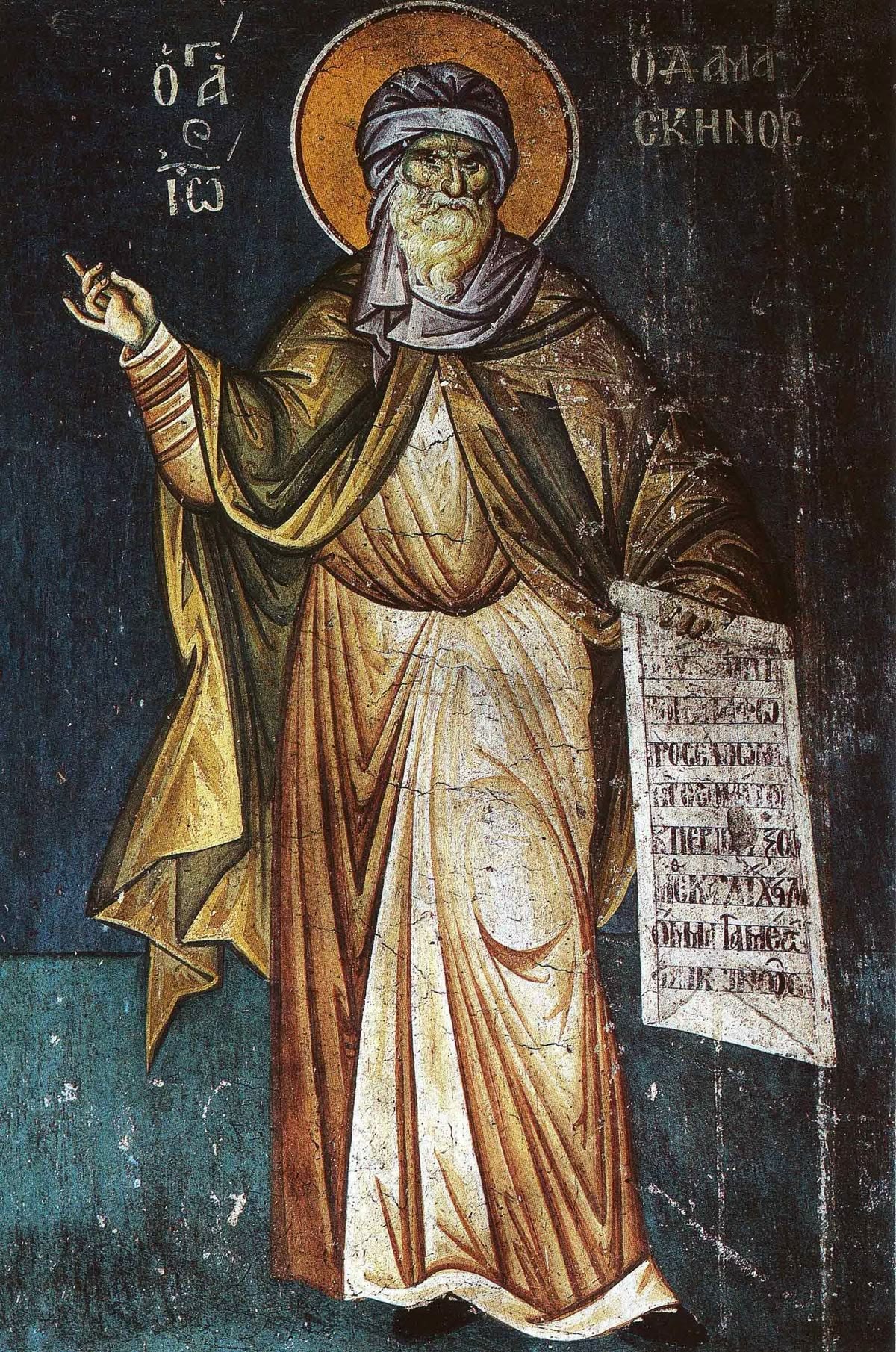
John of Damascus, Byzantine fresco from Mount Athos. The Greek inscription names him "the Damascene." Image: public domain, via Wikimedia Commons.
He matters to apologetics for three reasons. He wrote one of the earliest Christian assessments of Islam, from inside a Muslim-ruled city. He gave the classic defense of Christian images against the iconoclasts, and with it the distinction between the worship owed to God alone and the honor that may be shown to people and things. And his short statement that fallen angels cannot repent became the standard answer of the Catholic and Orthodox traditions.
Biographical sketch
- Born in Damascus around 675 to a prominent Christian family, the Mansur family, who served in the financial administration of the Umayyad caliphs.
- Served in the caliphal administration himself before leaving public life.
- Became a monk at the monastery of Mar Saba in the Judean desert near Jerusalem, where he was ordained a priest and wrote most of his works.
- Died at Mar Saba around 749.
- Condemned by name at the iconoclast Council of Hieria (754); vindicated when the Second Council of Nicaea (787) restored the veneration of icons.
- Declared a Doctor of the Church by Pope Leo XIII in 1890. He is commemorated as a saint in the Eastern Orthodox and Catholic churches.
See this page's graph and discover linked topics
Major works
- The Fount of Knowledge (Pēgē Gnōseōs), in three parts:
- Dialectica, philosophical definitions drawn largely from Aristotle and the Greek commentators, as tools for theology.
- On Heresies, a catalogue of heresies. Its final chapter treats the "heresy of the Ishmaelites," one of the earliest Christian discussions of Islam.
- An Exact Exposition of the Orthodox Faith (De Fide Orthodoxa; see On the Orthodox Faith), a systematic summary of doctrine: God and the Trinity, creation, angels and demons, humanity, providence, Christ, the sacraments and the last things.
- Three Treatises Against Those Who Attack the Divine Images (c. 726-730), written against the iconoclast policy of the Byzantine emperor Leo III.
- Hymns and liturgical poetry, including the canon sung at Easter in the Orthodox churches.
Theological contributions
1. A summary of patristic theology
An Exact Exposition of the Orthodox Faith is less an original system than an ordered digest of the Greek Fathers, especially the Cappadocians, Maximus and Cyril. It was translated into Latin in the twelfth century and used by Peter Lombard and Aquinas, which is one reason Eastern patristic theology entered Western scholastic debate.
2. Worship and honor: the image controversy
Against the iconoclasts, John argued that the incarnation changed the question of images: the invisible God had become visible in Christ, so Christ could be depicted. He distinguished two things that the iconoclasts ran together: latreia, the worship of adoration owed to God alone, and proskynēsis in the sense of honor or veneration, which may be shown to created things associated with God. Protestant traditions reject the veneration of images that he defended, but his distinction between worship and honor is the same distinction every Christian must make when Scripture uses one verb for bowing to a king and for worshipping God. See Worship and G4352 - proskuneo.
3. Angels and demons
In Book II of the Exact Exposition he describes angels as rational, free and incorporeal. Of the angel he writes that "it is not susceptible of repentance because it is incorporeal" (II.3), and of the fallen angels: "For after the fall there is no possibility of repentance for them, just as after death there is for men no repentance" (II.4). The second sentence is quoted in the Catechism of the Catholic Church (§393). The question of whether fallen angels can repent, and the earlier Fathers who disagreed, is set out in Repentance of Fallen Angels.
4. Engagement with Islam
The chapter on the "Ishmaelites" in On Heresies treats Islam as a Christian heresy rather than a new religion, discusses the Qur'an's denial of the crucifixion and of Christ's divinity, and records Muslim objections that Christians are "associators" for calling Christ God. It is a primary witness to how an Arabic-speaking Christian under Muslim rule understood the new faith within a century of its rise. Scholars debate how much of the chapter is John's own and how much is later expansion.
Reception
The Orthodox churches honor him as a theologian and hymnographer; the Catholic Church as a Doctor of the Church; Protestants read him chiefly as a witness to patristic Christology and to early Christian engagement with Islam, while rejecting his defense of icon veneration. His statement on the finality of the angelic fall is the most quoted patristic sentence on that question.
See also
- Repentance of Fallen Angels, his position and the Fathers who held otherwise
- Worship, his distinction between the worship owed to God and the honor owed to others
- G4352 - proskuneo, the Greek verb at the center of the image controversy
- Satan, the fallen angel whose fate his angelology addresses
- Islam, the faith his chapter on the "Ishmaelites" discusses
- Thomas Aquinas, who drew on his Exact Exposition
- Church Fathers, the wider patristic tradition he summarized
Common questions this page answers
Q: Who was John of Damascus?
A Christian monk and theologian from Damascus (c. 675-749) who lived under the Umayyad caliphate, wrote The Fount of Knowledge, defended Christian images against the iconoclasts, and is often called the last of the Greek Church Fathers.
Q: What did John of Damascus say about fallen angels?
That they cannot repent: "after the fall there is no possibility of repentance for them, just as after death there is for men no repentance" (Exact Exposition II.4). The Catholic Catechism quotes this line in §393.
Q: What did John of Damascus write about Islam?
The final chapter of his On Heresies discusses the "heresy of the Ishmaelites," treating Islam as a Christian heresy and answering its denial of Christ's divinity and crucifixion. It is one of the earliest Christian assessments of Islam.