Person
Job the Patriarch
Job (biblical figure), Job the righteous, Job of Uz, the patriarch Job, Job the man, was Job a real person, who was Job in the Bible, Job's children, Job's wifeJob is the righteous man of the land of Uz whose losses, protest and restoration fill the book that bears his name. Scripture introduces him with four descriptions, shows him praying for his children before any trouble comes, strips him of wealth, children and health under a charge that his faith is bought, lets him argue his case before God through most of the book, and then hears God say that Job, not his orthodox-sounding friends, spoke rightly. Ezekiel names him beside Noah and Daniel, and James holds him up as the model of endurance.
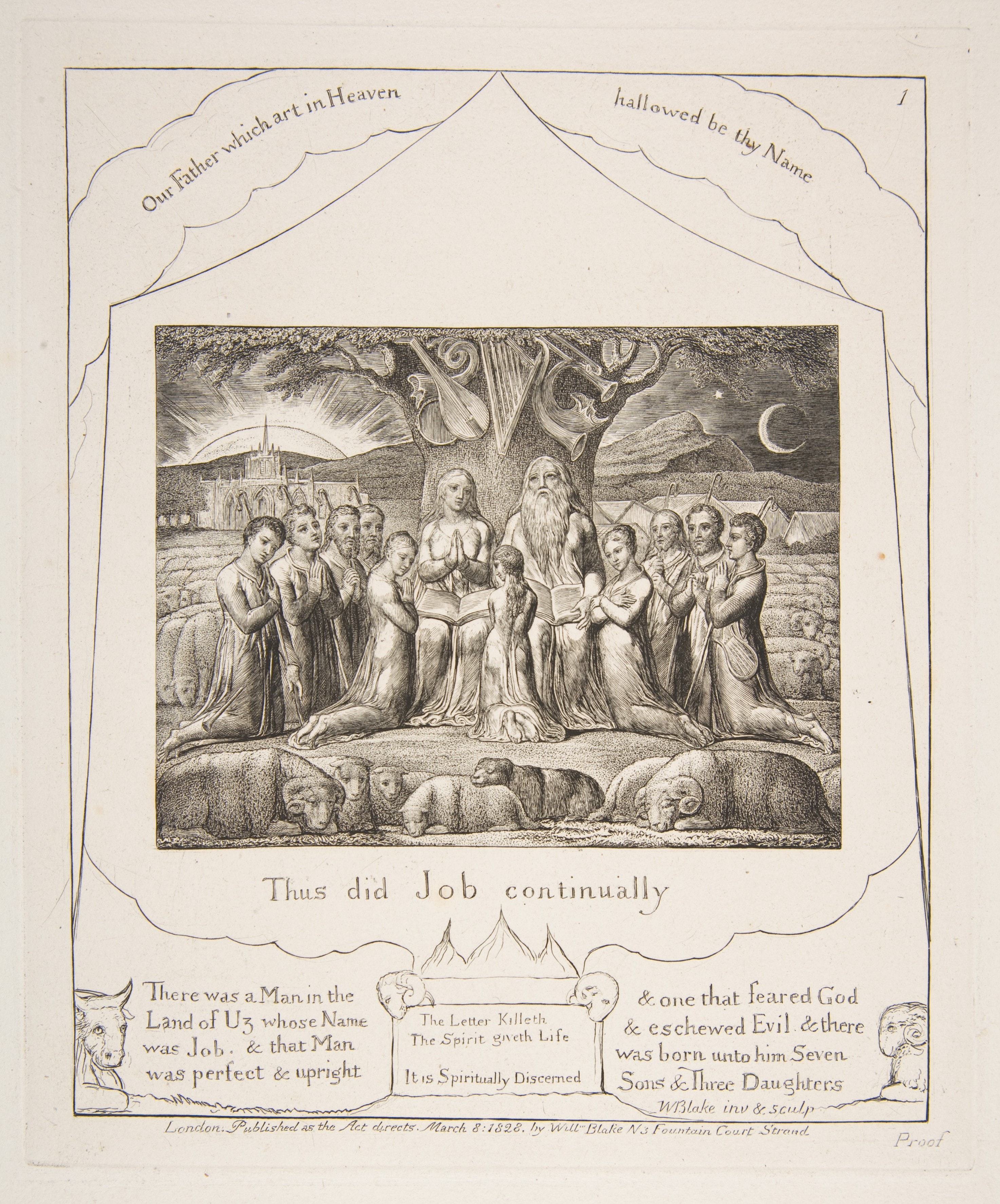
Job and His Family, plate 1 of William Blake's Illustrations of the Book of Job (engraved 1825, published 1826). The Metropolitan Museum of Art. Image: CC0, via Wikimedia Commons, resized.

The 30-second version:
Job was a wealthy, God-fearing man of Uz who lost his property, his ten children and his health in a single season. The book says plainly that he did nothing to deserve it, and it never calls his children's deaths a punishment. Job grieved, refused to curse God, and then argued with God hard and long. God answered him from the storm, Job confessed he had spoken beyond his knowledge, and God still said Job had spoken rightly while his friends had not. Ezekiel and James both treat him as a real and famous example of righteousness and endurance.
Who he is in the book
The book opens with a man and a place: "There was a man in the land of Uz, whose name was Job; and that man was perfect and upright, and one that feared God, and turned away from evil" (Job 1:1, ASV).
- Uz lies east of Israel. Lamentations 4:21 addresses the "daughter of Edom, that dwellest in the land of Uz" (ASV), and Job 1:3 calls him "the greatest of all the children of the east" (ASV). The book gives no king, dynasty or datable event.
- The four descriptions. The Hebrew of Job 1:1 calls him tam (H8535, whole, complete, a man of integrity), yashar (H3477, upright, straight), yere Elohim (one who fears God) and sar mera (one who turns aside from evil, from sur, H5493, and ra, H7451). The narrator says it in 1:1 and God repeats the same four in 1:8 and 2:3.
- Not sinless. Tam means integrity, not moral perfection in the later sense. Job himself speaks of "the iniquities of my youth" (Job 13:26, ASV) and asks God, "why dost thou not pardon my transgression" (Job 7:21, ASV). The book's claim is narrower and stronger: nothing he did caused what happened to him.
- Wealth and household. Seven sons, three daughters, seven thousand sheep, three thousand camels, five hundred yoke of oxen, five hundred she-asses and a very great household (Job 1:2-3).
See this page's graph and discover linked topics
The intercessor for his children
Before any trouble comes, the book shows what Job's faith looks like at home. When his children finished their rounds of feasting, "Job sent and sanctified them, and rose up early in the morning, and offered burnt-offerings according to the number of them all: for Job said, It may be that my sons have sinned, and renounced God in their hearts. Thus did Job continually" (Job 1:5, ASV).
- He acts as priest of his household, the pattern of the patriarchal period before a Levitical priesthood.
- He prays over a sin he only fears might have happened. "It may be" is the language of a father's worry, not of evidence against them.
- "Renounced" translates the Hebrew verb for bless, used here as a euphemism; the same verb returns in Satan's prediction (1:11) and in the advice of Job's wife (2:9).
- The book ends with the same man interceding again, this time for the friends who wronged him: "my servant Job shall pray for you; for him will I accept" (Job 42:8, ASV). The restoration comes "when he prayed for his friends" (Job 42:10, ASV).
The charge and the first response
The test turns on one question: "Doth Job fear God for nought?" (Job 1:9, ASV). Satan's claim is that Job's piety is payment for protection, and that removing the payment will remove the piety.
- God permits the trial within limits (1:12; 2:6). The book's own verdict on what follows is given by God in 2:3: Satan moved him "to destroy him without cause." The Hebrew word behind "without cause" is hinnam, the same word behind Satan's "for nought" in 1:9. The accuser said Job served God hinnam, for nothing; God says Job suffered hinnam, for nothing he had done.
- Job's first response is worship: "Naked came I out of my mother's womb, and naked shall I return thither: Jehovah gave, and Jehovah hath taken away; blessed be the name of Jehovah" (Job 1:21, ASV). The narrator adds, "In all this Job sinned not, nor charged God foolishly" (Job 1:22, ASV).
For the objection that this prologue is a wager, see Job Bet Objection Defeater and the shorter Job Bet Objection.
His wife
Job's wife is the one family member the narrative leaves alive, and she speaks once: "Dost thou still hold fast thine integrity? renounce God, and die." He answers, "Thou speakest as one of the foolish women speaketh. What? shall we receive good at the hand of God, and shall we not receive evil? In all this did not Job sin with his lips" (Job 2:9-10, ASV).
- Her words echo the accuser's prediction almost exactly, which is why many readers, ancient and modern, have read her as the last instrument of the test.
- Her loss is his loss. The ten children who died were hers too, and readers who judge her harshly often forget that.
- Job's rebuke is about what she said, not a dismissal of her. "Foolish" (from nabal, H5036) in Hebrew wisdom speech is a moral category, the person who acts as if God does not matter.
- The book does not mention her again by role. Job 19:17 refers to his breath being strange to his wife during his illness, and the restoration in chapter 42 implies the household continues.
The ten children
A messenger reports that "there came a great wind from the wilderness, and smote the four corners of the house, and it fell upon the young men, and they are dead" (Job 1:19, ASV).
- The narrative never calls their deaths deserved. It describes them feasting together, a picture of family harmony, and it reports Job's sacrifices for them as precaution, not as evidence of guilt.
- Bildad does say it. "If thy children have sinned against him, And he hath delivered them into the hand of their transgression" (Job 8:4, ASV). This is the friends' retribution theology applied to the dead: they suffered, so they must have sinned.
- God rejects the friends' theology. "My wrath is kindled against thee, and against thy two friends; for ye have not spoken of me the thing that is right, as my servant Job hath" (Job 42:7, ASV). Bildad is one of the three named in 42:9. Whatever else 42:7 covers, it removes any warrant for reading Bildad's claim about the children as the book's own view.
- The children are victims, not the subject of the test. The trial concerns Job's motives. That makes their deaths harder, not easier, and the book does not pretend otherwise; Job's grief and protest fill the dialogues.
The restoration
"Jehovah gave Job twice as much as he had before" (Job 42:10, ASV). The numbers bear that out for the livestock:
| Before (Job 1:3) | After (Job 42:12) | |
|---|---|---|
| Sheep | 7,000 | 14,000 |
| Camels | 3,000 | 6,000 |
| Yoke of oxen | 500 | 1,000 |
| She-asses | 500 | 1,000 |
| Sons | 7 | 7 |
| Daughters | 3 | 3 |
- The children are not doubled. Every possession is exactly doubled, and then the text says only, "He had also seven sons and three daughters" (Job 42:13, ASV).
- A long-standing reading takes the difference as deliberate: the first ten were not lost but had gone before, so Job's children too were doubled, ten on earth and ten beyond it. Matthew Henry's commentary records this view ("some give this reason") without claiming it as his own. The text does not state the explanation; it is an inference from the arithmetic, and should be offered as one.
- The daughters are named, Jemimah, Keziah and Keren-happuch, praised for their beauty, and given an inheritance among their brothers (Job 42:14-15), an unusual detail in an ancient Near Eastern text.
- The new children do not replace the old. Nothing in the text says the second ten make up for the first. Job lives another hundred and forty years and sees four generations (42:16), and he dies "old and full of days" (42:17, ASV).
Did Job's piety go wrong?
Some readers ask whether Job's righteousness turned into self-righteousness under pressure. The book itself raises the question and answers it with care.
- Elihu's charge. Elihu's anger burns against Job "because he justified himself rather than God" (Job 32:2, ASV).
- God's question. From the storm God asks, "Wilt thou even annul my judgment? Wilt thou condemn me, that thou mayest be justified?" (Job 40:8, ASV). Job's defence of his innocence had slid into an indictment of God's justice.
- Job's response. "Therefore have I uttered that which I understood not, Things too wonderful for me, which I knew not" (Job 42:3, ASV), and "I had heard of thee by the hearing of the ear; But now mine eye seeth thee" (Job 42:5, ASV).
- The debated verse. The ASV renders 42:6 "Wherefore I abhor myself, And repent in dust and ashes." The Hebrew is harder than the English suggests. The first verb (ma'as, to reject or despise) has no object in the Hebrew, so "myself" is supplied; some translators render it "I retract" or "I recant", meaning Job withdraws his charges. The second verb is nacham (H5162), which can mean "repent" or "be comforted, relent", and the phrase al afar va'efer, "upon (or concerning) dust and ashes", can describe either the posture of mourning or human frailty itself. Translations therefore range from deep self-abasement to a quieter withdrawal of his case.
- Yet 42:7. Immediately after, God says Job spoke rightly about Him and the friends did not. The book holds both: Job overreached in his speeches about God's justice, and Job's honest protest addressed to God was truer than the friends' tidy theology spoken about God.
The fair summary: Job was innocent of what his friends alleged, wrong to make his innocence the measure of God's justice, humble when God appeared, and vindicated in the end. Piety that refuses to let go of God while protesting to Him is not the vice; piety that makes one's own record the standard God must meet is.
Was Job a real person?
Christians and Jews have answered this in more than one way, and the evidence should be laid out evenly.
What the rest of Scripture says
- Ezekiel 14:14 and 20. God says that even if "Noah, Daniel, and Job" were in a land under judgment, "they should deliver but their own souls by their righteousness" (Ezekiel 14:14, ASV). Ezekiel names Job as a famous righteous man known to his hearers, alongside Noah.
- James 5:11. "Ye have heard of the patience of Job, and have seen the end of the Lord, how that the Lord is full of pity, and merciful" (James 5:11, ASV). The Greek word is hypomonē, endurance, which fits a man who protested but did not let go.
- What these texts show with certainty is that Job was a known figure of righteousness in Israel's tradition. Whether they also settle the historical question is where readers differ: some hold that naming him beside Noah treats him as a real man, others that a prophet or apostle can cite a well-known figure as an example either way.
The form of the book
- A prose frame and a poetic centre. Chapters 1-2 and 42:7-17 are narrative prose. Everything between is Hebrew poetry: Job's lament, three cycles of dialogue with Eliphaz, Bildad and Zophar, the poem on wisdom, Job's final defence, Elihu's speeches, God's speeches and Job's reply.
- Features readers weigh differently: scenes in the heavenly court that no human witness saw, speeches in sustained, elevated verse, round and symmetrical numbers (seven and three, then doubled), and no datable setting.
The three main views
- Historical. Job was a real man, and the book records his life, with the speeches given in poetic form. This was the dominant view in the church for most of its history.
- Literary. Job is a character created to explore righteousness and suffering; the book is a wisdom drama whose truth lies in what it teaches, not in a report of events.
- Historical core, developed as drama. A real righteous sufferer of the past, remembered in tradition, became the subject of an inspired poetic work in which the speeches and structure are crafted. Many conservative and mainstream scholars hold some form of this view.
None of these views changes what the book teaches about God, suffering and integrity. The genre question matters for how the speeches are read, not for whether the book is Scripture.
Jewish and early tradition
- The Talmud records a debate in Bava Batra 15a. One sage, speaking before Rabbi Samuel bar Nahmani, said that Job never existed and that the book is a parable (mashal). The reply cited Job 1:1, which gives a name and a homeland, details a parable would not need. The same passage records widely differing views on when Job lived, from the days of the patriarchs to the return from exile.
- The Septuagint adds a postscript to Job 42:17 identifying Job with Jobab, a king of Edom named in the list of Genesis 36:33. This is a later tradition, not part of the Hebrew text.
- Christian commentary from Gregory the Great's Moralia in Job (late sixth century) onward read Job as a real man and as a figure of Christ, the innocent sufferer who intercedes for others.
Job in the codex's apologetic
- Against the "wager" objection. The prologue is a court scene that tests a charge about human motives. See Job Bet Objection Defeater.
- Against retribution theology. Job is the Bible's own refutation of the idea that all suffering is punishment. The friends argue it, and God rejects it in 42:7. That matters for Problem of Evil discussions and for pastoral care.
- Innocent suffering and Christ. Job's suffering "without cause", his intercession for the friends who wronged him, and his cry for a go'el who lives (Job 19:25) are among the reasons Christian readers have seen in him a pointer to Christ.
- The children's destiny. Questions about where those who died before Christ went, and whether Christ's work reached them, belong to Christ's Descent to the Dead.
Scholarship
Published academic works this page draws on, each matched to a publisher, index or library catalog record.
- John E. Hartley, The book of Job (Eerdmans, 1988). Open Library
See also
- Job, the book hub, with every cited passage
- Job Bet Objection Defeater, the full debate-prep answer to "God made a bet with Satan"
- Job Bet Objection, the shorter concept page on the same objection
- Problem of Evil, the wider question the book addresses
- Theodicy, attempts to justify God's permission of evil
- Satan, the accuser of the prologue
- Christ's Descent to the Dead, Christ and the righteous dead who died before Him
- H5162 - nacham, the verb behind "repent" in Job 42:6
- Repentance, what turning to God involves
Scholarship
Standard academic works on the book of Job and the questions this page discusses (its literary form, Job's piety, and the translation of 42:6):
- David J. A. Clines, Job 1-20, Word Biblical Commentary 17 (Word, 1989).
- John E. Hartley, The Book of Job, New International Commentary on the Old Testament (Eerdmans, 1988).
- Carol A. Newsom, The Book of Job: A Contest of Moral Imaginations (Oxford University Press, 2003).
Common questions this page answers
Q: Who was Job in the Bible?
Job was a wealthy, God-fearing man of the land of Uz, described as blameless, upright, fearing God and turning from evil (Job 1:1). He lost his wealth, his ten children and his health, argued with God through most of the book, and was finally vindicated and restored. Ezekiel and James both name him as an example of righteousness and endurance.
Q: Did Job's wife die in the Bible?
No. The text never records her death. She speaks once, telling Job to "renounce God, and die" (Job 2:9), and he rebukes her words. The ten children who died were her children too.
Q: Were Job's children killed because they sinned?
The book never says so. Job sacrificed for them only because "it may be" they had sinned (Job 1:5). It is Bildad who claims they died for their sin (Job 8:4), and God later says Bildad and the other friends did not speak rightly about Him (Job 42:7).
Q: Why did God double Job's possessions but not his children?
Job's livestock is exactly doubled in Job 42:12, but he receives the same number of children as before, seven sons and three daughters (42:13). A long-standing reading, recorded in Matthew Henry's commentary, is that the first ten were not lost but had gone before, so his children were doubled too. The text does not state this; it is an inference from the numbers.
Q: Was Job a real person or a parable?
Views differ. Ezekiel 14:14 names him beside Noah and Daniel, and James 5:11 cites his endurance, so many hold he was historical. Others read the book as a wisdom drama, and many take a middle view: a real righteous sufferer whose story was shaped into inspired poetry. The Talmud itself records a rabbi who called Job a parable and a reply that the book gives his name and homeland.
Q: Did Job become self-righteous?
Partly, by the book's own account. Elihu says Job justified himself rather than God (32:2), and God asks whether Job would condemn Him to be justified himself (40:8). Job admits he spoke of things he did not understand (42:3). Yet God still says Job spoke rightly and the friends did not (42:7).
Q: What does "I abhor myself, and repent in dust and ashes" mean in Job 42:6?
The Hebrew is debated. The first verb has no stated object, so "myself" is supplied, and some render it "I retract" or "I recant". The second can mean "repent" or "be comforted". Readings range from deep self-abasement to Job withdrawing his case against God now that he has seen Him.