Argument
Jesus the Judge of All the Earth
Jesus is the judge of the world, who is the judge of the world, Jesus will judge the world, Christ the judge argument, judgment seat of Christ argument, divine prerogative of judgment, the Father has given all judgment to the SonIntro
When Abraham pleaded for Sodom, he asked a famous question: "Shall not the Judge of all the earth do right?" (Genesis 18:25, ASV). In the Old Testament there is one Judge of all the earth, and it is the LORD. He alone sits to judge the nations, and he alone can see into every heart to judge it fairly.
The New Testament then says something startling. Jesus will sit on the throne of glory with all the nations gathered before him (Matthew 25:31-32). Every person will appear "before the judgment-seat of Christ" (2 Corinthians 5:10). Jesus says the Father "hath given all judgment unto the Son; that all may honor the Son, even as they honor the Father" (John 5:22-23). Some say this only means God appointed a human deputy. But a deputy who can read every heart, and who must be honoured exactly as God is honoured, is doing what Scripture says only God can do. That is the argument of this page.
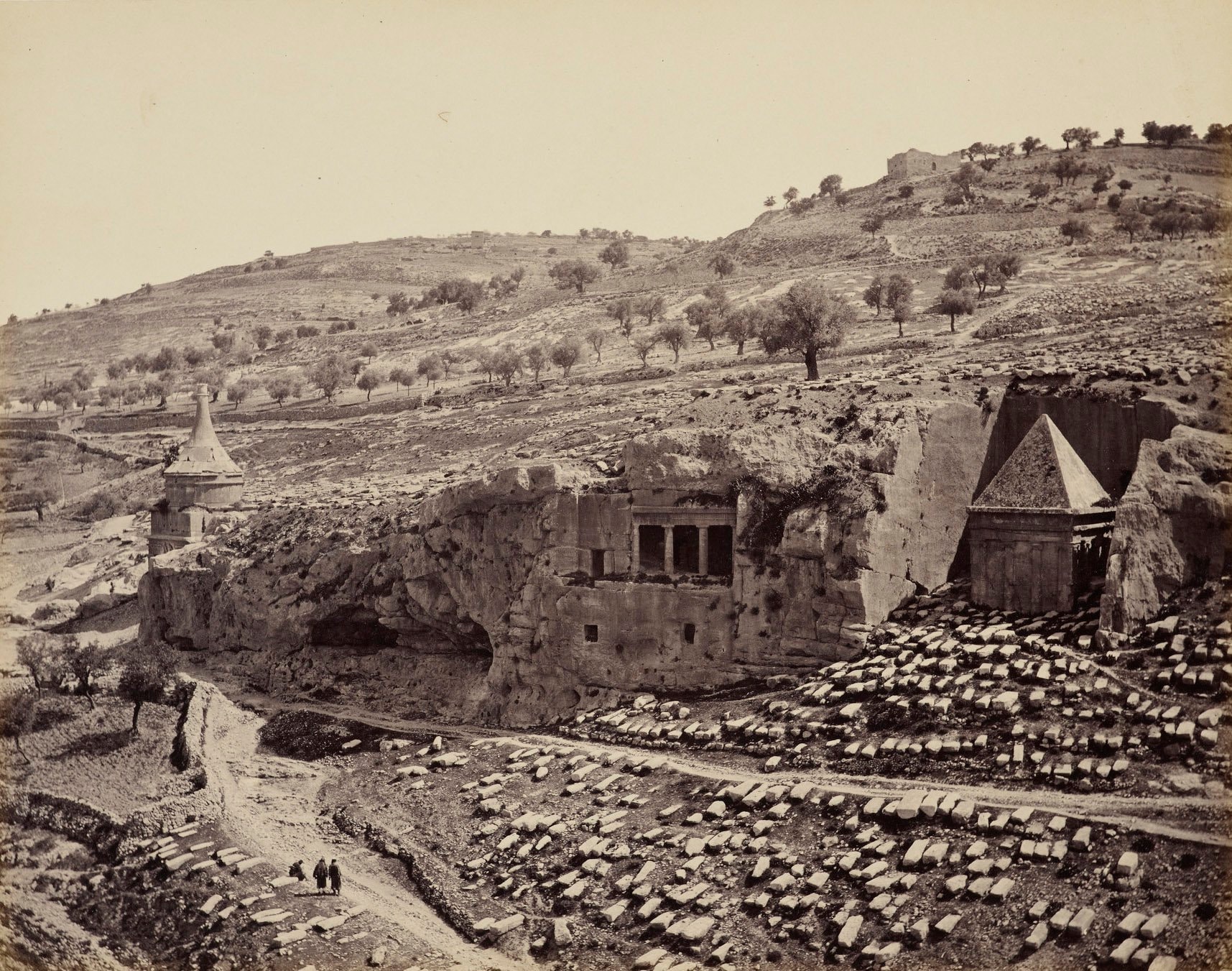
The Kidron Valley, long identified as Joel's "valley of Jehoshaphat," where the LORD says "there will I sit to judge all the nations round about" (Joel 3:12). Photograph by Francis Bedford, 1862, Royal Collection. Image: public domain, via Wikimedia Commons.
See this page's graph and discover linked topics
In full
The argument is a divine-prerogative argument in the sense developed by Richard Bauckham and Larry Hurtado. Second Temple Judaism identified the one God by what he alone does: he alone created all things, he alone rules all things, and he alone will judge all things at the end. Final, universal, heart-searching judgment is part of that identity (Genesis 18:25; Psalm 96:13; Joel 3:12; 1 Kings 8:39; Jeremiah 17:10). The New Testament assigns exactly this judgment to Jesus, often in the Old Testament's own words, and attaches to it a demand for honour equal to the Father's (John 5:23).
The strongest counter-reading is the delegated agent: God may appoint an agent to judge on his behalf, as Second Temple texts appear to do with Abel (Testament of Abraham, Recension A, ch. 13), Melchizedek (11QMelchizedek, which applies Psalm 82:1 to him), and the Elect One or Son of Man of the Similitudes of Enoch (1 Enoch 61-62), and as Paul does with the saints (1 Corinthians 6:2). The page grants that agency is real and that Jesus judges as the Father's appointed one (Acts 17:31). It argues that agency explains the commission and fails to explain three further features: the heart-searching that Scripture reserves to the LORD, the use of the LORD's own judgment texts for Jesus, and the command that he receive the Father's honour.
Grammar and hermeneutics
- "All judgment." In John 5:22 the object is tēn krisin pasan, all judgment. The Father keeps no portion back: "neither doth the Father judge any man."
- "Even as." John 5:23 uses kathōs, the ordinary comparative "just as," to set the honour owed the Son alongside the honour owed the Father. The purpose clause (hina) makes equal honour the reason the judgment was given.
- "Because he is a son of man." John 5:27 explains why the execution of judgment falls to the Son: "because he is a son of man." The anarthrous phrase echoes Daniel 7:13, the "one like unto a son of man" who receives everlasting dominion. The Son judges humanity as one who shares it, which fits the incarnation; it does not limit him to it, since 5:26 says the Father gave him "to have life in himself," language used of the Father in the same verse.
- One judgment seat, two names. Paul writes "we shall all stand before the judgment-seat of God" (Romans 14:10, ASV) and "we must all be made manifest before the judgment-seat of Christ" (2 Corinthians 5:10). The noun is bēma in both. Some manuscripts of Romans 14:10 read "of Christ" (followed by the KJV); the critical text reads "of God." Either reading leaves Paul naming one final tribunal as God's and as Christ's.
- The throne of glory. In Joel 3:12 the LORD speaks in the first person: "there will I sit to judge all the nations." In Matthew 25:31-32 the Son of Man "shall sit on the throne of his glory: and before him shall be gathered all the nations." The scene of Joel is reassigned with its subject changed.
- The reins and the hearts. The Old Testament pairs the inner parts and the heart as what only God examines: "the righteous God trieth the minds and hearts" (Psalm 7:9); "I, Jehovah, search the mind, I try the heart, even to give every man according to his ways" (Jeremiah 17:10). The risen Christ says: "all the churches shall know that I am he that searcheth the reins and hearts: and I will give unto each one of you according to your works" (Revelation 2:23, ASV). Both halves of Jeremiah's sentence, searching and repaying, are claimed.
Argument structure
| Premise | Support | |
|---|---|---|
| P1 | Scripture reserves the final, universal judgment of all people to the LORD. | Genesis 18:25; Psalm 9:7-8; Psalm 96:13; Joel 3:12; Ecclesiastes 12:14 |
| P2 | That judgment requires knowledge of every heart, which Scripture ascribes to the LORD alone. | 1 Kings 8:39; Psalm 7:9; Jeremiah 17:10 |
| P3 | The New Testament assigns that same final, universal judgment to Jesus. | John 5:22, 27; Matthew 25:31-32; Acts 17:31; 2 Corinthians 5:10; 2 Timothy 4:1; Acts 10:42 |
| P4 | Jesus claims the heart-searching prerogative in the LORD's own words. | Revelation 2:23 with Jeremiah 17:10; Matthew 7:22-23; John 2:24-25 |
| P5 | The judgment is given so that the Son receives the honour due the Father. | John 5:23; Isaiah 42:8; Philippians 2:10-11 with Isaiah 45:23 |
| C | Jesus exercises a prerogative Scripture reserves to God, with the honour reserved to God, and so is included in the identity of the one God. |
Master objections
MO1: "The Father gave him the judgment. Whatever is given is not his by nature."
- What the Father gives the Son, on the classical reading, he gives eternally and by nature: the same chapter says the Father "gave he to the Son also to have life in himself" (John 5:26), and life-in-oneself is the Father's own mode of life. The giving names the order between Father and Son. It does not make the gift a loan. See Eternal Generation and Father-Son Authority Asymmetry.
MO2: "Saints and apostles will judge too (1 Corinthians 6:2; Matthew 19:28). Judging is not a divine prerogative."
- Answered under P3 below: the saints judge with Christ and from thrones he gives them (Revelation 3:21); none of them is the one before whom all nations appear, none searches hearts, and none receives equal honour.
MO3: "Jewish texts already have an exalted judge figure. Christians borrowed the motif."
- Answered under P5 below, with the parallels set out. The closest parallel, the Similitudes' Son of Man, also sits on the throne of glory; Bauckham reads that figure as drawn into the divine identity for exactly this reason. The parallels sharpen the question the argument asks.
P1, final universal judgment belongs to the LORD
Affirmative case
- Abraham's title. "Shall not the Judge of all the earth do right?" (Genesis 18:25).
- The Psalms. "Jehovah sitteth as king for ever: He hath prepared his throne for judgment; And he will judge the world in righteousness" (Psalm 9:7-8); "he cometh to judge the earth" (Psalm 96:13).
- The prophets. "There will I sit to judge all the nations round about" (Joel 3:12).
- Every deed. "For God will bring every work into judgment, with every hidden thing" (Ecclesiastes 12:14).
Anticipated objections
- "Kings and judges in Israel judged too."
- "Psalm 82 calls judges elohim."
Rebuttals
- Local, earthly, fallible judgment differs in kind from final universal judgment. Israel's judges were accountable to the Judge of all the earth (Deuteronomy 1:17, "the judgment is God's"). P1 concerns the last judgment of every nation and every hidden deed.
- Psalm 82 condemns those judges. They "shall die like men" (Psalm 82:7), and the psalm closes by asking God himself to judge the earth (82:8).
Live-cite kit
- Scripture: Genesis 18:25; Psalm 9:7-8; Psalm 96:13; Joel 3:12; Ecclesiastes 12:14.
- Aphorism: There is one Judge of all the earth.
Tactical notes
- Get agreement on P1 first. Unitarians, Muslims and Jews all affirm it.
P2, the Judge must know every heart
Affirmative case
- "Thou only." "Thou, even thou only, knowest the hearts of all the children of men" (1 Kings 8:39).
- The searcher of hearts. Jeremiah 17:10 joins heart-searching to repayment: "I, Jehovah, search the mind, I try the heart, even to give every man according to his ways."
- Just judgment needs it. A judgment of "every hidden thing" (Ecclesiastes 12:14) presupposes a judge to whom nothing is hidden.
Anticipated objections
- "God can reveal what is in a heart to his agent, as he did to prophets."
Rebuttals
- Revelation of one heart on occasion differs from knowing all hearts. A prophet may be shown a secret (2 Kings 5:26). The final judge must know the hearts of "all the children of men" at once, which 1 Kings 8:39 restricts to God.
Live-cite kit
- Scripture: 1 Kings 8:39; Psalm 7:9; Jeremiah 17:10.
- Aphorism: To judge every heart you must see every heart.
Tactical notes
- P2 is the hinge. The agency model can accept P1 and P3; it struggles at P2 and P4.
P3, the New Testament gives that judgment to Jesus
Affirmative case
- All judgment. "Neither doth the Father judge any man, but he hath given all judgment unto the Son" (John 5:22).
- All nations. "Before him shall be gathered all the nations" (Matthew 25:32).
- The world, the living and the dead. God "will judge the world in righteousness by the man whom he hath ordained" (Acts 17:31); Christ Jesus "shall judge the living and the dead" (2 Timothy 4:1); "ordained of God to be the Judge of the living and the dead" (Acts 10:42).
- Everyone. "We must all be made manifest before the judgment-seat of Christ" (2 Corinthians 5:10), the same tribunal Paul calls "the judgment-seat of God" (Romans 14:10).
Anticipated objections
- "The saints judge the world too (1 Corinthians 6:2), and the apostles judge Israel (Matthew 19:28)."
- "Acts 17:31 says 'by the man.' A man, appointed."
- "John 5:27 says he judges because he is a son of man."
Rebuttals
- The saints judge as Christ's associates. Matthew 19:28 seats the apostles "when the Son of man shall sit on the throne of his glory"; Revelation 3:21 says the one who overcomes will "sit down with me in my throne." Their judging is a share in his. None of them is the one before whom all nations are gathered.
- Trinitarian Christology affirms that he judges as man. The incarnate Son judges humanity in the humanity he shares. Acts 17:31 identifies who judges and that God attests him by resurrection; P2, P4 and P5 show what kind of judging it is.
- The human judge is the fitting one. John 5:27 explains why the Son executes judgment: he shares the nature of those judged and fulfils Daniel 7:13. The preceding verse gives him "life in himself" as the Father has it, so the chapter does not reduce him to a son of man.
Live-cite kit
- Scripture: John 5:22, 27; Matthew 25:31-32; Acts 17:31; Acts 10:42; 2 Timothy 4:1; 2 Corinthians 5:10; Romans 14:10.
- Aphorism: The Judge of all the earth has a name, and the apostles preached it.
Tactical notes
- Concede that he judges as appointed and as man. The argument does not need to deny either.
P4, Jesus claims the LORD's heart-searching
Affirmative case
- Revelation 2:23 quotes the formula. "I am he that searcheth the reins and hearts: and I will give unto each one of you according to your works," the risen Christ's words, matching Jeremiah 17:10 in both its halves.
- The verdict "I never knew you." At the judgment Jesus himself pronounces the sentence: "And then will I profess unto them, I never knew you: depart from me" (Matthew 7:23). The sentence turns on relationship to him.
- Knowledge of all men in the Gospel. "He knew all men ... for he himself knew what was in man" (John 2:24-25); the disciples: "Now know we that thou knowest all things" (John 16:30).
Anticipated objections
- "Revelation 2:23 is the Father speaking through Christ."
- "Knowing people's hearts in the Gospels was prophetic insight."
Rebuttals
- The speaker is identified. The letter opens "These things saith the Son of God, who hath his eyes like a flame of fire" (Revelation 2:18). The first-person "I am he" belongs to the Son.
- John says "all." John 2:24-25 says he "knew all men" and "needed not that any one should bear witness concerning man." See John 16.30 for the disciples' confession and its pairing with John 21:17.
Live-cite kit
- Scripture: Revelation 2:18, 23 with Jeremiah 17:10; Matthew 7:22-23; John 2:24-25; John 16:30; John 21:17.
- Aphorism: He claims the LORD's sentence word for word.
Tactical notes
- Read Jeremiah 17:10 aloud first, then Revelation 2:23. Let the listener hear the echo.
P5, the Judge receives the Father's honour
Affirmative case
- The stated purpose. "He hath given all judgment unto the Son; that all may honor the Son, even as they honor the Father. He that honoreth not the Son honoreth not the Father that sent him" (John 5:22-23).
- God's glory is not shared. "I am Jehovah, that is my name; and my glory will I not give to another" (Isaiah 42:8).
- Every knee. Isaiah 45:23, "unto me every knee shall bow, every tongue shall swear," is applied in Philippians 2:10-11 to the name of Jesus.
Anticipated objections
- "Second Temple Jews had exalted judges: Abel (Testament of Abraham), Melchizedek (11QMelchizedek), the Elect One (1 Enoch). Jesus is one more."
- "Honouring the agent honours the sender. That is all John 5:23 means."
Rebuttals
- The parallels, taken seriously. In the Testament of Abraham, Abel conducts a first judgment, and the final judgment belongs to God; the scheme keeps the last word for God. In 11QMelchizedek, Melchizedek executes judgment in a heavenly council; he receives no honour equal to God's. In the Similitudes of Enoch, the Elect One sits on the throne of glory and judges, and the kings fall down before him. Richard Bauckham (Jesus and the God of Israel, 2008) reads that one figure as drawn into the divine identity by the throne itself; other scholars read him as a supreme agent. On either reading, the parallel that comes closest to the New Testament's picture is the one that places the judge on God's throne.
- "Even as" asks for more. An ambassador is honoured for the king. John 5:23 asks that the Son be honoured as the Father is honoured, and Isaiah 42:8 forbids giving that honour to another. Equal honour to a creature would be the idolatry Israel's Scriptures forbid.
Live-cite kit
- Scripture: John 5:22-23; Isaiah 42:8; Isaiah 45:23; Philippians 2:10-11.
- Scholarly: Richard Bauckham, Jesus and the God of Israel (2008); Larry Hurtado, Lord Jesus Christ (2003).
- Aphorism: An agent is honoured for the king. The Son is honoured as the Father.
Tactical notes
- Raise the Second Temple parallels yourself if the objector is informed. Owning the strongest evidence for the other side is persuasive.
- What not to defend: that no Jewish text ever imagined a heavenly judge. Several did. The question is what the New Testament adds.
Conclusion
Jesus is given the judgment of all nations, searches every heart in the LORD's own words, and receives the Father's honour as the purpose of the gift. The agency model explains that he judges as one appointed and as man; Trinitarian Christology affirms both. It does not explain P2, P4 or P5. The Judge of all the earth of Genesis 18:25 and the Son of Man on the throne of Matthew 25:31 are the same Judge, and the Father judges through him.
Tactical opening and closing
Opening line: "Who is the Judge of all the earth? Abraham said the LORD. Who sits on the throne with all the nations before him? Jesus says the Son of Man. So what does that make him?"
Closing line: "You can call him an agent. Then explain an agent who searches every heart, speaks the LORD's own verdict, and must be honoured exactly as the Father is honoured. The simplest explanation is the one John gives: the Word was with God, and the Word was God."
Scholarship
Published academic works this page draws on, each matched to a publisher, index or library catalog record.
- Richard Bauckham, Jesus and the God of Israel (2008). Open Library
- Larry W. Hurtado, Lord Jesus Christ: Devotion to Jesus in Earliest Christianity (Wm. B. Eerdmans Publishing Co, 2003). doi:10.5040/bci-003q
See also
- Cumulative Case for the Deity of Christ, the wider case, including the agency objection
- Christs Deity, divine prerogatives of Christ, including final judgment
- Sent One Cannot Be God Objection Defeater, the sending texts and the agency model
- Two Powers in Heaven, the Second Temple background to a second figure on the divine throne
- Father-Son Authority Asymmetry, how the Father gives and the Son receives within one nature
- Degrees of Punishment, what the final judgment renders
- Argument from Justice, why ultimate justice requires a final Judge
- Eschatology, the last things
- John 16.30, the disciples' confession that Jesus knows all things
Common questions this page answers
Q: Who is the judge of the world according to the Bible?
The Old Testament calls the LORD "the Judge of all the earth" (Genesis 18:25). The New Testament says the Father "hath given all judgment unto the Son" (John 5:22) and that God "will judge the world in righteousness by the man whom he hath ordained" (Acts 17:31). Christians read these together: God judges the world through Jesus.
Q: Does Jesus judge the world or does God?
Both, in the Trinitarian sense: the Father judges through the Son. Paul names the same tribunal "the judgment-seat of God" (Romans 14:10) and "the judgment-seat of Christ" (2 Corinthians 5:10).
Q: Why does it matter that Jesus is the judge?
Scripture reserves final judgment of every nation, and the searching of every heart, to God (1 Kings 8:39; Jeremiah 17:10). Jesus claims both (Matthew 25:31-32; Revelation 2:23) and says the judgment was given to him so that all would honour him as they honour the Father (John 5:23).
Q: Couldn't God appoint a human being to judge on his behalf?
God does appoint Jesus, and Jesus judges as man (John 5:27; Acts 17:31). But the judge Scripture describes searches all hearts and receives the Father's honour, which Isaiah 42:8 says God gives to no other. A merely human deputy could do neither.
Q: Won't Christians judge the world too?
Paul says "the saints shall judge the world" (1 Corinthians 6:2), and Jesus promises the apostles thrones (Matthew 19:28). They judge with Christ, from thrones he gives (Revelation 3:21). The one before whom all nations are gathered is Christ alone.