Argument
Jesus of Lubeck Slave Ship Objection Defeater
Jesus of Lübeck, Jesus of Lubeck, Good Ship Jesus, the good ship Jesus, slave ship named Jesus, first English slave ship was called Jesus, Queen Elizabeth slave ship Jesus, John Hawkins slave ship Jesus, Jesus of Lubeck Slave Ship ObjectionIntro
"England's slave trade sailed on a ship called Jesus. Queen Elizabeth I lent it to the slaver John Hawkins and took a cut of the profits. That tells you everything: Christianity blessed the slave trade." The story is usually told as if the name gives the game away.
Most of it is true, and a Christian should say so first. There really was a ship called the Jesus of Lübeck. A Protestant queen really did lend it to Hawkins for a slaving voyage in 1564, and backed his next one too. Hawkins told his crews to "serve God daily" while they carried stolen people across the ocean. That is a real sin, done by baptized people, and the church should own it without excuses.
But the conclusion does not follow, for four reasons.
- The name was not chosen for the trade. The Jesus was a big warship Henry VIII bought from the German port of Lübeck, and it carried that name in his navy years before Hawkins was a slaver. Ships of that age, warships and merchantmen alike, were named after Jesus, Mary and the saints.
- The Bible condemns exactly what Hawkins did. It made stealing a person and selling him a crime punished by death, and it lists slave-traders among the lawless.
- The same faith ended the trade. The people who fought the Atlantic slave trade until it was outlawed were mostly Christians arguing from the Bible, and one of them was a former slave-ship captain.
- A label is not a teaching. Jesus Himself warned that many would call Him "Lord" while doing evil. Judging Him by them is like judging medicine by a poisoner who called himself a doctor.
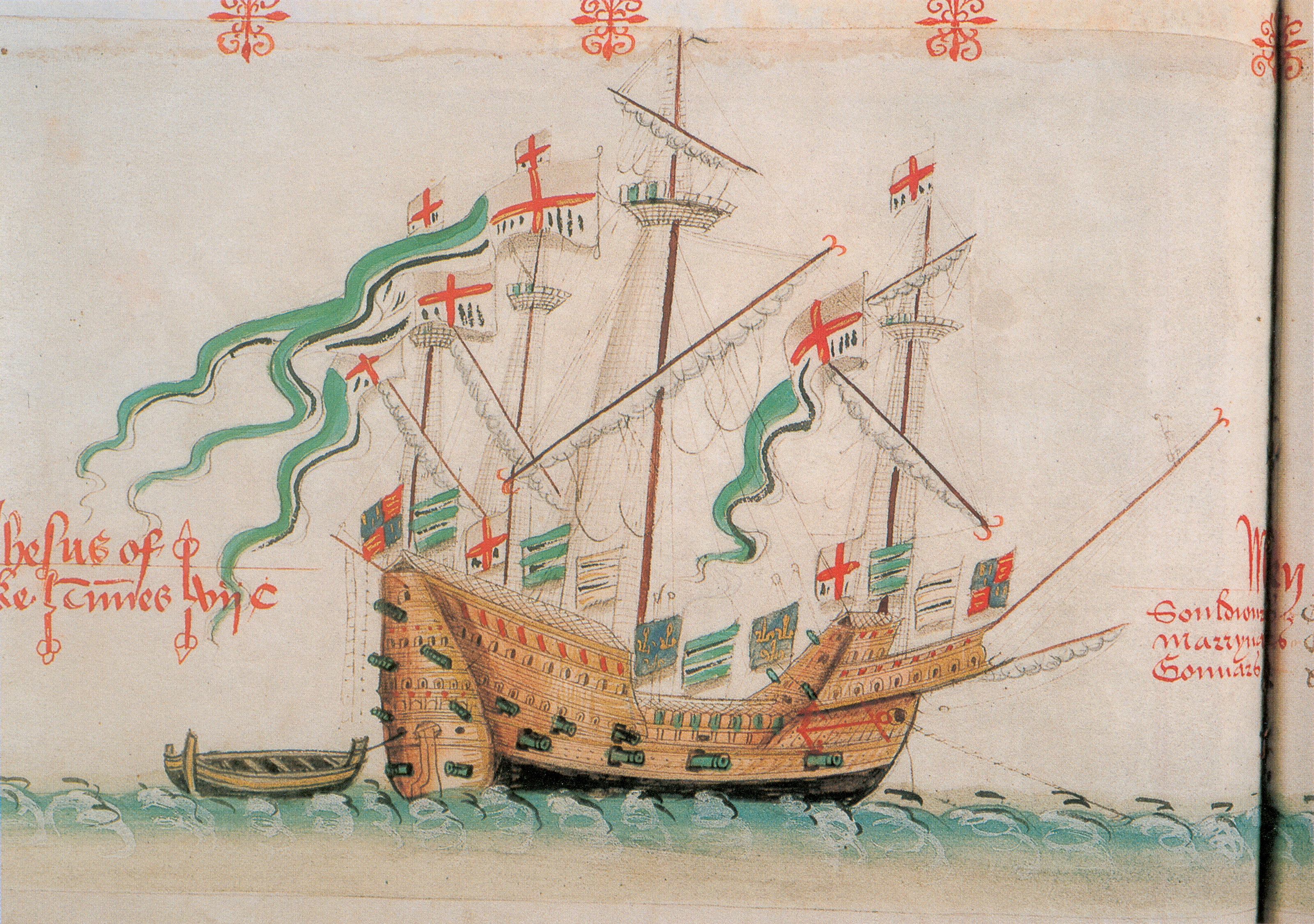
The Jesus of Lübeck on the Anthony Roll (Anthony Anthony, 1546), the inventory of Henry VIII's navy, drawn almost twenty years before the ship's first slaving voyage. Image: public domain, via Wikimedia Commons.
See this page's graph and discover linked topics
Cheatsheet
The 30-second reply:
Yes, the ship was called Jesus, a Christian queen lent it to a slaver, and that was a real sin the church has to own. But the name came with the ship: it was a German-built warship in Henry VIII's navy, on his 1546 inventory beside the Peter, the Matthew and the Mary Rose, almost twenty years before Hawkins used it. A name on a hull is not a teaching. What the Bible actually teaches is that stealing a man and selling him is a capital crime, and Paul lists slave-traders among the lawless. The movement that finally ended the trade was led by Christians quoting those verses.
30-second reply. "I'm not going to defend Hawkins or the Queen. Kidnapping people and selling them was evil, and calling it God's providence made it worse. But notice two things. First, the name: the Jesus was a royal warship bought from Lübeck and named long before Hawkins put a single captive in her hold. Ships in that navy were called Peter, Matthew, Trinity and Mary Rose. Second, the Book: Exodus 21:16 says whoever steals a man and sells him, or is found holding him, shall surely be put to death. By that verse Hawkins was a capital criminal. So the question isn't whether some Christians did evil. They did. It's which side Christianity's own teaching was on, and the abolitionists answered that by quoting it."
Fast facts.
- The ship. A large carrack built in Lübeck, a city of the Hanseatic League, and bought by Henry VIII for the Royal Navy. It appears on the Anthony Roll, presented to Henry in 1546. John Sparke, who sailed in her, gives her burden as 700 tons.
- The first voyage did not use her. Hawkins's first slaving voyage (October 1562 to September 1563) sailed with the Solomon, the Swallow and the Jonas. Hakluyt says Hawkins took at least 300 Africans in Sierra Leone "partly by the sword and partly by other means."
- Second voyage. The Jesus, lent from the Queen's navy, sailed from Plymouth on 18 October 1564 as Hawkins's flagship, with the Solomon, Tiger and Swallow.
- Third voyage. The Jesus sailed again on 2 October 1567. In September 1568, at San Juan de Ulúa on the Mexican coast, Spanish shore guns cut down her masts and Hawkins abandoned her, escaping in the Minion.
- The court case. In 1569 Hawkins and his backers sued for their losses before the High Court of Admiralty. A 2024 study of those depositions names the Queen as the most prominent of the voyage's backers.
- The crest. In 1565 Hawkins received a coat of arms whose crest showed a bound African captive.
- The trade was older than England's part in it. Portuguese raiders landed African captives at Lagos in 1444. The Spanish crown allowed enslaved Africans born under Christian rule into Hispaniola under instructions of 1501, and Charles V licensed direct shipments from Africa in 1518.
Concessions, and what each one collects.
- Grant: the ship was named Jesus. Collect: it bore the name in Henry VIII's navy, among ships named Peter, Matthew, Trinity Harry, Christopher and Mary Rose, before it ever carried a captive. The name tells you the vocabulary of the age, not the source of the trade.
- Grant: a Christian monarch invested and profited. Collect: the Bible she claimed condemns the investment by name (Exodus 21:16; 1 Timothy 1:10). A queen breaking a law does not make the law approve.
- Grant: Hawkins used pious language, "serve God daily," and credited God with his safe passage. Collect: Jesus predicted exactly this (Matthew 7:21-23; Luke 6:46). Religious words on evil deeds are what He condemned, not what He commanded.
- Grant: Christians took part in the trade for centuries. Collect: Christians also ended it, on biblical grounds, and some of the loudest voices were people the trade had touched: John Newton, who captained slave ships, and Olaudah Equiano, who was enslaved.
Counter-moves.
- "The name proves the trade was done in Christ's name." It proves the ship had a Christian name, as nearly every ship in that navy did. Ask what text of Christ's the trade appealed to. There is none; there is a text against it.
- "The church never objected." Many did not, and that is a real failure. But the law the church read made the trade a capital crime, and when Christians took that law seriously the trade fell. See Christian Abolitionist Movement.
- "You're doing No True Scotsman." No. Hawkins and Elizabeth were real Christians who did real evil. The claim is not that they weren't Christians but that their deed broke their own Scripture. See No True Scotsman Charge Defeater.
Closing line. "The ship carried Jesus' name. The trade broke Jesus' law. And the people who finally sank the trade were reading the same Bible the slavers ignored."
In full
The Jesus of Lübeck objection argues from a historical fact to a moral verdict: because the flagship of England's early transatlantic slaving voyages was named Jesus, and because a professing Christian monarch supplied it in return for a stake in the venture, Christianity itself sanctioned or produced the Atlantic slave trade. It is usually offered as a vivid capstone to the broader charge that Christianity is the religion of the slaveholder (see Christianity Is the White Mans Religion Objection Defeater and Most of the World Was Colonized by Christians Objection Defeater).
The defeater has five moves, and it begins by granting everything the record supports:
- Historical concession without minimizing. The ship, the royal loan, the profit motive, the captives taken by force and the pious language are all documented in the voyagers' own narratives, printed by Richard Hakluyt in 1589, and in the High Court of Admiralty depositions of 1569 studied by Baker and Lambert (2024). The defeater states them plainly, including Hawkins's crest of a bound captive.
- The name is not a teaching. The Jesus was a Lübeck-built royal warship listed on the Anthony Roll of 1546 among ships named for Christ, the Trinity, the Virgin and the apostles. Its name predates its slaving use by almost two decades and reflects Tudor naming practice, not a theological warrant for the trade. Inferring doctrine from a ship's name is a genetic and composition error.
- Internal critique. The Torah makes stealing and selling a person, or holding him, a capital crime (Exodus 21:16; Deuteronomy 24:7); Paul places andrapodistai, slave-dealers, in the vice list the law exists to condemn (1 Timothy 1:9-10); and every human being bears the image of God (Genesis 1:27; Acts 17:26). Hawkins's methods, as his own chroniclers describe them, meet the definition of man-stealing exactly.
- The abolitionist record. The campaign that outlawed the British slave trade in 1807 was led overwhelmingly by Christians arguing from these texts: Quakers, Granville Sharp, Thomas Clarkson, William Wilberforce, the converted slave-captain John Newton and the formerly enslaved Olaudah Equiano. The faith in whose name the ship sailed supplied the arguments that ended the trade.
- Consistency test. The objector would not accept that any worldview is defined by its worst adherents' labels. Applied evenly, the rule judges a teacher by his teaching and judges his followers by it too.
The defeater does not claim the Tudor church opposed the trade, that Hawkins was a nominal Christian, or that the Bible's servitude laws are easy texts. Those are separate questions, answered at Biblical Slavery Objection Defeater and Why Didnt God Ban Slavery Objection Defeater.
Grammar and hermeneutics
The objection treats a ship's name as if it were a text. The texts that actually bear on the trade answer it directly, and they can be read on grammatical grounds alone.
And he that stealeth a man, and selleth him, or if he be found in his hand, he shall surely be put to death. (Exodus 21:16, ASV)
-
The verb is theft. "Stealeth" is gānab (H1589), the same verb as the Eighth Commandment, "Thou shalt not steal" (Exodus 20:15); the identity is measured in the Strong's-tagged KJV. Taking a person by force or fraud is classed as theft of a human being.
-
The object is "a man," without qualification. The noun is 'îš (H376). Exodus 21:16 names no nationality and no exception. Deuteronomy's parallel narrows its focus to "any of his brethren of the children of Israel," but the Exodus law states the act itself.
-
The seller and the holder are equally liable. The clause "or if he be found in his hand" (māṣā', H4672; yād, H3027) extends the penalty from the man who sells to the man who still holds the stolen person. It reaches the raider in Sierra Leone, the captain who carried the captive, and the buyer in Hispaniola alike.
-
The penalty is emphatic. "Shall surely be put to death" doubles the verb mût (H4191 is tagged twice in the verse), the formula môt yûmāt that runs through the capital laws of Exodus 21:12, 21:15 and 21:17. Man-stealing is placed beside murder and striking a parent, not among property disputes.
-
Deuteronomy names the trade as well as the theft.
If a man be found stealing any of his brethren of the children of Israel, and he deal with him as a slave, or sell him; then that thief shall die: so shalt thou put away the evil from the midst of thee. (Deuteronomy 24:7, ASV)
"Deal with him as a slave" (KJV "maketh merchandise of him") is the rare verb ʿāmar (H6014), which in this sense appears only here and in Deuteronomy 21:14, where it forbids treating a captive woman as a commodity. The closing purge formula marks the deed as an evil to be removed from the community, not a business to be licensed.
-
Paul names the dealer.
as knowing this, that law is not made for a righteous man, but for the lawless and unruly, ... for fornicators, for abusers of themselves with men, for menstealers, for liars, for false swearers, and if there be any other thing contrary to the sound doctrine; (1 Timothy 1:9-10, ASV)
"Menstealers" is andrapodistais, the dative plural of andrapodistēs (G405), a word built on andrapodon, a captive taken and sold. It is the only New Testament occurrence. The list is introduced by "the law is good, if a man use it lawfully" (1 Timothy 1:8) and its second half follows the order of the second table of the Decalogue, so the slave-dealer sits where "Thou shalt not steal" sits. Paul describes the trade as "contrary to the sound doctrine," which is the opposite of a blessing.
-
Every person bears the image. "And God created man in his own image, in the image of God created he him" (Genesis 1:27, ASV); "he made of one every nation of men to dwell on all the face of the earth" (Acts 17:26, ASV; the KJV reads "of one blood"). The text gives no room for a class of humans who may be stolen. See Imago Dei.
-
Descriptive is not prescriptive, and a name is not a text. A ship's name is a description of a culture's vocabulary. It carries no imperative. The Gospels themselves anticipate people who use the Lord's name over deeds He forbids:
Not every one that saith unto me, Lord, Lord, shall enter into the kingdom of heaven; but he that doeth the will of my Father who is in heaven. (Matthew 7:21, ASV)
And why call ye me, Lord, Lord, and do not the things which I say? (Luke 6:46, ASV)
The construction in Luke is a rebuke built on a contrast: calling (kaleite) set against not doing (ou poieite). The grammar of the saying is the grammar of this objection. Jesus distinguishes the name invoked from the will obeyed, and judges by the second. The Third Commandment speaks the same way: "Thou shalt not take the name of Jehovah thy God in vain" (Exodus 20:7, ASV), where "take" is nāśā' (H5375), "lift" or "carry." Carmen Joy Imes (Bearing God's Name, 2019) reads the command as forbidding God's people to bear His name emptily. On any reading, putting His name on a deed His law calls capital is the misuse the commandment forbids, not something it endorses.
-
"By their fruits." "By their fruits ye shall know them" (Matthew 7:16, 7:20, ASV). Jesus' own test judges Hawkins by his deeds, not by his flagship's name. It applies to the church too: the fruit of the slave trade was evil, and the tree that bore it has to be called what it was.
History: what actually happened
These are the facts the defeater stands on. They are stated as the sources give them, including the ones that hurt.
The ship before Hawkins.
- The Jesus of Lübeck was a large carrack from Lübeck, a leading city of the Hanseatic League, bought by Henry VIII for the Royal Navy. The secondary literature dates the purchase to around 1540; the firm date is that she is drawn on the Anthony Roll, presented to Henry in 1546.
- The same roll lists the Henry Grace à Dieu, the Mary Rose, the Peter, the Matthew, the Trinity Harry, the Christopher of Bremen, the George, the Mary James and others. Christian and saints' names were the ordinary names of Henry's fighting ships.
- Hawkins's own fleets show the same habit: the Solomon and the Jonas on his first voyage, and on the second he met the Queen's ship Minion sailing with the John Baptist of London.
Hawkins's three slaving voyages.
- 1562-63. Backed by London merchants including Sir Lionel Ducket, Sir Thomas Lodge, Benjamin Gunson and Sir William Winter, Hawkins sailed in October 1562 with the Solomon (120 tons), the Swallow (100) and the Jonas (40). At Sierra Leone he "got into his possession, partly by the sword and partly by other means, to the number of 300 Negros at the least," and sold them in Hispaniola (Hakluyt). The Jesus was not on this voyage, so she was not England's first slave ship.
- 1564-65. The Jesus, "one of Her Majesty's ships," sailed from Plymouth on 18 October 1564 with the Solomon, Tiger and Swallow, about 170 men in all. Off Ferrol Hawkins issued sailing orders ending: "Serve God daily, love one another, preserve your victuals, beware of fire, and keep good company." When the fleet, carrying its captives, was becalmed on the crossing, John Sparke wrote that "the Almighty God, who never suffereth His elect to perish," sent the trade wind.
- 1567-68. The Jesus, the Minion and four smaller ships (one of them the Judith, under Francis Drake) sailed from Plymouth on 2 October 1567. In September 1568, at San Juan de Ulúa, a Spanish fleet attacked. In Hawkins's own words, the shore guns "cut all the masts and yards of the Jesus, in such sort that there was no hope to carry her away"; he escaped in the Minion, and the men who could not get off were left to "the mercy of the Spaniards." The voyage title in Hakluyt is "the third troublesome voyage."
The Crown's part.
- The Jesus was a Crown ship lent to a private venture; Payne's 1907 edition of the narratives notes that Hawkins made "his second voyage in one of the Queen's ships." The loan functioned as the Queen's stake in the enterprise.
- Gary Paul Baker and Craig Lambert's 2024 article in the English Historical Review studies the depositions taken before the High Court of Admiralty in March and April 1569, when Hawkins and his backers claimed compensation for what was lost at San Juan de Ulúa. It names the Queen as the most prominent of the 1567-68 voyage's backers, prints the testimony of the merchant William Fowler, who gave valuations of the lost cargo including the enslaved people, and concludes that the claims were conservative except for the valuation of the enslaved. The depositions survive in the State Papers (SP 12/53) and the Admiralty prize books (HCA 13/16 and 13/17).
The crest.
- In 1565, after the second voyage, Hawkins was granted a coat of arms whose crest is a "demi-Moor" bound as a captive. He made the trade part of his family's heraldry.
The older Iberian trade.
- Portuguese ships landed African captives for sale at Lagos in 1444, recorded by the chronicler Gomes Eanes de Zurara. Fifteenth-century papal bulls authorized Portuguese enslavement of "Saracens and pagans" (see Papal Bulls and Slavery).
- In Spanish America, the Crown's instructions to Governor Nicolás de Ovando in 1501 allowed enslaved Africans born under Christian rule into Hispaniola, and in 1518 Charles V licensed the shipment of 4,000 enslaved Africans directly from Africa to the Indies.
- England entered a trade the Iberian powers had run for more than a century, and it entered by selling captives to Spanish colonists. The objection's "England's first slave ship was named Jesus" is wrong on the ship and incomplete on the history, though the fact that matters morally, that English Christians joined the trade, is true.
Argument structure
| # | Premise |
|---|---|
| P1 | The objection needs a hidden premise: that what a professing Christian names, funds or does in Christ's name reveals what Christ's teaching endorses. |
| P2 | The Jesus's name was given before its slaving use and followed the ordinary Christian naming practice of the age, so it carries no information about the teaching behind the trade. |
| P3 | Christ's Scripture condemns the trade: man-stealing and holding stolen persons is capital (Exodus 21:16; Deuteronomy 24:7), slave-dealers are listed among the lawless (1 Timothy 1:9-10), and every human bears God's image (Genesis 1:27). |
| P4 | Christians, arguing from those texts, led the movement that ended the British slave trade, including people who had served in the trade and people it had enslaved. |
| P5 | Applied consistently, the objector's rule (judge a teaching by its worst adherents' labels) would condemn every worldview, so a fair standard judges a founder by his teaching and judges his followers by it. |
| C | Therefore the Jesus of Lübeck shows that Christians sinned gravely in the slave trade, not that Christianity sanctioned it; by Christianity's own standard the trade stands condemned. |
Form
Defensive. The argument grants every documented fact, then denies the inference from the facts to the verdict. P1 surfaces the hidden premise, P2 removes the evidential weight of the name, P3 supplies the internal critique, P4 supplies the historical counter-evidence, and P5 tests the objector's rule against the objector. P2 and P3 together are sufficient; P4 and P5 strengthen the case and redirect it. Soundness is contemporary: the historical facts are well attested, and the hermeneutical claims rest on the plain grammar of the texts.
P1, The objection needs a hidden premise
Affirmative case (second-order arguments)
- The facts alone are not a verdict. "A ship named Jesus carried captives" and "Christ's teaching sanctioned the trade" are different claims. To get from one to the other the objection needs a bridge: that what Christians label or fund in Christ's name shows what Christ taught.
- The bridge is a genetic fallacy in reverse. It judges a teaching by the conduct of people who later used its vocabulary, rather than by its content.
- It also commits composition. It moves from the acts of a queen, a captain and their investors to the character of a faith held by millions, including the millions who opposed the trade.
Anticipated objections
- "It isn't just a name. The Queen was head of the Church of England."
- "The point is that Christians felt no contradiction."
Rebuttals
- Being head of a church does not make every royal investment church teaching. Henry VIII headed the same church and had two of his wives executed; no one infers the church's teaching on marriage from his conduct.
- Many did not feel it, and that is the indictment. John Newton, a slave-ship captain, wrote later that he "never had a scruple upon this head at the time." The failure was real, but it was a failure to apply what they had been taught, which Newton himself came to see (P4).
Live-cite kit
- Scripture: Matthew 7:21; Luke 6:46.
- Scholarly: Newton, Thoughts upon the African Slave Trade (1788).
- Aphorism: "A name on a hull is not a verse in the Bible."
Tactical notes
- Lead by agreeing with the facts. Then ask: "What's the step from 'the ship was called Jesus' to 'Jesus approved'?" Make the objector state the bridge.
- What not to defend: the Queen, Hawkins, or the Tudor church's silence.
P2, The name came with the ship
Affirmative case (second-order arguments)
- Chronology. The Jesus was bought from Lübeck by Henry VIII and appears on the Anthony Roll in 1546. Hawkins's first slaving voyage was 1562, and the Jesus first sailed for him in 1564. The name was not chosen for the trade.
- Convention. The same roll lists the Henry Grace à Dieu, Mary Rose, Peter, Matthew, Trinity Harry, Christopher and George. These were warships, not slavers. A Christian name was what a Tudor ship was called.
- Hawkins's fleets confirm it. His other ships bore names like Solomon and Jonas. If biblical names proved theological approval, the Jonas would prove that the prophet Jonah endorsed slaving.
Anticipated objections
- "Hawkins could have refused to sail a ship called Jesus on that errand."
- "The name still shows how comfortable Christians were with the trade."
Rebuttals
- He could have, and the irony is real. But the objection's claim is about Christianity, not Hawkins's taste. His willingness to sail it shows his conscience, not the content of the faith.
- That is P1's point restated: it shows the conduct of a culture, which the defeater grants. The question is whether the conduct obeyed or broke the teaching. P3 answers it.
Live-cite kit
- Scholarly: C. S. Knighton and D. M. Loades, eds., The Anthony Roll of Henry VIII's Navy (2000), the edition of the roll.
- Aphorism: "The ship was named Jesus before it was a slaver. The trade was condemned by Jesus' Scripture before it began."
Tactical notes
- Show the image of the ship on the Anthony Roll if you can. It makes the chronology concrete: a royal warship, flying St George's crosses, drawn years before the slaving voyages.
- What not to defend: that the name meant nothing to anyone. Hawkins's piety was real to him; that is why P3 matters.
P3, Christ's Scripture condemns the trade
Affirmative case (second-order arguments)
- Man-stealing is capital. "He that stealeth a man, and selleth him, or if he be found in his hand, he shall surely be put to death" (Exodus 21:16, ASV). Hawkins took people "partly by the sword," sold them, and held them in his ships. Each clause of the verse describes him.
- The slave-dealer is named. 1 Timothy 1:10 lists the andrapodistēs among those "contrary to the sound doctrine." See G0405 - andrapodistes.
- The image of God forbids a class of stealable humans. Genesis 1:27; Acts 17:26. See Imago Dei and Four Pillars of Chattel Slavery.
- The New Testament judges the slave economy. Babylon's cargo ends "and slaves; and souls of men" (Revelation 18:13, ASV), where the word rendered "slaves" is literally "bodies" (KJV margin).
Anticipated objections
- "The Bible also regulates slavery, so it isn't against it."
- "Exodus 21:16 only protected Israelites."
- "If the texts were so clear, why didn't Tudor Christians see it?"
Rebuttals
- The laws regulating servitude in Israel govern debt service and similar arrangements, and they never license kidnapping, which the same chapter makes capital. That distinction is argued in full at Chattel Slavery vs Biblical Servitude and Biblical Slavery Objection Defeater. The Atlantic trade was built on the act the law forbids.
- Exodus 21:16 says "a man" ('îš) with no national limit; it is Deuteronomy 24:7 that specifies "his brethren." And Paul's andrapodistai in 1 Timothy 1:10 is not limited to Israelites at all.
- Some did not want to, because the trade paid. The Bible predicts that too (Matthew 7:21-23). When Christians did read the texts plainly, they turned them against the trade (P4), which is why slaveholders later printed a Bible with the liberating passages cut out (Slave Bible).
Live-cite kit
- Scripture: Exodus 21:16; Deuteronomy 24:7; 1 Timothy 1:9-10; Genesis 1:27; Revelation 18:13.
- Aphorism: "By the Bible's own law, Hawkins was a capital criminal."
Tactical notes
- This is the load-bearing premise. Read Exodus 21:16 aloud, slowly, and then read Hakluyt's "partly by the sword" beside it.
- What not to defend: that the Bible's servitude laws are easy. Route that to the dedicated pages.
P4, The same faith ended the trade
Affirmative case (second-order arguments)
- The movement was Christian. The campaign that brought about the British Slave Trade Act of 1807 was driven by Quakers, by the Anglican lawyer Granville Sharp, by Thomas Clarkson's evidence-gathering, and by the evangelical William Wilberforce in Parliament. See Christian Abolitionist Movement.
- A slave-ship captain repented in print. John Newton, captain in the trade until 1754 and later an Anglican clergyman, published Thoughts upon the African Slave Trade in 1788: "I hope it will always be a subject of humiliating reflection to me, that I was, once, an active instrument, in a business at which my heart now shudders." He had once called the trade "the line of life which Divine Providence had allotted me," the same providential language Hawkins's chronicler used. His faith, read rightly, is what changed his verdict.
- The enslaved used the same Bible. Olaudah Equiano, enslaved as a boy and later a Christian, published his Interesting Narrative in 1789 as a weapon for the abolition campaign. In America, Frederick Douglass distinguished "the Christianity of Christ" from "the Christianity of this land." See Black Christian Agency.
- Africans protested too. The Christian king Afonso I of Kongo protested the Portuguese trade in his own letters in the sixteenth century, close to Hawkins's own era.
Anticipated objections
- "Christians only cleaned up their own mess."
- "Secular Enlightenment ideas ended slavery, not Christianity."
Rebuttals
- Slavery was practised across the ancient and medieval world, and no earlier society had produced a lasting movement to abolish it as an institution. Christians cleaning up a sin their fellow Christians committed is exactly what repentance looks like, and it is what the objection's own moral outrage demands. See African Participation in the Atlantic Slave Trade and Trans-Saharan and Indian Ocean Slave Trades for the wider history.
- Enlightenment arguments played a part, but the mass petitioning, the boycotts and the parliamentary leadership in Britain were overwhelmingly Christian, and the arguments were biblical. Historians from David Brion Davis to Tom Holland have traced how deeply the abolitionist conscience drew on Christian premises.
Live-cite kit
- Scholarly: Newton, Thoughts upon the African Slave Trade (1788); Equiano, The Interesting Narrative (1789); David Brion Davis, The Problem of Slavery in Western Culture (1966).
- Aphorism: "One ship was named Jesus. The movement that sank the trade was full of people who followed Him."
Tactical notes
- Newton is the best single answer: he is Hawkins with repentance. Same trade, same pious vocabulary, and then the same faith turned him against it.
P5, Judge everyone by the same rule
Affirmative case (second-order arguments)
- The rule proves too much. If a worldview is defined by the worst deeds done under its labels, every worldview is condemned, including secular ones whose states and movements committed atrocities in the names of reason, progress and the people. See Atheist Regime Body Count.
- The fair rule is teaching plus conduct. Judge a founder by what he taught, and judge his followers by whether they kept it. On that rule Hawkins is condemned and Christ is not.
- This is a consistency test, not a tu quoque. The point is not "your side did worse," but that the objector would reject the rule if it were applied to his own view, so it cannot carry the verdict here.
Anticipated objections
- "That's whataboutism."
- "Christianity claims to transform people. Hawkins wasn't transformed, so the claim fails."
Rebuttals
- Whataboutism avoids a charge. This defeater grants the charge in full and tests the rule drawn from it.
- Christianity claims that God transforms those who repent and believe, and that many who say "Lord, Lord" are not His (Matthew 7:21-23). Newton is a case of the transformation; Hawkins, as far as the record shows, is a case of the warning. Neither falsifies the claim.
Live-cite kit
- Scripture: Matthew 7:16; Matthew 7:21-23.
- Aphorism: "Judge the teacher by the teaching, and the student by whether he kept it."
Tactical notes
- Use this last and gently. The person raising Hawkins often has a real grievance about the history; let them see you share it before you test their rule.
Conclusion
The Jesus of Lübeck is evidence that Christians sinned gravely in the slave trade. It is not evidence that Christianity sanctioned it. The facts are granted, including the royal loan, the profits, the crest and the prayers. The name came with a royal warship and followed the habit of the age (P2). The teaching of the One whose name it bore made the trade a capital crime and named its dealers among the lawless (P3). Christians reading that teaching led the movement that ended the trade (P4). And the objector's rule, applied evenly, would condemn every worldview, while the fair rule condemns Hawkins and not Christ (P5).
Master objections to the whole argument
- "You're minimizing the Church's guilt." No. The defeater states the guilt more fully than the objection usually does: the first voyage's captives were taken by the sword, the Queen backed the later voyages, and Hawkins put a bound captive on his crest. What it denies is that the guilt belongs to Christ's teaching rather than to the people who broke it.
- "No True Scotsman again." Hawkins and Elizabeth were Christians. The defence is not that they weren't, but that they broke the standard their own faith set. See No True Scotsman Charge Defeater and Christians Behaving Badly Defeater.
- "The Bible didn't stop it, so the Bible is useless against it." The Bible did not stop people who did not obey it. When people obeyed it, it did stop the trade. That is the difference between a law and a law kept.
Tactical opening / closing
Opening line: "You're right about the ship, and I'm not going to defend what was done with it. Can I show you what the Bible says about the man who captained it?"
Closing landing strip: "The ship carried Jesus' name across the Atlantic. The trade broke Jesus' law at every stage: stealing, selling, holding. And the people who finally ended it were reading the same Bible the slavers ignored. If you want to judge Christianity by the Jesus of Lübeck, judge it by Exodus 21:16 too."
Connection to Scripture
- Exodus 21:16, stealing, selling or holding a person is capital
- Deuteronomy 24:7, the kidnapper who sells his brother shall die
- 1 Timothy 1:9-10, slave-dealers among the lawless
- Genesis 1:27, every person made in God's image
- Acts 17:26, every nation made of one
- Matthew 7:21-23 and Luke 6:46, "Lord, Lord" without obedience
- Matthew 7:16, by their fruits
- Revelation 18:13, "slaves; and souls of men" in Babylon's cargo
- Galatians 3:28, neither bond nor free in Christ
Patristic / scholarly note
Primary sources:
- John Sparke, narrative of Hawkins's second voyage, and John Hawkins, account of the third voyage, in Richard Hakluyt, The Principall Navigations, Voiages and Discoveries of the English Nation (1589); edited in E. J. Payne, Voyages of Hawkins, Frobisher and Drake (Oxford: Clarendon Press, 1907), pp. 6-8 (first voyage), 10 (sailing orders), 27 (the crossing), 69-79 (third voyage)
- John Newton, Thoughts upon the African Slave Trade (London, 1788)
Modern:
- Gary Paul Baker and Craig Lambert, "'William Fowler', Sir William Garrard, Sir John Hawkins and the Sixteenth-Century Atlantic Slave Trade," The English Historical Review 139 (2024): 680-714, doi:10.1093/ehr/cead213, on the 1569 Admiralty depositions
- Harry Kelsey, Sir John Hawkins: Queen Elizabeth's Slave Trader (Yale University Press, 2003), a full modern biography
- C. S. Knighton and D. M. Loades, eds., The Anthony Roll of Henry VIII's Navy (2000)
- Carmen Joy Imes, Bearing God's Name: Why Sinai Still Matters (2019), on the Third Commandment
Scholarship
Published academic works this page draws on, each matched to a publisher, index or library catalog record.
- David Brion Davis, The Problem of Slavery in Western Culture (1966). Open Library
- Richard Hakluyt et al., The principall navigations, voiages, and discoveries of the English nations (1589). Open Library
- Carmen Joy Imes, Bearing God's Name (2019). Open Library
- John Newton, Thoughts upon the African Slave Trade (1788). Open Library
See also
- Christian Abolitionist Movement, the movement that ended the trade, and its biblical arguments
- Biblical Slavery Objection Defeater, the wider "the Bible endorses slavery" objection
- Why Didnt God Ban Slavery Objection Defeater, why man-stealing was capital and servitude was regulated
- Where Was God During Slavery Objection Defeater, the problem-of-evil form of the slavery question
- Chattel Slavery vs Biblical Servitude and Four Pillars of Chattel Slavery, why the Atlantic system is not biblical ebed
- G0405 - andrapodistes, the slave-dealer of 1 Timothy 1:10
- Papal Bulls and Slavery, the Iberian trade's earlier church entanglement
- African Participation in the Atlantic Slave Trade, the supply side of the trade
- Most of the World Was Colonized by Christians Objection Defeater and Christianity Is the White Mans Religion Objection Defeater, the larger charges this one usually serves
- Christians Behaving Badly Defeater and No True Scotsman Charge Defeater, judging a faith by its adherents
- William Wilberforce and Frederick Douglass, abolitionists on both sides of the Atlantic
- Slave Bible, the censored Bible slaveholders needed
Common questions this page answers
Q: Was the first English slave ship called Jesus?
No. John Hawkins's first slaving voyage (1562-63) used the Solomon, the Swallow and the Jonas. The Jesus of Lübeck, a royal warship bought by Henry VIII, was his flagship on the second voyage (1564-65) and the third (1567-68), when it was abandoned at San Juan de Ulúa in Mexico.
Q: Did Queen Elizabeth I support the slave trade?
Yes. She lent the royal ship Jesus of Lübeck to Hawkins's second voyage as a stake in the venture, and a 2024 study of the 1569 Admiralty court records names her as the most prominent backer of his third. That was a real moral failure, and it broke the Bible's own law, which made stealing and selling a person a capital crime (Exodus 21:16).
Q: Does a slave ship named Jesus prove Christianity supported slavery?
No. The ship already bore the name in Henry VIII's navy, among ships named Peter, Matthew and Mary Rose, years before its first slaving voyage. A ship's name reflects the naming habits of the age, not the teaching of Jesus, whose Scripture condemns man-stealing and lists slave-traders among the lawless (1 Timothy 1:10).
Q: What does the Bible say about the slave trade?
It condemns the act the Atlantic trade was built on. Exodus 21:16 makes stealing a person, selling him, or holding him a capital crime; Deuteronomy 24:7 repeats it; and 1 Timothy 1:9-10 lists "menstealers" (Greek andrapodistai, slave-dealers) among those "contrary to the sound doctrine."
Q: Who was John Hawkins?
An English sea captain from Plymouth (1532-1595) who led England's first organized slaving voyages to West Africa and the Caribbean in the 1560s, later served as Treasurer of the Navy and fought against the Spanish Armada. In 1565 he was granted a coat of arms whose crest showed a bound African captive.
Q: Who ended the Atlantic slave trade?
In Britain, the campaign that won the Slave Trade Act of 1807 was led overwhelmingly by Christians: Quakers, Granville Sharp, Thomas Clarkson, William Wilberforce, the former slave-ship captain John Newton and the formerly enslaved Olaudah Equiano, arguing from texts such as Exodus 21:16 and Genesis 1:27. See Christian Abolitionist Movement.