Argument
Jesus Is a Narcissist Objection Defeater
Jesus Narcissist, Hate Your Father and Mother Objection, Jesus Is a Narcissist, Was Jesus a Narcissist, Luke 14:26 Objection, Love Me More Than Your Family Objection, Jesus Narcissist Objection DefeaterIntro
"Jesus told people to love Him more than their own mother and children. In Luke He even says to hate your family. Anyone who talks like that is a narcissist." The charge sounds strong because the words are strong. Read in their own language and setting, though, the words say something different, and the man who spoke them behaved like the opposite of a narcissist.
A narcissist is self-important, feels entitled, craves admiration and lacks empathy. Jesus knelt with a towel and washed His followers' feet (John 13:4-5). He said He came "not to be ministered unto, but to minister, and to give his life a ransom for many" (Mark 10:45, ASV). He prayed for the men nailing Him to a cross (Luke 23:34). And while He was dying, He arranged for someone to take care of His mother (John 19:26-27).
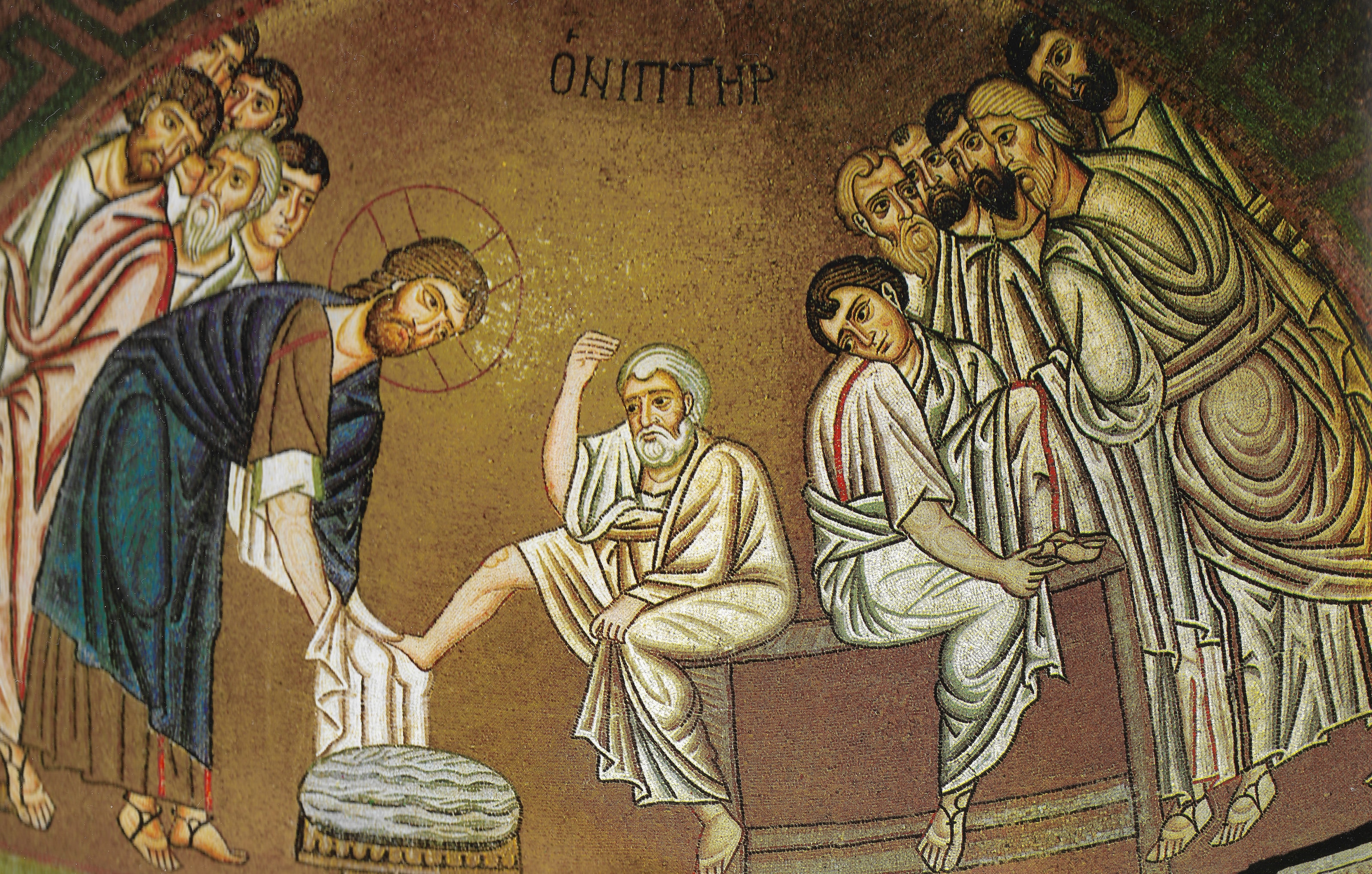
The Washing of the Feet, Byzantine mosaic in the narthex of the Katholikon of Hosios Loukas, Greece, early 11th century. Image: public domain, via Wikimedia Commons, resized.

The word "hate" in Luke 14:26 is an old Hebrew way of saying "love less." When the Bible says Jacob "loved also Rachel more than Leah," the very next verse says Leah "was hated" (Genesis 29:30-31, ASV). Matthew reports the same teaching in plain words: love Him "more than" father or mother (Matthew 10:37). So the real question is simple. Does Jesus have the right to come first? If He is who He said He is, the answer is yes, and putting Him first makes a person better at loving their family.
See this page's graph and discover linked topics
Cheatsheet
The 30-second reply:
In Luke 14:26 "hate" is a Hebrew idiom for "love less," the same usage as Genesis 29:30-31, where "loved Rachel more than Leah" is restated as "Leah was hated." Matthew 10:37 says it outright: love me "more than" father or mother. The list also ends with "his own life," so the demand falls on the disciple's self first. A narcissist exploits and lacks empathy; Jesus washed feet, died for others, prayed for His killers, condemned men who dodged supporting their parents, and provided for His mother from the cross. Whether the demand is fair depends on who is making it. So which is your objection: that Jesus is not God, or that even God could not rightly ask to come first?
The fast facts:
- The idiom. Luke 14:26 uses miseō (G3404, "hate"). Matthew 10:37 uses phileō (G5368, "love") with hyper (G5228, "more than"). Two reports of one teaching; Matthew's spells out the comparison Luke's idiom carries.
- The Old Testament pattern. "Hated" as "loved less" appears in Genesis 29:30-31 (Leah), Deuteronomy 21:15-17 (the "hated" wife whose son still gets the double portion), and Malachi 1:2-3, quoted in Romans 9:13.
- The self is on the list. "Yea, and his own life also" (Luke 14:26, ASV). The demand is self-renunciation, then the cross (Luke 14:27), then counting the cost (Luke 14:28-32).
- The conduct. Foot-washing (John 13:4-5), ransom (Mark 10:45), laying down life (John 15:13), forgiving His executioners (Luke 23:34). Each one inverts a diagnostic trait of narcissism.
- The family commands. Jesus attacked the Corban loophole that let sons stop supporting parents (Mark 7:10-13), restated "Honor thy father and mother" (Matthew 15:4; Matthew 19:19; Luke 18:20) and provided for Mary at the cross (John 19:26-27).
The 3 strongest counter-moves:
- "Is demanding first place narcissistic in itself, or only when the one demanding has no right to it?" Every legitimate authority asks for some priority. The question is warrant.
- "Name one trait of narcissism Jesus displays in His conduct." Grandiosity, entitlement, hunger for admiration, lack of empathy, exploitation: the Gospels show the reverse of each.
- "Is your objection that Jesus is not God, or that even God could not rightly ask to come first?" The fork splits the objection into a historical question (His identity) and a moral question (God's right). Both are answerable, and neither is narcissism.
Reciprocal concessions (grant the small point, then collect a bigger one):
- Grant: the words are severe, and discipleship really has split families (Matthew 10:34-36, quoting Micah 7:6). Now collect: that passage describes what persecutors do to disciples, and the same Teacher condemned anyone who left parents unsupported. A rule that forbids abandoning your parents cannot be a rule to abandon them.
- Grant: a merely human teacher who said this would be alarming. Now collect: so the objection stands or falls on whether Jesus is merely human, which concedes that the charge is really about His identity, and the case for His deity has to be answered on its merits.
- Grant: family is one of the highest goods in human life. Now collect: Christianity grounds that worth (Ephesians 5 and 6; 1 Timothy 5:8 calls the man who neglects his household "worse than an unbeliever"). A naturalist who prizes the family as sacred owes an account of where that sacredness comes from.
The closing line:
A narcissist uses the people closest to you to serve himself. Jesus put His own life first on the list of things to give up, told you to keep caring for your parents, and spent His last breaths arranging care for His mother. The only question left is whether He is the one with the right to come first.
In full
The objection runs: Jesus requires that His followers love Him more than their parents, spouses and children (Matthew 10:37), even that they "hate" them (Luke 14:26). Demanding to be loved above a person's own family is the signature of a narcissistic personality: grandiose self-regard, a sense of entitlement to others' devotion and indifference to the cost borne by the people around them. Therefore Jesus was a narcissist, and His moral authority is forfeit.
The defeat runs on four lines.
- Lexical and hermeneutical. The Lukan "hate" (miseō) reproduces a Semitic idiom of comparative preference attested in the Hebrew Bible (sane', H8130, set against 'ahab, H157), and the Matthean parallel renders the same saying with an explicit comparative (phileō hyper, "love more than"). The demand ranks loves, and the list climaxes in the disciple's own life, so its target is self-renunciation.
- Diagnostic. Narcissistic personality, as clinically described (DSM-5: grandiosity, need for admiration, entitlement, exploitativeness, lack of empathy), is a pattern of conduct. The conduct of Jesus as reported in all four Gospels inverts each criterion.
- Contextual. Jesus elsewhere enforces filial duty against religious loopholes (Mark 7:10-13), reaffirms the fifth commandment, and provides for His mother at His death. A saying cannot be read as dissolving obligations that its speaker vigorously upheld.
- Christological. Whether a claim to supreme allegiance is legitimate depends on the standing of the claimant. Ultimate allegiance is owed to the supreme source of goodness and obligation; God is that source; if Jesus is God incarnate, the claim is just. The objection therefore either presupposes that Jesus is not God, which is a historical and theological question about His identity, or asserts that even God could not rightly claim first place, which is a moral thesis the objector must defend and which collapses into the Cosmic Dictator Objection.
The positive alternative is Augustine's ordo amoris: virtue is love rightly ordered (City of God XV.22), so that one neither loves what ought not be loved nor loves more what ought to be loved less (De Doctrina Christiana I.27.28). Ranking God first is the condition under which family love stays sound.
Grammar and hermeneutics
The objection reads one English word, "hate," at face value. The grammar of the saying, its Synoptic parallel, the Old Testament usage behind it and its immediate literary context settle the meaning before any doctrine of Christ is invoked.
- Two reports, one teaching, one explicit comparative. Luke 14:26 has miseō (G3404, "hate"). The parallel in Matthew 10:37 has phileō (G5368, "love") governed by hyper (G5228) with the accusative, "he that loveth father or mother more than me is not worthy of me" (ASV). Matthew states as a comparison what Luke expresses by idiom. Commentators across traditions, including I. Howard Marshall and Darrell Bock, read the Lukan "hate" in exactly this comparative sense.
- The Hebrew Bible defines the idiom for us. Genesis 29:30 says Jacob "loved also Rachel more than Leah," with the Hebrew comparative min ("more than Leah"). The next verse restates the same situation: "Jehovah saw that Leah was hated" (ASV), using sane' (H8130). The narrator glosses "hated" by "loved less" in consecutive verses. Jacob married Leah, lived with her and had six sons by her; "hated" cannot mean hostility here.
- The idiom appears in law, where precision matters. Deuteronomy 21:15 legislates for a man with "two wives, the one beloved, and the other hated" (ASV), using 'ahab (H157) and sane' (H8130). The law then protects the "hated" wife's son, who keeps the double portion of the firstborn. A legal text uses "hated" as a technical term of lesser preference, and it guards the rights of the one less preferred.
- The idiom ranks covenant choices. Malachi 1:2-3, quoted in Romans 9:13, "Jacob I loved, but Esau I hated" (ASV; miseō in Romans, sane' in Malachi), concerns which brother's line carries the covenant. Whatever one's view of election, the same Torah commands, "Thou shalt not abhor an Edomite; for he is thy brother" (Deuteronomy 23:7, ASV). The vocabulary ranks covenant roles, and the law still forbids abhorring Esau's descendants.
- Jesus uses the same pair for allegiance elsewhere. "No man can serve two masters: for either he will hate the one, and love the other" (Matthew 6:24, ASV; miseō against agapaō, see G0025 - agapao). The context is service and loyalty; the hate-love pair names which master holds first claim.
- The list ends with the self. Luke's catalogue climbs through father, mother, wife, children, brethren and sisters to "yea, and his own life also" (Luke 14:26, ASV), the climactic addition eti te kai. The same verb with one's own life as object appears in John 12:25: "he that hateth his life in this world shall keep it unto life eternal" (ASV). Paul says plainly that "no man ever hated his own flesh; but nourisheth and cherisheth it" (Ephesians 5:29, ASV), so the hate of one's own life in the discipleship sayings has to be preference language. If "hate" meant psychological loathing, Luke 14:26 would command self-loathing alongside family-loathing, and no reader in the history of interpretation has taken it so.
- The demand terminates on the disciple, and the next verse says so. The saying is followed at once by "Whosoever doth not bear his own cross, and come after me, cannot be my disciple" (Luke 14:27, ASV). What is asked is the disciple's own self-giving. No benefit to Jesus at anyone else's expense is named anywhere in the unit.
- Genre and setting: a recruiting warning to a crowd. The passage opens with "great multitudes" following (14:25) and runs into two parables of counting the cost, the tower builder (Luke 14:28) and the king weighing a war (14:31-32), and closes, "whosoever he be of you that renounceth not all that he hath, he cannot be my disciple" (Luke 14:33, ASV). The form is prophetic hyperbole in a wisdom setting, meant to thin a crowd of the casually curious. Flattering a crowd to keep it would be the narcissist's move; Jesus turns to the multitude and makes following Him harder.
- The "sword" saying is descriptive prophecy. Matthew 10:34-36 ("I came to set a man at variance against his father") quotes Micah 7:6, where the prophet describes the breakdown of a faithless society. In Matthew 10 the surrounding verses are about disciples being handed over and persecuted (10:17-22). The saying forecasts the division others will bring on disciples, and the surrounding instructions tell disciples to endure it.
- The same Gospel enforces the fifth commandment. Luke, the Gospel with the word "hate," also has Jesus answer the ruler, "Thou knowest the commandments ... Honor thy father and mother" (Luke 18:20, ASV). An author does not report his subject abolishing a commandment four chapters before reporting him reciting it.
On grammar (the explicit comparative phileō hyper in Matthew, the sane'/'ahab pairing glossed in consecutive verses of Genesis 29, the technical legal use in Deuteronomy 21, the climactic "his own life also") and hermeneutics (Synoptic comparison, recruiting-warning genre, the descriptive Micah quotation, the same Gospel's affirmation of the fifth commandment) alone, Luke 14:26 commands an ordering of loves headed by self-renunciation, and the objection's reading of it fails.
Argument structure
| Premise | Notes | |
|---|---|---|
| P1 | The "hate" of Luke 14:26 is a Semitic idiom of comparative love, made explicit in Matthew 10:37; the demand ranks loves and includes the disciple's own life. | Lexical and hermeneutical |
| P2 | Narcissism is a pattern of conduct (grandiosity, entitlement, need for admiration, exploitation, lack of empathy), and the reported conduct of Jesus inverts each trait. | Diagnostic |
| P3 | Jesus commands and models care for family, so the ranking strengthens family obligation. | Contextual |
| P4 | Ultimate allegiance is rightly owed to the supreme source of goodness and obligation. | Moral principle |
| P5 | God is that source, and Jesus is God incarnate; therefore ultimate allegiance to Jesus is rightly owed. | Christological |
| C | Jesus's demand for first place is the rightful claim of God incarnate, expressed in an idiom of ordered love, by one whose conduct is the reverse of narcissism. The objection fails. |
Form
- Defensive defeater with an equivocation core: "hate" (idiom of preference vs emotional hostility) and "demands first place" (rightful authority vs self-aggrandizement).
- Valid deductive spine for P4 and P5: (1) Ultimate allegiance is rightly owed to the supreme source of goodness and obligation. (2) God is the supreme source of goodness and obligation. (3) Jesus Christ is God incarnate. (4) Therefore ultimate allegiance is rightly owed to Jesus Christ. The form is valid; premises 2 and 3 carry the weight and are defended on Christs Deity and Cumulative Case for the Deity of Christ.
P1, "Hate" in Luke 14:26 is comparative love, and the list ends with the self
Affirmative case (second-order arguments)
- The Synoptic parallel states the comparison. Matthew's "loveth father or mother more than me" (ASV) is the same teaching with the comparative made explicit.
- The Old Testament supplies the idiom. Genesis 29:30-31 glosses "hated" by "loved more than" in consecutive verses; Deuteronomy 21:15-17 uses it as legal terminology for the less preferred wife.
- Jesus uses the pair for allegiance. Matthew 6:24 sets "hate the one, and love the other" in a context of serving masters.
- "His own life also." The climactic item is the disciple's self, which fixes the sense as renunciation and rules out a reading where others are sacrificed for Jesus's gain.
Anticipated objections
- "Calling it an 'idiom' is a convenient way to soften what He plainly said."
- "Even 'love Me more than your children' is a monstrous thing to ask."
- "Matthew softened Luke. The harsher version is the original."
Rebuttals
- The idiom is documented. Genesis 29 and Deuteronomy 21 are centuries older than the Gospels and show the usage in narrative and in law. Reading an ancient idiom by its attested sense is ordinary philology; reading it by a modern English connotation is the error. The softening charge needs a counter-reading of Genesis 29:31 in which Jacob felt hostility to a wife he lived with and had six sons by.
- The comparative version moves the question to warrant. Everyone ranks loves: a parent who loved a child more than truth would lie for the child's crimes. Whether it is monstrous to ask for first place depends entirely on who asks (P4 and P5).
- Either way the sense is the same. Grant Luke's wording as earlier. The idiom still means what Genesis 29 shows it means, and Luke himself follows it with the cross and the cost-counting parables. The direction of the softening hypothesis changes nothing.
Live-cite kit
- Scripture: "he loved also Rachel more than Leah ... Jehovah saw that Leah was hated" (Genesis 29:30-31, ASV)
- Scholarly: Marshall and Bock on Luke 14:26 as a Semitic idiom of preference
- Aphorism: "In Hebrew, 'hated' can mean 'loved less.' Genesis defines it for you in two verses."
Tactical notes
- Read Genesis 29:30-31 aloud. It is the fastest and least contestable move.
- What NOT to defend: do not claim miseō "really means" love less in every context. It is a normal word for hate; the idiom is a usage in a comparative frame, and the frame is what you point to.
P2, The conduct of Jesus inverts every trait of narcissism
Affirmative case (second-order arguments)
- Grandiosity vs voluntary lowliness. He stooped to the slave's task of washing feet (John 13:4-5) and told His followers to do likewise (John 13:14). Paul describes the whole Incarnation as self-emptying (Philippians 2:6-8; see Kenosis).
- Entitlement vs service. "The Son of man also came not to be ministered unto, but to minister" (Mark 10:45, ASV), spoken to correct disciples who wanted thrones.
- Exploitation vs self-sacrifice. "Greater love hath no man than this, that a man lay down his life for his friends" (John 15:13, ASV). A narcissist spends others to protect himself; Jesus spends Himself.
- Lack of empathy vs compassion under torture. "Father, forgive them; for they know not what they do" (Luke 23:34, ASV). At the cross He also provides for His mother (John 19:26-27).
- Need for admiration vs turning crowds away. In Luke 14 He turns to a large following and raises the cost of following. In John 6:66-67 He lets many leave and asks the Twelve whether they will go too.
Anticipated objections
- "Self-sacrifice can be a narcissistic performance. Martyr complexes are real."
- "Those stories were written by His admirers."
Rebuttals
- A performance needs an audience and a payoff. The washing happened privately among twelve men, one of whom was about to betray Him; the prayer for His killers was offered while they gambled for His clothes. Nothing in either scene fits the theory, and the objector now has to explain the "performance" while granting the deeds.
- The objection relies on the same sources. The sayings in Luke 14 and Matthew 10 come from the same Gospels. An objector cannot take the demanding sayings as accurate and dismiss the servant deeds as admiring invention; both stand or fall together, and if they fall the objection has no text to object to.
Live-cite kit
- Scripture: Mark 10:45; Luke 23:34
- Scholarly: DSM-5 (American Psychiatric Association, 2013), criteria for narcissistic personality disorder: grandiosity, need for admiration, entitlement, exploitativeness, lack of empathy
- Aphorism: "A narcissist sends others to die for him. Jesus went Himself."
Tactical notes
- Ask the objector to define narcissism first, then walk the definition trait by trait.
- What NOT to defend: do not psychoanalyse the objector. Keep the diagnosis on the text.
P3, Jesus commands and models care for family
Affirmative case (second-order arguments)
- The Corban rebuke. Jesus condemns those who declare their support for parents "Corban, that is to say, Given to God" and so "no longer suffer him to do aught for his father or his mother," calling it "making void the word of God by your tradition" (Mark 7:10-13, ASV). He refuses to let even a religious vow excuse neglect of parents.
- The fifth commandment restated. Matthew 15:4; Matthew 19:19; Luke 18:20; see Exodus 20:12.
- Provision from the cross. "Woman, behold, thy son! ... Behold, thy mother! And from that hour the disciple took her unto his own home" (John 19:26-27, ASV).
- The apostolic household codes follow His lead. Husbands love wives as Christ loved the church (Ephesians 5:25); children honor parents (Ephesians 6:2-3); fathers do not provoke children (Ephesians 6:4); the man who will not provide for his household "is worse than an unbeliever" (1 Timothy 5:8, ASV).
Anticipated objections
- "In Mark 3 He disowned His own family: 'Who is my mother? and who are my brethren?'"
- "He told a man to skip his father's funeral: 'Let the dead bury their dead.'"
Rebuttals
- Read the setting. His relatives had come "to lay hold on him: for they said, He is beside himself" (Mark 3:21, ASV). His reply in Mark 3:31-35 widens family to include all who do God's will; it says nothing against His mother. The same Gospel tradition ends with Mary among His followers (Acts 1:14) and in John's care.
- The burial saying is a call with a deadline. In Matthew 8:22 and Luke 9:59-60, the man asks to go "first"; many interpreters take the father to be still living and the request as an indefinite postponement. On any reading the saying is a one-time call to a specific would-be disciple about the urgency of the kingdom, and it sits alongside the Corban rebuke that forbids neglecting parents. Do not build a family ethic on one urgent call while ignoring the standing commands.
Live-cite kit
- Scripture: Mark 7:10-13; John 19:26-27
- Scholarly: Mishnah tractate Nedarim, which regulates vows of the kind Jesus attacks, shows the practice was real
- Aphorism: "He condemned men who used God as an excuse to neglect their parents. That is the opposite of the charge."
Tactical notes
- Lead with John 19:26-27. A dying man arranging his mother's care is hard to cast as indifferent to family.
- What NOT to defend: do not pretend discipleship never causes family conflict. It does, and Jesus said it would.
P4, Ultimate allegiance is rightly owed to the supreme source of goodness
Affirmative case (second-order arguments)
- Ordered love is a moral truism. Everyone agrees some loyalties outrank others: truth outranks a friend's wish that you lie for him; justice outranks a brother's wish that you hide his crime. Ranking is unavoidable; the only question is what goes at the top.
- The highest good earns the highest rank. If there is a source of all goodness, every finite good is good by relation to it, so loving it first is loving goodness itself first.
- Augustine's ordo amoris. The just person "neither loves what ought not to be loved, nor fails to love what ought to be loved, nor loves that more which ought to be loved less" (De Doctrina Christiana I.27.28). Virtue is the order of love (City of God XV.22). See Augustine and Virtue Ethics.
- The greatest commandment carries this order. Love God with all the heart, then neighbor as self (Matthew 22:37-39; Mark 12:29-31; Deuteronomy 6:4-5).
Anticipated objections
- "Nothing should outrank my children. That is just what a decent parent feels."
- "Putting an abstraction above people is how fanatics justify cruelty."
Rebuttals
- Then nothing could stop you harming others for them. A parent who ranked a child above everything could lie, steal or kill for the child without limit. Decent parents already rank goodness above their children's wishes; Christianity names the source of that goodness.
- The source of goodness is personal and commands love of people. The first commandment comes bundled with the second. A God who is love cannot be ranked first in a way that licenses cruelty to neighbors, because His own command is to love them. C. S. Lewis argues in The Four Loves that natural loves turned into gods become demons; loving God first is what keeps family love from becoming possessive or idolatrous.
Live-cite kit
- Scripture: Matthew 22:37-39
- Scholarly: Augustine, De Doctrina Christiana I.27.28; City of God XV.22
- Aphorism: "Everyone ranks their loves. The only question is what sits at the top."
Tactical notes
- Get the objector to agree that some things outrank family (truth, justice). Then the question becomes what deserves the top.
P5, God is that source, and Jesus is God incarnate
Affirmative case (second-order arguments)
- Classical theism identifies God as goodness itself. He is the uncreated source on whom all finite goods depend (see Aseity).
- Jesus claimed divine prerogatives. "Before Abraham was born, I am" (John 8:58); "I and the Father are one" (John 10:30); Thomas's confession "My Lord and my God" (John 20:28). See Jesus Never Claimed to Be God Objection Defeater and Cumulative Case for the Deity of Christ.
- The demand itself is a deity claim. Only God can rightly ask to be loved above father and mother, which is why the saying belongs with the Shema. The saying presents Jesus in the place the Shema reserves for Yahweh.
- The trilemma. A man who claimed this and was not God was deluded or deceptive; His conduct (P2) fits neither. See Liar Lunatic or Lord.
Anticipated objections
- "This is circular: you assume Jesus is God to excuse what He said."
- "If He is just a man, the charge sticks."
Rebuttals
- The argument is conditional, and the condition is argued elsewhere. The defeater claims only that the demand is just if Jesus is God. Whether He is God is settled by the historical and theological case linked below. That concession already removes the narcissism charge from moral to historical ground.
- Then the objection is really a deity objection. The objector is now arguing that Jesus is not God, which needs evidence about the resurrection, the early worship of Jesus and His self-claims. Narcissism was never the real issue.
Live-cite kit
- Scripture: John 20:28
- Scholarly: see the attribution lists on Cumulative Case for the Deity of Christ
- Aphorism: "Who has the right to come first? That is the whole question, and it is a question about who Jesus is."
Tactical notes
- Deploy the fork here: "Is your objection that Jesus is not God, or that even God could not rightly ask this?" Then follow whichever branch the objector chooses.
Master objections to the whole argument
MO1: "Any human who said 'love me more than your family' would be a cult leader."
- The test for a cult leader is how the claim is used. Cult leaders isolate followers from family, cut off contact, and redirect resources and loyalty to themselves (Robert Jay Lifton calls the first of these "milieu control" in Thought Reform and the Psychology of Totalism, 1961). Jesus commands honoring parents, condemns using religion to escape supporting them, provides for His mother and takes nothing for Himself. See Christianity Is a Cult Objection Defeater.
- And the human comparison is the fork: if He is merely human, argue that; if He is God, the comparison does not hold.
MO2: "The jealous God of the Old Testament shows the same pattern: a deity who wants exclusive devotion."
- Biblical jealousy (qanna', zēlos) is covenantal zeal for an exclusive relationship, the zeal of a faithful spouse, and the exclusivity protects the people from idols that deform them. See Divine Jealousy Is Covenantal Zeal (Defeater) and Cosmic Dictator Objection Defeater.
MO3: "The disciples really did abandon their families."
- Jesus promised that those who left home for His sake would receive "a hundredfold now in this time, houses, and brethren, and sisters, and mothers, and children" (Mark 10:29-30, ASV; see Mark 10:30), a new family large enough to take in the old one.
- Peter's wife traveled with him: Paul asks, "Have we no right to lead about a wife that is a believer, even as the rest of the apostles, and the brethren of the Lord, and Cephas?" (1 Corinthians 9:5, ASV). Clement of Alexandria, quoted by Eusebius (Ecclesiastical History III.30), preserves a tradition that Peter encouraged his wife as she was led to martyrdom.
MO4: "Even if Jesus were God, a good God would not ask to come before my children."
- This is the second branch of the fork, and it is a claim about God, so it inherits the Cosmic Dictator answer: God needs nothing from us (Aseity), and loving Him first is for our good, including our children's good. A parent who loves goodness first is the parent who will not let love for a child excuse injustice to someone else's child.
Tactical opening / closing
- Opening: "Before we talk about whether Jesus was a narcissist, define narcissism for me, and then let's check His conduct against your definition."
- Pivot: "So it comes down to who He is. Is your objection that Jesus is not God, or that even God could not rightly ask to come first?"
- Closing: "He put His own life at the top of the list of things to give up, and the people He asked you to love less are the people He told you never to neglect. That is how someone talks when He knows He is the source of the love you have for them."
Connection to Scripture
- Luke 14:26 and 14:27, the saying and the cross
- Matthew 10:37-39, the comparative parallel
- Genesis 29:30-31, Deuteronomy 21:15-17, Malachi 1:2-3, Romans 9:13, the idiom
- Mark 7:10-13, Matthew 15:4, John 19:26-27, family duty
- John 13:4-5, Mark 10:45, John 15:13, Luke 23:34, servant conduct
- 1 Corinthians 9:5, 1 Timothy 5:8, apostolic family practice
Patristic / scholarly note
- Augustine framed the issue as the order of love: De Doctrina Christiana I.27.28 on loving each thing in its due measure, and City of God XV.22, "a brief and true definition of virtue is the order of love."
- C. S. Lewis, The Four Loves (1960), argues that natural loves become destructive when given the unconditional allegiance owed only to God.
- I. Howard Marshall (The Gospel of Luke, NIGTC, 1978) and Darrell Bock (Luke 9:51-24:53, BECNT, 1996) treat the Lukan "hate" as a Semitic expression of preference, read alongside Matthew 10:37.
- Robert Jay Lifton, Thought Reform and the Psychology of Totalism (1961), supplies the "milieu control" marker of coercive groups used in MO1.
Scholarship
Published academic works this page draws on, each matched to a publisher, index or library catalog record.
- C. S. Lewis, The Four Loves (1960). Open Library
- Robert Jay Lifton, Thought reform and the psychology of totalism: a study of 'brainwashing' in China (1961). Open Library
- I. Howard Marshall, The Gospel of Luke: a commentary on the Greek text (1978). Open Library
See also
- Cosmic Dictator Objection Defeater, the companion charge that God demanding worship makes Him a tyrant; the second branch of this page's fork lands there
- Divine Jealousy Is Covenantal Zeal (Defeater), why exclusive devotion in Scripture is covenantal zeal
- Christs Deity, the doctrine on which the legitimacy of the demand turns
- Cumulative Case for the Deity of Christ, the historical case for the first branch of the fork
- Liar Lunatic or Lord, the trilemma applied to Jesus's self-claims
- Jesus Never Claimed to Be God Objection Defeater, His self-claims in their Jewish idiom
- Christianity Is a Cult Objection Defeater, the cult-leader comparison answered at length
- Biblical Love, the ordered loves of Scripture and the tradition
- Kenosis, the self-emptying that inverts grandiosity
- Marriage, the Christian ground of family obligation
- Arguments, master index
Common questions this page answers
Q: Was Jesus a narcissist for saying to love Him more than your family?
No. Narcissism is a pattern of grandiosity, entitlement, craving admiration and lacking empathy, and Jesus's recorded conduct reverses each one: He washed feet, gave His life for others, prayed for His executioners and provided for His mother while dying. Whether His demand to come first is fair depends on who He is.
Q: What does "hate your father and mother" mean in Luke 14:26?
It is a Hebrew idiom for "love less." Genesis 29:30-31 says Jacob loved Rachel more than Leah and then says Leah "was hated," and Matthew 10:37 reports the same teaching as loving Jesus "more than" father or mother. The list in Luke ends with "his own life also," so the call is to self-renunciation.
Q: Does Jesus want Christians to abandon their families?
No. He condemned people who used a religious vow (Corban) to stop supporting their parents (Mark 7:10-13), repeated the command to honor father and mother, and arranged care for His mother from the cross (John 19:26-27). The New Testament calls a man who neglects his household "worse than an unbeliever" (1 Timothy 5:8).
Q: Isn't demanding to come first what cult leaders do?
Cult leaders isolate followers from their families and take their loyalty and resources for themselves. Jesus told His followers to honor their parents, took nothing for Himself and gave His own life. The comparison holds only if He is merely human, which turns the objection into a question about His identity.
Q: How can it be right for anyone to ask to be loved more than my children?
Only if that person is the source of all goodness, including the goodness of your love for your children. Everyone already ranks truth and justice above a child's wishes. Christianity says the source of that goodness is God, and that Jesus is God incarnate, so loving Him first keeps every other love in its right order.
Q: What is the best one-line answer to "Jesus is a narcissist"?
Ask: "Is your objection that Jesus is not God, or that even God could not rightly ask to come first?" The first is a historical question about His identity, the second is a moral question about God, and neither one is narcissism.