Person
Jeroboam II
Jeroboam son of Joash, Jeroboam the son of Joash, Jeroboam II of Israel, King Jeroboam II, Yarovam IIIntro
Jeroboam II was king of the northern kingdom of Israel for about forty years in the eighth century BC. He was the son of Joash (Jehoash) and the great-grandson of Jehu. Under him Israel won back lost land and grew rich, and the prophets Amos and Hosea preached in his day against the injustice and false worship that came with the wealth.
A beautiful seal found at Megiddo in 1904 reads "belonging to Shema, servant of Jeroboam." Most scholars take this Jeroboam to be Jeroboam II, which makes the seal a trace of one of his royal officials.
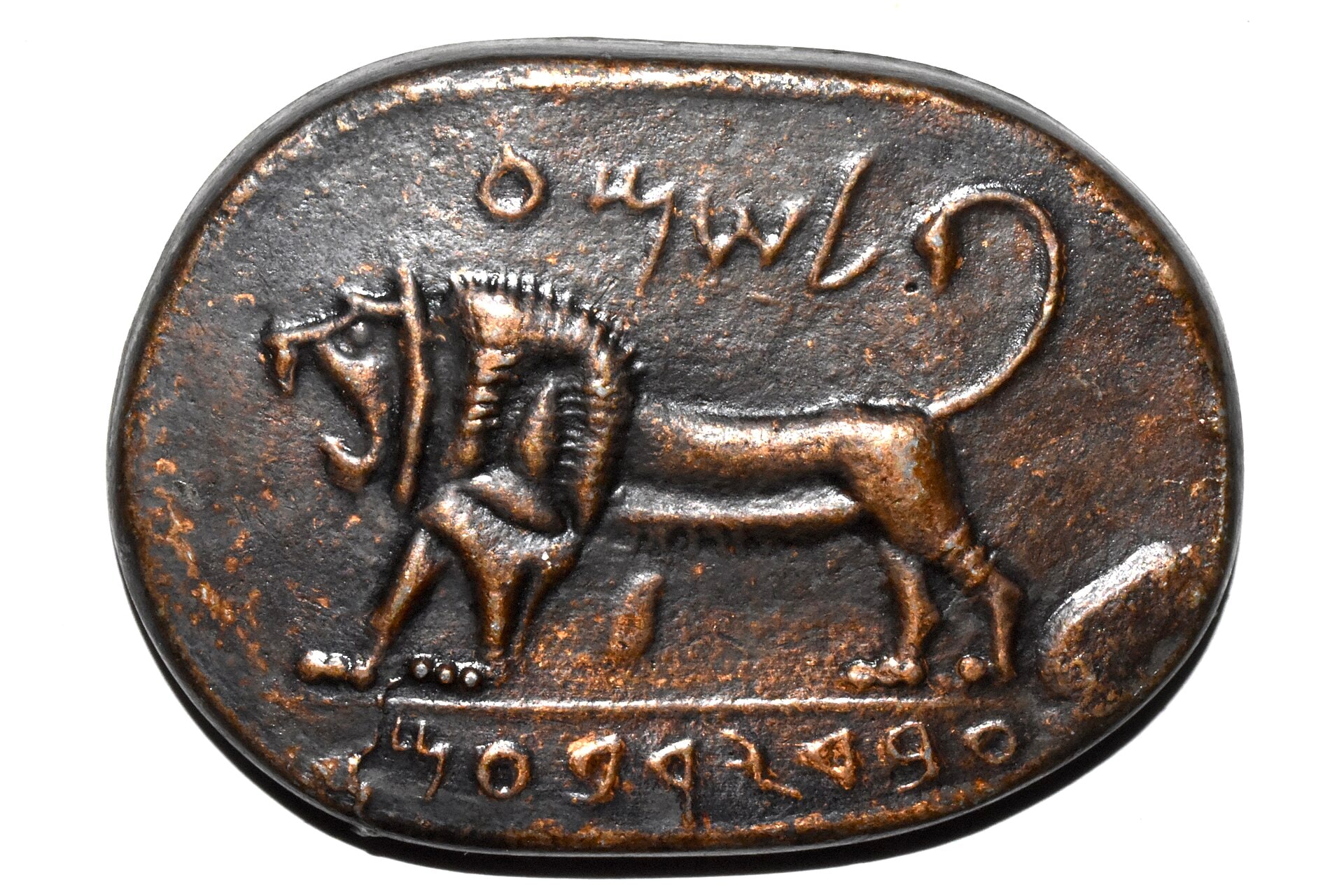
A bronze cast of the Shema seal from Megiddo, showing a roaring lion and the inscription "belonging to Shema, servant of Jeroboam." The jasper original, found in 1904, was sent to Constantinople and is now lost. Photo: Fred Cherrygarden, CC BY-SA 4.0, via Wikimedia Commons, resized.

The 30-second version:
Jeroboam II ruled Israel for about forty years in the 700s BC and restored its borders "from the entrance of Hamath unto the sea of the Arabah," as the prophet Jonah had foretold. It was a time of wealth and of injustice, and Amos and Hosea spoke against both. A seal from Megiddo naming "Shema, servant of Jeroboam" is read by most scholars as belonging to one of his officials. Within thirty years of his death the kingdom he enlarged was gone.
See this page's graph and discover linked topics
In full
Jeroboam son of Joash is the fourth king of the dynasty of Jehu. Kings gives him a reign of forty-one years in Samaria (2 Kings 14:23), which most chronologies understand to include a co-regency with his father; Lawrence Mykytiuk's chart dates him c. 790 to 750/749 BC, and Edwin Thiele's system c. 793 to 753 BC. The historian of Kings judges him evil for keeping the calf worship of Jeroboam son of Nebat (14:24), yet also says that God "saved them by the hand of Jeroboam the son of Joash" (14:27). His military success came while Aram-Damascus was weakened by Assyrian pressure and before Tiglath-Pileser III revived Assyria's westward campaigns.
The one extra-biblical object usually tied to his reign is the seal of Shema. Its identification with Jeroboam II is the majority view, and Mykytiuk includes him among the 53 Hebrew Bible persons he regards as securely identified. David Ussishkin has argued for Jeroboam I instead, on the basis of the seal's archaeological context at Megiddo.
In the Bible
- Accession. "Joash slept with his fathers; and Jeroboam sat upon his throne" (2 Kings 13:13, ASV). This is his first appearance.
- His reign. 2 Kings 14:23-29 summarizes it: forty-one years, the sins of Jeroboam son of Nebat, and a remarkable restoration of territory: "He restored the border of Israel from the entrance of Hamath unto the sea of the Arabah, according to the word of Jehovah... which he spake by his servant Jonah the son of Amittai, the prophet, who was of Gath-hepher" (14:25, ASV). The summary adds that he "recovered Damascus, and Hamath" for Israel (14:28).
- Census of the Transjordan tribes. 1 Chronicles 5:17 dates the genealogical registration of the tribe of Gad to "the days of Jotham king of Judah, and in the days of Jeroboam king of Israel" (ASV).
- Hosea. The prophet's heading places his ministry "in the days of Jeroboam the son of Joash, king of Israel" (Hosea 1:1).
- Amos. Amos prophesied "in the days of Jeroboam the son of Joash king of Israel, two years before the earthquake" (Amos 1:1). At Bethel the priest Amaziah reported him to the king: "Amos saith, Jeroboam shall die by the sword, and Israel shall surely be led away captive out of his land" (Amos 7:11, ASV). The oracle God gave Amos was "I will rise against the house of Jeroboam with the sword" (7:9, ASV), and it was fulfilled when Jeroboam's son Zechariah was assassinated after six months (2 Kings 15:8-10).
Family and lineage
- Father: Joash (Jehoash) king of Israel (2 Kings 13:13; 14:23).
- Dynasty: Jehu, Jehoahaz, Joash, Jeroboam II, Zechariah. God had promised Jehu four generations on the throne (2 Kings 10:30), and Zechariah's death ended the line exactly there (15:12).
- Son and successor: Zechariah, who reigned six months (2 Kings 14:29; 15:8).
Historical and archaeological evidence
- The seal of Shema, servant of Jeroboam. A large jasper seal (about 37 by 27 mm) found in 1904 by Gottlieb Schumacher's excavation at Megiddo. It shows a roaring lion, with the inscription "(belonging) to Shema" above and "servant of Jeroboam" below. "Servant of the king" was a title for a high royal official. The original was sent to the Ottoman sultan in Constantinople and later lost; casts survive. Most scholars, including Mykytiuk, identify the Jeroboam as Jeroboam II on the basis of the script and style. Grade: strong, with a named dissent (Ussishkin, Jeroboam I).
- The Samaria ostraca. Over a hundred inked potsherds from the royal quarter at Samaria record deliveries of wine and oil dated by regnal years. Many scholars place them in the first half of the eighth century, in or near Jeroboam's reign; they do not name the king, so they illustrate the administration of his era rather than attest him.
- Amos's earthquake. Amos dates his first oracles to "two years before the earthquake." Geologist Steven Austin and colleagues ("Amos's Earthquake," International Geology Review, 2000) argued from destruction layers at Hazor and other sites for a major mid-eighth-century earthquake; the dating of individual destruction levels remains debated among archaeologists.
Scholarly consensus
Jeroboam II's historicity is not seriously disputed. Even scholars who date much of the biblical text late, such as Israel Finkelstein, treat the first half of the eighth century as the high point of the northern kingdom and credit Jeroboam II with a major building and economic expansion; Finkelstein's The Forgotten Kingdom (2013) gives his reign particular weight. What is debated is the extent of his conquests: whether "recovered Damascus, and Hamath" describes direct rule, a sphere of influence, or tributary relations.
Theological significance
- Mercy to an unfaithful king. Kings is frank that Jeroboam continued the calf cult, yet it says God saw "the affliction of Israel, that it was very bitter" and saved them by his hand (2 Kings 14:26-27). Deliverance came as compassion for the people, not reward for the king.
- Prosperity under judgment. The wealth of his reign is the background of Amos's oracles against "beds of ivory" and the oppression of the poor (Amos 6:4; 2:6-7). The kingdom fell to Assyria about thirty years after his death, as Amos had warned.
- Jonah's other prophecy. 2 Kings 14:25 is the only place outside the book of Jonah where that prophet is named, and it anchors him as a historical figure of Jeroboam's reign.
Church Fathers
No sustained patristic comment on Jeroboam II has been verified for this page; the Fathers treat him mainly as the king named in the headings of Hosea and Amos.
Scholarship
Published academic works this page draws on, each matched to a publisher, index or library catalog record.
- Israel Finkelstein, The forgotten kingdom (2013). Open Library
See also
- People of the Bible, every person on the codex's list, by the book that first names them
- Biblical Figures Confirmed by Archaeology, Mykytiuk's list, where Jeroboam II is number 16
- Amos and Hosea, the prophets of his reign
- Jonah, the prophet whose word his conquests fulfilled
- Uzziah, his contemporary on the throne of Judah
- Menahem, who seized the throne after Jeroboam's dynasty ended
- Lawrence Mykytiuk, whose criteria grade the seal
Common questions this page answers
Q: Who was Jeroboam II in the Bible?
He was king of the northern kingdom of Israel for about forty years in the eighth century BC, son of Joash and great-grandson of Jehu. He restored Israel's borders as the prophet Jonah had foretold (2 Kings 14:25), and Amos and Hosea prophesied during his reign.
Q: Is there archaeological evidence for Jeroboam II?
Yes. A jasper seal found at Megiddo in 1904 reads "belonging to Shema, servant of Jeroboam," and most scholars, including Lawrence Mykytiuk, identify this Jeroboam as Jeroboam II. David Ussishkin dissents and argues for Jeroboam I. The original seal is lost, but casts survive.
Q: What is the difference between Jeroboam I and Jeroboam II?
Jeroboam I, son of Nebat, founded the northern kingdom around 930 BC and set up the golden calves at Bethel and Dan. Jeroboam II, son of Joash, ruled about 150 years later, in the eighth century BC, and Kings says he continued Jeroboam I's sins.
Q: Did Amos say Jeroboam would die by the sword?
That was the priest Amaziah's report of Amos's message (Amos 7:11). The oracle Amos himself gives in 7:9 is against "the house of Jeroboam," and it was fulfilled when Jeroboam's son Zechariah was assassinated (2 Kings 15:10). Kings says Jeroboam himself "slept with his fathers."