Concept
Jeanne Fretel (Lourdes 1948)
Jeanne Frétel, Jeanne Fretel, 52nd Lourdes miracle, Lourdes 52nd miracle, Fretel Lourdes healing, Frétel Lourdes healingIntro
Jeanne Fretel was a woman from Rennes, in Brittany, born in 1914. For years she had tuberculosis of the lining of the abdomen, a disease called tuberculous peritonitis. She went through operation after operation and spent long stretches in hospitals and sanatoriums. By the autumn of 1948 she was thin, feverish, on morphine every day, and expected to die.
In October 1948 she was taken to Lourdes with a pilgrimage. On 8 October she received Communion at the Mass for the Sick and was then taken to the Grotto. There her pain and fever stopped. Soon she could get up, walk and eat.
The doctors at Lourdes examined her the next day and again a year later. They found no medical explanation, a national committee of doctors agreed, and the Archbishop of Rennes declared the cure a miracle. It is the 52nd miracle officially recognized at Lourdes. She lived until 2005. The case is filed in the documented tier because it passed the Lourdes medical process.
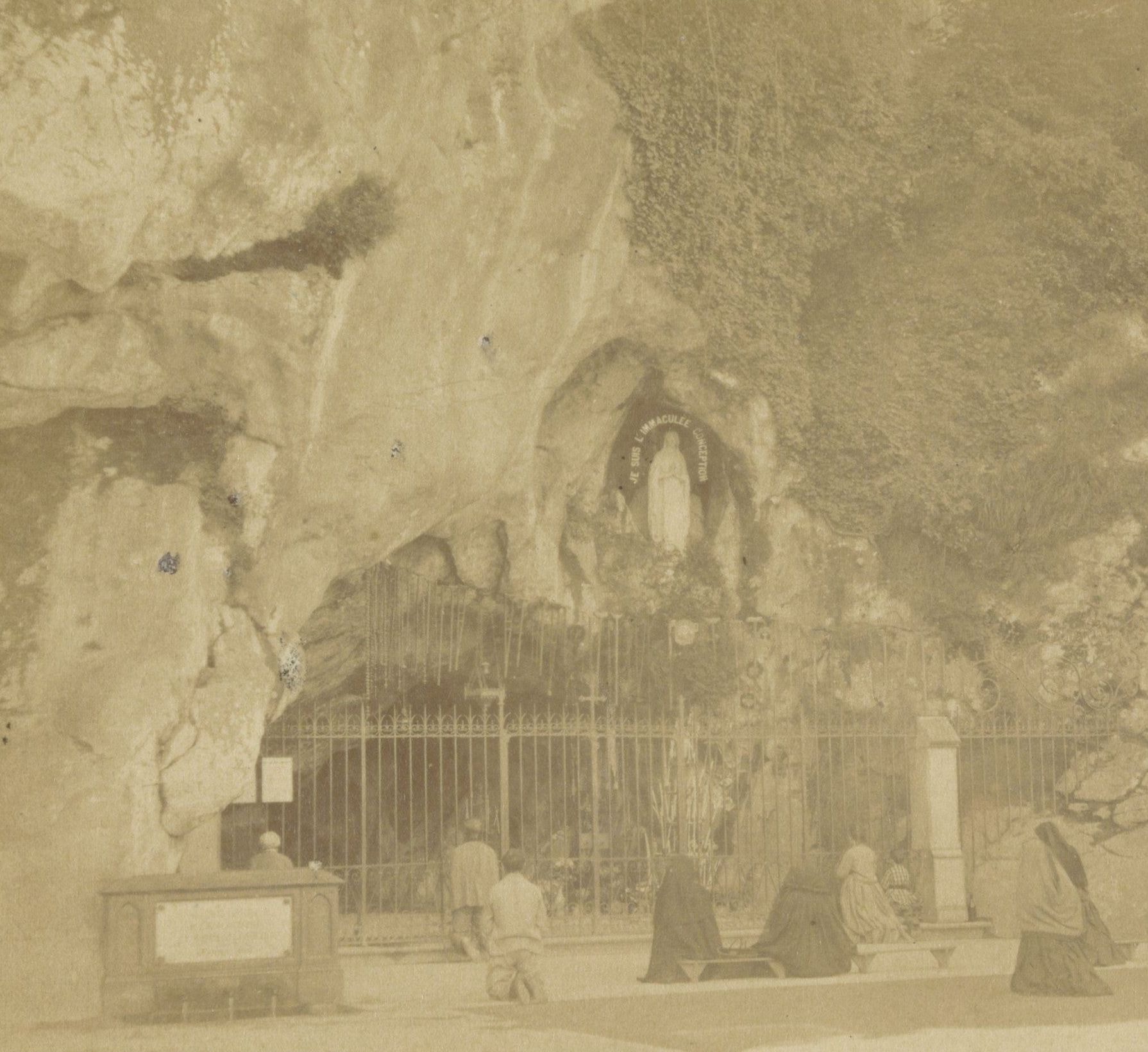
The Grotto of Massabielle at Lourdes, where Jeanne Fretel was taken after Communion on 8 October 1948, in a stereo photograph by Provost Père et Fils of Toulouse, about 1860 to 1880 (one frame of the pair shown). Photo: Provost Père et Fils, Rijksmuseum, CC0, via Wikimedia Commons, cropped.

The 30-second version: Jeanne Fretel of Rennes, born in 1914, had tuberculous peritonitis for years and was operated on again and again. By October 1948 she was emaciated, feverish and on daily morphine, and she reached Lourdes with the Rosary Pilgrimage in a dying state. On 8 October, after Communion at the Mass for the Sick, she was taken to the Grotto, and her fever and pain stopped; she got up, walked and ate. The Lourdes Medical Bureau examined her on 9 October 1948 and again on 5 October 1949 and wrote, "No explanation of this cure can be given." A national medical committee confirmed it in March 1950, and Cardinal Clément Roques, Archbishop of Rennes, declared it miraculous. The Sanctuary lists it as the 52nd Lourdes miracle, recognized 20 November 1950. She lived another 57 years.
See this page's graph and discover linked topics
In full
Jeanne Fretel was born on 25 May 1914 (Mangiapan and d'Andria, 1987, as reproduced by The Miracle Hunter) and lived in Rennes; one reference list describes her as a student nurse (Wikipedia, "Lourdes Medical Bureau"). From 1938 to 1946 she was operated on seven times for tuberculous peritonitis and spent long periods in sanatoria and hospitals (Mangiapan and d'Andria). An account adapted from her own book of interviews gives eleven years in hospital and thirteen operations (Marie de Nazareth, 2023, after Fretel, Un miracle eucharistique à Lourdes, 8 octobre 1948). Streptomycin was prescribed in April 1948, and by the autumn she was emaciated, with high fever and daily morphine, and was considered close to death (Mangiapan and d'Andria). According to the Lourdes summary, "she was dying on arriving with the Rosary Pilgrimage on 5.10.1948." On 8 October 1948, after receiving Communion at the Mass for the Sick at the altar of Saint Bernadette, she was taken to the Grotto, where the first signs of cure appeared: her abdomen returned to normal, the fever and pain stopped, and she could get up, walk and eat (Mangiapan and d'Andria). The Lourdes Medical Bureau examined her on 9 October 1948 and again on 5 October 1949 and concluded, "No explanation of this cure can be given." A National Medical Committee confirmed the inexplicable character of the cure in March 1950, and after a favourable report from his canonical commission, Cardinal Clément Roques, Archbishop of Rennes, declared the cure miraculous (Mangiapan and d'Andria). The Sanctuary's official list enters her as number 52, "Jeanne FRÉTEL from Rennes (France)," recognized 20 November 1950. Under the Miracles schema the case is Tier 1 on medical-bureau ratification. The Bureau files are not published online, and the published accounts differ on several details, set out under Tensions below.
Summary
Jeanne Fretel (1914 to 2005), of Rennes, had tuberculous peritonitis treated by repeated operations over many years. On 8 October 1948, aged 34, after receiving Communion at the Mass for the Sick at Lourdes and being taken to the Grotto, her fever and pain stopped and she rose, walked and ate. The Lourdes Medical Bureau examined her the next day and a year later and found no explanation, a national medical committee confirmed the finding in March 1950, and Cardinal Clément Roques, Archbishop of Rennes, declared the cure miraculous. It is the 52nd cure recognized as a miracle at Lourdes, under the date 20 November 1950.
The event
- The illness. She was operated on seven times between 1938 and 1946 for tuberculous peritonitis, with long stays in sanatoria and hospitals (Mangiapan and d'Andria). Her own later account, as adapted, speaks of eleven years in hospital and thirteen operations (Marie de Nazareth).
- 1948. Streptomycin was prescribed in April 1948. By the autumn she was emaciated, needed morphine every day, had a high fever, and was considered near death (Mangiapan and d'Andria). The adapted account says her doctor asked for a coffin to be ordered, expecting she would not come back (Marie de Nazareth).
- Arrival. She came to Lourdes with the Rosary Pilgrimage on 5 October 1948, "dying on arriving" (Mangiapan and d'Andria). The adapted account says she had been in a coma for three months and eight days and did not know she was at Lourdes (Marie de Nazareth).
- 8 October 1948, the Mass for the Sick. She received Communion at the Mass for the Sick at the altar of Saint Bernadette (Mangiapan and d'Andria). In her own words, as adapted: "When I closed my mouth, I suddenly opened my eyes and asked where I was" (Marie de Nazareth). The same account says a priest opened her mouth with a spoon to give her Communion.
- At the Grotto. She was taken to the Grotto, where the first signs of cure appeared (Mangiapan and d'Andria); by her own account she had asked to go there after Communion (Marie de Nazareth). She later said, "At the grotto, I had the impression that someone was taking me under the arms to sit me down," and, "I turned around, but no one was there" (Marie de Nazareth).
- The change. Her abdomen returned to normal, the fever and pain stopped, and she could get up, walk and eat (Mangiapan and d'Andria).
- The Medical Bureau. The Bureau examined her on 9 October 1948 and again on 5 October 1949, and concluded, "No explanation of this cure can be given" (Mangiapan and d'Andria).
- The National Medical Committee. In March 1950 it confirmed the inexplicable character of the cure (Mangiapan and d'Andria).
- The declaration. After his canonical commission reported favourably, Cardinal Clément Roques, Archbishop of Rennes from 1940 to 1964, declared the cure miraculous; the Lourdes summary and the Sanctuary's list both give 20 November 1950.
- Afterward. She lived another 57 years and died in 2005 (Marie de Nazareth). She gave her own account in a book of interviews and testimonies, Un miracle eucharistique à Lourdes, 8 octobre 1948, published by Éditions F.-X. de Guibert.
Witnesses + documentation
- Jeanne Fretel, the patient, who gave her own account in a published book of interviews.
- The Rosary Pilgrimage that brought her to Lourdes in October 1948; its members are not named in the accounts found.
- The priest who gave her Communion at the Mass for the Sick, unnamed in the accounts found.
- Her doctor in Rennes, who by her account expected her to die on the journey; unnamed in the accounts found.
- The Lourdes Medical Bureau, which examined her on 9 October 1948 and 5 October 1949.
- The National Medical Committee, which confirmed the finding in March 1950.
- Cardinal Clément Roques, Archbishop of Rennes (1940 to 1964, cardinal from 1946), who declared the cure miraculous after a favourable report from his canonical commission.
Verification
What was checked:
- The recognition. The Sanctuary of Lourdes' official list of recognized cures enters "Jeanne FRÉTEL from Rennes (France)" as number 52, with "Date of recognition : 20th November 1950." The Lourdes summary reproduced by The Miracle Hunter gives the same date for Cardinal Roques' recognition.
- The date of the cure. The Lourdes summary, the adapted account of her book, and a French reference list ("Jeanne Frétel de Rennes guérie à 34 ans le 8 octobre 1948 d'une péritonite tuberculeuse") all give 8 October 1948.
- Her age. Born 25 May 1914, she was 34 on 8 October 1948, which matches the French list ("à 34 ans"), the Lourdes summary ("in her 35th year"), and the adapted account ("aged 34").
- The archbishop. Clément-Émile Roques was Archbishop of Rennes from 11 May 1940 until his death on 4 September 1964, and a cardinal from 18 February 1946, so he held the see in 1950 (Catholic-Hierarchy).
- The diagnosis. The Lourdes summary, the French list and the Wikipedia summary all give tuberculous peritonitis.
- Durability. She lived until 2005, 57 years after the cure.
Naturalistic explanations considered:
- Streptomycin. This is the strongest natural explanation, and it should be faced squarely. Streptomycin, the first effective drug against tuberculosis, was prescribed for her in April 1948, about six months before the cure. A delayed response to the drug could in principle explain recovery from tuberculous peritonitis. Against it, the Lourdes summary records that six months into that treatment she was still emaciated, febrile and on daily morphine, and that the change came within a day, with the Bureau examining her on the morning after. The Bureau and the National Medical Committee, who had the records, judged the cure inexplicable. Their reports are not public, so an outside reader cannot check how they weighed the streptomycin.
- Suggestion. Suggestion can relieve pain for a time. It does not account for a dying, emaciated patient with long-standing abdominal tuberculosis rising, eating normally, and remaining well for 57 years.
- Spontaneous remission. Tuberculous disease can become inactive. The reported speed and the durability over half a century are what the medical review found exceptional.
Caveats and remaining uncertainties:
- No published report. No Bureau file or committee report has been found online. The clinical picture rests on the Lourdes summary and on her own later account.
- Her own account is indirect. Her quoted words come from an English-language adaptation of her book, not from the book itself, which was not available for checking.
- Unnamed witnesses. The priest, her doctor in Rennes and the Bureau physicians are not named in the accounts found.
Tensions
The published accounts differ on several points. They are recorded here, attributed, without choosing a winner.
- Recognition date. The Sanctuary's list and the Lourdes summary give 20 November 1950. The Wikipedia summary gives 11 November 1950. The adapted account of her book gives 8 December 1949.
- Date of the visit. The Lourdes summary and the adapted account place her at Lourdes in October 1948 (arrival 5 October, cure 8 October). The Wikipedia summary gives "Visited Lourdes: 10 May 1948."
- Her age. Born 25 May 1914, she was 34 at the cure, as most sources say; the Wikipedia summary gives 31.
- Length of illness and number of operations. The Lourdes summary gives seven operations between 1938 and 1946; the Wikipedia summary gives "complications for seven years"; the adapted account of her book gives eleven years in hospital and thirteen operations.
- Coma. The adapted account says she arrived in a coma of three months and eight days. The Lourdes summary says only that she was dying on arrival and does not mention a coma.
Apologetic value
- A dying patient, not a mild complaint. By the medical summary she was emaciated, febrile, on daily morphine and expected to die. Her recovery began within the day and was examined the next morning.
- The obvious natural cause was checked. She was already on streptomycin, and the doctors knew it. A finding of "no explanation" made with the drug in view is a stronger finding than one made in ignorance of it, though the reasoning is not published.
- Durable for 57 years. A temporary rally does not explain half a century of life.
- Passed the strictest filter available. Lourdes has recognized only about seventy cures in more than a century and a half; this one went through the Medical Bureau twice and a national committee before the archbishop acted.
- Read in biblical terms. She had "suffered many things of many physicians" and "was nothing bettered, but rather grew worse" (Mark 5:26). The cure fits Jesus' answer to John the Baptist, "the lame walk" (Matthew 11:5). Catholic recognition attributes the cure to the intercession of Our Lady of Lourdes and links it with the Eucharist she had just received; Protestant readers will attribute it to God answering prayer. Both agree that the healing comes from God.
- Honest limits. The files are not public, the witnesses are unnamed, and the sources disagree on dates and details. Use it as one strand in a cumulative case, not as a stand-alone proof. See Argument from Miracles.
- How to deploy it. Lead with the medical state the summary records: years of abdominal tuberculosis, repeated surgery, morphine, a high fever, and a patient expected to die. Then concede the streptomycin openly, note that the doctors judged the cure inexplicable with that drug in view, and ask what explains a turn from dying to walking and eating within a day that lasted 57 years.
See also
- Miracles, master hub
- _schema, the vetting standard this entry follows
- Lourdes Medical Bureau, the body that examined the case
- Bernadette Soubirous, the visionary of Lourdes
- Marie Bailly (Lourdes 1902), another tuberculous peritonitis cured at Lourdes, witnessed by Alexis Carrel
- Elisa Aloi (Lourdes 1958), another tuberculous illness cured at Lourdes, in the bones of the leg
- Edeltraud Fulda (Lourdes 1950), a cure from the same years of Lourdes recognitions
- Argument from Miracles, the argument this case supports
- David Hume, whose standard for credible miracle testimony this case presses on
- Naturalism, the worldview such cases press against
Common questions this page answers
Q: What was the 52nd miracle of Lourdes?
It was the cure of Jeanne Fretel of Rennes, France, from tuberculous peritonitis. She was cured at Lourdes on 8 October 1948 after receiving Communion at the Mass for the Sick, and the Sanctuary lists the cure as recognized on 20 November 1950.
Q: Who was Jeanne Fretel?
She was a French woman from Rennes, born on 25 May 1914, who had tuberculosis of the abdominal lining for years and many operations. She was cured at Lourdes in 1948, aged 34, told her story in a book of interviews, and died in 2005.
Q: How was Jeanne Fretel's cure investigated?
The Lourdes Medical Bureau examined her the day after the cure and again a year later and found no explanation. A national medical committee confirmed the finding in March 1950, and Cardinal Clément Roques, Archbishop of Rennes, declared the cure miraculous after his canonical commission reported favourably.
Q: Could streptomycin explain Jeanne Fretel's recovery?
It is the main natural explanation, since the drug was prescribed for her in April 1948. Against it, six months later she was still emaciated, feverish and on morphine, and the change came within a day at Lourdes. The doctors who had her records judged the cure inexplicable, though their reports are not published.