Concept
Jake Finkbonner (Kateri Tekakwitha 2006)
Jake Finkbonner, Finkbonner healing, Kateri Tekakwitha canonization miracle, Kateri canonization miracle, Saint Kateri miracleIntro
Jake Finkbonner was a five-year-old Lummi boy from Ferndale, Washington. On 11 February 2006, in the last basketball game of his season, he fell and cut his lip on the base of a portable hoop. Bacteria got into the cut. Within days he had necrotizing fasciitis, a fast-moving infection that destroys flesh, and it spread across his face. He was flown to Seattle Children's Hospital, and for about two weeks his doctors could not stop it. A priest gave him last rites.
The family's priest urged them to pray for the help of Blessed Kateri Tekakwitha, a seventeenth-century Mohawk and Algonquin woman revered by Native American Catholics. A relic of Kateri was brought to his bedside. The family says the infection stopped spreading that same day, and Jake went home about nine weeks after he was admitted, after 29 operations.
The Catholic Church investigated his recovery for years, interviewed his doctors and read his medical records. On 19 December 2011 Pope Benedict XVI approved it as a miracle, and on 21 October 2012 Kateri was declared a saint, the first Native American saint. It is filed in the documented tier because it passed the full Vatican canonization process.
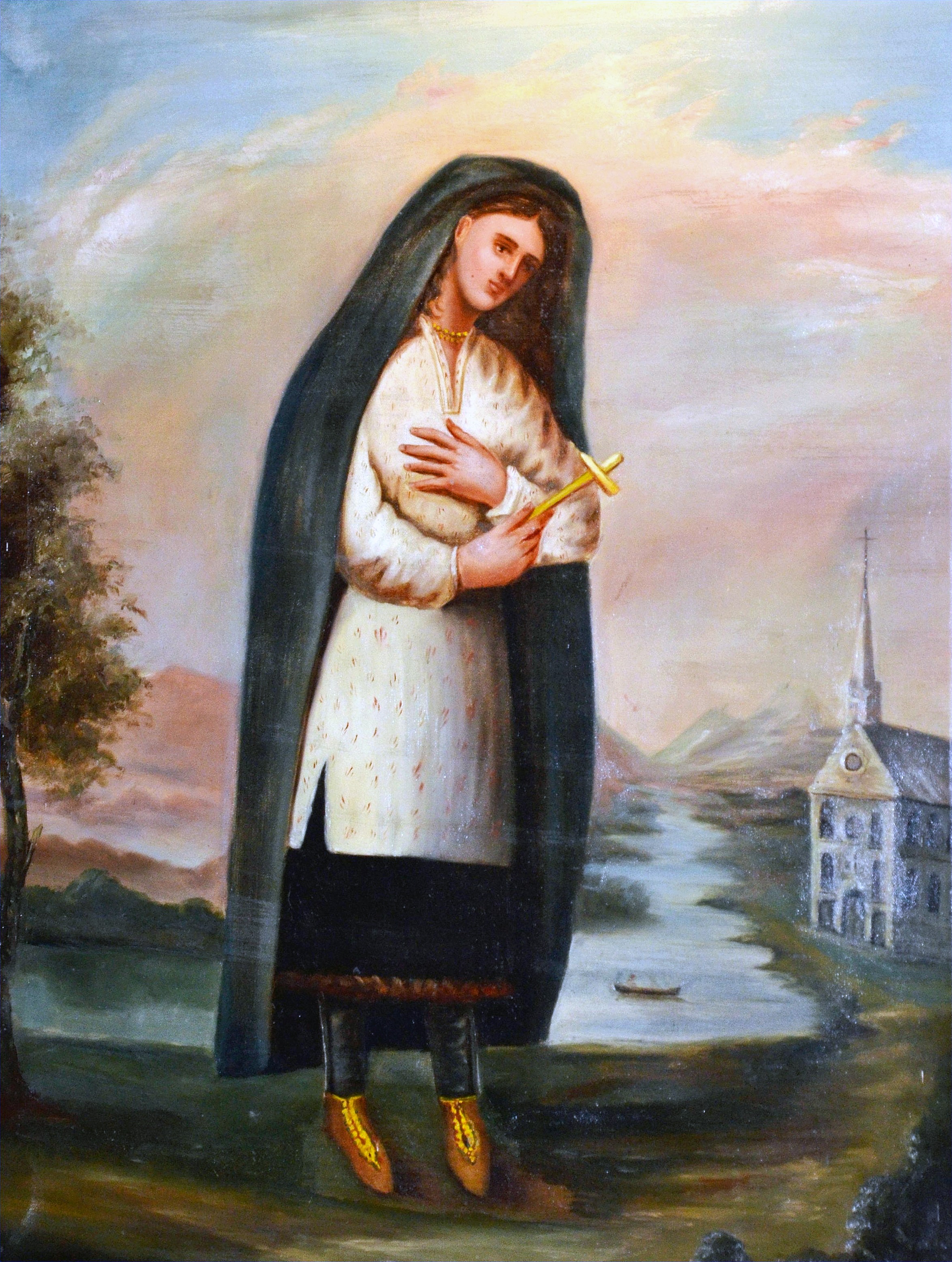
Kateri Tekakwitha, whose intercession the Finkbonner family sought. Painting attributed to Joseph Légaré, 1843. Public domain, via Wikimedia Commons, resized.

The 30-second version:
In February 2006 a five-year-old Washington boy, Jake Finkbonner, cut his lip in a basketball game and developed necrotizing fasciitis from Strep A. For about two weeks surgeons removed infected flesh daily at Seattle Children's Hospital while the infection kept advancing, and he was given last rites. His family and parish prayed for the intercession of Blessed Kateri Tekakwitha, and a relic of hers was placed with him. The family reports that the infection stopped advancing that day. He survived after 29 surgeries. A church panel that included a physician interviewed his treating doctors, and Pope Benedict XVI approved the recovery as a miracle on 19 December 2011, clearing Kateri's canonization on 21 October 2012. Survival from this infection is possible with surgery, and the published reports are thin on medical detail, so the strength of the case rests on the Vatican process.
See this page's graph and discover linked topics
In full
The case is the canonization miracle of Kateri Tekakwitha (1656 to 1680), beatified by Pope John Paul II in 1980 and canonized by Pope Benedict XVI on 21 October 2012 together with six others (Associated Press, 20 October 2012). The patient, Jake Finkbonner, son of Elsa Finkbonner and Donny Finkbonner, a member of the Lummi Nation, injured his mouth on the base of a portable basketball hoop on Saturday 11 February 2006 (McClatchy, 20 December 2011). The wound was infected with Group A streptococcus and progressed to necrotizing fasciitis, which damaged his head, neck and chest (NBC News, 20 December 2011). He was airlifted to Seattle Children's Hospital two days later, received last rites on the Wednesday, and spent most of roughly two weeks of unsuccessful treatment in a drug-induced coma (Associated Press, 2012). Surgeons removed dead tissue daily, and he had hyperbaric oxygen treatment daily for two weeks at Virginia Mason Medical Center (McClatchy). At the urging of the family's priest, Father Tim Sauer, the family and many others prayed for Kateri's intercession, and a relic of Kateri was brought to his bedside. The family reports that the infection stopped progressing from that point. He was discharged after about nine weeks, having had 29 surgeries in all (McClatchy; Associated Press). With the approval of Archbishop Alex J. Brunett of Seattle, a church panel including a physician and a canon lawyer interviewed community members and the treating doctors, and the findings went to the Congregation for the Causes of Saints (NBC News, 2011). Pope Benedict XVI signed the decree recognizing the miracle on 19 December 2011. Conflicts among the published accounts, chiefly over how the relic arrived and which day the turn came, are recorded under Tensions. Under the Miracles schema the case is Tier 1 on Vatican canonization ratification.
Summary
Jake Finkbonner, a five-year-old from Ferndale, Washington, developed necrotizing fasciitis after cutting his lip on 11 February 2006. Treated at Seattle Children's Hospital with daily surgery and hyperbaric oxygen, he remained critical for about two weeks, received last rites, and was not expected to live. His family and parish prayed for the intercession of Blessed Kateri Tekakwitha, a relic of Kateri was placed with him, and by the family's account the infection stopped spreading that day. He survived after 29 surgeries and was discharged about nine weeks after admission. After an inquiry authorized by the Archbishop of Seattle, the Congregation for the Causes of Saints accepted the recovery as medically unexplained, Pope Benedict XVI approved it on 19 December 2011, and Kateri was canonized in Rome on 21 October 2012.
The event
- The injury. On Saturday 11 February 2006, at a Boys & Girls Club basketball game, Jake fell and hit his mouth on the base of a portable hoop (NBC News, 2011; McClatchy, 2011).
- The infection. Group A streptococcus entered the cut and caused necrotizing fasciitis. It spread from the lip across his face and damaged his head, neck and chest (NBC News, 2011).
- Seattle Children's Hospital. He was airlifted there two days after the injury. On the Tuesday doctors told his parents his condition was critical (Canadian Catholic News, 2012), and on the Wednesday he received last rites (Associated Press, 2012). His parents discussed donating his organs (Associated Press, 2012).
- Treatment. Surgeons removed damaged flesh each day, and he received hyperbaric oxygen daily for two weeks at Virginia Mason Medical Center (McClatchy, 2011). He spent most of this period in a drug-induced coma (Associated Press, 2012). The family reports being told, "If you are praying people, you need to pray" (NBC News, 2011).
- The prayer. Father Tim Sauer, a family friend who then pastored three Whatcom County churches, one of them a predominantly Native parish, and was familiar with Kateri, urged the family to ask for her intercession. Friends, neighbours and strangers joined in (NBC News, 2011; McClatchy, 2011).
- The relic. A relic of Kateri was brought to his bedside. The accounts differ on how (see Tensions). His mother said the day the relic came was the last day the infection progressed (Canadian Catholic News, 2012).
- Recovery. He was discharged about nine weeks after admission, with skin grafts and many reconstructive operations, 29 surgeries in all (NBC News, 2011; McClatchy, 2011; Associated Press, 2012). He later said that during the illness he saw Jesus and his late godfather, and was told he had to return to his family (Canadian Catholic News, 2012).
- Later life. By 2012 he was a healthy seventh-grader at Assumption Catholic School in Bellingham who still played basketball, and he attended the canonization in Rome with his family (Canadian Catholic News, 2012).
Witnesses + documentation
- Jake Finkbonner, the patient, and his parents Elsa and Donny Finkbonner, who submitted information to the Church in 2006 (McClatchy, 2011).
- Father Tim Sauer, the family's priest, who wrote to the Archbishop of Seattle describing the possible miracle and later told reporters that the doctors had no clear medical explanation for the turnaround (NBC News, 2011).
- The treating physicians at Seattle Children's Hospital, interviewed by the church panel. They are not named in the published reports reviewed here.
- Archbishop Alex J. Brunett of Seattle, who approved the inquiry (Canadian Catholic News, 2012).
- The diocesan panel, which included a physician and a canon lawyer and took testimony in Ferndale and Seattle (NBC News, 2011).
- Monsignor Paul A. Lenz, vice postulator of Kateri's cause, who confirmed the link to Jake and said of the doctors, "They didn't think any of their medical expertise was the cure" (McClatchy, 2011).
- Greg Magnoni, spokesman for the Archdiocese of Seattle, who described the process as akin to a civil trial (McClatchy, 2011).
- The Congregation for the Causes of Saints and Pope Benedict XVI, decree of 19 December 2011.
- Published record:
- "Boy's survival of flesh-eating bacteria deemed miracle by his family, Pope," NBC News, 20 December 2011.
- Kie Relyea, "Pope calls Bellingham boy's recovery a 'miracle'," McClatchy Newspapers, via HeraldNet, 20 December 2011.
- Eric W. Mauser, "Boy's recovery a Kateri miracle," Canadian Catholic News, via The Catholic Register, 20 October 2012.
- Nicole Winfield, "Boy's miracle cure makes 'Lily of the Mohawks' first Native American saint," Associated Press, via NBC News, 20 October 2012.
Verification
What was checked:
- The diagnosis and its gravity. Necrotizing fasciitis is a named, culture-confirmable infection, and the severity is shown by what was done: daily surgical removal of tissue, daily hyperbaric oxygen, a drug-induced coma, last rites, and 29 operations in total. These details agree across a secular wire service, a regional newspaper and the Catholic press.
- A formal medical inquiry. The church panel included a physician, interviewed the treating doctors and received the medical records (NBC News, 2011; McClatchy, 2011). A canonization miracle must then pass the Congregation's own medical board before the theologians and the Pope consider it.
- Timing. The recovery dates from February 2006; the decree came nearly six years later. The family's account and the Church's finding were both in place before the canonization was scheduled.
Naturalistic explanations considered:
- Successful treatment. This is the strongest natural explanation. Necrotizing fasciitis is treated with aggressive surgical removal of infected tissue, antibiotics and, in some centres, hyperbaric oxygen, and some patients survive with that care. Jake received all of it. His mother herself said, "We know Jake would not be here if those doctors were not so fabulous" (NBC News, 2011). Against it, the reported medical view is that the infection had been advancing despite that treatment and that the doctors could not explain why it stopped when it did (NBC News, 2011; McClatchy, 2011).
- Coincidence of timing. A turning point after many days of daily surgery could in principle have come at any time. The miracle claim rests partly on the timing matching the prayer and the relic, and the accounts disagree on the exact day (see Tensions).
Caveats and remaining uncertainties:
- The medical file is not public. None of the sources reviewed here prints the hospital records, the culture results, or the report of the Vatican medical board.
- The doctors speak only through others. Every statement attributed to the treating physicians is reported by the family, Father Sauer or Monsignor Lenz. No treating physician is quoted by name in the reports reviewed.
- No independent skeptical analysis was found. A search turned up no published critique of this case, and no independent medical reanalysis either.
Tensions
The published accounts conflict on several points. They are recorded here, attributed, without choosing a winner.
- How the relic arrived. NBC News (December 2011) reports that on the ninth day of his hospitalization a relic arrived from the national office of the Tekakwitha Conference in Great Falls, Montana, and was placed on a pillow beside his head. Canadian Catholic News and the Associated Press (October 2012) report instead that a nun named Sister Kateri, brought in by Jake's great-aunt, prayed with the family and placed a relic she carried on his bed (Canadian Catholic News) or on his leg (Associated Press).
- Which day the turn came. NBC News (2011) places the unexpected improvement on the ninth day of hospitalization, the day the relic arrived. The Associated Press (2012) says the infection stopped the day after the nun's visit, and that the family connected the timing only years later. Canadian Catholic News (2012) quotes his mother that the day of the visit was the last day the disease progressed, and says recovery began after about two weeks of surgery.
- What the doctors said. Sister Kateri is quoted as having heard that the doctors called the recovery "beyond any medical intervention" (Canadian Catholic News, 2012). Father Sauer's version is more cautious: the doctors told the investigators they had no clear medical explanation (NBC News, 2011).
- The year. A 2017 Aleteia feature gives the year of the illness as 2012, against 2006 in every contemporaneous report and in the date of the papal decree. The 2006 date is the one the record supports.
Apologetic value
- A canonization miracle in an American hospital. The recovery took place in a major children's hospital, under daily surgical care, with the records available to investigators. It is not a shrine cure or a remote village report.
- Answered prayer at a precise moment. The claim is not that medicine failed entirely but that an infection advancing despite full treatment stopped when a community prayed. That is the shape of the biblical promise, "the prayer of faith shall save him that is sick, and the Lord shall raise him up" (James 5:15, ASV).
- Honest limits. The strongest natural explanation, survival through aggressive treatment, is real, and the published record is thin on medical detail. The case should be deployed as one strand in a cumulative case, not as a stand-alone proof. See Argument from Miracles.
- How to deploy it. Lead with the documented facts: the injury date, the diagnosis, the daily surgery and hyperbaric oxygen, last rites, and the reported inability of the doctors to explain the turn. Concede openly that the accounts differ on the relic and the exact day. The recognition is Catholic and attributes the cure to Kateri's intercession; for a Protestant audience, present the medical facts and the answered prayer of a praying family and parish, and let the audience weigh the setting.
See also
- Miracles, master hub
- _schema, the vetting standard this entry follows
- Matteo Pio Colella (Padre Pio 2000), another child's recovery from an overwhelming infection accepted as a canonization miracle
- Marcilio Andrino (Mother Teresa 2008), a canonization miracle in which a relic was placed on the patient
- Melissa Villalobos (Newman 2013), another American canonization miracle from the same era
- Argument from Miracles, the argument this case supports
- David Hume, whose standard for credible miracle testimony this case presses on
- Naturalism, the worldview such cases press against
Common questions this page answers
Q: What was the miracle that made Kateri Tekakwitha a saint?
It was the recovery of Jake Finkbonner, a five-year-old Lummi boy from Ferndale, Washington, from necrotizing fasciitis in 2006. His family and parish prayed for Kateri's intercession, and a relic of hers was placed with him at Seattle Children's Hospital. Pope Benedict XVI approved the recovery as a miracle on 19 December 2011, and Kateri was canonized on 21 October 2012.
Q: What happened to Jake Finkbonner?
On 11 February 2006 he cut his lip on the base of a basketball hoop, and the wound became infected with Strep A, causing necrotizing fasciitis across his face. He was critical for about two weeks despite daily surgery and hyperbaric oxygen, and was given last rites. He survived after 29 surgeries and left the hospital about nine weeks after admission.
Q: How did the Church investigate the Finkbonner healing?
With the approval of Archbishop Alex J. Brunett of Seattle, a panel that included a physician and a canon lawyer interviewed the treating doctors and people in the community and received the medical records. The findings went to the Congregation for the Causes of Saints in Rome, which accepted the recovery as medically unexplained before the Pope signed the decree.
Q: Could Jake Finkbonner have survived through medical treatment alone?
That is the main natural explanation. Some patients do survive necrotizing fasciitis with aggressive surgery and antibiotics, and he received full treatment. The reported view of his doctors is that the infection had been advancing despite that treatment and that they could not explain why it stopped when it did. The medical file has not been published.
Q: Was Kateri Tekakwitha the first Native American saint?
Yes. Kateri Tekakwitha, born in 1656 to a Mohawk father and an Algonquin mother and died in 1680 near Montreal, was beatified in 1980 and canonized on 21 October 2012, the first Native American to be declared a saint.