Concept
Israel 1948 and Prophecy
Israel 1948, Israel in prophecy, Israel 1948 prophecy, Is Israel a fulfillment of prophecy, Israel fulfilled prophecy, modern Israel and Bible prophecy, rebirth of Israel prophecy, nation born in a day, 1948 prophecy, Christian Zionism, Dispensationalism and Israel, Religious ZionismIntro
On 14 May 1948, David Ben-Gurion read Israel's Declaration of Independence in Tel Aviv. For the first time in almost nineteen centuries there was an independent Jewish state in the land of Israel. Many Christians and many Jews saw the hand of God in it. Others, including many devout Christians and some of the most observant Jews, did not read it as the fulfilment of prophecy at all.
The Bible has several prophecies about God gathering the scattered people of Israel back to their land. The question is which return they mean: the return from Babylon in the 500s BC, the modern return that produced the State of Israel, a future gathering still to come, or the gathering of Jews and Gentiles into Christ.
This page sets out the main answers side by side: dispensational, historic premillennial, covenantal and amillennial, Jewish religious views on both sides of the Zionism question, and the secular historian's view. It gives each its strongest case and does not declare a winner.
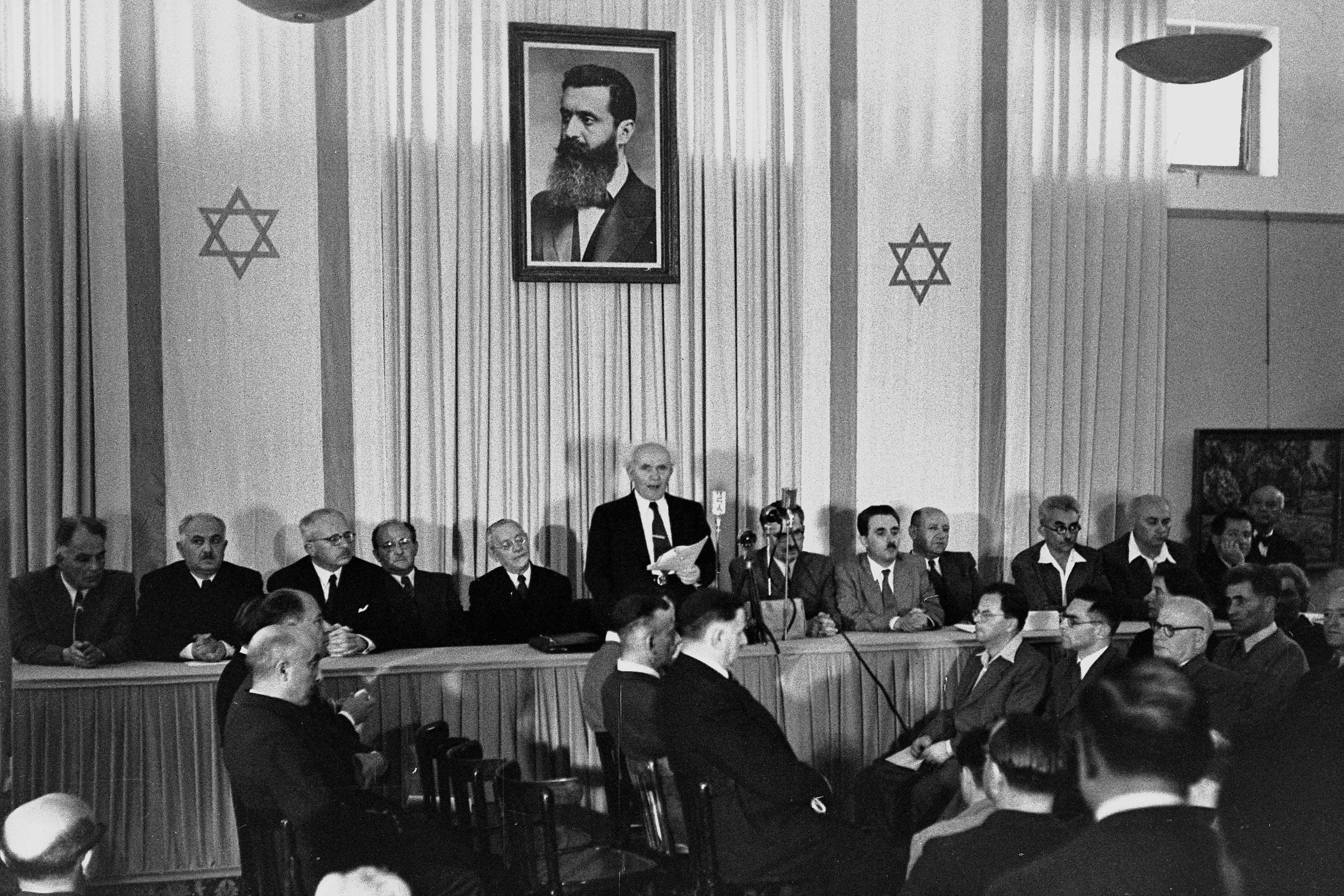
David Ben-Gurion reads the Declaration of the Establishment of the State of Israel, 14 May 1948, in the Tel Aviv Museum hall on Rothschild Boulevard, beneath a portrait of Theodor Herzl. Photo: Rudi Weissenstein, National Photo Collection of Israel, Government Press Office (D247-041), public domain, via Wikimedia Commons, resized.

See this page's graph and discover linked topics
In full
The interpretive question concerns the restoration texts of the Hebrew prophets (Isaiah 11:11-12, Isaiah 66:8, Jeremiah 16:14-15, Ezekiel 36-37, Amos 9:14-15), read together with Paul's teaching on Israel in Romans 11:25-29 and Jesus' saying in Luke 21:24 that "Jerusalem shall be trodden down of the Gentiles, until the times of the Gentiles be fulfilled."
Three exegetical decisions separate the positions. First, referent: whether the gathering is the post-exilic return under Cyrus (538 BC onward), a later return, or the ingathering of the nations into the Messiah's people. Second, fulfilment mode: whether land promises to ethnic Israel are fulfilled literally and territorially, typologically in Christ and the church, or both. Third, sequence: whether the prophets envisage a return in unbelief followed by spiritual renewal (a reading drawn from Ezekiel 36:24-27 and the two stages of the dry bones in Ezekiel 37:7-10), or a return that follows repentance (Deuteronomy 30:1-5).
Two further layers matter. Within Judaism, the question is whether a human-led political return before the Messiah is a stage of redemption (Religious Zionism) or a rebellion against it (Haredi anti-Zionism). Outside faith altogether, historians explain 1948 by the rise of Jewish nationalism, European antisemitism and the Holocaust, British and United Nations decisions, and the outcome of a war.
The broader doctrine of Israel's election is treated on Israel and the Church, which sets out the case from Romans 11:29 that God's gifts and calling to Israel are irrevocable. That conviction does not settle whether 1948 is a fulfilment of prophecy, and traditions that share it still differ on this question.
The historical facts
- Before 1948. Theodor Herzl published Der Judenstaat in 1896 and convened the First Zionist Congress at Basel in 1897. The Balfour Declaration of 2 November 1917 committed Britain to "a national home for the Jewish people" in Palestine, which Britain governed under a League of Nations Mandate from the early 1920s. On 29 November 1947 the United Nations General Assembly adopted Resolution 181, recommending partition into a Jewish and an Arab state.
- 14 May 1948. The Declaration of the Establishment of the State of Israel was read in Tel Aviv on the afternoon of 14 May, a few hours before the British Mandate ended at midnight. The United States extended de facto recognition the same day, and the Soviet Union recognised Israel de jure three days later. Armies of neighbouring Arab states entered the territory on 15 May.
- The war and its people. In the 1947-1949 war, around 700,000 Palestinian Arabs fled or were expelled from the territory that became Israel, an event Palestinians call the Nakba ("catastrophe"). In the years that followed, several hundred thousand Jews left or were driven from Arab and Muslim countries, most of them settling in Israel. The Law of Return (1950) granted every Jew the right to immigrate.
- 1967. In the Six-Day War of 5-10 June 1967, Israel took the Sinai, Gaza, the West Bank, the Golan Heights and East Jerusalem, including the Old City and the Temple Mount, captured on 7 June.
These facts are common ground. Their meaning is what the positions below dispute, and the political questions they raise lie outside the scope of this page.
The texts
| Text | What it says (ASV) | The interpretive question |
|---|---|---|
| Isaiah 11:11-12 | "the Lord will set his hand again the second time to recover the remnant of his people... from the four corners of the earth" | Is the "second time" the return from Babylon (the Exodus being the first), or a later return (Babylon being the first)? |
| Isaiah 66:8 | "Shall a land be born in one day? shall a nation be brought forth at once? for as soon as Zion travailed, she brought forth her children" | A single-day national birth (1948), or Zion's sudden repopulation in the restoration? |
| Jeremiah 16:14-15 | Israel will swear by the God who "brought up the children of Israel from the land of the north, and from all the countries whither he had driven them" | Babylon (the land of the north), or a worldwide dispersion? |
| Ezekiel 36:24 | "I will take you from among the nations, and gather you out of all the countries, and will bring you into your own land" | Followed in verses 25-27 by cleansing and a new heart: return before renewal, or with it? |
| Ezekiel 37:1-14, 21-22 | The dry bones; "I will make them one nation in the land... and one king shall be king to them all" | Who is the one king (the Davidic Messiah, verse 24), and when are the two kingdoms reunited? |
| Amos 9:14-15 | "I will plant them upon their land, and they shall no more be plucked up out of their land" | The post-exilic return was followed by a second dispersion in AD 70-135; so does the promise point beyond it? |
| Romans 11:25-29 | "a hardening in part hath befallen Israel, until the fulness of the Gentiles be come in; and so all Israel shall be saved... the gifts and the calling of God are not repented of" | A future turning of ethnic Israel, the elect of Israel across history, or the whole people of God? Does it involve the land at all? |
| Luke 21:24 | "Jerusalem shall be trodden down of the Gentiles, until the times of the Gentiles be fulfilled" | Does "until" imply an end to Gentile control, and is 1967 that end? |
The positions
Dispensational: fulfilment, or the first stage of it
- Claim. God's promises of land and nationhood to ethnic Israel are unconditional and will be fulfilled literally. The modern return is the beginning of the end-time regathering, a return largely in unbelief that precedes a national turning to the Messiah (Ezekiel 36-37 read in sequence; Zechariah 12:10; Romans 11:26).
- Key moves. The "second time" of Isaiah 11:11 is the modern return, since the Babylonian return gathered from one region, not "the four corners of the earth." Amos 9:15's "no more be plucked up" was not fulfilled after 538 BC, because Israel was uprooted again by Rome, so it points to a later, final return. Luke 21:24's "until" implies a terminus to Gentile rule over Jerusalem, which many dispensationalists connected with 1967.
- Representatives. John Nelson Darby and the Scofield Reference Bible (1909) shaped the system; John F. Walvoord, Israel in Prophecy (1962), applied it to the modern state. Progressive dispensationalists, such as Craig Blaising and Darrell Bock, Progressive Dispensationalism (1993), keep a distinct future for national Israel while reading Israel and the church as more closely united.
- Strength. It takes the land promises and the "no more be plucked up" clause at their most natural reading, and it explains why Paul, writing after the cross, still speaks of Israel's irrevocable calling.
- Cautions raised from within. Date-setting from 1948 has a poor record. Hal Lindsey's The Late Great Planet Earth (1970) linked the generation of Matthew 24:34 to the generation that saw Israel's rebirth, and the expectations of the late 1980s built on that reckoning passed. Many dispensational scholars now distinguish carefully between affirming a future for Israel and identifying the present state, with its politics, as prophetic fulfilment.
Historic premillennial: a future for Israel, caution about 1948
- Claim. Christ will return before a millennial reign, and many in this tradition expect a future large-scale turning of Jews to Christ (Romans 11:26). The church is the one people of God, in continuity with Israel's believing remnant.
- On 1948. Positions vary. Some see the modern state as providentially significant and consistent with a future for ethnic Israel; others think the restoration texts are fulfilled chiefly in Christ and do not identify the political state with prophecy. George Eldon Ladd is the best-known modern representative of historic premillennialism generally.
- Strength. It affirms Romans 11's future for Israel without committing to a detailed dispensational timetable.
Covenantal and amillennial: fulfilled in the return and in Christ
- Claim. The restoration promises were fulfilled in the return from Babylon under Cyrus (Ezra 1:1-4) and find their deeper fulfilment in the Messiah, who gathers the scattered of Israel and the nations into one people. The land promise expands into the inheritance of the whole renewed earth (Romans 4:13; Matthew 5:5).
- Key moves. Jeremiah 16:14-15 names "the land of the north," the standard prophetic term for the direction from which Babylon came. In Acts 15:15-18, James cites Amos 9:11-12 as fulfilled in the inclusion of Gentiles in the church, which suggests the apostles read the restoration context of Amos 9 through Christ. Ezekiel 37's one king "David my servant" (37:24) is the Messiah, and the reunion of Israel's tribes happens in him. On Luke 21:24, the saying predicts the fall of Jerusalem in AD 70 and the long Gentile rule that followed; "until" need not specify what happens after.
- Representatives. John Calvin read "all Israel" in Romans 11:26 as the whole people of God, Jew and Gentile. O. Palmer Robertson, The Israel of God (2000), argues the case in detail. Not all covenant theologians agree on Romans 11: a significant stream, including Charles Hodge and John Murray, expected a future mass conversion of ethnic Jews while not tying it to a return to the land. See Covenant Theology.
- Strength. It reads the prophets in their own historical setting, where the return from Babylon was the pressing hope, and it follows the New Testament's own use of restoration texts.
- A related critique. Palestinian Christians, such as the Anglican priest Naim Ateek and the evangelicals of the Christ at the Checkpoint conferences at Bethlehem Bible College, argue from broadly covenantal premises that Christian Zionism neglects the Christians and Muslims who were displaced and still live in the land.
Jewish religious views
- Religious Zionism. Rabbi Abraham Isaac Kook (1865-1935), the first Ashkenazi Chief Rabbi of Mandatory Palestine, taught that the secular Zionist return was part of the unfolding of redemption, and his son Rabbi Zvi Yehuda Kook developed this after 1948 and 1967. The Prayer for the State of Israel, composed in 1948 and recited in many synagogues, calls the state "the first flowering of our redemption" (reishit tzemichat ge'ulatenu).
- Haredi anti-Zionism. Rabbi Joel Teitelbaum, the Satmar Rebbe, argued in Vayoel Moshe (1961) that the ingathering of the exiles belongs to the Messiah alone, and that a human-led return in sovereignty violates the "Three Oaths" of the Talmud (Ketubot 110b-111a), which bind Israel not to "go up as a wall" and not to rebel against the nations. Groups such as Neturei Karta take this further. Many other Haredi communities take a non-Zionist middle position, living in and participating in the state without giving it religious significance.
- Common ground. Both sides read the prophets as promising a future ingathering under the Messiah. They differ on whether the modern state is its beginning or a premature human substitute for it.
Secular-historical
Historians explain the founding of Israel through nineteenth-century nationalism, the pressure of European antisemitism and the pogroms, the Balfour Declaration and British policy, the Holocaust, the 1947 United Nations vote, and the military outcome of 1948. On this view, the restoration texts shaped the hopes of some participants, and many early Zionist leaders, including Herzl and Ben-Gurion, were secular; whether God was at work is a question history alone cannot answer. A believer can accept the historical causes and still ask the theological question; the positions above differ on how to answer it.
Where the positions agree
- God has not cast away his people (Romans 11:1-2). Every Christian position above affirms this, though they understand Israel's future differently.
- The prophets expected a regathering. The dispute is over its referent and timing, not its existence.
- Date-setting is a mistake. Representatives of every Christian position warn against predicting the end from 1948 or 1967 (Matthew 24:36; Acts 1:7).
- Apologetic caution. Because 1948 is a disputed fulfilment, the codex's prophecy catalogue grades it as contested (Grade C) on Biblical Prophecy and does not use it as primary evidence for the argument from prophecy. The survival of the Jewish people as a people through dispersion (Jeremiah 30:11; 31:35-37) is a separate and less contested point.
Questions to put to each position
- To the dispensationalist: How do you know the modern return is the end-time gathering and not another return, if the prophets' first hearers would have understood the return from Babylon?
- To the covenantal reader: If Amos 9:15 was fulfilled after 538 BC, what do you make of the second uprooting in AD 70 and 135?
- To the historic premillennialist: What would count as evidence that a political event is connected to Romans 11's future for Israel?
- To the Religious Zionist: What would show that the state is the dawn of redemption rather than a human enterprise?
- To the Haredi anti-Zionist: How should the return of millions of Jews to the land since 1948 be understood, if it is not a stage of the ingathering?
Scholarship
Published academic works this page draws on, each matched to a publisher, index or library catalog record.
- Craig A. Blaising, Progressive dispensationalism (1993). Open Library
- Theodor Herzl, Der Judenstaat (1896). Open Library
- O. Palmer Robertson, The Israel of God (2000). Open Library
- John Walvoord, Israel in prophecy (1962). Open Library
See also
- Israel and the Church, the codex's treatment of Israel's irrevocable election and of supersessionism
- Covenant Theology, the framework behind the covenantal reading
- Eschatology, the wider map of millennial positions
- Rapture Timing Comparison, the related dispute within premillennialism
- Biblical Prophecy, where the 1948 entries are graded as contested
- Prophecies Against the Nations, the prophets' oracles about Israel's neighbours
- Judaism, the world-religions hub
- The Jewish Defense, apologetics with Jewish interlocutors
- Cyrus the Great, under whom the first return from Babylon began
Common questions this page answers
Q: Is the founding of Israel in 1948 a fulfilment of Bible prophecy?
Christians disagree. Dispensational Christians generally see 1948 as the beginning of the end-time regathering promised in texts such as Isaiah 11:11-12 and Ezekiel 36-37. Covenantal and amillennial Christians read those texts as fulfilled in the return from Babylon and in Christ, and some historic premillennialists are cautious about linking any political state to prophecy. This codex presents the readings without choosing between them.
Q: Does Isaiah 66:8, "a nation born in a day," predict 14 May 1948?
It is a popular reading, especially among Christian Zionists, because Israel's independence was declared on a single day. Many Jewish and Christian interpreters read the verse instead as a picture of Zion's sudden repopulation in the restoration after exile, since the poem describes a birth without labour pains rather than a political declaration.
Q: What does "the second time" mean in Isaiah 11:11?
Dispensational interpreters count the return from Babylon as the first gathering and the modern return as the second, noting that Isaiah says "from the four corners of the earth." Others count the Exodus from Egypt as the first and the return from Babylon as the second, since Isaiah's list of lands (Assyria, Egypt, Elam, Shinar) matches the dispersion of his own era.
Q: Why do some Orthodox Jews oppose the State of Israel?
Some Haredi Jews, following the Satmar Rebbe Joel Teitelbaum, hold that only the Messiah may restore Jewish sovereignty, and that founding a state before his coming breaks the Talmud's "Three Oaths" (Ketubot 110b-111a). Religious Zionists disagree and call the state "the first flowering of our redemption."
Q: What did Jesus mean by "the times of the Gentiles" in Luke 21:24?
Jesus said Jerusalem would be trodden down by the Gentiles until the times of the Gentiles are fulfilled. Many dispensationalists connect the end of that period with Israel's capture of the Old City in 1967; covenantal interpreters read the verse as predicting AD 70 and the long Gentile rule that followed, without specifying an end date.
Q: Did Hal Lindsey predict the end of the world from 1948?
In The Late Great Planet Earth (1970), Lindsey linked "this generation" of Matthew 24:34 to the generation that saw Israel's rebirth, which led many readers to expect the end by the late 1980s. That expectation passed, and many dispensational scholars now warn against date-setting from 1948.