Concept
Is God Present in Hell
is God in hell, is hell the absence of God, is hell separation from God, God's presence in hell, omnipresence and hell, if God is everywhere is He in hell, was hell invented laterIntro
People often say that hell is "the absence of God." It is a vivid way to put it, but the Bible teaches that God is everywhere. There is no place in all creation where God simply is not. So the better question is not whether God is in hell, but how He is there.
The Bible describes God's presence in more than one way. In heaven, God is present to bless: His people see His face and live in His joy. In this world, God is present to hold everything in being and to call people to Himself. In the final judgment, God is present as judge. What the lost lose is not God's existence around them but His welcome, His favor and His fellowship.
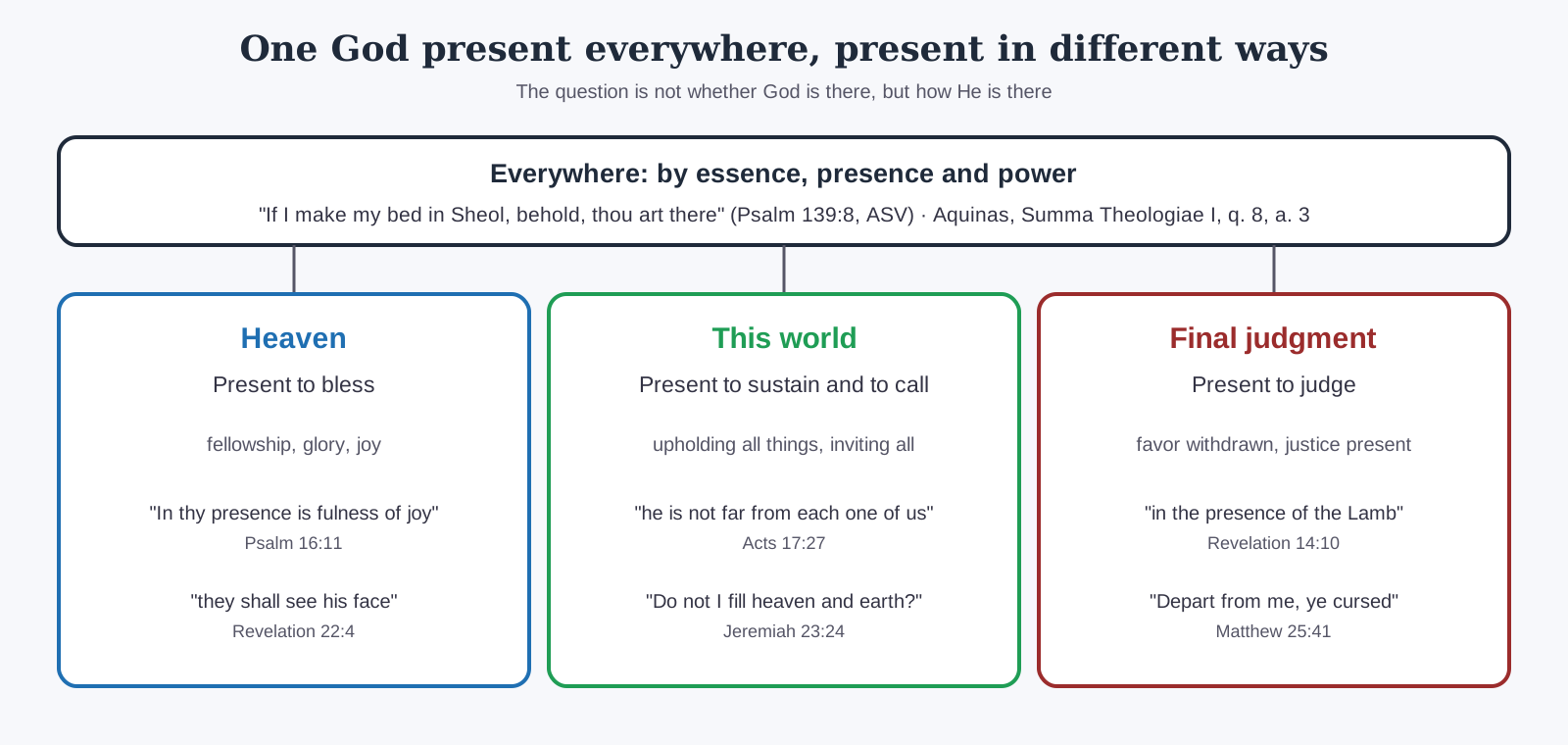
God's omnipresence and the different ways He is present, with the texts that ground each. Diagram drawn for the codex.
So a more careful way to say it is this: hell is being shut out from God's friendly, relational presence while still standing under His rule and His judgment. Jesus' words "Depart from me" describe a broken relationship, not a place God cannot reach.
See this page's graph and discover linked topics
In full
Classical theism affirms divine omnipresence (immensity): God is present to every created thing, in Aquinas's formula "by essence, presence and power" (Summa Theologiae I, q. 8, a. 3). It follows that no created state, including final judgment, can be one of literal divine absence. Scripture nevertheless speaks of the lost as excluded from God's presence (Matthew 25:41; 2 Thessalonians 1:9) while also placing judgment "in the presence of the Lamb" (Revelation 14:10). The tension resolves through the traditional distinction between God's omnipresence, which is universal, and His manifest, covenantal or favorable presence, which is given or withheld. Hell is therefore the poena damni, the loss of God's beatifying presence, under the continued presence of God as sovereign and judge. The exegetical crux is 2 Thessalonians 1:9, where apo prosōpou tou kyriou is read either as separation ("away from the presence of the Lord") or as source ("from the face of the Lord," echoing the "from before the terror of Jehovah" refrain of Isaiah 2:10, 19, 21); neither reading posits a region where God is not. The page closes with the development of the Bible's afterlife vocabulary (Sheol, Hades, Gehenna, the lake of fire) to answer the related charge that heaven and hell were later inventions.
The short answer
- Yes, God is present in hell, as He is present everywhere. Nothing in creation is outside His sustaining power and knowledge.
- No, God is not present there as He is in heaven. The fellowship, favor and joy of His presence are what the lost forfeit.
- "Absence of God" is shorthand. It names a real loss, the loss of God's friendly presence, but taken literally it would contradict omnipresence.
God is everywhere, including the realm of the dead
The Old Testament places God's reach explicitly in Sheol, the realm of the dead:
Whither shall I go from thy Spirit? Or whither shall I flee from thy presence? If I ascend up into heaven, thou art there: If I make my bed in Sheol, behold, thou art there. (Psalm 139:7-8, ASV)
Older English versions render Sheol here as "hell." Sheol is the general realm of the dead rather than the final place of judgment (see H7585 - sheol), but the psalm's logic runs from the highest place to the lowest: there is nowhere God is not.
The same conviction appears across the canon:
- Amos 9:2, "Though they dig into Sheol, thence shall my hand take them."
- Job 26:6, "Sheol is naked before God, And Abaddon hath no covering."
- Proverbs 15:11, "Sheol and Abaddon are before Jehovah."
- Jeremiah 23:24, "Do not I fill heaven and earth? saith Jehovah."
- Hebrews 4:13, "all things are naked and laid open before the eyes of him with whom we have to do."
Different kinds of presence
The Bible speaks of God being "present" in more than one sense, and the distinctions are what make sense of hell.
| Kind of presence | What it means | Where Scripture shows it |
|---|---|---|
| Sustaining | God holds every creature in existence | Acts 17:27-28, "in him we live, and move, and have our being" |
| Knowing | Nothing is hidden from Him | Hebrews 4:13; Proverbs 15:11 |
| Blessing | Fellowship, favor, joy, the sight of His face | Psalm 16:11; Revelation 22:3-4 |
| Judging | God as righteous judge, His wrath against sin | Revelation 14:10; Isaiah 2:10, 19 |
Thomas Aquinas gave the classic statement of the first two: God is in all things "by His power," because all things are subject to it; "by His presence," because all things are open to His eyes; and "by His essence," because He is present to all as the cause of their being (Summa Theologiae I, q. 8, a. 3). None of these can be withdrawn from any creature without that creature ceasing to exist.
What can be withdrawn is the third kind. The redeemed "shall see his face" (Revelation 22:4). The lost hear "Depart from me, ye cursed" (Matthew 25:41). That is the language of a relationship refused and ended, not of a location outside God's reach.
In the presence of the Lamb
Revelation 14:10 is striking. Those who worship the beast "shall be tormented with fire and brimstone in the presence of the holy angels, and in the presence of the Lamb." The judgment takes place before Christ, not out of His sight. Whatever the imagery of fire signifies, the text does not picture God as absent from it.
The crux text: 2 Thessalonians 1:9
who shall suffer punishment, even eternal destruction from the face of the Lord and from the glory of his might, (2 Thessalonians 1:9, ASV)
The Greek phrase behind "from the face of the Lord" is apo prosōpou tou kyriou, and it is read two ways.
- Separation. Many modern translations render it "away from the presence of the Lord." On this reading the punishment is exclusion from the Lord's presence, which fits Matthew 25:41 and the "outer darkness" sayings. This is the reading taken in Hell as Eternal Torment Objection Defeater.
- Source. The ASV and KJV render it "from the face" or "from the presence" of the Lord, and the wording closely follows Isaiah 2:10, 19 and 21, where people hide in the rocks "from before the terror of Jehovah, and from the glory of his majesty." The parallel is visible even in English: 2 Thessalonians 1:9 ends "and from the glory of his might." On this reading the destruction proceeds from the Lord's presence, as judgment going out from Him.
Both readings share the point that matters here. The separation reading describes exclusion from the Lord's favorable, glorious presence; the source reading describes judgment flowing from that presence. Neither describes a place where God does not exist.
Did early Christians believe in heaven and hell?
A related charge is that heaven and hell were invented later, by medieval Christianity or by the Greeks. The Bible's vocabulary does develop, but the core beliefs are early.
- Sheol. In the earliest Old Testament texts the dead go down to Sheol, the realm of the dead. Jacob says, "I will go down to Sheol to my son mourning" (Genesis 37:35). See H7585 - sheol.
- Heaven as God's dwelling. From the start heaven is God's realm: "Look down from thy holy habitation, from heaven" (Deuteronomy 26:15).
- Resurrection to two destinies. Later prophecy makes the destinies explicit: "many of them that sleep in the dust of the earth shall awake, some to everlasting life, and some to shame and everlasting contempt" (Daniel 12:2).
- Jesus' vocabulary. Jesus speaks of Gehenna, the place of final judgment ("fear him who is able to destroy both soul and body in hell," Matthew 10:28), and of Hades, the realm of the dead before judgment (Luke 16:23). The two are not synonyms. See G1067 - geenna and G0086 - hades.
- Hades is not the final state. "Death and Hades were cast into the lake of fire. This is the second death" (Revelation 20:14).
- The earliest Christian writings. Paul's letters, written in the AD 50s, make bodily resurrection and final judgment central to the gospel (1 Corinthians 15; 2 Thessalonians 1).
The fair summary is that resurrection, final judgment, eternal life and the punishment of the wicked are present from the earliest Christian sources, and grounded in Jesus' own teaching. What developed later is the popular shorthand, "heaven or hell when you die," which compresses a richer biblical picture of an intermediate state followed by resurrection and judgment. See Hell and Eternal Punishment and Heaven.
Why the distinction matters
- It keeps omnipresence intact. If hell were literally God-free, there would be a region of creation outside God's power, which no orthodox tradition teaches.
- It sharpens what is lost. The tragedy of hell is not that God has gone away but that a person faces God without His favor. Psalm 16:11 says "In thy presence is fulness of joy"; to be in the presence of the same God without that joy is the loss.
- It answers an objection. Critics sometimes argue that a God who is everywhere cannot coherently "separate" anyone from Himself. The distinction between kinds of presence shows the biblical language is not contradictory.
Tensions
- The phrase "hell is the absence of God" appears in popular preaching and in some codex summaries of the doctrine of hell as a description of its chief suffering. Taken as shorthand for the loss of God's favorable presence it is accurate; taken literally it conflicts with omnipresence. This page uses the more precise form.
- On 2 Thessalonians 1:9, interpreters divide between the separation and source readings of apo prosōpou. The codex records both and does not settle the question; both are compatible with the conclusion of this page.
See also
- Hell and Eternal Punishment, the doctrine of hell and its vocabulary
- Hell as Eternal Torment Objection Defeater, the moral objection to hell
- Conditional Immortality, one of the three views of hell's duration
- Heaven, the presence of God as blessing
- New Heavens and New Earth, the final state of the redeemed
- Divine Attributes, the attributes of God, including His immensity
- Thomas Aquinas, whose account of God's presence this page uses
- H7585 - sheol, the Old Testament realm of the dead
- G0086 - hades, the realm of the dead in the New Testament
- G1067 - geenna, Jesus' word for the place of final judgment
Common questions this page answers
Q: Is God in hell?
Yes, in the sense that God is everywhere and nothing exists outside His power and knowledge. But He is not present there in blessing or fellowship. Hell is the loss of God's favorable presence while remaining under His judgment.
Q: Is hell the absence of God?
Not literally. The Bible teaches God is everywhere, and Psalm 139:8 says even in the realm of the dead "thou art there." "Absence of God" is a shorthand for losing His friendly, relational presence, which is the real heart of hell's loss.
Q: If God is everywhere, how can anyone be separated from Him?
Scripture speaks of different kinds of presence. God is present to everything to sustain and know it, but His presence to bless is given to those who receive Him. The lost are separated from that blessing presence, not from God's existence or rule.
Q: What does "from the presence of the Lord" mean in 2 Thessalonians 1:9?
Interpreters read it two ways: as exclusion "away from" the Lord's presence, or as destruction coming "from" the Lord's presence, echoing Isaiah 2:10. Both readings agree that God is not absent from the judgment.
Q: Did the early church believe in heaven and hell?
Yes. Resurrection, final judgment, eternal life and the punishment of the wicked appear in Daniel 12:2, in Jesus' teaching about Gehenna and Hades, and in Paul's letters from the AD 50s. What developed later was the simplified phrase "heaven or hell when you die."
Q: What is the difference between Sheol, Hades and Gehenna?
Sheol is the Old Testament realm of the dead, and Hades is its usual New Testament equivalent. Gehenna is Jesus' word for the place of final judgment. Revelation 20:14 shows Hades itself being cast into the lake of fire, so the realm of the dead and the final judgment are distinct.