Concept
Illumination of the Holy Spirit
illumination, illumination of the Spirit, doctrine of illumination, Spirit illumination, how does the Holy Spirit help us understand the Bible, Holy Spirit and interpretation, does the Holy Spirit interpret Scripture for us, epistemic discrimination problemIntro
Christians say the Holy Spirit helps them understand the Bible. That raises a fair question. If two believers both pray, both read carefully, and both say the Spirit led them, why do they sometimes come away with opposite answers? And if the Spirit is the one doing the teaching, how would anyone check?
The answer starts with what the Bible actually promises. The Spirit opens the mind to receive what God has said: of the risen Jesus Luke writes, "Then opened he their mind, that they might understand the scriptures" (Luke 24:45, ASV). The words themselves stay fixed, and the Spirit who inspired them works through them. So the believer still reads the grammar, the context and the whole of Scripture, and the claim "the Spirit showed me" gets tested against what the Spirit already wrote. Think of a lamp in a library. It lets you read the books on the shelf. It does not write a new book for you, and two people under the same lamp can still misread a page.
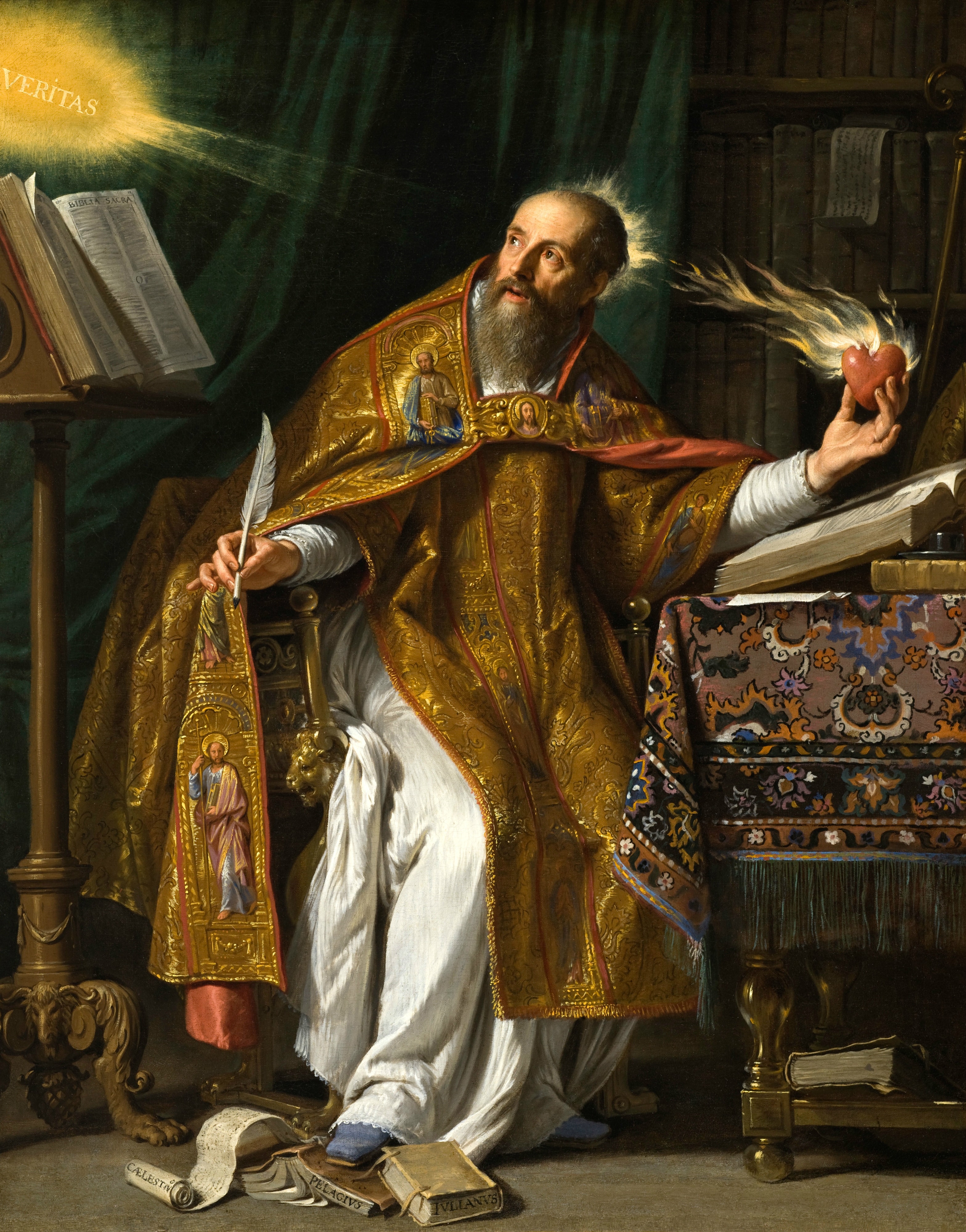
Philippe de Champaigne, Saint Augustine, c. 1645-1650, Los Angeles County Museum of Art. Augustine looks up to the light marked Veritas, "truth," the image behind his teaching that the mind sees truth by a light it does not supply for itself. Image: public domain, via Wikimedia Commons.
See this page's graph and discover linked topics
In full
Illumination is the Holy Spirit's work of enabling a person to apprehend, receive and respond to truth God has already revealed. Christian theology distinguishes it from three neighbouring acts. Revelation is God making truth known. Inspiration is the Spirit's superintending of the biblical authors so that what they wrote is God's word (Inspiration; 2 Peter 1:21). Interpretation is the human act of forming a judgment about what a text means. Illumination sits between the fixed text and the human interpreter: it acts on the reader's mind and will, and it adds no new content to Scripture.
The doctrine faces a serious epistemological objection, which this page calls the epistemic discrimination problem. If believers who hold contradictory readings can sincerely make the same appeal to the Spirit, then the appeal alone cannot decide between them. The classical Protestant answer accepts that conclusion for the bare appeal and denies that illumination was ever meant to work that way. Illumination is a causal claim about how understanding arises. The justification of a reading is a separate matter, carried by public evidence (grammar, context, canon) that any reader can inspect. Plantinga's account of warrant shows how a belief produced by the Spirit can be warranted for the believer; it does not hand the believer a certificate to settle a public dispute, and its defenders do not claim it does.
The distinctions that carry the doctrine
| Act | Who acts | What it produces | Key text |
|---|---|---|---|
| Revelation | God | Truth made known | Hebrews 1:1-2 |
| Inspiration | The Spirit on the biblical authors | A written word that is God's word | 2 Peter 1:20-21 |
| Illumination | The Spirit on the reader | Reception and understanding of that word | 1 Corinthians 2:12-14; Luke 24:45 |
| Interpretation | The human reader | A judgment about what the text means | Acts 17:11 |
| Justification | The reader, before others | Reasons others can inspect | 1 John 4:1 |
Three questions follow from the table, and running them together is the source of most confusion on this topic:
- What caused the belief? A question of causation. The Spirit may be part of the answer.
- What justifies the belief? A question of epistemology. Public reasons answer it.
- Is the belief true? A question about the text's meaning, fixed by what its author meant.
A true belief can arise from poor reasoning, and careful reasoning can miss the truth for lack of information. So the cause of a belief, the grounds for it and its truth have to be assessed separately. That holds for every belief anyone holds, Christian or not.
The biblical basis
- The Spirit enables reception. "But we received, not the spirit of the world, but the spirit which is from God; that we might know the things that were freely given to us of God" (1 Corinthians 2:12, ASV). Paul's verdict on the unregenerate reader is that he "receiveth not the things of the Spirit of God: for they are foolishness unto him" (2:14). The problem Paul names is a failure to receive, which is why illumination concerns reception more than information.
- Christ opens the mind to the Scriptures. Luke 24:45: "Then opened he their mind, that they might understand the scriptures." The content was already written; what changed was the disciples' grasp of it.
- The anointing teaches. 1 John 2:27 says the anointing "teacheth you concerning all things." In context John is writing against teachers who deny that Jesus is the Christ (2:22-26), so the promise concerns the core confession that protects believers from those teachers. It is a reassurance about the gospel's center, and John writes a whole letter of instruction alongside it.
- The promise to the apostles. "When he, the Spirit of truth, is come, he shall guide you into all the truth" (John 16:13, ASV). Jesus speaks to the Eleven in the upper room. Many interpreters read the primary fulfilment in the apostles' witness, which became the New Testament, and a derived application in the Spirit's ongoing work with every believer (Paraclete, Identity and Recipients).
- The command to test. "Beloved, believe not every spirit, but prove the spirits, whether they are of God" (1 John 4:1, ASV). The same Scripture that promises the Spirit's teaching commands believers to test claims made in the Spirit's name. A command to test presupposes that some such claims are false.
Historical theology
Augustine: clearer passages explain obscure ones
Augustine gave Christian hermeneutics its most durable rule. In On Christian Doctrine, Book 2, chapter 9, he advises readers to become familiar with the plain passages first and then use the plainer expressions to throw light on the obscure ones. In Book 3 he adds the rule of faith and the double love of God and neighbour as guards on interpretation. Augustine believed God illumines the mind, and he also built a public method for reading. The two belong together in his thought, and he never treated private conviction as a substitute for reading the text well.
Augustine also held a broader theory of illumination: that the human mind knows any unchanging truth only by a light from God (developed in De Magistro and De Trinitate). That epistemological theory is related to the doctrine on this page and distinct from it; see Christian Theories of Knowledge.
Aquinas: the gift of understanding
Thomas Aquinas treats understanding (intellectus) as one of the seven gifts of the Holy Spirit (Summa Theologiae II-II, q. 8). The natural light of the intellect reaches only so far, and the gift strengthens the mind to penetrate truths of faith. Aquinas locates the Spirit's work in the perfecting of a faculty, which fits the picture of illumination working through the reader's mind and through his reading.
Calvin: the internal testimony
John Calvin argued that Scripture's authority is sealed on the heart by the internal testimony of the Holy Spirit (Institutes I.7.4-5), and that the Spirit and the word belong together, so that a "spirit" leading away from the written word is to be rejected (Institutes I.9). The internal testimony concerns the believer's certainty that Scripture is God's word. Calvin did not claim it settles every disputed reading; his commentaries argue exegetically, verse by verse. See Witness of the Holy Spirit.
Classical Pentecostalism
Classical Pentecostal teaching, in the Azusa Street stream, holds that the Spirit who baptizes and empowers also teaches, and it ties that teaching to Scripture as the final rule. The same tradition that most emphasizes the Spirit's present activity also insists that prophecy and impressions be judged (1 Corinthians 14:29; 1 Thessalonians 5:20-21).
The epistemic discrimination problem
The objection, steel-manned
A careful critic does not need to deny that the Spirit exists. The strongest form runs:
- If an appeal to divine illumination is offered as a sufficient reason to prefer one reading over a contradictory one, there must be some way to tell which reading is the illuminated one.
- Believers holding contradictory readings can sincerely make the same appeal.
- The bare appeal supplies no independent criterion for deciding between them.
- So the bare appeal cannot justify preferring one contested reading over another.
The argument is valid, and its conclusion is correct as stated. It targets one specific use of the doctrine: treating "the Spirit showed me" as the reason another person should accept a reading.
Replies
- The conclusion is one the doctrine already holds. The church never taught that illumination makes individual readers infallible. Paul says believers "know in part" (1 Corinthians 13:9), and 1 John 4:1 commands testing. A source can be perfectly reliable while the people receiving it are fallible, in the way two drivers can follow the same accurate map and one still takes a wrong turn.
- A cause can be real without a known mechanism. Gravity was described and predicted for centuries before anyone could say what it is. A causal claim can be rationally held on the strength of its effects before its mechanism is understood. The analogy has a limit, and it should be stated: gravity's effects are publicly measurable, and illumination's effects are not isolated by any instrument. The point it establishes is narrow: "you cannot specify the mechanism" does not show "there is no cause."
- Justification is carried by public reasons. The text has a determinate meaning fixed by its author, and disagreement about a meaning does not show there is none. Grammar, context, genre, the argument of the book and the rest of Scripture are open to every reader. Augustine's rule, clearer passages explaining obscure ones, is one of those public tools. Illumination explains how a reader comes to receive the meaning; the evidence explains why others should accept the reading.
- The circular form is a misuse. "I know my reading is right because the Spirit gave it, and I know the Spirit gave it because the reading is right" is circular, and orthodox theology rejects it. The test runs the other direction: a claimed leading is checked against the written word the Spirit inspired (2 Peter 1:20-21; Acts 17:11).
- Warrant for the believer and proof for the critic are different goods. Alvin Plantinga (Warranted Christian Belief, 2000) argues that beliefs produced by the Spirit's internal instigation can be warranted for the believer without being inferred from public evidence. William Lane Craig puts the same distinction as knowing versus showing (Witness of the Holy Spirit). Neither claims that the believer can use the warrant to settle a public dispute.
- The standards the critic uses need a ground. The objection appeals to binding norms: reasons must be given, contradictions cannot both be true, one ought to prefer the better-supported reading. Those norms are part of what is in dispute between theism and naturalism. See Argument from Epistemic Normativity for the argument that categorical epistemic norms fit a world grounded in a rational God far better than a world without one.
What illumination does and does not promise
- Promised: reception of the gospel's center (1 Corinthians 2:12-14), opened understanding of Scripture (Luke 24:45), protection against denial of Christ (1 John 2:22-27), conviction and assurance (Romans 8:16).
- Not promised: that every sincere believer reaches the right answer on every disputed passage, or that a private impression outranks the text. Scripture itself leaves some questions to individual conscience (Romans 14:5).
- The practical rule: treat illumination as the reason to read prayerfully and the text as the reason to read carefully. Where two Christians disagree, the dispute is argued from Scripture, as at the Jerusalem Council (Acts 15:15).
Tensions
- Scope of John 16:13. Interpreters divide on how directly the promise to the apostles extends to later believers. Most Protestant and Pentecostal readers affirm a derived application; some restrict the "all the truth" clause to the apostolic witness. Both readings agree that the derived application gives no individual infallibility.
- How much illumination adds. Some theologians describe illumination chiefly as moral and spiritual receptivity (removing the resistance of 1 Corinthians 2:14); others include a strengthening of understanding itself (Aquinas's gift of understanding). The page presents both; neither changes the answer to the discrimination problem.
Scholarship
Published academic works this page draws on, each matched to a publisher, index or library catalog record.
- Alvin Plantinga, Warranted Christian Belief (Oxford University Press, 2000). doi:10.1093/0195131932.001.0001
See also
- Witness of the Holy Spirit, the Spirit's assurance of the gospel's truth, with Plantinga and Craig
- Pneumatology, the doctrine of the Holy Spirit, including the inspiration and illumination table
- Holy Spirit Isnt Real Because Christians Disagree Objection Defeater, the debate-prep reply to the disagreement objection
- Christian Theories of Knowledge, Augustine's illumination theory and the wider schools
- Inspiration, how the text the Spirit illumines came to be written
- Reformed Epistemology, warrant without inference from public evidence
- Argument from Epistemic Normativity, the ground of the norms the critic appeals to
- Paraclete, Identity and Recipients, who the John 14 to 16 promises were made to
- Sola Scriptura, Scripture as the fixed test for claims made in the Spirit's name
- Theories of Truth, object language and metalanguage, useful for separating what a claim says from how it is justified
Common questions this page answers
Q: What is the illumination of the Holy Spirit?
It is the Spirit's work of enabling a person to understand and receive truth God has already revealed in Scripture. Inspiration concerns how the Bible was written; illumination concerns how a reader comes to grasp it. Luke 24:45 is the model: "Then opened he their mind, that they might understand the scriptures."
Q: If the Holy Spirit guides Christians, why do they interpret the Bible differently?
Because illumination works through fallible readers and does not make them infallible. Paul says believers "know in part" (1 Corinthians 13:9). A reliable source and imperfect receivers together explain disagreement, and Scripture commands believers to test claims rather than accept them on someone's say-so (1 John 4:1).
Q: How can you know whether an interpretation came from the Holy Spirit?
By testing it against the written word the Spirit inspired: its grammar, its context and the rest of Scripture. The appeal "the Spirit told me" settles nothing by itself, and Christian theology has never said it does. A reading that contradicts what the Spirit already wrote is rejected.
Q: Does John 16:13 promise that every Christian will understand all truth?
Jesus spoke those words to the apostles, and many interpreters see their primary fulfilment in the apostolic witness that became the New Testament. Believers share in the Spirit's teaching in a derived sense, but the verse does not promise each reader an error-free interpretation of every passage.
Q: Isn't saying "the Holy Spirit showed me" circular reasoning?
Used as a proof to others, it would be: the source vouches for the reading and the reading vouches for the source. Orthodox theology rejects that move. The Spirit's work explains how a believer comes to understand; public reasons from the text are what justify a reading to anyone else.
Q: Do you need to know how the Holy Spirit works in order to believe he does?
No. Many causes were known by their effects long before their mechanisms were understood. A Christian can hold that the Spirit opens the mind without claiming to describe the process, and the justification of any particular reading still rests on the text.