Argument
I Don't Have Enough Faith to Be an Atheist Argument
I don't have enough faith to be an atheist, i dont have enough faith to be an atheist, atheism takes more faith than christianity, does atheism require faith, it takes more faith to be an atheist, atheism requires more faith, is atheism a faith position, atheism takes faithIntro
"I don't have enough faith to be an atheist" is one of the best-known lines in Christian apologetics. It is the title of a 2004 book by Norman Geisler and Frank Turek, and it turns a common charge around. Atheists often say Christians believe things on faith. The slogan replies that the atheist believes plenty of things on faith too, and that on the biggest questions the atheist actually has to trust more.
What does the atheist have to trust? If there is no God, then the universe either popped into being with no cause, or it has always existed with no explanation. Life came from chemistry that no one has yet shown can do the job. The laws of physics landed, by chance or by a vast number of unseen universes, inside the narrow range that lets life exist. Minds that feel and think came from matter that does neither. And the brain, built only to survive, still has to be trusted to tell us the truth about all of this. Each of those may turn out to be true. None of them has been shown. The atheist has to take them on trust.
The line works only if "faith" is used carefully. If faith means believing without evidence, the slogan sounds like a jab, and a sharp atheist will say so. The version on this page uses faith the way the Bible and ordinary life use it: trust that goes beyond what can be strictly proven, resting on reasons. In that sense everyone has faith, the question is whose faith rests on the better reasons, and that is a question we can actually argue about.
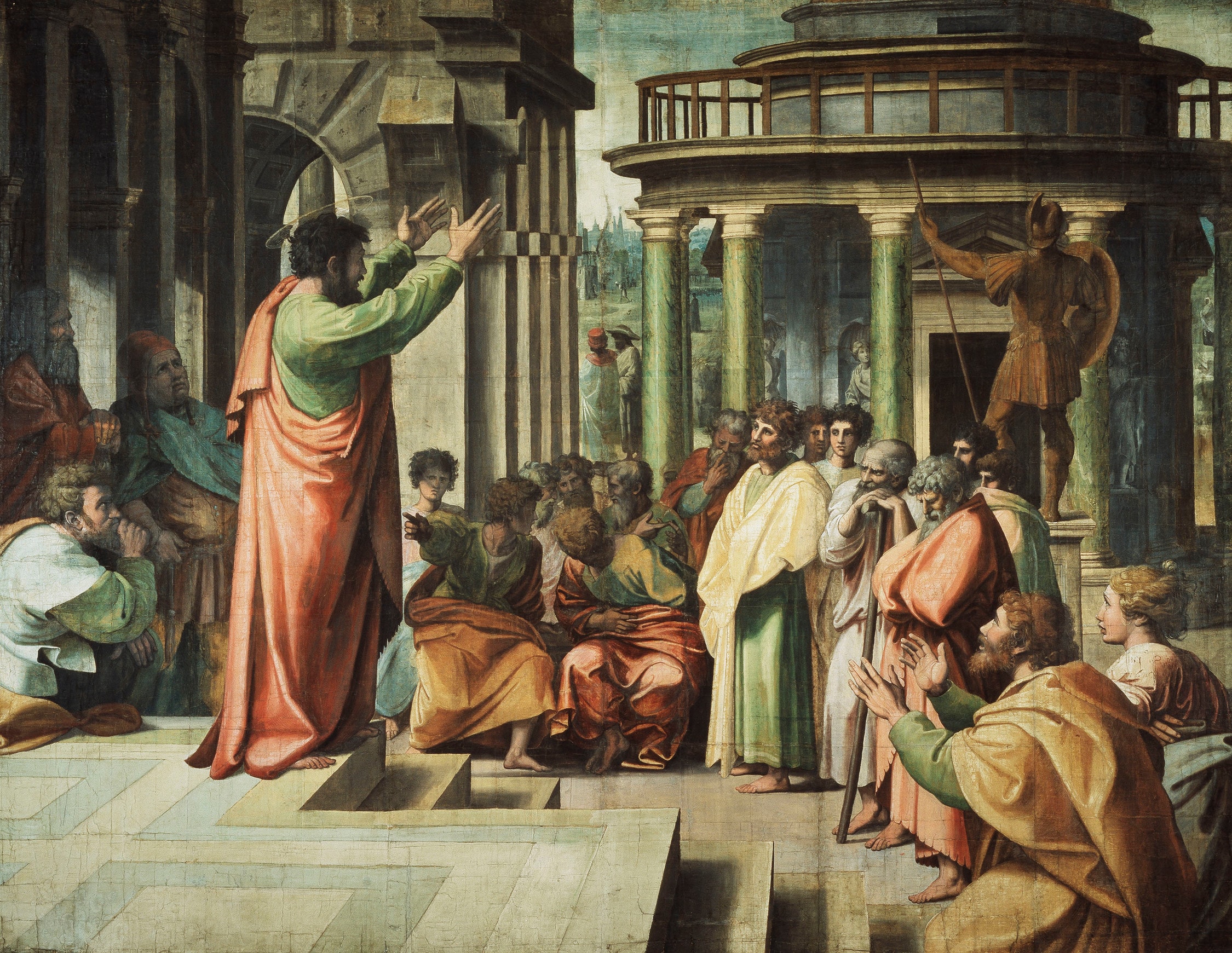
St Paul Preaching at Athens, by Raphael, c. 1515, a tapestry cartoon of Acts 17, where Paul reasons with philosophers from creation to the resurrection. Image: public domain, via Wikimedia Commons.

The 30-second version: Nobody can prove their worldview from the ground up, so everybody trusts something past the point of proof. The question is who trusts more, and on what. Without God, the universe exists with no explanation, life comes from non-life by a route no one has found, the laws of physics happen to allow life, mind comes from mindless matter, and reason built for survival still somehow tracks truth. Those are a lot of IOUs. The theist makes one inference, to a cause with the power and mind to explain all of them. That is why I say I don't have enough faith to be an atheist.
See this page's graph and discover linked topics
In full
The argument is a comparative, abductive claim about the epistemic cost of rival worldviews. Its thesis, in Geisler and Turek's own framing, is that every worldview, atheism included, requires some faith, because "faith covers a gap in knowledge," and that "the less evidence you have for your position, the more faith you need to believe it (and vice versa)" (I Don't Have Enough Faith to Be an Atheist, preface; p. 26 as quoted by both Jeffery Jay Lowder and John W. Loftus). They argue that Christianity requires the least such faith because it is the best-evidenced view; the publisher describes the book as arguing that Christianity is more reasonable even than unbelief.
Restated without the rhetoric, the argument runs:
- No comprehensive worldview is demonstrable from premises every rational person must accept; each commits its holder to some propositions that exceed proof (faith in the sense of reasoned trust, not credulity).
- Atheism held as a worldview is in practice metaphysical naturalism, and naturalism is committed, on each of the big explanatory questions (existence, the beginning, fine-tuning, the origin of life, consciousness, moral obligation, the reliability of reason), either to an unexplained brute fact or to a promissory note that future science will supply an explanation of a kind not yet in hand.
- Theism answers the same questions by a single inference to a necessary, personal, rational and good cause, an inference independently supported by the cosmological, teleological, moral, noetic and historical arguments.
- Other things equal, a view that leaves more of the data unexplained, or explained only on credit, requires more trust beyond the evidence than a view that explains the data from one independently motivated posit.
- Therefore naturalism requires more faith, in the reasoned-trust sense, than theism.
The page's main work is to keep the argument honest. Stated as "atheists believe without evidence," the slogan commits the equivocation its critics charge. Stated as "atheists must hold that the universe came from nothing," it attacks a position many atheists do not hold. The defensible version is the comparative audit above, which grants the atheist every concession that is due and then presses the larger concessions the atheist owes in return. It does not by itself establish Christianity; it clears ground for the positive case (Cumulative Case for Christian Theism) and the historical bridge to Christ (Argument from the Resurrection).
Cheatsheet
The 30-second reply (read aloud). I'm not saying you believe things for no reason. I'm saying neither of us can prove our worldview from scratch, so we both trust some things past proof. So let's compare. If there's no God, why is there a universe at all? How did life start? Why do the laws of physics allow life? How does matter become a mind that feels? And why trust a brain that evolved to survive, not to find truth? On each one, you either say "it just is" or "science will figure it out." I've got one answer that covers all five. That's all I mean: your view runs on more trust than mine.
The 5 fast facts:
- The source. Norman Geisler and Frank Turek, I Don't Have Enough Faith to Be an Atheist (Wheaton: Crossway, 2004; foreword by David Limbaugh). The book runs from truth to God to miracles to the New Testament to Jesus.
- Their definition of faith. "Faith covers a gap in knowledge"; the less evidence for a position, the more faith it takes. That is a claim about the proportion of belief that outruns proof, not a definition of faith as believing without evidence.
- The biblical word agrees. Pistis (πίστις) comes from peithō, "to persuade." In Acts 17:31 Paul says God "hath given assurance unto all men" by raising Jesus, and the word for "assurance" there is pistis: faith as the proof God supplies.
- The atheist sense is different, and on the record. Richard Dawkins called faith "blind trust, in the absence of evidence, even in the teeth of evidence" (The Selfish Gene, 1976, ch. 11). Peter Boghossian defined it as "pretending to know things you don't know" (A Manual for Creating Atheists, 2013). The slogan is not using either definition.
- Atheists have named the brute fact themselves. In the 1948 BBC debate with Frederick Copleston, Bertrand Russell said the universe "is just there, and that's all." That is not an explanation; it is a decision to stop asking, which is a form of trust.
The 3 strongest counter-moves:
- "Which sense of faith?" Before anything else, fix the term. "I mean trust that goes beyond proof, resting on reasons. Do you hold any beliefs like that?" Everyone does (other minds, the past, the reliability of memory).
- "Brute fact or IOU?" For each big question, ask: is your answer that it is just so, or that science will explain it later? Either is fine to hold, but both are trust, not evidence.
- "What is your account?" If the atheist says "I just lack belief," ask whether they also lack belief in naturalism. If they do, they are agnostic about the big questions and should stop claiming science has made God unnecessary.
Reciprocal concessions (grant the small point, then collect a bigger one):
- Grant: the title is a rhetorical flourish, and "faith" is a loaded word in this debate. Now collect: then the atheist must drop "faith" as a smear for Christian belief too. If faith means trust beyond proof, both sides have it; if it means belief without evidence, the atheist must show that Christian belief has none, which is a much harder claim.
- Grant: an atheist need not believe the universe came from nothing; a past-eternal universe or a brute-fact universe are live options. Now collect: each of those is itself a commitment that outruns the evidence. Past-eternal models face the Borde-Guth-Vilenkin Theorem and the Second Law, and "it just is" is the end of explanation, not an explanation.
- Grant: "I don't know how life began" is honest and requires no faith. Now collect: "I don't know, but it wasn't God" is not "I don't know." The second clause is a commitment, and it needs reasons.
- Grant: theism also ends in something unexplained, namely God. Now collect: the theist ends in one necessary being whose nature is the kind of thing that could explain the rest; the naturalist ends in a stack of contingent brute facts, each of which could have been otherwise.
What NOT to defend:
- Do not say atheists have no evidence for anything, or that atheists are dishonest. Neither is true, and the second violates 1 Peter 3:15.
- Do not claim every atheist believes the universe came from nothing. Ask what they believe first.
- Do not claim physicalism has been scientifically disproven, or that the origin of life is proven impossible. Claim only what the argument needs: that these are unexplained, and that naturalism holds them on credit.
- Do not treat faith as a measurable quantity. "More faith" means more of the view resting on trust rather than on evidence in hand.
The closing line. We both live by trust. I just want mine to rest on the best explanation of why anything exists, why it's knowable, and why it matters. When I tally what naturalism asks me to take on credit, I don't have that much faith.
Key definitions: the two senses of "faith"
The slogan stands or falls on one word. The five-step equivocation pattern applies in reverse here, because the critic's main reply is that the slogan itself equivocates.
| Step | Application |
|---|---|
| 1. The contested term | "faith" |
| 2. Sense A | belief without evidence, or against it (Dawkins, Boghossian) |
| 3. Sense B | reasoned trust: assent and reliance that go beyond strict proof but rest on evidence (Hebrews 11:1; Geisler and Turek's "gap in knowledge") |
| 4. What the slogan must mean | Sense B. It claims naturalism leaves a larger gap between evidence and commitment than theism does |
| 5. What the careless version means | it slides toward Sense A, implying atheists believe without reasons, which is false and easily refuted |
The rule for live use: say Sense B out loud before using the slogan. Then the equivocation charge has nothing to bite on, and the atheist's own use of Sense A against Christians is exposed as the real equivocation, since no Christian creed defines faith that way. See Faith is Belief Without Evidence Objection Defeater and Faith.
Argument structure
| Premise | Notes | |
|---|---|---|
| P1 | Every comprehensive worldview commits its holder to propositions that exceed proof | Faith as reasoned trust is universal |
| P2 | Naturalism, on each of the big questions, rests on a brute fact or a promissory note | The commitment ledger below |
| P3 | Theism answers the same questions by one independently supported inference to a necessary, personal cause | Cumulative Case for Christian Theism |
| P4 | A view that holds more of the data on credit requires more trust beyond the evidence | Comparative explanatory virtue |
| C | Naturalism requires more faith, in the reasoned-trust sense, than theism | Comparative and probabilistic, not a proof |
Form
Abductive and comparative. The argument does not claim to prove God; it claims that on a fair audit of explanatory debts, the naturalist carries more of them. It is also defensive: it answers the rhetorical move that casts the theist as the only party taking anything on trust. Its conclusion is modest and, for that reason, hard to dislodge.
P1, Every worldview goes beyond what can be proven
Affirmative case
- Foundations cannot all be proven. Any chain of justification ends somewhere: in basic beliefs (other minds, an external world, the reliability of memory and sense perception, the uniformity of nature) that we hold without independent proof. This is a commonplace of epistemology, not a theistic invention. See Reformed Epistemology.
- Science presupposes what it cannot test. The scientific method assumes that nature is orderly, that the future will resemble the past, and that our minds can grasp the order. Those assumptions make science possible; science cannot verify them without circularity. See Argument from Science as Faith-Based (Guillen).
- Worldviews answer questions no experiment settles. Why there is something rather than nothing, whether there are objective moral facts, and whether the physical is all there is are philosophical questions. A worldview that takes a side on them goes beyond what a laboratory can show.
Anticipated objections
- "Trusting my senses isn't faith. It's just how knowledge works."
- "Science is self-correcting, so its assumptions are earned, not taken on faith."
Rebuttals
- Agreed, and that is the point. Call it trust, basic belief or working assumption; it is belief held beyond proof on reasonable grounds. That is exactly Sense B. The slogan needs nothing stronger.
- Self-correction presupposes the assumptions. Science corrects its theories by trusting observation and inference; it does not and cannot correct its way to a proof that observation and inference are reliable. The track record is real evidence, but it is evidence gathered by the very faculties in question. That is why the reliability of reason reappears as an item in P2.
Live-cite kit
- Scripture: prove all things; hold fast that which is good (1 Thessalonians 5:21, ASV).
- Scholarly: Anselm's motto fides quaerens intellectum, "faith seeking understanding" (Proslogion, preface).
- Aphorism: "Everybody stops asking somewhere. The question is whether they stop at an explanation or at a shrug."
Tactical notes
- Win P1 quickly and without the word "faith" if the atheist bristles. "Trust" or "commitments" does the same work.
- Do not let P1 become radical skepticism. The point is parity of the human condition, not that nothing can be known.
P2, Naturalism's commitment ledger
Affirmative case
The naturalist need not hold any single answer below, but must hold some answer to each, and the available answers are either brute facts or promissory notes.
| Question | Naturalist options | What each requires | Theistic answer | Codex hub |
|---|---|---|---|---|
| Why does anything exist? | brute fact; necessary universe | that a contingent-looking universe needs no explanation, or that it exists necessarily | a necessary being grounds contingent reality | Contingency Argument, Principle of Sufficient Reason |
| Did the universe begin? | uncaused beginning; past-eternal universe | something from no cause, or a past that evades the Borde-Guth-Vilenkin Theorem and the Second Law | a transcendent cause of the beginning | Kalam Cosmological Argument, Big Bang |
| Why are the constants life-permitting? | chance; a Multiverse; unknown deeper law | luck on a vast scale, or many unobserved universes with their own fine-tuned generator | design by a mind | Fine-Tuning Argument, Anthropic Principle |
| How did life begin? | an undiscovered chemical pathway | that chemistry alone produced self-replicating, information-bearing systems by a route not yet shown | intelligence as the known cause of functional information | Argument from Origin of Life, Abiogenesis, Information Argument |
| Why is there consciousness? | identity with brain states; emergence; panpsychism | that subjective experience is, or arises from, wholly non-experiential matter | a fundamental mind grounds finite minds | Argument from Consciousness |
| Are there binding moral obligations? | anti-realism; non-natural moral realism | that obligations are illusions, or that they exist as brute necessary facts with no lawgiver | goodness grounded in God's nature | Moral Argument |
| Can reason be trusted? | evolution selected for truth-tracking | that faculties shaped for survival reliably track abstract truth, including the truth of naturalism | minds made by a rational Creator to know | Argument from Reason, Argument from the Reliability of Reason |
- Each row is a debt, not a refutation. The claim is not that the naturalist answers are impossible. It is that none is in hand as an explanation; each is held because naturalism requires it.
- The debts compound. One brute fact is a cost; seven independent ones, each surprising, are a much larger cost. A worldview whose every hard question is answered "it just is" or "we'll find out" is running on trust.
- Some naturalists say so. Bertrand Russell's "the universe is just there, and that's all" (BBC debate with Copleston, 1948) states the brute-fact option without apology. Richard Lewontin wrote that scientists hold "a prior commitment, a commitment to materialism" that comes before the evidence (review of Carl Sagan, The New York Review of Books, 9 January 1997). The atheist philosopher Thomas Nagel argued in Mind and Cosmos (2012) that the standard materialist account of mind and its origins is very likely false.
Anticipated objections
- "You're attacking a strawman. I never said the universe came from nothing."
- "Science has a great track record of filling gaps. Betting on it isn't faith."
- "Brute facts are fine. Every view has some."
Rebuttals
- Then pick a row. The ledger lists the alternatives on purpose. If not an uncaused beginning, then a past-eternal universe or a brute-fact one; each is a commitment. The argument never needed the "from nothing" version.
- Track record is real evidence, within its domain. Science has succeeded at explaining how parts of nature work in terms of other parts. The ledger's questions are about why there is a natural order at all, why it is fine-tuned, why it contains minds and obligations. Past success at the first kind of question is weak evidence for success at the second. Betting it will come is a reasonable hope, but it is still a bet.
- Agreed, so count them. The theist accepts one ultimate, necessary terminus. The naturalist accepts several contingent ones. If parsimony counts, it counts here. See Occam's Razor.
Live-cite kit
- Scripture: For the invisible things of him since the creation of the world are clearly seen, being perceived through the things that are made, even his everlasting power and divinity; that they may be without excuse (Romans 1:20, ASV).
- Scholarly: Bertrand Russell, BBC debate with Frederick Copleston (1948); Richard Lewontin, "Billions and Billions of Demons," The New York Review of Books (9 January 1997); Thomas Nagel, Mind and Cosmos (Oxford, 2012).
- Aphorism: "Seven brute facts are not an explanation. They are a pile of shrugs."
Tactical notes
- Use the ledger as a menu, not a lecture. Ask the opponent to choose their answer to two or three rows, then press those.
- Lead with the rows you know best. A half-understood fine-tuning claim loses more than it wins.
P3, Theism answers with one independently supported inference
Affirmative case
- One posit, many explanations. A necessary, personal, rational and good Creator explains why there is something rather than nothing, why the universe began, why its laws permit life, why there are minds, why there are binding obligations and why minds can know. One hypothesis covering many independent data is the mark of a strong explanation. See Cumulative Case for Christian Theism and Bayesian Argument for Theism.
- The posit is independently argued. The inference is not invented to fill gaps; it is the conclusion of separate arguments (contingency, Kalam, fine-tuning, moral, reason) that converge on the same cause.
- The attributes fit the job. A cause of all physical reality must transcend it; a cause of fine-tuning must be able to choose; a ground of obligation must be personal and good; a ground of rational minds must be rational. Those are the attributes classical theism ascribes to God.
Anticipated objections
- "God is just a bigger brute fact."
- "Positing God explains everything, so it explains nothing."
Rebuttals
- Necessary is not brute. A brute fact is a contingent fact with no explanation. God, on classical theism, exists by the necessity of his own nature; his existence is explained by what he is, not left unexplained. The atheist may dispute that any being is necessary, but that is a different argument, taken up in Who Created God Objection Defeater and Contingency Argument.
- Theism makes risky predictions. If God exists, we should expect a universe that is ordered, intelligible, life-permitting and morally structured, with minds able to know it. A theism that predicted chaos would fail. The match between prediction and observation is the evidence.
Live-cite kit
- Scripture: All things were made through him; and without him was not anything made that hath been made (John 1:3, ASV).
- Scholarly: Richard Swinburne, The Existence of God (2nd ed., Oxford, 2004), the cumulative probabilistic case.
- Aphorism: "One cause that explains seven facts beats seven facts that explain nothing."
Tactical notes
- Keep P3 short in debate. Its job is to show that theism has an account; the hubs carry the detail.
- Be ready for Who-created-God. It comes every time.
P4, More held on credit means more faith
Affirmative case
- The definition does the work. If faith is the gap between evidence and commitment (Geisler and Turek's own definition), then the view with more of its commitments unbacked by present explanation has the wider gap.
- Promissory notes are faith by definition. "Science will explain it" is a statement about evidence we do not have. Believing it is trusting that the gap will close.
- The reliability of reason is the deepest debt. Alvin Plantinga argued that if naturalism and unguided evolution are both true, the probability that our cognitive faculties are reliable is low or inscrutable, which gives the naturalist a defeater for all her beliefs, naturalism included (Warrant and Proper Function, 1993, ch. 12; Where the Conflict Really Lies, 2011). C. S. Lewis made an earlier version of the point (Miracles, 1947, ch. 3). Darwin himself recorded a "horrid doubt" about whether convictions of a mind developed from lower animals are trustworthy (letter to William Graham, 3 July 1881). Trusting reason on naturalism is trusting it without a ground for the trust.
Anticipated objections
- "Evolution favors true beliefs, because true beliefs help you survive."
- "The Christian uses the same faculties to argue for God, so the circularity cuts both ways."
Rebuttals
- Partly, and that is conceded. Accurate perception of predators and food plainly aids survival. The question is whether that selection pressure reaches abstract reasoning about metaphysics, mathematics and morality, which played no obvious role in ancestral survival. The naturalist's confidence there is extrapolation, held on trust. See Fitness Beats Truth Argument.
- Same faculties, different grounds. Both sides use their faculties; neither can step outside them. The difference is that theism supplies a reason to expect them to be reliable (they were made to know), while naturalism supplies at best a reason to expect survival-useful outputs. Both trust their minds; only one has an account of why the trust is warranted.
Live-cite kit
- Scripture: Come now, and let us reason together, saith Jehovah (Isaiah 1:18, ASV).
- Scholarly: Alvin Plantinga, Where the Conflict Really Lies (Oxford, 2011); C. S. Lewis, Miracles (1947), ch. 3.
- Aphorism: "If your brain was built only to survive, why trust it to tell you it was built only to survive?"
Tactical notes
- Present Plantinga's argument as a challenge about grounds, not as "atheists can't think." The second is false and insulting.
- Concede the survival point immediately. It makes the remaining question sharper.
Where the slogan overreaches, and the version that survives
Honesty about the slogan's weak points is what makes it hold up in front of an informed critic.
- It is a title, not an argument. Geisler and Turek built a 448-page cumulative case behind it. Used on its own, the line asserts the conclusion without the case.
- "Faith" invites the equivocation charge. The atheist critic Jeffery Jay Lowder, reviewing the book in 2015, argued that because many atheists hear "faith" as belief without or against evidence, the authors' wording invites misreading, and that "probable belief" or "uncertain belief" would make the same point with less baggage (Secular Frontier, "G&T Rebuttal, Part 1: Introduction," 13 March 2015). That is a fair point about rhetoric. It is not a refutation: grant the vocabulary and the comparative claim survives intact.
- Not every atheist is a metaphysical naturalist. Some hold no worldview at all on these questions. Against them the argument does not apply; the right tool is Mere Lack of Belief Defense Defeater or Agnostic Retreat Defeater.
- "More faith" is not a measurement. No one can put numbers on it. The claim is ordinal and argued: more unexplained items, more credit extended.
- It reaches theism, not yet Christ. A necessary, personal Creator is not yet the Triune God revealed in Jesus. Paul at Athens began with creation and providence but did not stop there; he ended with the resurrection (Acts 17:24-31). The argument is the first stage; the historical case is the second.
The version that survives: Every worldview trusts something beyond proof. On why anything exists, why it began, why it is fine-tuned, why it contains minds and moral obligations and why reason works, naturalism answers with a series of brute facts and promissory notes, while theism answers with one well-argued cause. So naturalism asks me to take more on credit. That is what I mean when I say I don't have enough faith to be an atheist.
Master objections to the whole argument
MO1: "Atheism is just a lack of belief, so it has no commitments and needs no faith."
- Grant the definition for a person who genuinely holds no view. But that person also lacks belief in naturalism, and so cannot claim science has made God unnecessary, that the universe needs no cause, or that morality is evolved preference. Most atheists who use the definition also make those claims. See Mere Lack of Belief Defense Defeater and Atheism is a Belief.
MO2: "This is an equivocation on 'faith'."
- It is if the slogan uses Sense A. Fix the term as reasoned trust (Sense B) up front, using the authors' own "gap in knowledge" definition, and the charge fails. The reciprocal concession follows: the atheist then has to stop using Sense A against Christians, since Christianity's own texts define faith as conviction and persuasion, not as believing without reasons.
MO3: "You're shifting the burden of proof. You made the claim that God exists; you prove it."
- The argument does not ask the atheist to disprove God. It is a comparative claim, and it shares the burden: the theist must argue P3 (the positive case), and anyone who asserts a rival explanation of existence, life, mind and morality must argue theirs. Only someone who asserts nothing at all is exempt. See Burden of Proof.
MO4: "'I don't know' is not faith."
- Correct, and honest "I don't know" deserves respect. But "I don't know, and it wasn't God" is a commitment, not suspension. And a person who says "I don't know" to every row of the ledger is an agnostic about naturalism and owes the theistic arguments a fair hearing, not dismissal.
MO5: "This is just God of the gaps."
- God-of-the-gaps reasoning infers God from what we do not know. The argument here infers God from what we do know: that the universe is contingent, began, is fine-tuned, contains minds, obligations and reason. Those are positive features, not holes. The gap-filling move in this exchange is the promissory note "science will explain it," which is naturalism-of-the-gaps. See God of the Gaps Objection Defeater.
MO6: "Theism has its own debts: evil, divine hiddenness, and an unexplained God."
- Fair, and they belong in the audit. The problem of evil and divine hiddenness are real evidence that must be weighed; they are answered in Evidential Problem of Evil Defeater and Divine Hiddenness Objection Defeater, and the unexplained-God charge in Who Created God Objection Defeater. The argument claims that after weighing those, the ledger still favors theism, not that theism has no costs.
MO7: "The best atheist philosophers say no theistic argument succeeds."
- Graham Oppy argues in Arguing about Gods (Cambridge, 2006) that no theistic argument should persuade a reasonable non-theist, and J. L. Mackie's The Miracle of Theism (Oxford, 1982) is the classic critique. Take them seriously; they are the steel-man. But both are arguments about whether theistic arguments are rationally compelling, not demonstrations that naturalism has paid its debts. Oppy's own defense of naturalism rests on comparative theoretical virtues, which is the same kind of audit this argument runs; the disagreement is over the scoring, not the method.
Tactical opening / closing
- Opening. "When I say I don't have enough faith to be an atheist, I don't mean you believe things for no reason. I mean neither of us can prove our worldview from scratch, so let's compare what each of us has to take on trust."
- Closing. "You've been honest about what you don't know, and I respect that. I'm asking you to be equally honest about what your worldview needs to be true. When I add it up, I don't have that much faith."
Connection to Scripture
- Now faith is assurance of things hoped for, a conviction of things not seen (Hebrews 11:1, ASV). The word rendered "conviction" is elenchos, a term for proof or the act of convincing. Biblical faith is conviction about what is not seen, not belief against what is seen.
- inasmuch as he hath appointed a day in which he will judge the world in righteousness by the man whom he hath ordained; whereof he hath given assurance unto all men, in that he hath raised him from the dead (Acts 17:31, ASV). "Assurance" translates pistis: the faith God asks for rests on a public act he performed.
- but sanctify in your hearts Christ as Lord: being ready always to give answer to every man that asketh you a reason concerning the hope that is in you, yet with meekness and fear (1 Peter 3:15, ASV). The word for "answer" is apologia (ἀπολογία), a reasoned defense, and it comes with a demand for gentleness. Win the argument and lose the person, and the verse has been broken.
- that they should seek God, if haply they might feel after him and find him, though he is not far from each one of us (Acts 17:27, ASV). Paul's Areopagus speech is the biblical model for this argument's structure: start from common ground about creation and dependence, then move to repentance and the risen Christ.
- These texts state what Christianity teaches about faith and evidence; they are not offered as proof to someone who rejects their authority. The philosophical case has to be made on shared ground, as Paul made it in Athens.
Live-cite kit
Scripture:
- Hebrews 11:1 (faith as conviction); Acts 17:31 (pistis as God-given assurance); 1 Peter 3:15 (apologia with meekness); Acts 1:3 (many proofs); Romans 1:20 (creation's witness).
Scholarly:
- Norman Geisler and Frank Turek, I Don't Have Enough Faith to Be an Atheist (Crossway, 2004)
- Alvin Plantinga, Warrant and Proper Function (Oxford, 1993), ch. 12; Where the Conflict Really Lies (Oxford, 2011)
- C. S. Lewis, Miracles (1947), ch. 3
- Richard Swinburne, The Existence of God (2nd ed., Oxford, 2004)
- Thomas Nagel, Mind and Cosmos (Oxford, 2012)
- Steel-man critics: Jeffery Jay Lowder, "G&T Rebuttal, Part 1: Introduction," Secular Frontier (13 March 2015); Graham Oppy, Arguing about Gods (Cambridge, 2006); J. L. Mackie, The Miracle of Theism (Oxford, 1982)
Aphorism:
- "We both have faith. Mine has a cause; yours has a list of IOUs."
- "'It just is' is where explanation ends, not where it succeeds."
- "If your brain was built only to survive, why trust it to tell you it was built only to survive?"
Scholarship
Published academic works this page draws on, each matched to a publisher, index or library catalog record.
- Peter Boghossian, A Manual for Creating Atheists (2013). Open Library
- Richard Dawkins, The Selfish Gene (1976). Open Library
- Norman L. Geisler, Frank Turek and David Limbaugh, I Don't Have Enough Faith to Be an Atheist (Crossway, 2004). Open Library
- J. L. Mackie, The Miracle of theism (1982). Open Library
- Thomas Nagel, Mind and Cosmos: Why the Materialist Neo-Darwinian Conception of Nature is Almost Certainly False (Oxford University Press, 2012). doi:10.1093/acprof:oso/9780199919758.001.0001
- Graham Oppy, Arguing about Gods (Cambridge University Press, 2006). doi:10.1017/cbo9780511498978
- Alvin Plantinga, Warrant and Proper Function (Oxford University Press, 1993). doi:10.1093/0195078640.001.0001
- Alvin Plantinga, Where the Conflict Really Lies (2011). Open Library
- Richard Swinburne, The Existence of God (Oxford University Press, 2004). doi:10.1093/acprof:oso/9780199271672.001.0001 open access
See also
- Atheism is a Belief, the companion argument that atheism is a position, not a default
- Mere Lack of Belief Defense Defeater, when the opponent retreats to "I just lack belief"
- Agnostic Retreat Defeater, when the retreat is to "I don't know"
- Faith is Belief Without Evidence Objection Defeater, the equivocation on faith in full
- Faith, what the Bible means by faith
- Cumulative Case for Christian Theism, the positive case this argument clears ground for
- Kalam Cosmological Argument, the beginning of the universe
- Contingency Argument, why anything exists at all
- Fine-Tuning Argument, the life-permitting constants
- Argument from Origin of Life, life from non-life
- Argument from Consciousness, mind from matter
- Moral Argument, the ground of obligation
- Argument from Reason, the reliability of reason on naturalism
- Stealing from God Argument, Turek's later argument that atheism borrows from theism
- God of the Gaps Objection Defeater, why this is not an argument from ignorance
- Burden of Proof, who owes what
- Frank Turek and Norman Geisler, the authors of the book
- Atheism, master hub
Common questions this page answers
Q: What does "I don't have enough faith to be an atheist" mean?
It means that every worldview trusts some things beyond what can be proven, and that atheism, held as naturalism, has to trust more of them than theism does. Without God, the existence of the universe, its fine-tuning, the origin of life, consciousness, morality and the reliability of reason are each either brute facts or problems science is expected to solve someday.
Q: Who wrote I Don't Have Enough Faith to Be an Atheist?
Norman Geisler and Frank Turek, published by Crossway in 2004 with a foreword by David Limbaugh. The book builds a cumulative case from the existence of truth to God, miracles, the reliability of the New Testament and the deity of Jesus.
Q: Does atheism require faith?
It depends on what you mean by faith. If faith means believing without evidence, then no, and neither does Christianity at its best. If faith means trust that goes beyond strict proof, then yes: an atheist who holds that nature is all there is must trust answers to the biggest questions that are not yet in hand.
Q: Isn't the slogan just an equivocation on the word faith?
It becomes one if it implies atheists believe without reasons. Used with the authors' own definition, faith as what covers the gap between evidence and commitment, it makes a fair comparative claim. The atheist critic Jeffery Jay Lowder argued that "probable belief" would be a less loaded phrase, which is a fair point about wording but leaves the argument itself standing.
Q: Isn't atheism just a lack of belief, so it doesn't need faith?
A person who genuinely holds no view needs no faith, but such a person also cannot claim that science has made God unnecessary or that the universe needs no explanation. Most atheists who define atheism as lack of belief also make those claims, and those claims are commitments.
Q: Isn't "I don't have enough faith to be an atheist" just a God of the gaps argument?
No. God-of-the-gaps reasoning infers God from what we don't know. This argument starts from what we do know: that the universe exists, began, is fine-tuned for life and contains minds, moral obligations and reliable reason. The appeal to future science to explain those things is the gap-filling move.
Q: Does this argument prove Christianity is true?
No. At most it shows that theism requires less trust beyond the evidence than naturalism. Getting from a Creator to the God revealed in Jesus requires the historical case for the resurrection, which is why Paul in Athens moved from creation to the risen Christ.