Argument
Humans Have No Soul Objection Defeater
Humans Have No Soul Objection, There Is No Soul Objection, Neuroscience Disproves the Soul, The Soul Is a Myth, You Are Just Your Brain, Science Has Disproved the Soul, do humans have a soul, is there scientific evidence for the soul, does brain damage prove there is no soul, the Bible says man is a soul, not has a soulIntro
"There is no soul. Damage the brain and you damage the person: memories go, personality changes, even the sense of self can split. Everything you call your soul is just your brain at work. When the brain dies, you are gone."
This is one of the strongest-sounding objections a Christian will meet, and it deserves respect. The evidence it points to is real. A stroke can take away speech. Alzheimer's disease can erase a lifetime of memories. A blow to the head can change someone's character. If the soul were a separate thing riding around in the body, why would the body have so much say over it?
But showing that the mind depends on the brain is a different thing from showing that the mind is the brain. A pianist depends on a working piano, and a broken piano silences the music, yet nobody concludes the pianist is the piano. The harder questions remain on the table. How can firing neurons feel like anything from the inside? How can a brain state be about something, or be true? Why is your experience one experience, when your brain has billions of parts? How are you the same person you were as a child, when almost everything physical about you has changed?
Christians answer these questions in more than one way. Some hold that the soul is a real, non-physical self. Others, following Thomas Aquinas, hold that the soul is the living form of the body. A smaller group of Christian thinkers hold that humans are physical through and through, and place all their hope in the resurrection of the body. This page lays out the objection at full strength, shows where it overreaches, and presents the Christian options fairly.
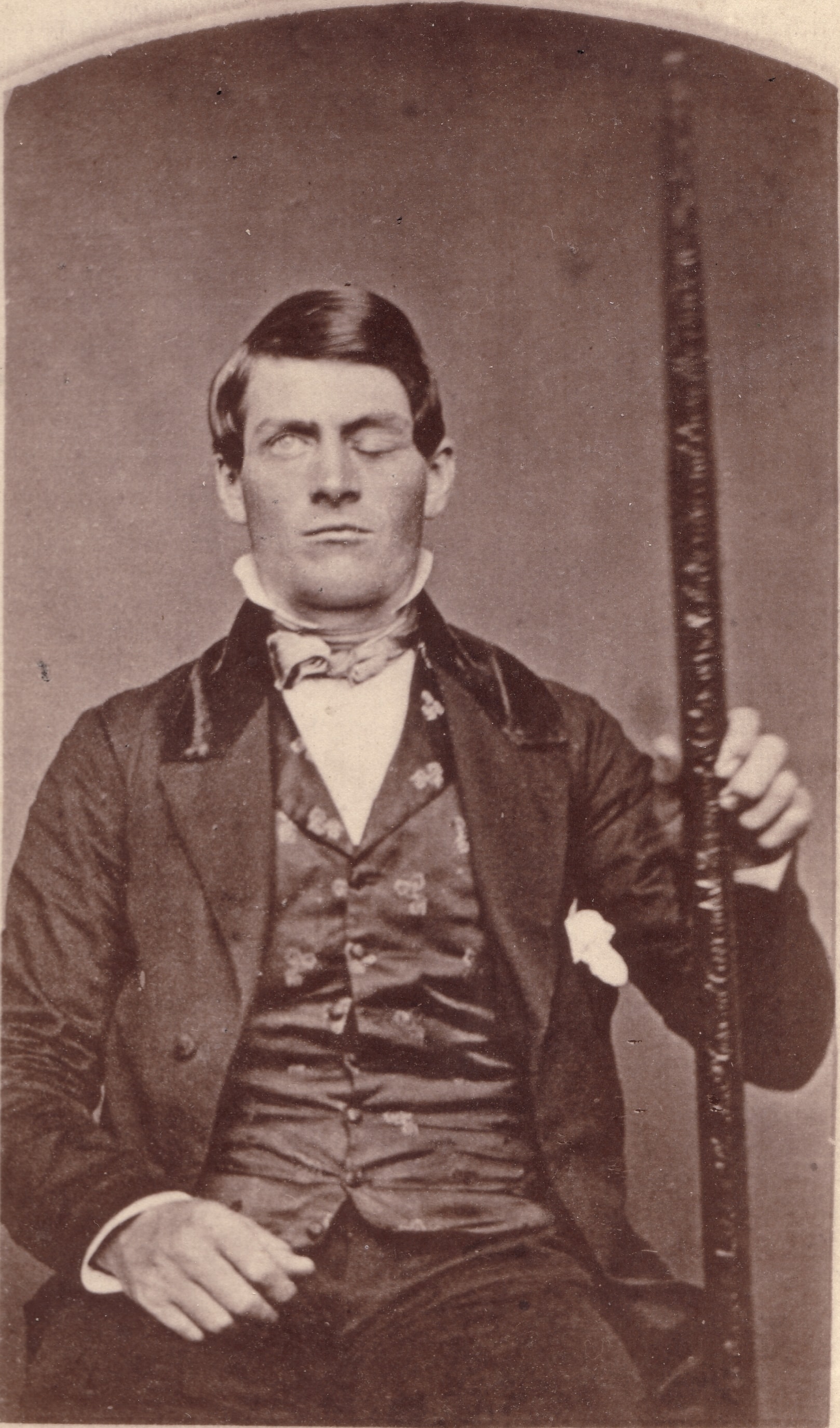
Phineas Gage (1823 to 1860), holding the tamping iron that passed through the front of his brain in a railroad blasting accident in Vermont in 1848. His recovery and reported change of character made him the most famous case in the history of brain science. Cabinet-card portrait, photographer unknown, public domain, via Wikimedia Commons, resized.

See this page's graph and discover linked topics
Cheatsheet
The 30-second reply (read aloud). You're right that the brain matters enormously. Damage it and the mind suffers, and Christians have no reason to deny that. But depending on something is different from being it. Neuroscience shows that the brain and the mind are tightly linked; it has never shown that the feeling of pain, or a thought about tomorrow, or the "I" who has them, is nothing but chemistry. Even many atheist philosophers admit nobody knows how physical processes could produce an inner point of view. And there's a deeper problem: if your thoughts are just chemical reactions, what makes any of them true, including the thought that there is no soul? I think the best explanation is that you are more than your brain. And Christians who disagree with me about the soul still agree on the main thing: death is not the end, because God raises the dead.
The 5 fast facts:
- Dependence is not identity. Brain damage altering the mind fits physicalism, and it fits dualism and hylomorphism too. Every Christian view of the person expects a damaged brain to impair the mind in this life.
- The hard problem is admitted on both sides. David Chalmers named it in 1995: explaining why brain processing is accompanied by experience at all. The atheist philosopher Thomas Nagel argued in 1974 that physical science, as it stands, leaves the subjective point of view out.
- Split-brain patients are less split than the headlines. A 2017 study in Brain by Yair Pinto and colleagues found that split-brain patients could respond to stimuli anywhere in the visual field, and the authors concluded that perception was divided while consciousness remained unified.
- Gage was still Gage. Phineas Gage's personality change after his 1848 injury is real but was exaggerated in retelling. Malcolm Macmillan's research shows he later worked for years as a stagecoach driver in Chile.
- Genesis 2:7 does not settle it either way. Man "became a living soul" (ASV): the Hebrew nephesh chayyah means a living being, the same phrase used of animals. Other texts, such as Matthew 10:28 and 2 Corinthians 5:8, speak of the person continuing beyond bodily death.
The 3 strongest counter-moves:
- "What experiment showed the mind is the brain?" Ask for the study that shows identity, not correlation. Every result offered will be a correlation, however detailed.
- "Is your belief that there's no soul true?" If the belief is only the output of neurons shaped for survival, ask what makes it true rather than merely produced. See Argument from Reason.
- "Which soul are you rejecting?" A ghost in a machine? Aquinas's form of the body? Many objectors are rejecting a picture most Christian theologians never held.
Reciprocal concessions (grant the small point, then collect a bigger one):
- Grant: mental life depends heavily on the brain in this life. Now collect: then the physicalist owes an account of how a brain produces experience, meaning and a single self, which is the part neuroscience has not supplied.
- Grant: Genesis 2:7 calls man a living nephesh, not a body with a soul inside. Now collect: then "soul" in Scripture names the whole living person, and the same Scriptures speak of that person being "absent from the body" and "at home with the Lord" (2 Corinthians 5:8, ASV). The question is how persons survive death, and Scripture answers that they do.
- Grant: some Christians are physicalists. Now collect: then physicalism, even granted, does not refute Christianity. Christian physicalists still affirm God, Christ's resurrection and ours; it is the atheist conclusion that needs the extra premise.
The closing line. The brain is the instrument the mind plays in this life, and when the instrument breaks the music falters. But the music never told us it was made of wood and wire.
In full
The objection runs: (1) every mental function so far studied depends on specific brain activity; (2) damage to the brain impairs or alters those functions, including memory, personality and the sense of self; (3) the simplest explanation is that the mind just is brain activity; (4) therefore there is no soul and no survival of death. Its strongest defenders are not careless. Paul and Patricia Churchland argue that our ordinary vocabulary of beliefs and desires is a folk theory neuroscience will eventually replace (eliminative materialism). Daniel Dennett argues that the "inner theater" of consciousness is an illusion produced by parallel brain processes. Francis Crick put the thesis bluntly: "You, your joys and your sorrows, your memories and your ambitions, your sense of personal identity and free will, are in fact no more than the behavior of a vast assembly of nerve cells and their associated molecules" (The Astonishing Hypothesis, 1994). Jaegwon Kim's causal exclusion argument holds that if every physical event has a sufficient physical cause, a non-physical mind has no work left to do. Sean Carroll argues that the well-tested physics of everyday matter leaves no room for an immaterial soul to push atoms around undetected.
The defeater grants premises (1) and (2) and contests (3) and (4). Five considerations block the step from dependence to identity: correlation underdetermines identity; the hard problem and the knowledge argument show a gap between physical description and experience; intentionality and rational inference resist reduction to causal processes; the unity of consciousness fits poorly with a mind that is a collection of parts; and personal identity persists through total material change. None of these is a proof of the soul, and each is contested in the literature. Together they show that the objection's conclusion is an inference to one disputed metaphysics, which neuroscience by itself cannot deliver.
On the Christian side, the codex does not adopt a single anthropology. Substance dualism (the soul as a distinct immaterial substance), Thomist hylomorphism (the soul as the form of the living body, able to subsist after death), emergent dualism (a soul generated by the brain but not reducible to it) and Christian physicalism (the person as a physical organism, preserved through death by God for resurrection) all have serious Christian defenders. All affirm that persons are made in God's image, that death is not annihilation of hope, and that God will raise the dead. The disagreement among them is real and is laid out below.
Argument structure
| # | Premise | Prong |
|---|---|---|
| P1 | Neuroscience establishes that mental life depends on the brain; it does not establish that mental life is the brain, because every Christian view of the person also predicts that brain damage impairs the mind | Correlation and identity |
| P2 | Physical descriptions of the brain leave out what it is like to have experiences, as the hard problem (Chalmers) and the knowledge argument (Jackson) show; this gap has not been closed | Hard problem |
| P3 | Thoughts are about things and stand in rational relations (true, false, follows from); purely physical states have causes but not, on their own, meanings or truth | Intentionality and reason |
| P4 | Conscious experience is unified in a single subject, which is hard to explain if the subject is a collection of billions of separately operating parts | Unity of consciousness |
| P5 | A person remains the same person through continual material change, which suggests the person is not identical to any particular collection of matter | Personal identity |
| C | The claim that humans have no soul is a contested metaphysical thesis that science has not established. The evidence is consistent with several Christian accounts of the person, and the strongest arguments in the philosophy of mind favor the view that persons are more than their brains |
Form
The page is defensive: it does not need to prove substance dualism, only to show that the objection's conclusion does not follow from its evidence. P1 removes the objection's main support. P2 to P5 are independent positive considerations; any one of them, if sound, is enough to block "you are just your brain," and the defender can lead with whichever the opponent finds strongest. The argument is abductive in shape: it asks which account best explains the full data of mental life, including the data neuroscience cannot measure from the outside.
Grammar and hermeneutics
Some objectors add a biblical twist: "Even the Bible says man is a soul, not that he has one. The soul is just the living body." The texts need to be read on their own grammatical and literary terms, and they do not all point the same way.
- Genesis 2:7, "man became a living soul." "Jehovah God formed man of the dust of the ground, and breathed into his nostrils the breath of life; and man became a living soul" (ASV). The Hebrew is wayhi ha'adam lenephesh chayyah: the verb hayah with the preposition le- means "became," and nephesh chayyah means "a living being." The same phrase is used of animals: "living creatures" (Genesis 1:20, 1:24) and "every living creature" (Genesis 2:19). The objector is right that this verse does not describe a soul placed inside a body. It describes a whole living being, animated by God's own "breath of life" (nishmat chayyim). Read on its own, the verse does not settle whether anything of the person survives death. See H5315 - nephesh and H2416 - chay.
- The range of nephesh and psychē. Both words cover life, the inner self, appetite and the whole person. When Jesus asks what a man is profited if he "forfeit his life (psychē)" (Matthew 16:26, ASV), psychē means life. Context decides each case, so neither side can win by citing the word alone. Some Old Testament texts speak of the nephesh departing at death ("as her soul was departing (for she died)," Genesis 35:18, ASV) and returning (1 Kings 17:21-22), though these can be read as the life-breath leaving and returning. See G5590 - psyche.
- Matthew 10:28, body and soul distinguished. "Be not afraid of them that kill the body, but are not able to kill the soul: but rather fear him who is able to destroy both soul and body in hell" (ASV). The Greek sets to sōma against tēn psychēn as objects of the same verb, apokteinō, "kill." Human killers can do the first and not the second. If psychē here meant only biological life, the first clause would contradict itself, since killing the body ends biological life. Here the word must name something of the person that bodily death does not reach. The second clause says God "is able to destroy (apolesai) both soul and body in Gehenna"; conditionalists read apolesai as final destruction and traditionalists as ruin, but on either reading the soul is something other than the body that men can kill. Christian physicalists such as Joel Green read psychē as the person's life as held and secured by God. See G4983 - soma and G1067 - geenna.
- 2 Corinthians 5:8, absent from the body. "We are of good courage, I say, and are willing rather to be absent from the body, and to be at home with the Lord" (ASV). The two aorist infinitives, ekdēmēsai ek tou sōmatos ("to be away from home, out of the body") and endēmēsai pros ton kyrion ("to be at home with the Lord"), echo verse 6, where being "at home in the body" means being "absent from the Lord." Paul treats being out of the body and with the Lord as a real condition a person can be in. In the same passage he shrinks from being "found naked" or "unclothed" (5:3-4) and longs for the resurrection body, which is why most interpreters read 5:8 as an intermediate state between death and resurrection. Philippians 1:23-24 runs in parallel: "to depart and be with Christ" set against "to abide in the flesh" (ASV). Some interpreters, including some Christian physicalists, argue that for the one who dies there is no experienced interval before resurrection, so "with the Lord" can be read without a separable soul; the plainest reading of the syntax favors a personal presence with Christ before the resurrection.
- Ecclesiastes 12:7, the spirit returns. "The dust returneth to the earth as it was, and the spirit returneth unto God who gave it" (ASV). The verse deliberately reverses Genesis 2:7 and 3:19: dust goes back to dust, and the ruach goes back to its giver. Ruach can mean breath; the same book says of humans and beasts "they have all one breath (ruach)" (Ecclesiastes 3:19) and asks "who knoweth the spirit of man, whether it goeth upward" (3:21). On grammatical grounds alone, 12:7 shows that the life God gave returns to God; it does not by itself describe a conscious self. It is better used as one strand in a wider case than as a proof text. The Westminster Confession (32.1) echoes its wording when it teaches that the souls of the dead "neither die nor sleep" but "immediately return to God who gave them." See H7307 - ruach.
- Wider canonical witness. Jesus answers the Sadducees that God "is not the God of the dead, but of the living" (Matthew 22:32, ASV), and Luke adds "for all live unto him" (Luke 20:38). After the resurrection the disciples think they are seeing a spirit, and Jesus does not deny the category: "a spirit hath not flesh and bones, as ye behold me having" (Luke 24:39, ASV). Jesus commits His spirit (pneuma) to the Father at death (Luke 23:46), and Stephen prays "Lord Jesus, receive my spirit" (Acts 7:59). The Old Testament pictures the dead in Sheol as diminished but able to speak (Isaiah 14:9-10). See G4151 - pneuma and H7585 - sheol.
Verdict on the text. The biblical words "soul" and "spirit" do not map neatly onto Descartes's immaterial substance, and the objector scores a fair point against popular Christian talk of a soul "inside" the body. But the same Scriptures speak repeatedly of persons continuing with God after bodily death and awaiting the resurrection. The text rules out the atheist conclusion that death is the end of the person; it leaves Christians to debate how persons continue.
P1, Dependence is not identity
Affirmative case
- Every Christian view predicts the data. On substance dualism the brain is the soul's instrument in embodied life; on hylomorphism the soul is the form of the body and acts through bodily organs; on Christian physicalism the person is the organism. All three expect strokes, tumors, drugs and dementia to impair memory, speech and character. The data of brain damage cannot decide between views that all predict it.
- Correlation underdetermines identity. Finding that a mental event always accompanies a brain event is consistent with identity, with causation in one or both directions, and with the brain being the necessary condition of the mind's expression. William James argued in his 1898 Ingersoll Lecture Human Immortality that the brain could have a "transmissive" function rather than a "productive" one, and that the medical evidence did not distinguish between them. The same structure of evidence, however detailed, will not settle the question by itself.
- The best-known cases are weaker than their reputation. Phineas Gage's injury (Vermont, 1848) did change him, but Malcolm Macmillan's study An Odd Kind of Fame (2000) showed that later retellings inflated the change, and that Gage worked for years afterwards as a stagecoach driver in Chile. Split-brain patients, studied by Roger Sperry and Michael Gazzaniga from the 1960s, show striking dissociations in the lab, yet in daily life they present as one person, and Pinto and colleagues (Brain, 2017) found evidence of one unified consciousness with divided perception. Sperry himself came to reject reductive materialism and argued that consciousness has real causal power.
Anticipated objections
- "Correlation this tight, at this resolution, is identity. Every time we look closer, we find the brain doing the work."
- "Interaction is impossible. A non-physical soul would have to move particles, violating conservation of energy; physics shows no such violations" (Sean Carroll, Jaegwon Kim).
- "If the soul survives without the brain, why can't it remember things when the brain is damaged?"
Rebuttals
- Finer resolution leaves the question where it was. Finer mapping produces finer correlations; the question is what the correlated items are. A perfect map of which neurons fire when you see red still leaves open whether the seeing is the firing (see P2). Identity is a philosophical claim about the correlation, and has to be argued for, not read off the scanner.
- The interaction objection is contested within physics and philosophy. Conservation of energy holds for causally closed systems, so assuming it against dualism assumes the point at issue. Robin Collins ("Modern Physics and the Energy-Conservation Objection to Mind-Body Dualism," American Philosophical Quarterly, 2008) argues that energy conservation in modern physics is a consequence of particular symmetries and does not straightforwardly forbid mind-body interaction. Hylomorphists add that the soul does not push particles at all; it is the form of the body, the principle that makes this matter a living human being. Kim's exclusion argument, for its part, threatens every non-reductive view of mind, including the property dualism many naturalists hold. See Substance Dualism and Property Dualism.
- Embodied memory is expected. On dualist and hylomorphic views alike, a soul acting through a brain in this life depends on the brain for remembering and expressing. What it would be like without a body is a separate question Christian theology answers modestly: the intermediate state is real but incomplete, and the hope is resurrection.
Live-cite kit
- Scripture: Psalm 139:13-14 ("thou didst form my inward parts"), God's care in the making of the body
- Scholarly: William James, Human Immortality (1898); Malcolm Macmillan, An Odd Kind of Fame: Stories of Phineas Gage (MIT, 2000); Yair Pinto et al., "Split brain: divided perception but undivided consciousness," Brain (2017); Robin Collins (2008)
- Aphorism: "A broken radio goes silent. That tells you about the radio. Whether there was a broadcast is another question."
Tactical notes
- Lead with the pianist or radio analogy, then ask the opponent to name the experiment that distinguishes dependence from identity.
- Do not claim neuroscience supports dualism. Claim only that it does not refute it.
P2, The hard problem
Affirmative case
- Experience has an inside. Thomas Nagel's "What Is It Like to Be a Bat?" (Philosophical Review, 1974) argued that a complete physical account of a bat's sonar would leave out what it is like to be the bat. David Chalmers ("Facing Up to the Problem of Consciousness," 1995; The Conscious Mind, 1996) separated the "easy problems" of explaining functions from the "hard problem" of explaining why any of it is felt.
- The knowledge argument. Frank Jackson's Mary ("Epiphenomenal Qualia," Philosophical Quarterly, 1982) knows every physical fact about color vision but has lived in a black-and-white room. When she first sees red, she seems to learn something new. If so, not all facts are physical facts.
- No derivation exists. Wetness can be derived from molecular structure; nobody can derive the felt quality of pain from a description of neurons. The full case is made at Consciousness Emerges from Neurons Objection Defeater.
Anticipated objections
- "Jackson himself gave up the knowledge argument and became a physicalist."
- "The hard problem is an illusion. There is no extra 'what it is like' to explain" (Dennett; Keith Frankish's illusionism).
Rebuttals
- True, and it does not end the debate. Jackson abandoned the argument from the late 1990s, holding that Mary gains a new way of representing old facts. Many philosophers who are not theists, Chalmers and Nagel among them, still find the argument sound in substance, and the "new way of knowing old facts" reply itself has to explain what the new way is without bringing experience back in. An argument does not stand or fall with its author's later opinion.
- Illusion presupposes experience. An illusion is something that seems a certain way to someone. Denying that anything seems any way to anyone denies the datum every theory of mind starts from. Most philosophers of mind, theist and atheist, regard illusionism as a minority position.
Live-cite kit
- Scholarly: Nagel (1974; Mind and Cosmos, 2012); Chalmers (1995; 1996); Jackson (1982); Joseph Levine, "Materialism and Qualia: The Explanatory Gap" (1983)
- Aphorism: "You can map every wire in the stereo and never find the song."
Tactical notes
- Use pain or the taste of coffee, not color science; it keeps the conversation concrete.
- Cite atheist authors (Nagel, Chalmers) so the point is not dismissed as religious special pleading.
P3, Intentionality and reason
Affirmative case
- Aboutness. Franz Brentano (Psychology from an Empirical Standpoint, 1874) made intentionality, the mind's being about things, the mark of the mental. A neuron's firing has causes and effects; it is not, by itself, about Paris or about tomorrow. See Intentionality.
- Meaning does not come from syntax. John Searle, a naturalist, argued with his Chinese Room (1980) that manipulating symbols by rules does not produce understanding. If meaning cannot be built from formal processing, a purely mechanical account of thought is incomplete.
- Reasoning requires grounds. When you infer a conclusion, you believe it because the premises support it. If every belief is fully explained by prior physical causes, the "because" of logic does no work, and the belief that there is no soul is produced, not justified. See Argument from Reason.
Anticipated objections
- "Teleosemantics explains aboutness: a brain state is about X because it was selected to track X."
- "Computers reason. Logic can be implemented in physical machines."
Rebuttals
- Selection explains tracking and leaves meaning unexplained. Natural selection rewards behavior that works, whether or not the beliefs behind it are true, as Alvin Plantinga's evolutionary argument against naturalism presses. Teleosemantic theories face well-known problems of indeterminacy (is the frog's detector about flies, or small dark moving things?), which suggests the content is not fixed by the physical story alone.
- Computers implement logic designed by minds. A calculator's outputs count as arithmetic because people built and interpret it. The question is where meaning comes from in the first place. See AI Consciousness Proves Mind Is Computation (Defeater).
Live-cite kit
- Scholarly: Brentano (1874); Searle, "Minds, Brains, and Programs" (1980); C. S. Lewis, Miracles (1947), ch. 3; Victor Reppert, C. S. Lewis's Dangerous Idea (2003); Plantinga, Where the Conflict Really Lies (2011)
- Aphorism: "If my thoughts are only chemistry, so is your argument that they are."
P4, The unity of consciousness
Affirmative case
- One subject, many contents. At this moment you see the page, hear a sound and feel the chair, and all three are experienced by one subject at once. The brain processes them in different regions.
- Leibniz's mill. Leibniz imagined walking inside a thinking machine enlarged to the size of a mill: you would find only parts pushing parts, and nothing to explain perception (Monadology 17, 1714).
- Hasker's argument. William Hasker (The Emergent Self, 1999) argues that a unified experience cannot be a collection of separate states distributed across parts, since no single part has the whole experience. Hasker concludes for an "emergent" soul produced by the brain but not reducible to it.
Anticipated objections
- "The brain binds information through synchronized activity. Unity is a neural achievement."
- "Split-brain cases show the unity breaks when the brain is cut."
Rebuttals
- Binding explains how information is coordinated. Synchrony explains how signals are integrated; it does not explain how the integration is experienced by one someone. That is the hard problem again, at the level of the self.
- The split-brain evidence is contested and cuts both ways. As in P1, recent work finds unified consciousness with divided perception, and patients do not report becoming two people.
P5, Personal identity through change
Affirmative case
- The matter changes, the person remains. Through metabolism the atoms and molecules that make up a body are continually exchanged over a lifetime. Yet you are the same person who was once a child, responsible for promises you made and remembering what happened to you.
- Identity is all-or-nothing. Thomas Reid (Essays on the Intellectual Powers of Man, 1785) argued that personal identity, unlike the identity of a ship or a river, does not come in degrees. Richard Swinburne (The Evolution of the Soul, 1986) argues that no amount of physical and psychological continuity entails that a later person is you, so the fact of who you are is something further.
Anticipated objections
- "Identity is just psychological and physical continuity. Ships and rivers persist through change too."
- "Derek Parfit showed identity is not what matters."
Rebuttals
- Ships and rivers are identical by convention. Whether a rebuilt ship is "the same ship" depends on how we choose to use words. Whether the person who suffers tomorrow is you does not seem to be a matter of convention, which is why the thought experiments of duplication and fission feel troubling.
- Parfit accepted the cost. In Reasons and Persons (1984) Parfit concluded that, on a reductionist view, identity is not what matters, and found the conclusion liberating. Most people find it a reason to doubt the reductionist premise. The objector who takes Parfit's route has to accept that "will I survive?" may have no answer.
Near-death experiences, weighed
Near-death experiences are often raised on both sides. The codex treats them with care: the evidential weight rests on the small set of cases with verified perception during clinical crisis, not on the visions themselves; prospective studies such as AWARE II have not yet produced a hidden-target identification; and mainstream medicine has not endorsed a dualist reading. The Christian doctrine of the person does not stand or fall with this research. See NDEs (Near Death Experiences) and DMT Explains Near-Death Experiences Objection Defeater.
The Christian options on the person
Christians who accept the full authority of Scripture hold different accounts of the human person. The codex sets them out without choosing among them.
| View | The claim | Leading defenders | How the person survives death |
|---|---|---|---|
| Substance dualism | The soul is a distinct immaterial substance, united with the body in this life | Augustine; Descartes; Richard Swinburne; J.P. Moreland and Scott Rae (Body and Soul, 2000); John W. Cooper's "holistic dualism" (Body, Soul, and Life Everlasting, 1989) | The soul continues in an intermediate state with God, awaiting the resurrection of the body |
| Hylomorphism (Thomist) | The rational soul is the form of the body, what makes this matter a living human; the Council of Vienne (1312) taught that the soul is of itself and essentially the form of the body | Thomas Aquinas (Summa Theologiae I q.75-76); Eleonore Stump; Edward Feser | The soul subsists after death but incomplete; Aquinas wrote anima mea non est ego, "my soul is not I" (on 1 Corinthians 15), so full personal life awaits the resurrection |
| Emergent dualism | The brain gives rise to a soul that is a new, non-physical individual and can be sustained by God apart from the brain | William Hasker (The Emergent Self, 1999) | God sustains the emergent self through death until resurrection |
| Christian physicalism | The person is a physical organism; "soul" names the person's capacities for relationship with God and others | Nancey Murphy (Bodies and Souls, or Spirited Bodies?, 2006); Joel B. Green (Body, Soul, and Human Life, 2008); Kevin Corcoran; Peter van Inwagen | God raises the person at the resurrection; philosophers propose models for how the same person returns (van Inwagen, 1978; Dean Zimmerman, 1999) |
| Resurrection-only / soul sleep | The dead are unconscious until the resurrection | Seventh-day Adventists and some other Protestant groups. Oscar Cullmann's lecture Immortality of the Soul or Resurrection of the Dead? is often cited for its resurrection emphasis, though Cullmann himself spoke of the dead as sleeping "with Christ" | No conscious interval; the person is raised at the last day. See Conditional Immortality and Seventh-day Adventism |
Where they agree. Every view affirms that humans are made in God's image (Imago Dei), that the body is good and not a prison, that death is an enemy, and that the final hope is the Resurrection of the Body. Classical Protestant confessions, such as the Westminster Confession (32.1), and Catholic and Orthodox teaching hold to conscious existence between death and resurrection; John Calvin wrote Psychopannychia against soul sleep. Christian physicalists and resurrection-only Christians dissent from that consensus while keeping the resurrection.
Why the disagreement does not help the objector. The atheist conclusion is that death is the end of the person. None of the Christian views accepts that. Even if physicalism about humans were proven, the question of whether God exists and raises the dead would remain open, and it would be decided on other grounds, above all the evidence for Christ's own Resurrection.
Conclusion
The claim that humans have no soul is a contested metaphysical thesis that science has not established. Neuroscience has shown how deeply the mind depends on the brain; it has not shown that experience, meaning, reason, a unified self and personal identity are nothing but brain activity. Those features remain the hardest problems in the philosophy of mind, admitted as such by leading atheist philosophers. Christians may reasonably hold that persons are more than their brains, and have several careful accounts of how. What the objection cannot deliver is its conclusion that death is the end.
Master objections to the defeater as a whole
- "This is a soul of the gaps. Science will close these gaps." The gaps listed here are conceptual: they concern what a feeling, a meaning or a self is, and no quantity of extra data fills a conceptual gap. More data about neurons is still data about neurons. If physicalism is true it will be shown by an account that closes the conceptual gap, and none exists yet.
- "Christians can't even agree what a soul is." Disagreement about the account is compatible with agreement about the fact. Physicists disagree about the interpretation of quantum mechanics without doubting that atoms exist.
- "Animals have brains and minds too. Do they have souls?" Aristotle and Aquinas said yes: every living thing has a soul in the sense of a life-principle, and humans have a rational soul. Scripture calls animals nephesh chayyah too (Genesis 1:24). The question is what is distinctive of humans, and Scripture locates it in the image of God.
Tactical opening / closing
Opening line: "I agree the brain matters more than most people realize. So let's be precise: what result in neuroscience shows that the mind is the brain, rather than that it depends on the brain?"
Closing landing strip: "We've agreed that your mind depends on your brain. We haven't found any reason to think a thought about truth is just a chemical event, or that you are just the atoms you happen to have this year. If you're more than your brain, the question of what happens at death is wide open, and I'd like to show you why I think the answer is resurrection."
Live-cite kit
- Scripture: Genesis 2:7 (a living being, from dust and divine breath); Matthew 10:28 (body killed, soul untouched); 2 Corinthians 5:8 (absent from the body, at home with the Lord); Philippians 1:23; Luke 23:46; Matthew 22:32
- Physicalist case: Patricia Churchland, Neurophilosophy (1986) and Touching a Nerve (2013); Paul Churchland, "Eliminative Materialism and the Propositional Attitudes" (Journal of Philosophy, 1981); Daniel Dennett, Consciousness Explained (1991); Francis Crick, The Astonishing Hypothesis (1994); Jaegwon Kim, Mind in a Physical World (1998); Sean Carroll, The Big Picture (2016)
- Replies: Thomas Nagel (1974); David Chalmers (1995, 1996); Frank Jackson (1982); William Hasker (1999); Richard Swinburne (1986); J.P. Moreland and Scott Rae (2000); Cooper (1989)
- Christian physicalism: Warren S. Brown, Nancey Murphy and H. Newton Malony, eds., Whatever Happened to the Soul? (1998); Murphy (2006); Green (2008)
- Aphorism: "Depending on the brain and being the brain are two different claims, and neuroscience has only ever shown the first."
Scholarship
Published academic works this page draws on, each matched to a publisher, index or library catalog record.
- Sean M. Carroll, The Big Picture (2016). Open Library
- David J. Chalmers, The Conscious Mind: In Search of a Fundamental Theory (Oxford University Press, 1996). Open Library
- David J. Chalmers, "Facing Up to the Problem of Consciousness," Toward a Science of Consciousness (1996). doi:10.7551/mitpress/6860.003.0003
- Patricia Smith Churchland, Neurophilosophy (1986). Open Library
- Patricia Smith Churchland, Touching a Nerve (2013). Open Library
- John W. Cooper, Body, soul, and life everlasting (1989). Open Library
- Francis Crick, The astonishing hypothesis (1993). Open Library
- Daniel C. Dennett, Consciousness explained (1991). Open Library
- Joel B. Green, Craig Bartholomew and Christopher Seitz, Body, Soul, and Human Life (2008). Open Library
- William Hasker, The emergent self (1999). Open Library
- William James, Human immortality: Two supposed objections to the doctrine (Houghton, Mifflin and Company, 1898). doi:10.1037/10997-000
- Jaegwon Kim, Mind in a Physical World: An Essay on the Mind-Body Problem and Mental Causation (The MIT Press, 1998). doi:10.7551/mitpress/4629.001.0001
- Joseph Levine, "Materialism And Qualia: The Explanatory Gap," Pacific Philosophical Quarterly 64 (1983). doi:10.1111/j.1468-0114.1983.tb00207.x
- Nancey Murphy, Bodies and Souls, or Spirited Bodies? (Cambridge University Press, 2006). doi:10.1017/cbo9780511802805
- Thomas Nagel, Mind and Cosmos: Why the Materialist Neo-Darwinian Conception of Nature is Almost Certainly False (Oxford University Press, 2012). doi:10.1093/acprof:oso/9780199919758.001.0001
- Derek Parfit, Reasons and Persons (Oxford University Press, 1984). Open Library
- Yair Pinto et al., "Split brain: divided perception but undivided consciousness," Brain (2017). doi:10.1093/brain/aww358 PubMed 28122878
- Alvin Plantinga, Where the Conflict Really Lies (2011). Open Library
- Victor Reppert, C.S. Lewis's dangerous idea (2003). Open Library
- John R. Searle, "Minds, brains, and programs," Behavioral and Brain Sciences 3 (1980). doi:10.1017/s0140525x00005756
- Richard Swinburne, The evolution of the soul (1986). Open Library
See also
- Soul, the short answer on what Christians mean by the soul
- Mind, Soul, Consciousness, the mind-body problem in five positions and its apologetic use
- Substance Dualism, the classic case for the soul as a distinct substance
- Property Dualism, the middle view many naturalists hold
- Reductionism, why "made of parts" is a different claim from "nothing but parts"
- Consciousness Emerges from Neurons Objection Defeater, the full treatment of the hard problem and emergence
- God Cannot Be Conscious Without a Brain Objection Defeater, the companion claim that every mind needs a brain
- AI Consciousness Proves Mind Is Computation (Defeater), the machine version of the objection
- Argument from Consciousness, the positive argument from mind to God
- Argument from Reason, why reasoning resists reduction to causes
- Resurrection of the Body, the hope every Christian view of the person shares
- Soul and Spirit, Origin and Awareness, on the soul-spirit distinction and trichotomy
- H5315 - nephesh, G5590 - psyche, G4151 - pneuma, H7307 - ruach, the biblical vocabulary
Common questions this page answers
Q: Has neuroscience proven that humans don't have a soul?
No. Neuroscience has shown in great detail that the mind depends on the brain in this life, which every Christian view of the person expects. It has not shown that experience, thought and the self are identical to brain activity, and leading philosophers, including atheists like Thomas Nagel and David Chalmers, regard how the brain produces consciousness as an unsolved problem.
Q: If brain damage changes your personality, doesn't that prove there's no soul?
It proves the mind depends on the brain, which is different from proving the mind is the brain. A broken instrument silences a musician without showing that the musician was the instrument. Substance dualists, Thomists and Christian physicalists all predict that brain injury affects the mind in this life.
Q: Does the Bible say we are a soul or that we have a soul?
Both ways of speaking have support. Genesis 2:7 says man "became a living soul," meaning a whole living being, the same phrase used of animals. But other texts speak of the soul surviving what kills the body (Matthew 10:28) and of being "absent from the body" and "at home with the Lord" (2 Corinthians 5:8). Scripture teaches that persons continue after death, and Christians debate exactly how.
Q: Do split-brain patients have two souls?
The evidence does not show that. Split-brain patients show striking effects in laboratory tests, but they live and report as one person, and a 2017 study in the journal Brain found evidence of unified consciousness alongside divided perception. The cases are interesting for every theory of mind and do not settle the soul question.
Q: Can a Christian believe humans are entirely physical?
Some do. Christian physicalists such as Nancey Murphy and Joel Green hold that the person is a physical organism and that God will raise the dead. This is a minority view, and most Christian traditions teach conscious existence with God between death and resurrection, but all these views agree that death is not the end of the person.
Q: What is the hard problem of consciousness?
It is the question of why physical processing in the brain is accompanied by felt experience at all, why there is something it is like to see red or feel pain. The philosopher David Chalmers named it in 1995, and it is widely regarded as unsolved by any purely physical theory.