Person
Hiram of Tyre
Hiram I, Hiram I of Tyre, Hiram king of Tyre, King Hiram, Huram king of Tyre, HiromIntro
Hiram was king of Tyre, the great Phoenician port city, in the tenth century BC. He sent cedar wood, carpenters and masons to build David's palace, and later supplied the cedar and fir and the skilled workmen for Solomon's Temple in exchange for wheat and olive oil. His sailors joined Solomon's fleet on voyages to Ophir for gold. The Bible calls him "ever a lover of David," and he and Solomon made a treaty and called each other "brother."
No inscription of Hiram himself has been found, but the Jewish historian Josephus quotes two Greek historians who drew on the royal records of Tyre and describe the same king and his friendship with Solomon.
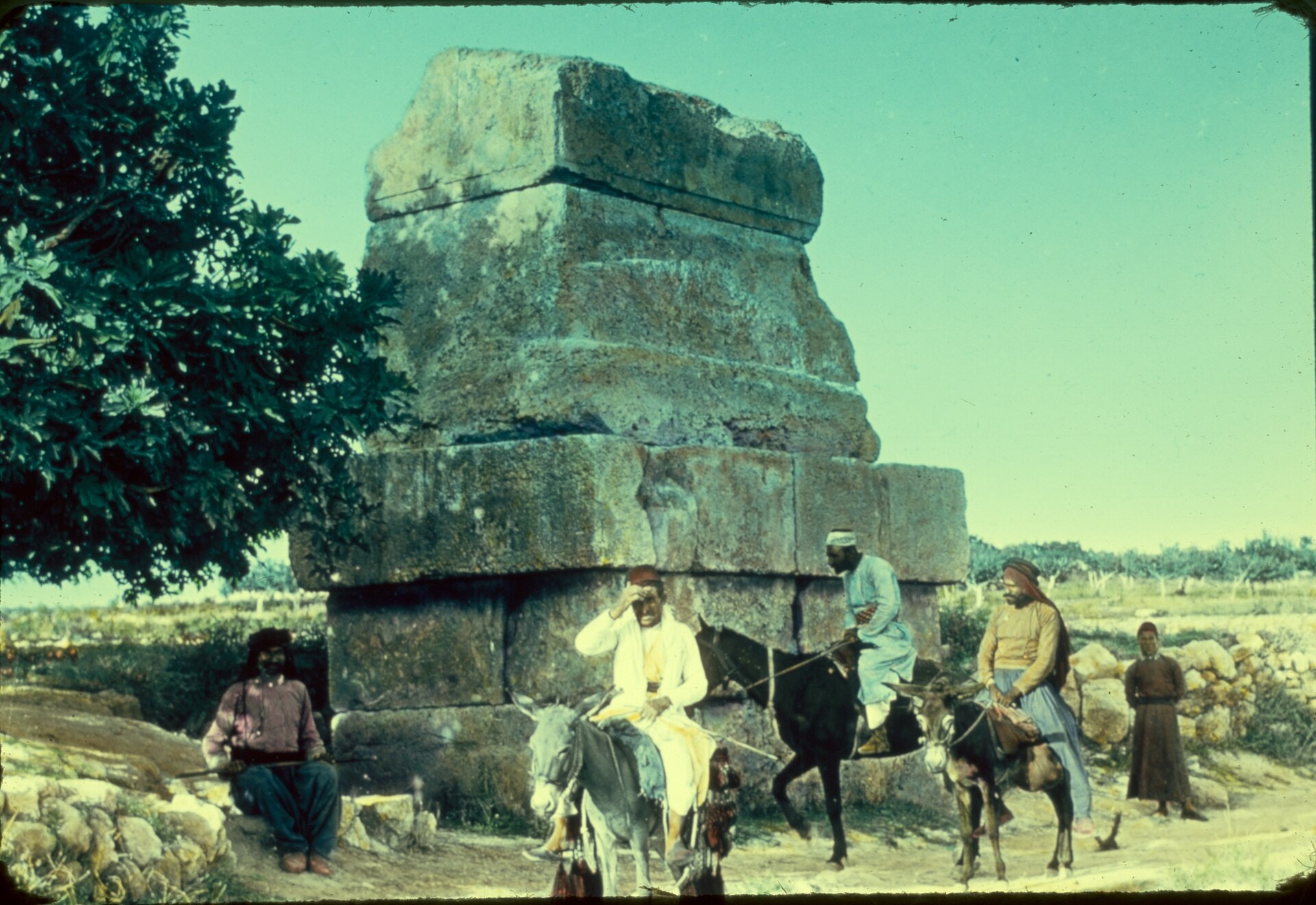
The monument near Tyre known locally as Qabr Hiram, the "Tomb of Hiram," early twentieth century. The attribution to Hiram is traditional; archaeologists date the monument to the Persian period, centuries after his reign. Photo: American Colony (Jerusalem) Photo Department, G. Eric and Edith Matson Photograph Collection, Library of Congress, public domain, via Wikimedia Commons, resized.

The 30-second version:
Hiram king of Tyre was David's and Solomon's ally. He sent cedar and builders for David's palace and Solomon's Temple, was paid in wheat and oil, and sent his sailors with Solomon's fleet to Ophir. Josephus quotes Menander of Ephesus and Dius, who used the archives of Tyre: Hiram son of Abibalus reigned thirty-four years, rebuilt Tyre's temples, and traded riddles with Solomon, and the Temple in Jerusalem was built in his twelfth year.
See this page's graph and discover linked topics
In full
Hiram I, son of Abibaal, ruled Tyre at the start of its rise as the leading Phoenician city. Josephus, Against Apion 1.106-127, preserves two independent Greek summaries of Tyrian history. Dius says Hiram enlarged the city, joined the island temple of Zeus (Baal Shamem) to the city, adorned it with gold, and exchanged riddles with Solomon. Menander of Ephesus, who Josephus says translated the Tyrian archives into Greek, gives a king list: on the death of Abibalus "his son Hirom took the kingdom; he lived fifty-three years, and reigned thirty-four," built new temples to Heracles (Melqart) and Astarte, and was succeeded by his son Baleazar. Josephus computes from Menander's list that the Temple in Jerusalem was founded in Hiram's twelfth year and that 143 years and eight months separated it from the founding of Carthage. That Tyrian king list is one of the anchors used to date Solomon's reign.
The evidence is literary and indirect: Hellenistic writers reporting earlier Phoenician records, quoted by a first-century Jewish apologist. It is also independent of the Bible in origin, and its details (father's name, regnal years, building works) are of the kind found in genuine king lists. The usual dating of his reign, c. 980 to 947 BC, depends on combining this list with the biblical chronology.
In the Bible
- David's palace. "Hiram king of Tyre sent messengers to David, and cedar-trees, and carpenters, and masons; and they built David a house" (2 Samuel 5:11, ASV; also 1 Chronicles 14:1).
- Friendship with Solomon. "Hiram king of Tyre sent his servants unto Solomon; for he had heard that they had anointed him king in the room of his father: for Hiram was ever a lover of David" (1 Kings 5:1, ASV).
- The Temple contract. Solomon asked for cedars, "for thou knowest that there is not among us any that knoweth how to cut timber like unto the Sidonians" (5:6, ASV). "Hiram gave Solomon timber of cedar and timber of fir according to all his desire. And Solomon gave Hiram twenty thousand measures of wheat for food to his household, and twenty measures of pure oil" (5:10-11, ASV). "There was peace between Hiram and Solomon; and they two made a league together" (5:12, ASV). Solomon's builders, Hiram's builders and the Gebalites (men of Byblos) prepared the stone and timber (5:18).
- Chronicles' version. In 2 Chronicles 2 the king is called Huram, and his letter to Solomon blesses "Jehovah, the God of Israel, that made heaven and earth, who hath given to David the king a wise son" (2 Chronicles 2:12, ASV).
- The cities of Cabul. Solomon gave Hiram twenty towns in Galilee, which displeased him: "What cities are these which thou hast given me, my brother? And he called them the land of Cabul" (1 Kings 9:11-13, ASV). Hiram sent Solomon 120 talents of gold (9:14).
- The fleet to Ophir. "Hiram sent in the navy his servants, shipmen that had knowledge of the sea, with the servants of Solomon. And they came to Ophir, and fetched from thence gold" (9:27-28, ASV; also 10:11, 22).
- A different Hiram. The bronze-worker Hiram (Huram-abi) of 1 Kings 7:13-14 and 2 Chronicles 2:13-14, son of a widow of Naphtali and a Tyrian father, is a different man from the king.
Family and lineage
- Father: Abibaal (Abibalus in Josephus' sources). He is not named in the Bible.
- Son and successor: Baal-eser (Baleazar), according to Menander.
- He is not related by blood to Israel's royal house; the "brother" language of 1 Kings 9:13 is the standard vocabulary of ancient treaties between kings of equal standing.
Historical and archaeological evidence
- Menander of Ephesus and Dius, quoted by Josephus. Against Apion 1.106-127; also Antiquities book 8, where Josephus says copies of the letters between Solomon and Hiram were kept in the Tyrian archives. Both writers present Hiram son of Abibalus as a great builder of Tyre and a contemporary and friend of Solomon. Grade: strong literary attestation; no contemporary inscription.
- No inscription of Hiram I. No monument of Hiram I has been excavated, which is unsurprising, since ancient Tyre lies under the modern city and very little of its tenth-century levels has been explored.
- Easily confused names. "Hiram of Tyre" in the annals and Iran Stele of Tiglath-Pileser III (about 738 BC) is Hiram II, a much later king. The famous inscribed sarcophagus of Ahiram (Byblos, about 1000 BC) belongs to a king of Byblos. The monument called the Tomb of Hiram, near Tyre, is generally dated to the Persian period. None of these is evidence for Hiram I.
- Phoenician craftsmanship. The biblical picture of Phoenician masons and timber-workers serving Israelite kings fits the archaeological record of Phoenician influence on Iron Age architecture and luxury goods in Israel, such as the carved ivories of Samaria, which are later but stylistically Phoenician.
Scholarly consensus
Most historians accept Hiram I as a historical king of Tyre on the strength of Menander's king list, which they regard as derived from genuine Tyrian records, and use it in reconstructing tenth- and ninth-century chronology. Minimalist scholars who doubt the scale of Solomon's kingdom treat the biblical account of the Hiram alliance as an idealized picture written much later, while accepting that Hiram himself is likely historical.
A specific chronological problem is often noted: if Hiram reigned c. 980 to 947 BC, he would have come to the throne late in David's reign, so the cedars of 2 Samuel 5:11, placed right after David's capture of Jerusalem, would be early for him. Proposed solutions include a topical rather than chronological placement of 2 Samuel 5:11 (the chapter gathers notices of David's rise), an early co-regency, or adjustments to the Tyrian figures.
Theological significance
- The nations serve the house of God. A Gentile king provides materials and craftsmen for the Temple, and Chronicles gives him words of praise to "Jehovah, the God of Israel, that made heaven and earth." Later prophets speak of the wealth of the nations and of Tyre coming to the LORD (Isaiah 23:18; 60:5-13; Psalm 45:12).
- Tyre's later pride. The friendship of Hiram's day stands in contrast to the oracles against Tyre in Amos 1:9 (which accuses Tyre of forgetting "the brotherly covenant") and Ezekiel 26 to 28. See Tyre Prophecy Argument and Failed Prophecy of Tyre Objection Defeater.
- Wisdom recognized. Both 1 Kings 5:7 and Dius' account of riddles exchanged between Hiram and Solomon picture Hiram recognizing Solomon's wisdom, a theme shared with the visit of the Queen of Sheba.
Church Fathers
- Theophilus of Antioch, To Autolycus 3.22, cites the record "made by Hiram (that is the name of the king of the Tyrians), the son of Abimalus," and quotes Menander the Ephesian that "in the 12th year of the reign of Hiram the temple in Jerusalem was built," to show that the Jewish Temple and Scriptures are older than the Greek writers.
See also
- People of the Bible, every person on the codex's list, by the book that first names them
- Solomon, his treaty partner
- David, whose palace he helped build
- Josephus, who preserves the Tyrian sources
- Tyre Prophecy Argument, on the later history of Tyre
- Queen of Sheba, another foreign ruler drawn to Solomon
Common questions this page answers
Q: Who was Hiram king of Tyre?
Hiram I was the Phoenician king of Tyre in the tenth century BC who supplied cedar, fir and skilled builders for David's palace and Solomon's Temple, was paid in wheat and olive oil, and joined Solomon in sea trade to Ophir (2 Samuel 5:11; 1 Kings 5; 9).
Q: Is King Hiram mentioned outside the Bible?
Yes, in literary sources. Josephus (Against Apion 1.106-127) quotes Menander of Ephesus and Dius, who drew on Tyrian records: Hiram son of Abibalus reigned thirty-four years, rebuilt Tyre's temples and exchanged riddles with Solomon. No inscription of Hiram I himself has been found.
Q: Was Hiram the king the same person as Hiram the craftsman?
No. The bronze-worker Hiram of 1 Kings 7:13-14 was the son of a widow of Naphtali and a Tyrian father, sent to make the Temple's bronze work. The king of Tyre is a different person with the same name.
Q: Is Hiram's tomb near Tyre real?
A large stone monument near Tyre is traditionally called the Tomb of Hiram, but archaeologists date it to the Persian period, several centuries after Hiram I. It is not evidence for his burial place.