Person
Herod Philip
Herod Philip I, Philip the husband of Herodias, Herodias' first husband, Herod son of Mariamne, Herod II, Herod Boethus, Philip (Mark 6:17)Intro
Herod Philip was a son of Herod the Great and the first husband of Herodias. When Herodias left him to marry his half-brother Herod Antipas, John the Baptist condemned the marriage, and that rebuke led to John's arrest and death. The Gospels call him "his brother Philip."
Unlike several of his brothers, he never ruled any territory. Josephus calls him simply Herod. He is easy to confuse with another son of Herod the Great, Philip the tetrarch, who ruled the lands northeast of the Sea of Galilee.
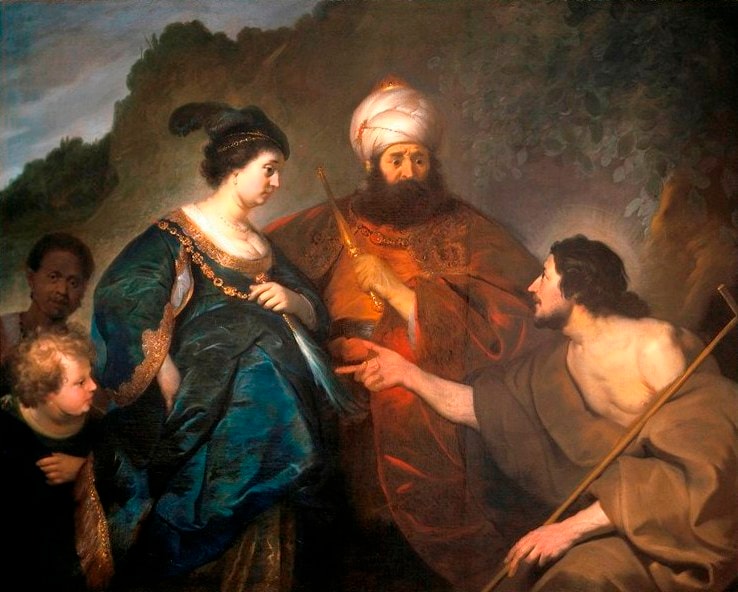
Jacob Adriaensz Backer, John the Baptist Accusing Herod and Herodias (17th century), Fries Museum, Leeuwarden. Public domain, via Wikimedia Commons.

See this page's graph and discover linked topics
In full
Josephus identifies Herodias's first husband as Herod, a son of Herod the Great by Mariamne, the daughter of Simon the high priest (Antiquities 18.136). This Mariamne, usually called Mariamne II to distinguish her from Herod's Hasmonean wife, was one of Herod the Great's ten wives, and her father Simon son of Boethus had been made high priest by Herod.
- Heir, then disinherited. For a time this son was named in Herod's will as heir after Antipater. When Herod learned that Mariamne II had known of Antipater's plot to poison him, he divorced her, removed her father from the high priesthood and struck her son out of his will (Jewish War 1.29.2, 1.30.7).
- Marriage to Herodias. He married his niece Herodias, daughter of his half-brother Aristobulus. They had a daughter, Salome (Antiquities 18.136).
- Divorce. When Herod Antipas visited him on a journey to Rome, "he lodged with Herod, who was his brother indeed, but not by the same mother," and "fell in love with Herodias, this last Herod's wife." Herodias "divorced her self from her husband, while he was alive, and was married to Herod" Antipas (Antiquities 18.109-110, 18.136).
- Private life. Josephus records no office for him; he seems to have lived as a private member of the royal family, probably in Jerusalem or Rome.
In the Bible
- "For Herod had laid hold on John, and bound him, and put him in prison for the sake of Herodias, his brother Philip's wife" (Matthew 14:3, ASV). John had told Antipas, "It is not lawful for thee to have her" (Matthew 14:4, ASV).
- "For Herod himself had sent forth and laid hold upon John, and bound him in prison for the sake of Herodias, his brother Philip's wife; for he had married her" (Mark 6:17, ASV).
- Luke refers to him without naming him: Herod the tetrarch was "reproved by him for Herodias his brother's wife" (Luke 3:19, ASV). Some later manuscripts add "Philip" here; the ASV follows the older text.
The law John invoked forbade a man to marry his brother's wife (Leviticus 18:16; Leviticus 20:21), the one exception being the levirate duty toward the widow of a brother who died childless (Deuteronomy 25:5-6). Philip was alive and had a daughter, which is why Josephus stresses that Herodias left her husband "while he was alive."
Family and lineage
- Father: Herod the Great.
- Mother: Mariamne II, daughter of Simon son of Boethus, high priest.
- Half-brothers: Herod Antipas, Herod Archelaus, Philip the tetrarch, Aristobulus, Alexander and Antipater, among others.
- Wife: Herodias, daughter of his half-brother Aristobulus, who left him for Antipas.
- Daughter: Salome, the dancer of Matthew 14:6-11 and Mark 6:22-28, who later married Philip the tetrarch (Antiquities 18.137).
Historical and archaeological evidence
| Source | What it says | Date | Where it is now | Grade |
|---|---|---|---|---|
| Josephus, Antiquities 18.109-110, 18.136-137 | Son of Herod and Mariamne II; husband of Herodias; father of Salome; Herodias leaves him for Antipas | written c. AD 93-94 | manuscript tradition | contemporary witness, strong |
| Josephus, Jewish War 1.28.4, 1.29.2, 1.30.7 | Herod's arrangements for his sons; this son named in the will, then removed | written c. AD 75 | manuscript tradition | contemporary witness, strong |
As a private man he issued no coins and is named on no known inscription. Lawrence Mykytiuk counts him among the eleven members of the Herodian family confirmed outside the New Testament, on the strength of Josephus, and distinguishes him from Philip the tetrarch ("New Testament Political Figures Confirmed," Biblical Archaeology Review 43:5, 2017). See Biblical Figures Confirmed by Archaeology.
Scholarly consensus
The man himself is secure: Josephus and the Gospels agree that Herodias was first married to a son of Herod the Great and left him, while he lived, for Antipas. The debated question is his name.
- He bore both names. Harold W. Hoehner (Herod Antipas, Cambridge University Press, 1972) and many conservative scholars hold that he was called Herod Philip, Josephus using the dynastic name Herod and the Gospels the personal name Philip. Herodian princes often carried the dynastic name Herod alongside a personal name (Herod Antipas, Herod Archelaus, Herod Agrippa), so a double name is plausible.
- The Gospels confused two brothers. Many critical commentators hold that Mark mixed up Herodias's husband with Philip the tetrarch, who later married Salome, and that Matthew followed Mark.
- Mykytiuk's listing. Mykytiuk lists him as "Herod Philip" and treats him as distinct from the tetrarch, which assumes the double-name solution or at least that the Gospels and Josephus refer to the same man.
The common modern label "Herod II" for him is a scholarly convenience; no ancient source uses it.
Theological significance
- The occasion of John's death. Philip's broken marriage is the background to the prophetic rebuke that cost John the Baptist his life (Mark 6:17-29). John held a king to the law of God on marriage at the cost of his freedom and then his life.
- Marriage and the law. John's words, "It is not lawful for thee to have her," apply Leviticus 18:16 to a royal household that claimed to be Jewish. The Gospels present John as a prophet in the line of Elijah, who confronted Ahab and Jezebel.
- Accurate family detail. The Gospels know that Herodias had been married to a brother of Antipas who was still living, a fact Josephus confirms independently.
Church Fathers
No patristic commentary devoted to Herodias's first husband has been verified; the Fathers discuss the episode under John the Baptist and Herod Antipas.
Scholarship
Published academic works this page draws on, each matched to a publisher, index or library catalog record.
- Harold W. Hoehner, Herod Antipas (1972). Open Library
See also
- Herod the Great, his father
- Herod Antipas, his half-brother, who took his wife
- Herod Archelaus, another half-brother
- Josephus, the historian who names him
- Biblical Figures Confirmed by Archaeology, Mykytiuk's list of confirmed persons
- People of the Bible, the hub of attested biblical people by book
Common questions this page answers
Q: Who was Philip, the brother of Herod, in Matthew 14 and Mark 6?
He was a son of Herod the Great by Mariamne II and the first husband of Herodias. Herodias left him to marry his half-brother Herod Antipas, and John the Baptist's condemnation of that marriage led to John's execution.
Q: Is Herodias's husband Philip the same as Philip the tetrarch?
They are usually distinguished. Philip the tetrarch ruled the lands northeast of the Sea of Galilee and married Salome, Herodias's daughter. Herodias's first husband held no office and is called Herod by Josephus. Some scholars think the Gospels confused the two; others think the first husband was called Herod Philip.
Q: Why did John the Baptist say Herod's marriage to Herodias was unlawful?
The law of Moses forbade a man to marry his brother's wife (Leviticus 18:16). Herodias's first husband, Antipas's half-brother, was still alive when she left him and married Antipas, so the levirate exception (Deuteronomy 25:5-6) did not apply.
Q: Is Herod Philip mentioned outside the Bible?
Yes. Josephus names him as the son of Herod the Great and Mariamne, the husband of Herodias and the father of Salome, and tells how Herodias left him for Antipas.