Person
Herod Antipas
Antipas, Herod the tetrarch, Herod tetrarch of Galilee, King Herod (Mark 6), that fox, Herod AntipaterIntro
Herod Antipas was the son of Herod the Great who ruled Galilee, where Jesus grew up and did most of his ministry. He is the Herod who had John the Baptist arrested and beheaded, the Herod Jesus called "that fox", and the Herod to whom Pilate sent Jesus during his trial.
He ruled for more than forty years. He built the city of Tiberias on the Sea of Galilee and named it after the emperor. The Jewish historian Josephus also tells how he executed John the Baptist, and how many Jews saw his later defeat in war as God's punishment for it. His coins, stamped "of Herod the tetrarch", still survive.
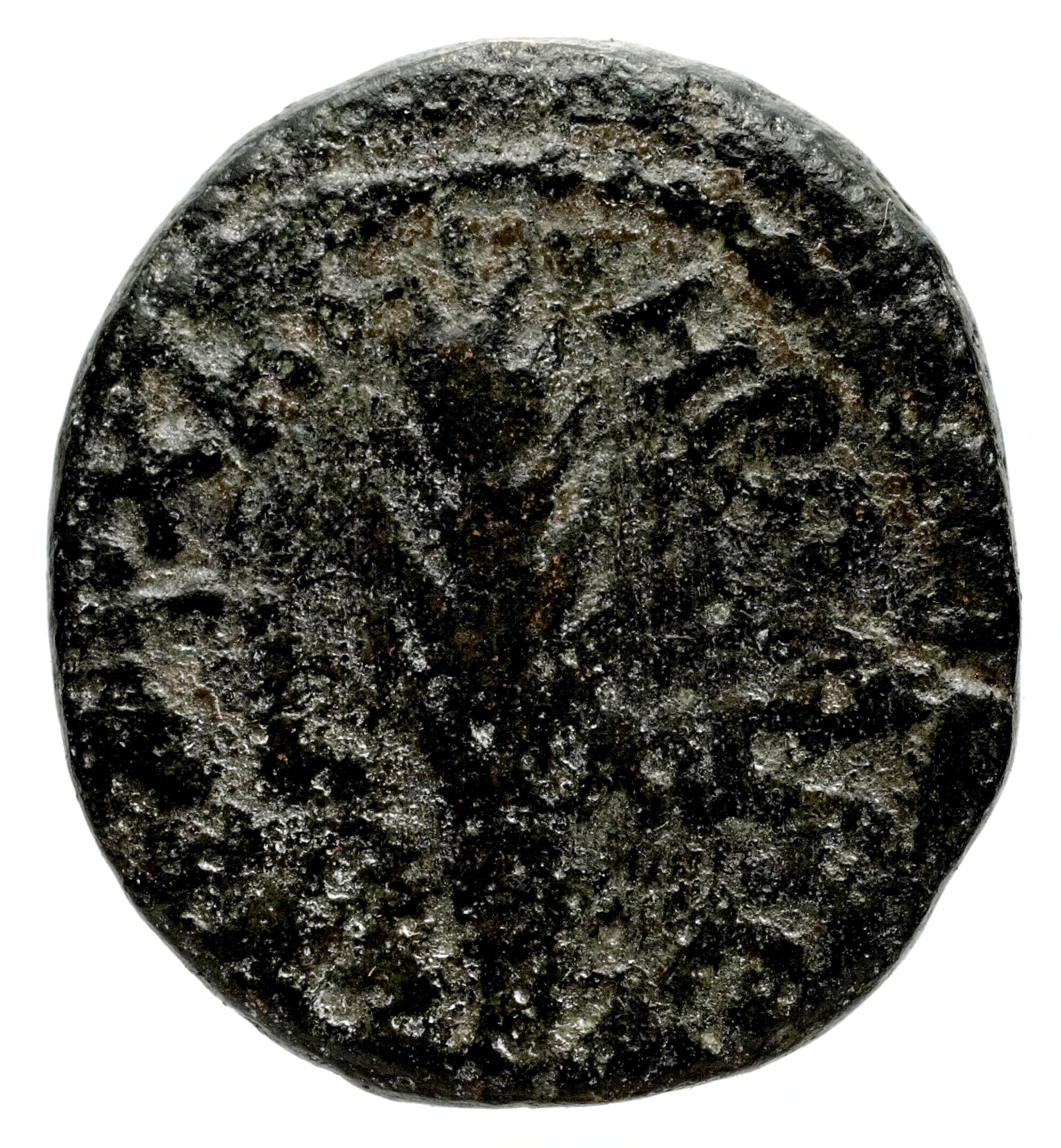
Bronze coin of Herod Antipas, tetrarch of Galilee and Perea (4 BC to AD 39), whose coins carry his name and a reed or palm in place of a portrait. Bibliothèque nationale de France, Cabinet des médailles. Public domain, via Wikimedia Commons, resized.

See this page's graph and discover linked topics
In full
Antipas was a son of Herod the Great by Malthace, a Samaritan, and the younger full brother of Herod Archelaus. When Herod died in 4 BC, Augustus confirmed Antipas as tetrarch of Galilee and Perea, the region east of the Jordan (Josephus, Antiquities 17.318). He held that territory until AD 39, the longest reign of Herod's sons.
- Builder. He rebuilt Sepphoris, a few miles from Nazareth, and founded Tiberias on the western shore of the lake about AD 19/20, naming it for Tiberius (Antiquities 18.27, 18.36-38).
- Marriages. His first wife was a daughter of the Nabataean king Aretas IV. On a visit to Rome he fell in love with Herodias, the wife of his half-brother Herod, and agreed to marry her and divorce Aretas' daughter, who escaped to her father (Antiquities 18.109-112).
- John the Baptist. Josephus reports that Antipas, fearing that John's influence over the crowds might lead to revolt, sent him in chains to the fortress of Machaerus and put him to death there (Antiquities 18.116-119).
- War with Aretas. Aretas, angered by the insult to his daughter and by a border dispute, destroyed Antipas' army in AD 36. Josephus writes that some of the Jews thought this defeat came from God as a just punishment for what Antipas had done to John, "that was called the Baptist" (Antiquities 18.116).
- Fall. When the emperor Gaius (Caligula) made Herodias' brother Agrippa a king, Herodias urged Antipas to go to Rome and ask for a royal title too. Agrippa sent accusations ahead of him, and in AD 39 Gaius deposed Antipas and exiled him. Herodias chose to share his exile (Antiquities 18.240-255). Josephus names the place as Lugdunum in Gaul in Antiquities 18.252; Jewish War 2.183 says Spain.
In the Bible
Antipas appears more often than any other Herod. The Gospels call him "Herod the tetrarch" or simply "Herod", and Mark calls him "king".
- John the Baptist's death. "At that season Herod the tetrarch heard the report concerning Jesus" (Matthew 14:1, ASV), and he concluded that John had risen from the dead. Matthew 14:3-12 and Mark 6:17-29 explain that Herod had imprisoned John "for the sake of Herodias, his brother Philip's wife; for he had married her" (Mark 6:17, ASV), because John told him, "It is not lawful for thee to have thy brother's wife" (Mark 6:18). Mark adds that "Herod feared John, knowing that he was a righteous and holy man, and kept him safe. And when he heard him, he was much perplexed; and he heard him gladly" (Mark 6:20, ASV). At his birthday banquet he swore an oath to the daughter of Herodias and, "for the sake of his oaths", had John beheaded (Mark 6:26).
- Luke's synchronism. "Herod being tetrarch of Galilee" is one of the six rulers by which Luke dates John's ministry (Luke 3:1, ASV). Luke notes that John reproved him "for Herodias his brother's wife, and for all the evil things which Herod had done" (Luke 3:19, ASV).
- Curiosity about Jesus. "John I beheaded: but who is this, about whom I hear such things? And he sought to see him" (Luke 9:9, ASV).
- "That fox." When Pharisees warned that Herod wanted to kill him, Jesus answered, "Go and say to that fox, Behold, I cast out demons and perform cures to-day and to-morrow, and the third day I am perfected" (Luke 13:32, ASV).
- The leaven of Herod. "Take heed, beware of the leaven of the Pharisees and the leaven of Herod" (Mark 8:15, ASV). Mark also mentions the Herodians, his partisans, plotting with the Pharisees (Mark 3:6; 12:13).
- The trial of Jesus. Only Luke records it: learning that Jesus was "of Herod's jurisdiction", Pilate sent him to Herod, who was in Jerusalem for the feast. "When Herod saw Jesus, he was exceeding glad: for he was of a long time desirous to see him... and he hoped to see some miracle done by him" (Luke 23:7-8, ASV). Jesus did not answer him; Herod and his soldiers mocked him, dressed him in bright clothing and sent him back. "Herod and Pilate became friends with each other that very day: for before they were at enmity between themselves" (Luke 23:12, ASV).
- In Acts. The church prays that "both Herod and Pontius Pilate, with the Gentiles and the peoples of Israel, were gathered together" against Jesus (Acts 4:27, ASV). His household reached into the church: Joanna, "the wife of Chuzas Herod's steward", supported Jesus (Luke 8:3, ASV), and Manaen, "the foster-brother of Herod the tetrarch", was a leader in the church at Antioch (Acts 13:1, ASV).
Family and lineage
- Father: Herod the Great. Mother: Malthace, a Samaritan.
- Full brother: Herod Archelaus. Half-brothers include Philip the Tetrarch and Herod, the first husband of Herodias.
- First wife: a daughter of Aretas IV of Nabataea (her name is not given by Josephus), divorced about AD 28 or later.
- Second wife: Herodias, his niece and the former wife of his half-brother. Her daughter, Salome, was his step-daughter.
- Children: none recorded.
Historical and archaeological evidence
- Coins. Antipas minted bronze coins at Tiberias, inscribed in Greek "of Herod the tetrarch" with the city's name, Tiberias, and dated by his regnal years. His latest coins, of his forty-third year (AD 38/39), name the emperor Gaius as "Gaius Caesar Germanicus". Like his father he avoided human images on coins for his Jewish subjects, using reeds, palm branches and wreaths. Specimens survive in many collections. Grade: direct.
- Tiberias and Sepphoris. Both cities are excavated. Tiberias still carries the name he gave it, and the Gospel of John calls the lake "the sea of Tiberias" (John 6:1; 21:1).
- Josephus. Antiquities 18 narrates his building, marriage to Herodias, execution of John, war with Aretas and exile. The account of John's death (18.116-119) is accepted as authentic by nearly all scholars, including those who reject parts of the Testimonium about Jesus. See Josephus.
- Mykytiuk counts him among the thirty New Testament figures firmly identified outside the Bible, on the basis of Josephus and his coins. See Biblical Figures Confirmed by Archaeology.
Scholarly consensus
- Existence and rule: uncontested.
- John's execution. The Gospels and Josephus independently agree that Antipas imprisoned and executed John. They give different emphases: Josephus a political motive, fear of an uprising; Mark a personal one, John's condemnation of the marriage. Most historians, including John P. Meier (A Marginal Jew, vol. 2), treat the two as compatible, since in a ruler's eyes public denunciation of his marriage was itself politically dangerous. Josephus names Machaerus as the place; the Gospels do not name it.
- "King" in Mark. Mark 6:14 calls Antipas "king" while Matthew 14:1 and Luke 3:1 use the exact title tetrarch. Skeptical readers count this as an error. Others, including Harold Hoehner (Herod Antipas, 1972), note that "king" was a common courtesy title for any ruler in the East, and that Antipas' wish for the formal title is precisely what destroyed him; Mark's usage may even carry irony. Matthew uses both terms for him in one chapter (Matthew 14:1, 14:9).
- Herodias' first husband. The Gospels call him Philip; Josephus calls him Herod. See Herodias for the positions.
- The trial before Herod. Only Luke reports it. Some scholars regard it as a Lukan composition built on Psalm 2:1-2 (cited in Acts 4:25-27). Others, including Hoehner, consider it historically plausible: Antipas would have been in Jerusalem for Passover, and Luke had sources in Herod's household (Luke 8:3; Acts 13:1).
Theological significance
- The cost of the prophetic word. John died for telling a ruler the truth about his marriage. His death foreshadows the death of Jesus, and in Mark the account is placed where it prepares the reader for the cross.
- Power without conviction. The Gospels portray Antipas as fascinated by holy men, troubled by conscience and ruled by fear of losing face. He heard John "gladly" and still killed him; he wanted to see Jesus perform a sign and then mocked him. Jesus' silence before him (Luke 23:9) contrasts with his answers to Pilate.
- The rulers against the anointed. The early church read the alliance of Herod and Pilate as the fulfillment of Psalm 2:1-2, the kings of the earth taking counsel against the Lord and his anointed (Acts 4:25-28), and yet doing what God's hand had determined beforehand.
Church Fathers
- Eusebius, Church History 1.11, quotes Josephus' account of John's execution and of the war with Aretas, arguing that Josephus' independent testimony confirms the Gospels. See Eusebius of Caesarea.
- John Chrysostom, Homilies on Matthew 48, preaches on the banquet, the dance and Herod's oath ("he swore with an oath to give her whatsoever she would ask"), treating the scene as a warning about drunken feasting and rash oaths. See John Chrysostom.
Scholarship
Published academic works this page draws on, each matched to a publisher, index or library catalog record.
- Harold W. Hoehner, Herod Antipas (1972). Open Library
See also
- People of the Bible, the full list of biblical people by book of first mention
- Herod the Great, his father
- Herodias, his second wife, and Salome, her daughter
- Herod Archelaus and Philip the Tetrarch, his brothers
- Aretas IV, his first father-in-law, who defeated him in battle
- Tiberius, for whom he named Tiberias
- Biblical Figures Confirmed by Archaeology, Mykytiuk's list
- New Testament Archaeology Evidence Catalog, the graded catalog of NT evidence
- Josephus, the main ancient source for his reign
- Herod Philip, his half-brother, Herodias's first husband
Common questions this page answers
Q: Which Herod killed John the Baptist?
Herod Antipas, son of Herod the Great and tetrarch of Galilee and Perea. Both the Gospels (Matthew 14, Mark 6) and the Jewish historian Josephus (Antiquities 18.116-119) report that he imprisoned and executed John.
Q: Which Herod did Jesus stand before at his trial?
Herod Antipas. Luke 23:6-12 records that Pilate, learning Jesus was a Galilean, sent him to Antipas, who was in Jerusalem for Passover. Antipas questioned and mocked him and sent him back to Pilate.
Q: Why did Jesus call Herod "that fox"?
In Luke 13:32 Jesus answered a warning that Herod wanted to kill him by calling Herod "that fox", a word that suggested cunning and insignificance. Jesus said he would continue his work until his appointed end regardless of Herod's threats.
Q: Was Herod Antipas a king?
His official title was tetrarch, which Matthew and Luke use. Mark calls him "king", a courtesy title commonly given to eastern rulers. When Antipas later asked Rome for the actual royal title, the request led to his removal and exile in AD 39.
Q: Is there archaeological evidence for Herod Antipas?
Yes. His bronze coins minted at Tiberias carry the Greek legend "of Herod the tetrarch", and the cities he built, Tiberias and Sepphoris, have been excavated. Josephus also describes his reign in detail.